
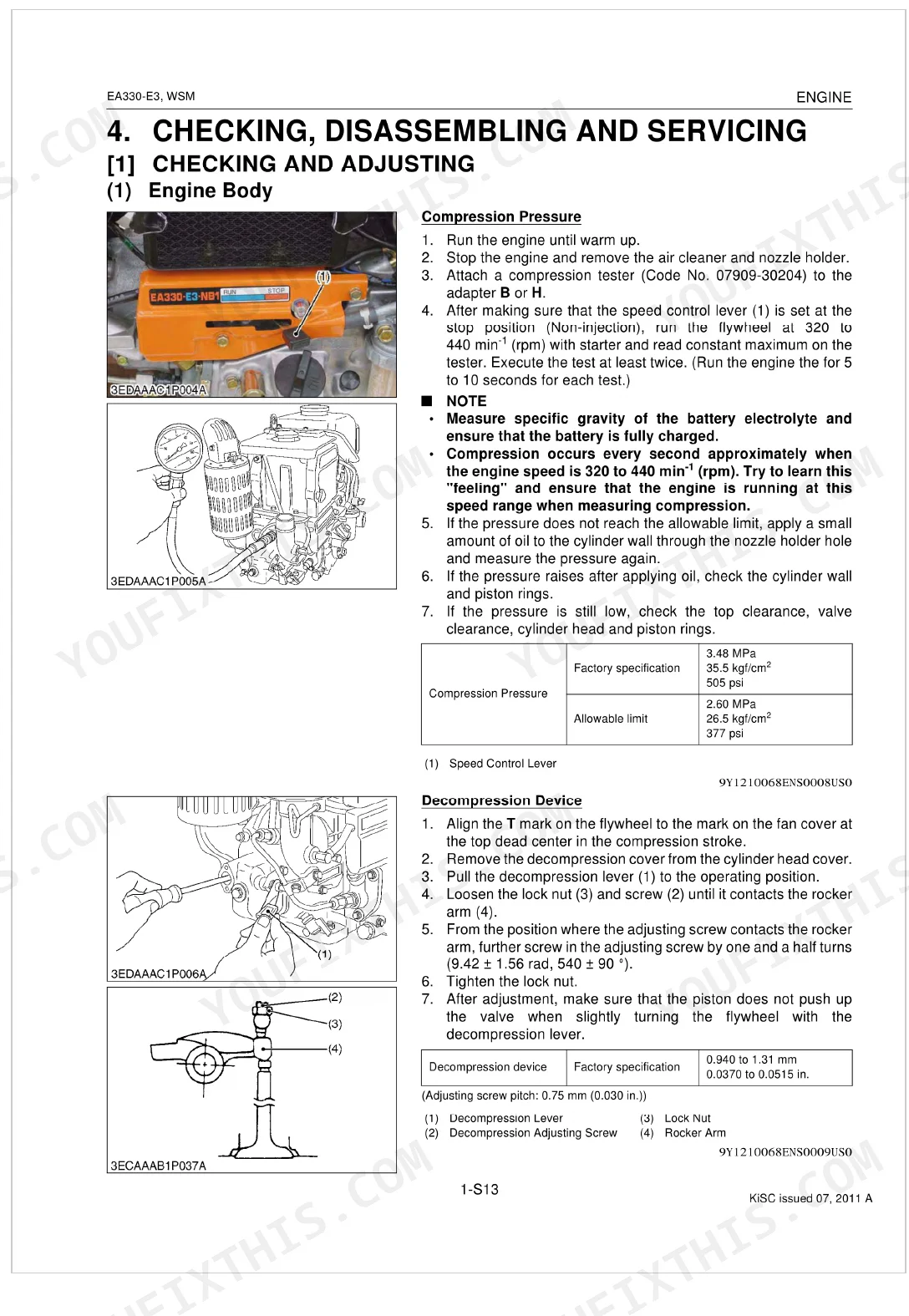
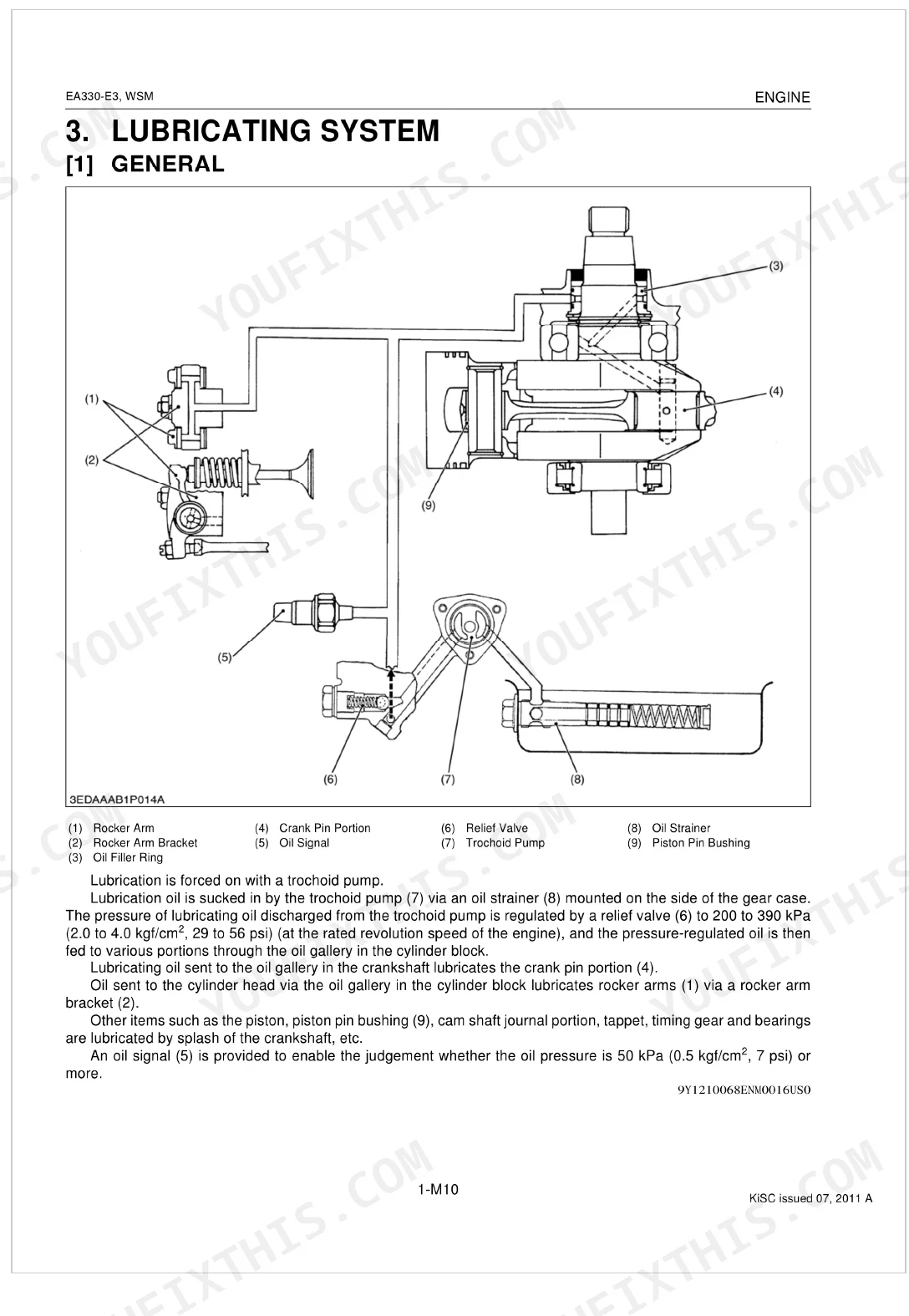
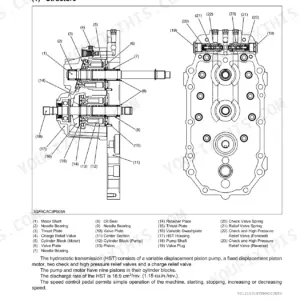
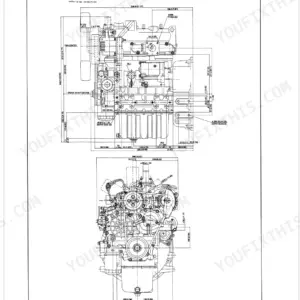
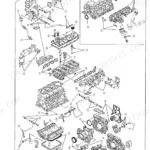
OEM #9Y021-01877 covers a single engine family: the E3-series diesel behind the EA330-E3, EA330-E3-NB1, and both APU variants. The 129 pages break down into 20 exploded-view diagrams running from cylinder head to dynamic balancer and 10 system diagrams for lubrication, cooling, fuel injection, intake/exhaust, and electrical. A maintenance checklist lays out 50-hour and 100-hour service intervals. Troubleshooting takes four pages of fault isolation, and 50 pages of step-by-step procedures handle disassembly, assembly, and adjustment across every major system. Cylinder head studs torque to 25-29 N·m, and the fuel filter gets replaced every 100 hours, both straight from Kubota factory data. Bookmarks let you jump to any section, and keyword search pulls up any spec in seconds once the file is open.
What's Inside This Kubota EA330-E3 SERIES Manual
| System | Pages | Key Topics |
|---|---|---|
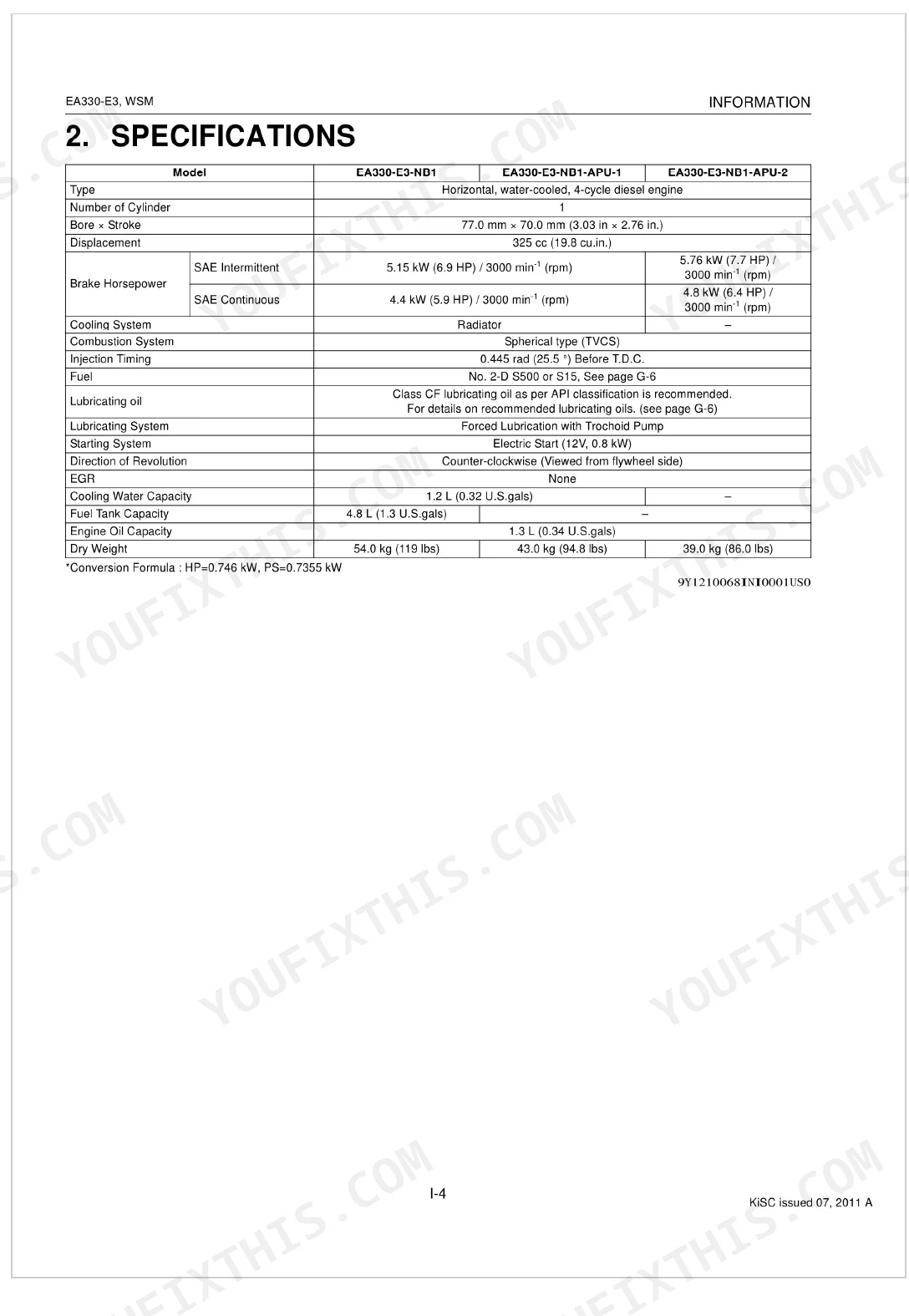
| Information | 3-13 | Safety First, Specifications, Performance Curves, Dimensions |
| General | 14-30 | Engine Identification (Model Name and Engine Serial Number), Maintenance Check List |
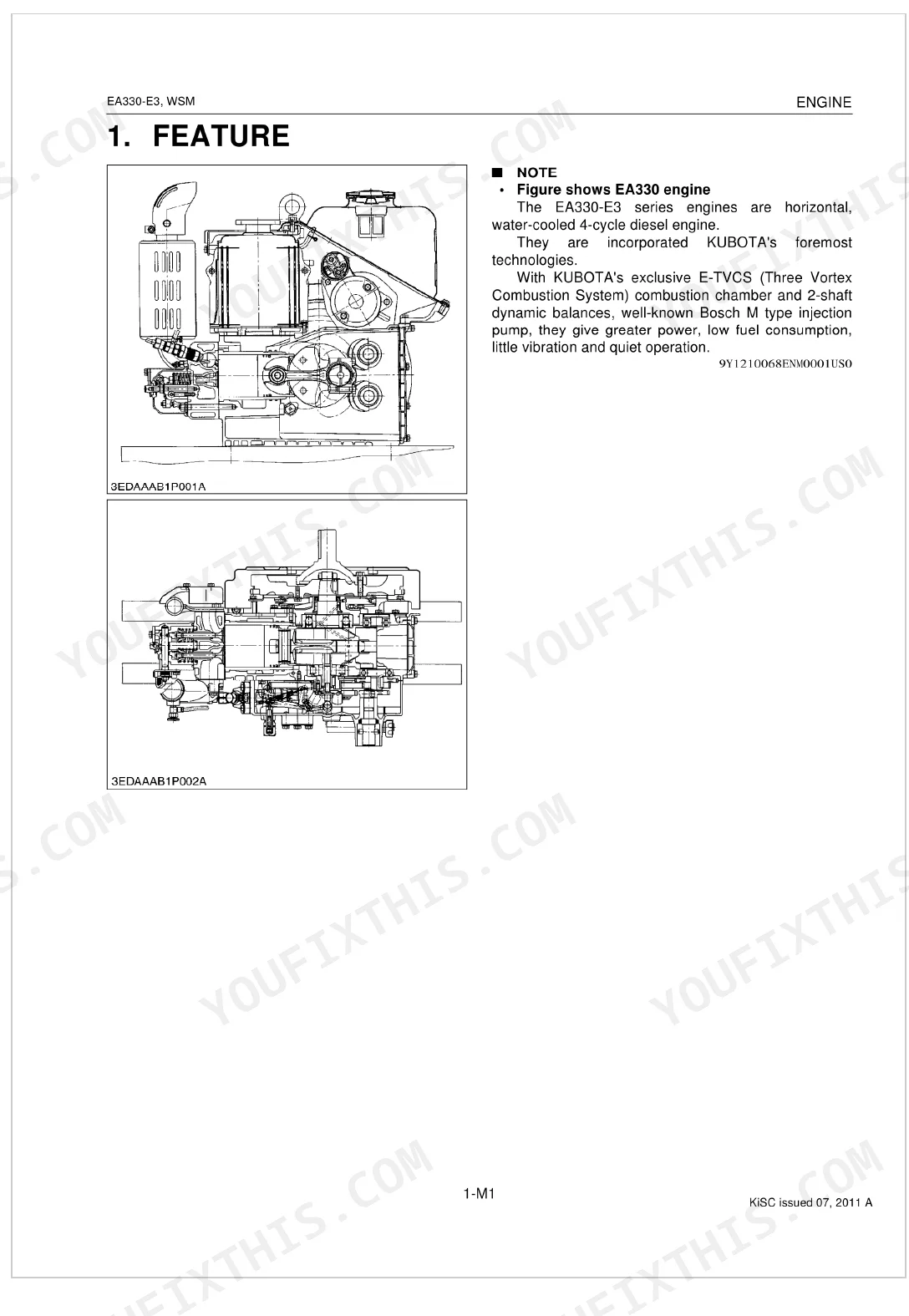
| Mechanism | 31-63 | Feature |
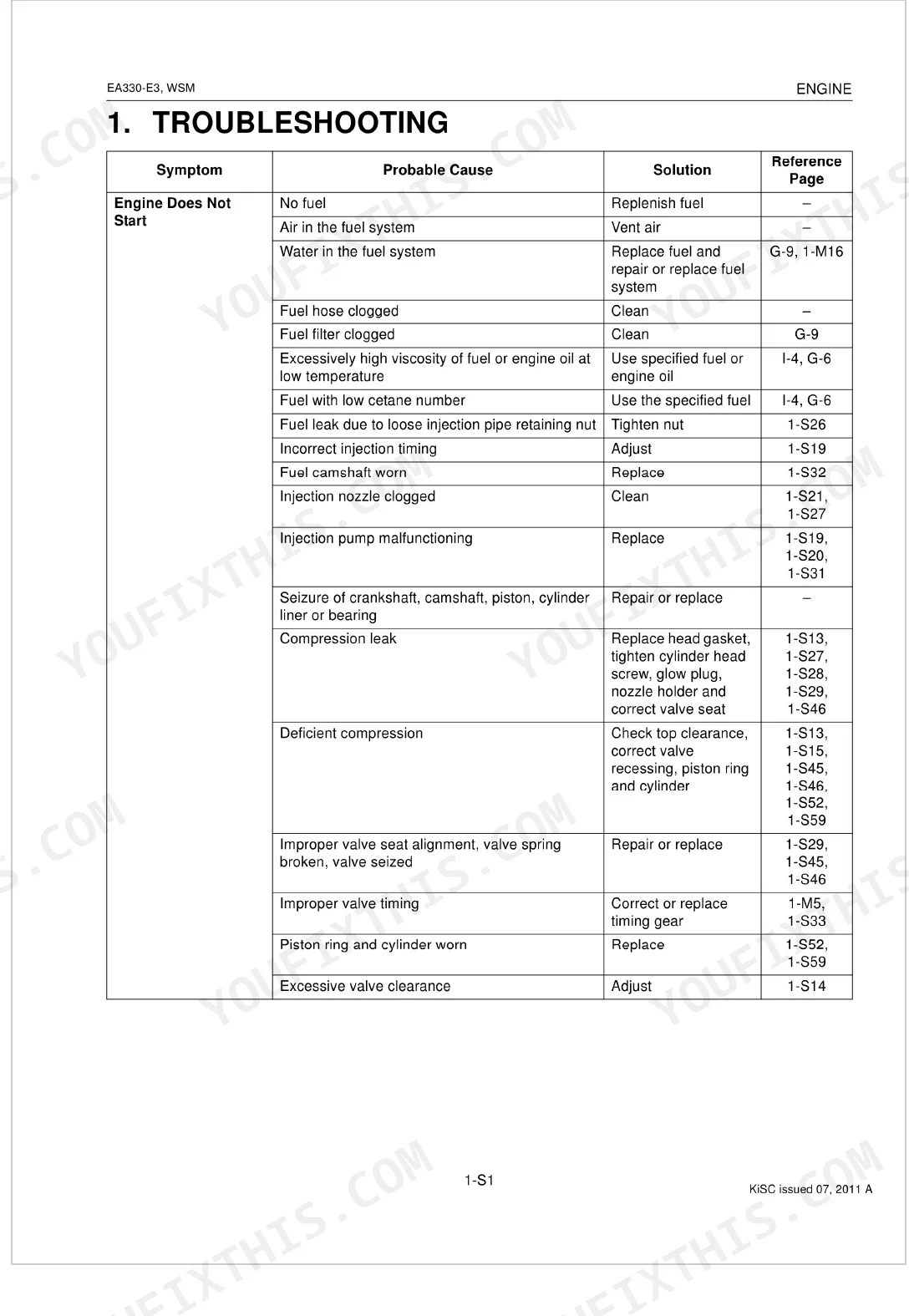
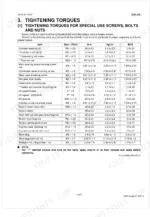
| Servicing | 64-129 | Troubleshooting, Servicing Specifications, Tightening Torques (Special Use Screws, Bolts and Nuts, General Use Screws, Bolts and Nuts), Checking |
Quick Reference Specifications
| Specification | Value | Page |
|---|---|---|
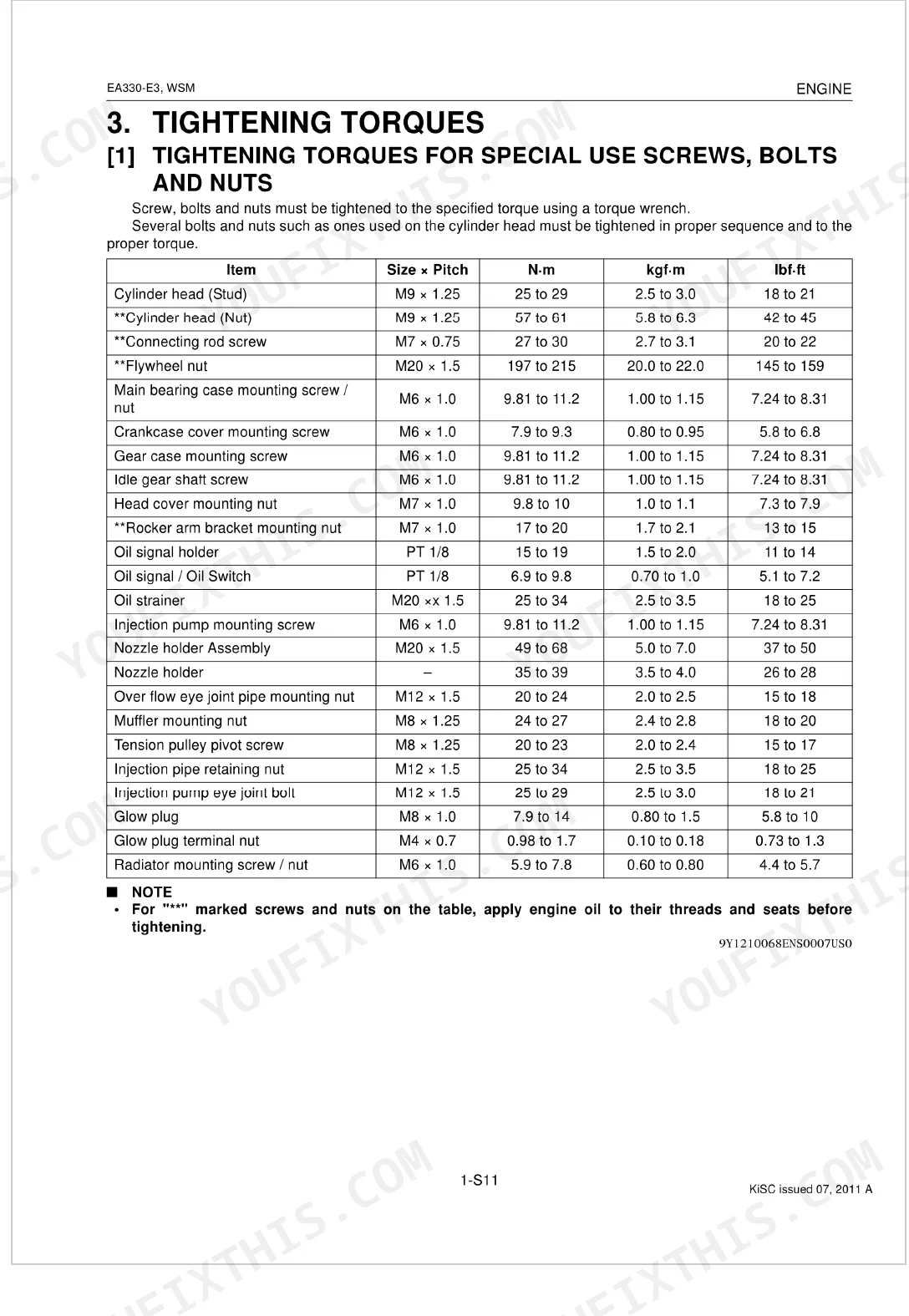
| Cylinder head (Stud) torque | 25 to 29 N·m (2.5 to 3.0 kgf·m, 18 to 21 lbf·ft) | p. 75 |
| Fuel filter element replacement interval | Every 500 hrs or Every 1 year | p. 20 |
| Fuel filter mounting screw torque | 25 to 29 N·m (2.5 to 3.0 kgf·m, 18 to 21 lbf·ft) | p. 88 |
| Air cleaner element replacement interval | Every 100 hrs or Every 1 year | p. 20 |
| Air cleaner element cleaning interval | Every 50 hrs or Every 1 year | p. 20 |
| Oil filter cartridge replacement interval (implied with crankcase oil change) | Every 100 hrs or Every 1 year | p. 20 |
| Oil filter mounting screw torque | 25 to 29 N·m (2.5 to 3.0 kgf·m, 18 to 21 lbf·ft) | p. 88 |
| Fan belt check interval | Every 50 hrs or Every 1 year | p. 20 |
| Fan belt tension (Factory Specification) | 5.0 to 10 mm / 98 N (10 kgf, 22 lbs) | p. 73 |
| Injection nozzle mounting screw torque | 25 to 34 N·m (2.5 to 3.5 kgf·m, 18 to 25 lbf·ft) | p. 75 |
| Nozzle holder assembly torque | 49 to 68 N·m (5.0 to 7.0 kgf·m, 37 to 50 lbf·ft) | p. 75 |
| Battery check interval | Every 50 hrs or Every 1 year | p. 20 |
Kubota EA330-E3 SERIES Common Problems This Manual Covers
Kubota EA330-E3 engine cranks but won't start, or starts and immediately dies p. 65
Bleed the fuel line: loosen the bleed screw and prime until bubble-free fuel flows. Replace the fuel filter element every 100 hours (page 20); torque the mounting screw to 25 to 29 N·m (18 to 21 lbf·ft) on reinstall. Then work the full no-start sequence.
Manual Section: Engine Does Not StartEngine loses power under load, runs rough, or blows black or white smoke p. 66
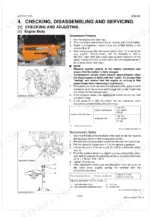
Inspect the air cleaner element and clean it every 50 hours; replace it every 100 hours or annually (page 20). Check valve clearance cold: spec is 0.16 to 0.20 mm (0.0063 to 0.0079 in.) per page 69. If smoke continues, verify nozzle injection pressure against the 13.73 to 14.71 MPa spec and follow the troubleshooting path.
Manual Section: Deficient OutputEngine temperature climbs into the red or coolant level drops during operation p. 73
Let the engine cool before checking coolant level; capacity is 1.2 L (0.32 U.S. gals), and never pull the cap hot. Inspect fan belt tension: spec is 5.0 to 10 mm under 98 N (22 lbs) force, per page 73. A defective radiator cap or clogged core both appear in the overheating troubleshooting sequence.
Manual Section: Engine OverheatedOil pressure warning light on, or engine knocking with suspected low oil p. 73
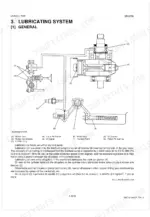
Verify oil level immediately; the crankcase holds 1.3 L (0.34 U.S. gals), so even small losses matter. At idle, pressure must exceed 50 kPa (7 psi); at rated speed, 250 kPa (36 psi) or more, per page 73. If levels check out, inspect the oil strainer and relief valve through the troubleshooting sequence.
Manual Section: Lubricant Oil IssuesBattery dead or engine cranks too slowly to fire in cold conditions p. 57
Test battery voltage and check electrolyte level every 50 hours; recommended capacity is 28 to 32 Ah (page 57). A weak cell drops cranking speed below what the glow plugs need to fire. Measure the starter commutator O.D. against the 28.0 mm (1.10 in.) wear limit on page 74, then work through the electrical starting-system checks.
Manual Section: Electrical/Starting System IssuesFrequently Asked Questions
What are the torque specs for the Kubota EA330-E3?
Torque values are listed per component. The cylinder head studs go to 25 to 29 N·m (2.5 to 3.0 kgf·m, 18 to 21 lbf·ft), and the connecting rod screw to 27 to 30 N·m (2.7 to 3.1 kgf·m, 20 to 22 lbf·ft).
What is the maximum torque of the Kubota EA330-E3 engine?
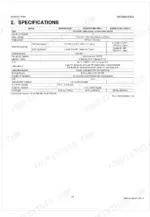
Per the performance curves, the EA330-E3-NB1 peaks at roughly 19.8 N·m (14.6 lbf·ft) of intermittent torque near 2000-2200 rpm. The EA330-E3-NB1-APU-2 reaches about 21.6 N·m (15.9 lbf·ft) at a similar engine speed.
What are the replacement specifications for Fuel filter element?
Check the fuel filter element every 50 hours and clean or change it every 100 hours; if it is damaged, swap it out. On reassembly, wipe a thin film of fuel onto the O-ring and tighten it fully by hand.
What are the replacement specifications for Air cleaner element?
Check the air cleaner element every 50 hours and clean or change it every 200 hours. Plan on a yearly replacement, or after every sixth cleaning. Never run the engine without the element in place.
How will I receive this Kubota EA330-E3 SERIES Workshop Manual?
Download starts instantly. The full 129-page searchable Workshop Manual lands in your hands right after payment, ready to open on a laptop, tablet, or phone out in the shop.
Are there any print restrictions on this Kubota EA330-E3 SERIES manual?
None at all. The PDF ships DRM-free, so print whatever sections you want to carry into the shop. Standard letter or A4 paper both work.
Document Quality
This document is a scanned PDF with an applied OCR layer, allowing you to search and copy the full text. The text quality is crisp and consistently easy to read throughout. Diagrams and illustrations are clear raster images, with all labels remaining legible. Pages are clean, free from scan artifacts, stains, or skewed content. Note that there are several blank filler pages included in the document.


Reviews
There are no reviews yet.