
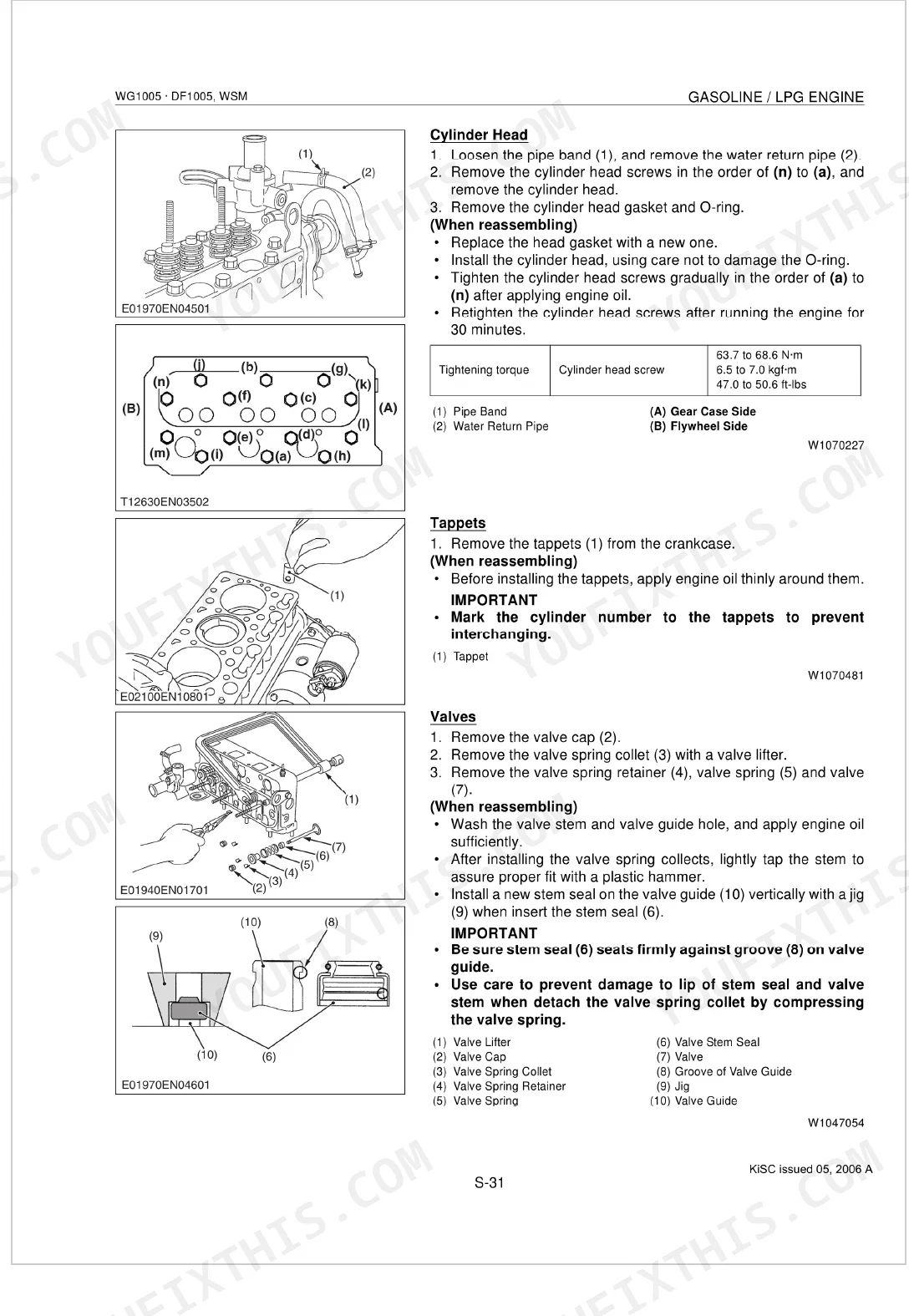
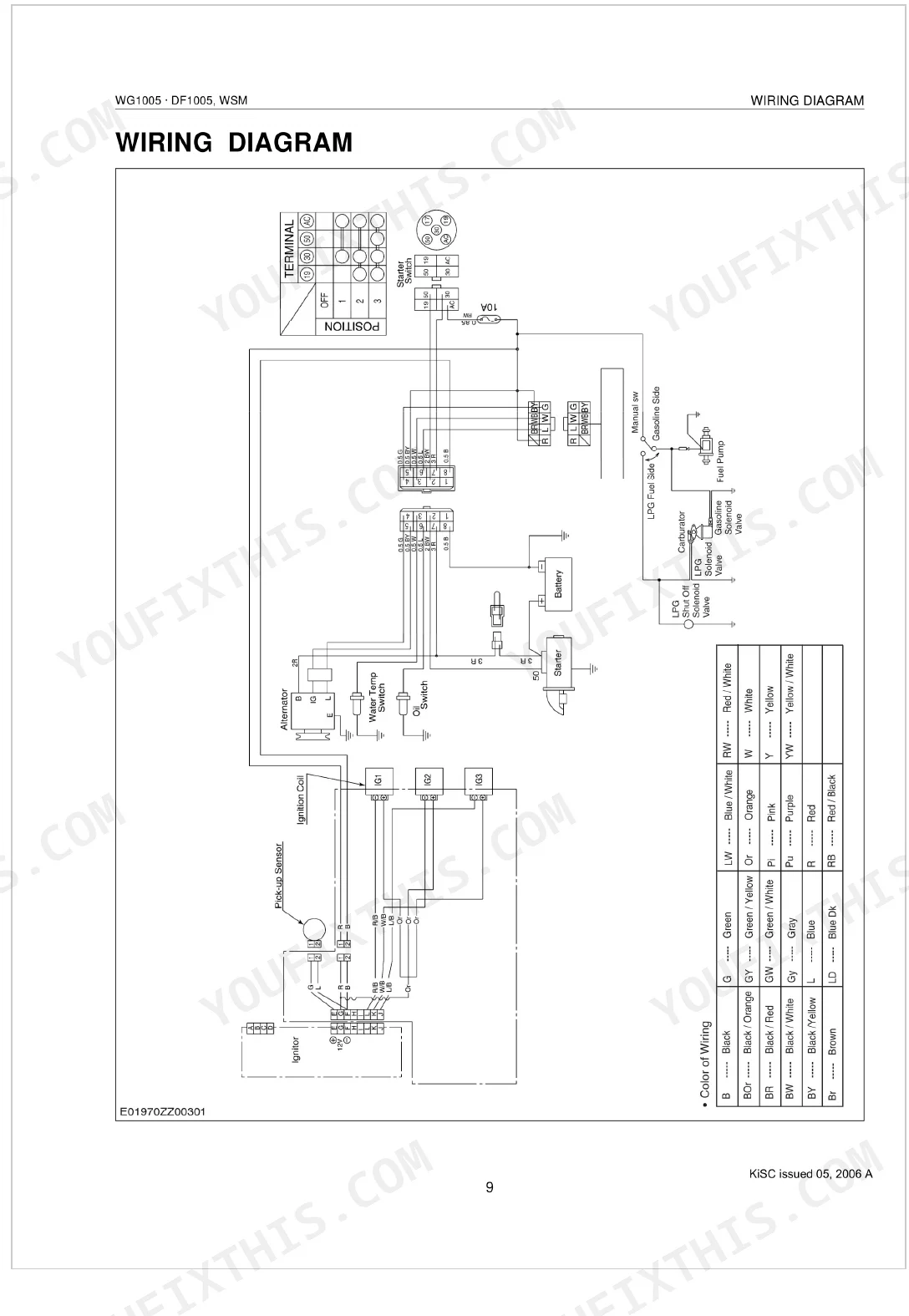
Got a dual-fuel Kubota built between 2001 and 2012? This workshop manual treats the gasoline WG1005 and propane-ready DF1005 as the separate animals they are, right down to two troubleshooting charts: one for gasoline fuel systems, one for LPG. Its 106 pages carry wiring diagrams with full color-coded component identification, plus 20 pages of tightening torques for every fastener from connecting rod caps to carb mounting nuts. Servicing procedures run another 30 pages, and 15 pages of exploded views map the cylinder head, gear train, crankshaft, and vaporizer assemblies. Specifics you'll reach for daily: cylinder head screws at 63.7-68.6 N-m, an NGK BKR4E gapped to 0.7 mm, a crankcase that takes 4.6 liters. Bookmarked by section and keyword-searchable, so the answer is two taps away on a tablet at the bench.
What's Inside This Kubota WG1005, DF1005 Manual
| System | Pages | Key Topics |
|---|---|---|
| Safety Instructions | 3-5 | Safety First, Before Servicing and Repairing, Safety Starting, Safety Working, Avoid Fires, Ventilate Work Area, Prevent Acid Burns, Dispose of Fluids Properly |
| Important Items of Exhaust Emission Regulation | 6-7 | Inlet and Exhaust System, Altitude Compensation Kit, LPG Regulator With Vaporizer, Kubota Recommended LPG Fuel Specifications, Length of The LPG Vapor Hose |
| Specifications | 8 | WG1005 Engine Specifications, DF1005 Engine Specifications, Kubota Recommended LPG Fuel Specifications |
| Performance Curves | 9 | WG1005 and DF1005: Gasoline, Df1005: Lpg, Engine Speed Rpm |
| Dimensions | 10 | Engine Dimensions Overview, Standard Fan Position Dimensions, Low Fan Position Dimensions |
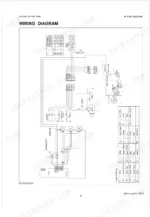
| Wiring Diagram | 11-12 | Main Wiring Diagram, Wiring Components, Color Code for Wiring |
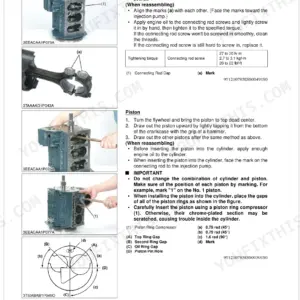
| Engine Body | 13-16 | Cylinder Block, Cylinder Head (Intake and Exhaust Port, Combustion System), Crankshaft, Piston and Piston Rings, Connecting Rod, Rocker Arm, Camshaft, Flywheel |
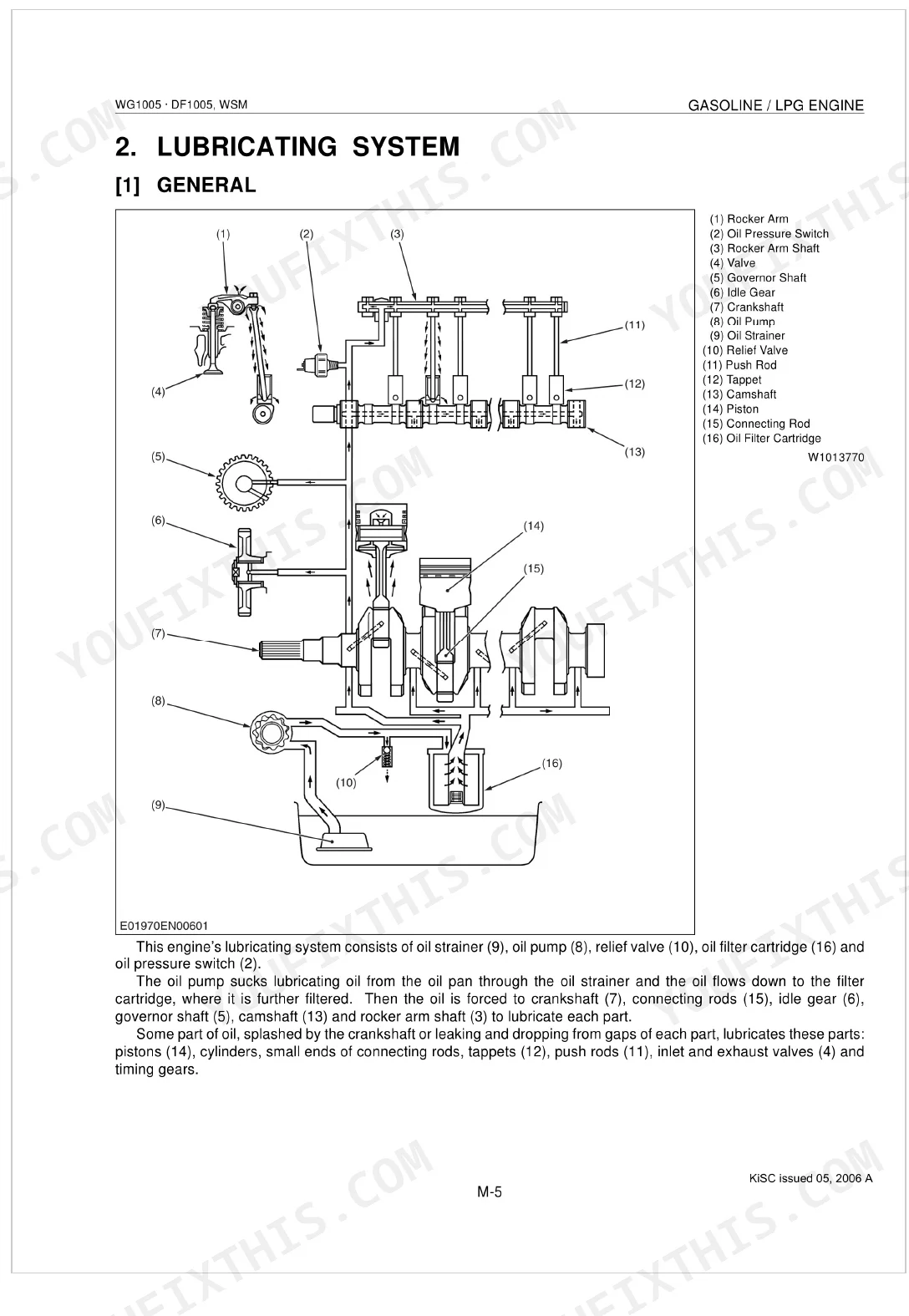
| Lubricating System | 17-19 | Oil Pump, Relief Valve, Oil Filter Cartridge, Oil Pressure Switch |
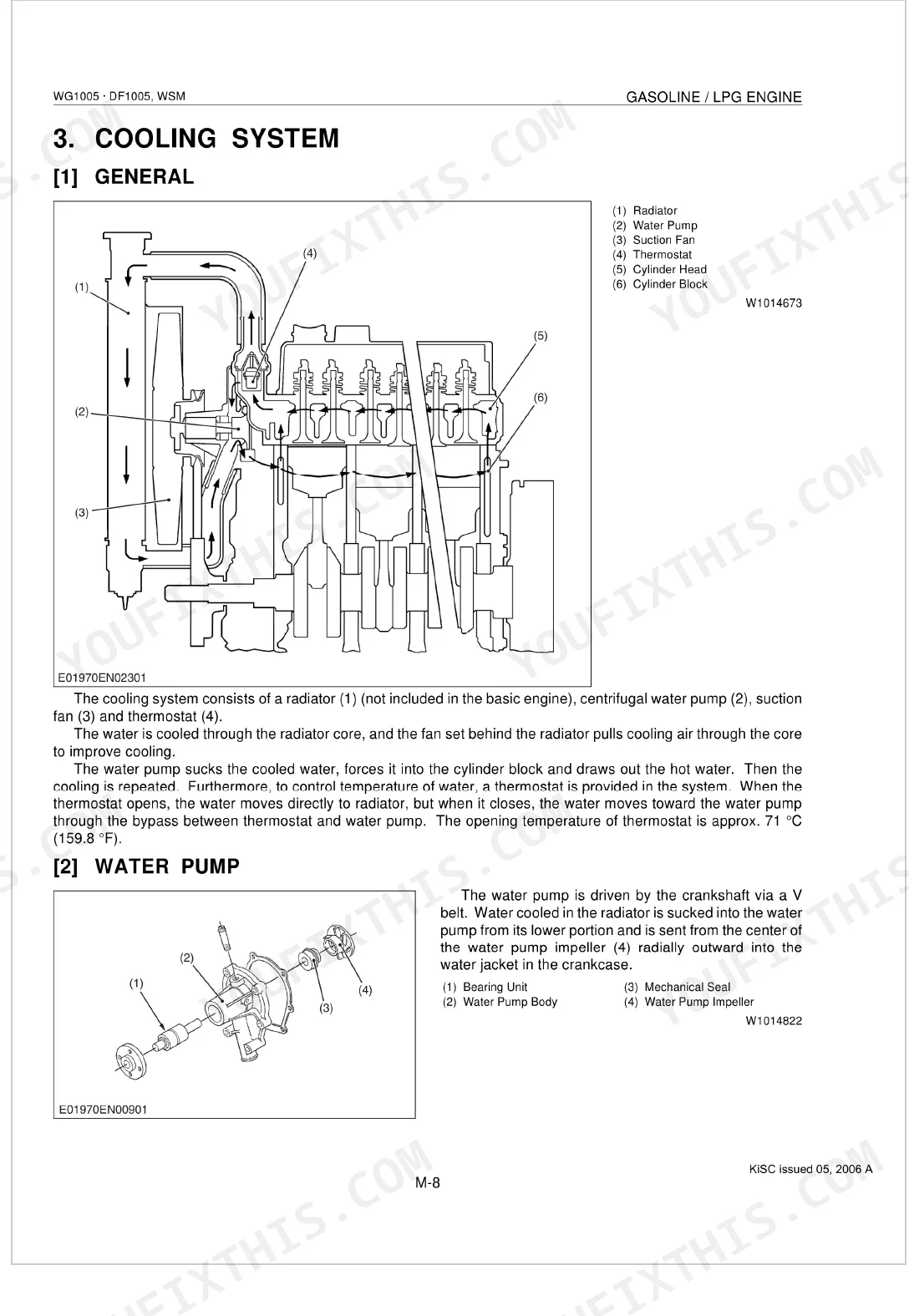
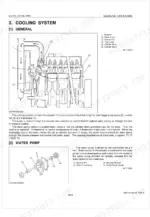
| Cooling System | 20-22 | Water Pump, Thermostat, Radiator, Radiator Cap, Vaporizer For LPG Fuel |
| Fuel System | 23-30 | Carburetor For Gasoline Fuel, DF Carburetor (LPG Fuel), Vaporizer For LPG Fuel (Primary Chamber, Secondary Chamber, Vacuum Lock Chamber), Governor, Inlet Manifold |
| Ignition System | 31 | Degital Ignition System (General, Control at Ignition Time, Control at Energizing Time, Lock Prevention, Over-Speed Limits Control) |
| Electrical System | 32-34 | Charging System, Alternator Characteristics, IC Regulator Characteristics (Alternator) |
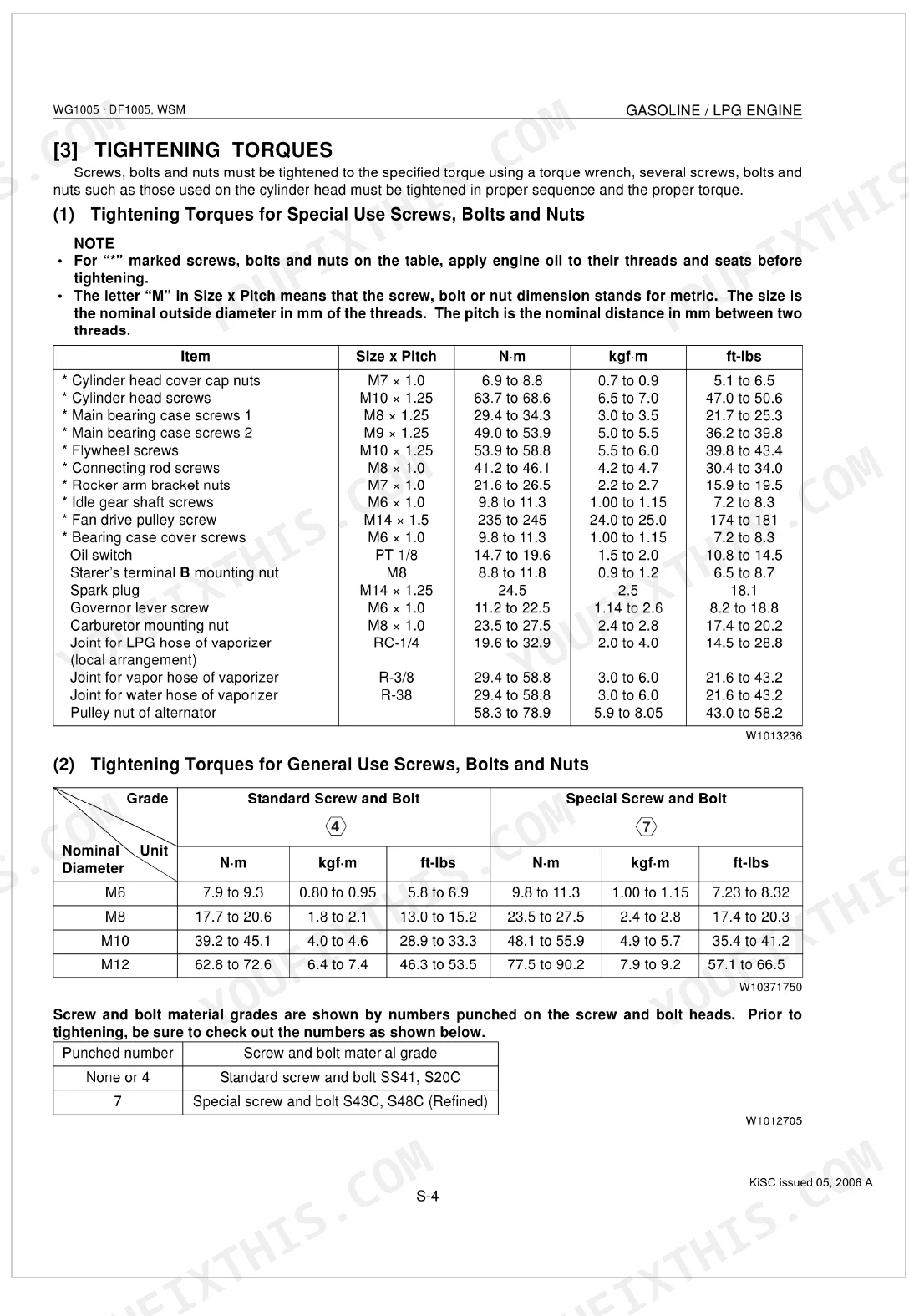
| General (Servicing) | 35-60 | Engine Identification (Model Name and Engine Serial Number, Cylinder Number), Tightening Torques (Special Use Screws, Bolts and Nuts, General Use Screws, Bolts and Nuts) |
| Engine Body (Servicing) | 61-87 | Checking and Adjusting (Compression Pressure, Top Clearance) |
| Lubricating System (Servicing) | 88-89 | Checking (Engine Oil Pressure), Servicing (Clearance Between: Inner Rotor and Outer Rotor, Outer Rotor and Pump Body, Inner Rotor and Cover) |
| Cooling System (Servicing) | 90-92 | Checking and Adjusting (Fan Belt Tension, Fan Belt Damage and Wear, Radiator Cap Air Leakage, Radiator Water Leakage, Thermostat Valve Opening Temperature) |
| Fuel System (Servicing) | 93-95 | Checking and Adjusting (Governor, Engine Speed, Carburetor, Vaporizer LPG Model) |
| Ignition System (Servicing) | 96-97 | Checking (Timing Light Test, Spark Plug, Ignition Coil, Ignitor, Pick-Up Sensor) |
| Electrical System (Servicing) | 98-106 | Checking (Starter, Fuel Cut Off Solenoid), Disassembling and Assembling (Starter, Alternator), Servicing (Starter, Alternator, Rectifier, IC Regulator) |
Quick Reference Specifications
| Specification | Value | Page |
|---|---|---|
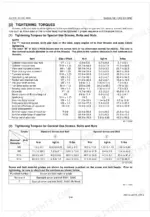
| Cylinder head cover cap nuts tightening torque | 6.9 to 8.8 N-m (0.7 to 0.9 kgf.m, 5.1 to 6.5 ft-lbs) | p. 38 |
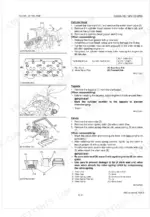
| Cylinder head screws tightening torque | 63.7 to 68.6 N-m (6.5 to 7.0 kgf.m, 47.0 to 50.6 ft-lbs) | p. 38 |
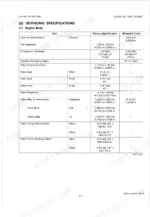
| Total Displacement | 996 cc (60.89 cu.in.) | p. 8 |
| Lubricating Oil Capacity | 4.6 L (4.8 U.S.qts.) | p. 50 |
| Spark Plug Gap (NGK BKR4E) | 0.7 mm (0.0276 in.) | p. 46 |
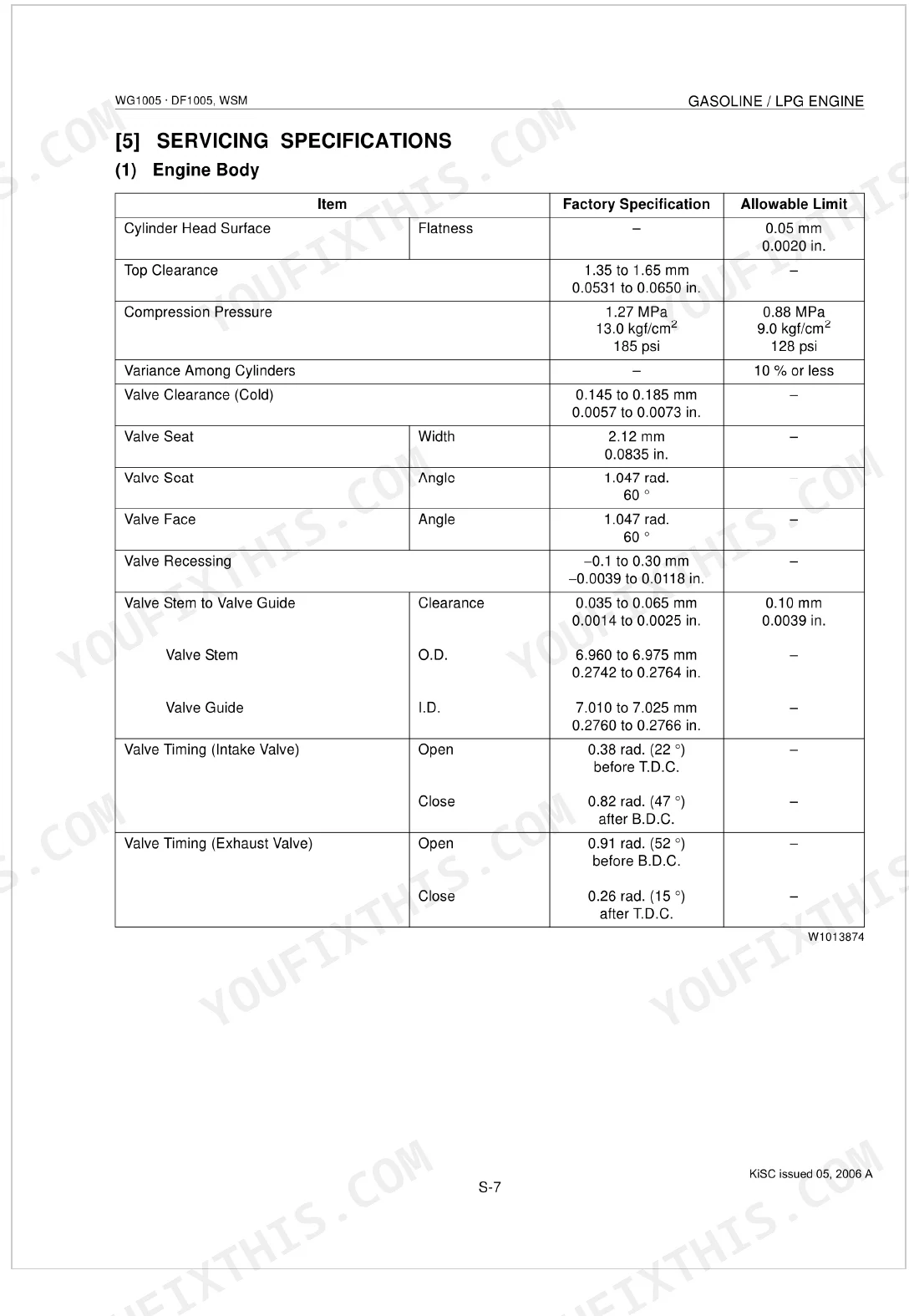
| Valve Clearance (Cold) | 0.145 to 0.185 mm (0.0057 to 0.0073 in.) | p. 41 |
| Cylinder Head Screws Torque | 63.7 to 68.6 N-m (6.5 to 7.0 kgf.m, 47.0 to 50.6 ft-lbs) | p. 38 |
| Connecting Rod Screws Torque | 41.2 to 46.1 N-m (4.2 to 4.7 kgf.m, 30.4 to 34.0 ft-lbs) | p. 38 |
| Compression Pressure (Factory Spec) | 1.27 MPa (13.0 kgf/cm², 185 psi) | p. 41 |
| Fan Belt Tension (Deflection) | 7.0 to 9.0 mm (0.28 to 0.35 in.) | p. 45 |
| Thermostat Valve Opening Temperature (At Beginning) | 69.5 to 72.5 °C (157.1 to 162.5 °F) | p. 45 |
| Fuel Cut Off Solenoid for Gasoline Resistance | 38 Ω at 20 °C | p. 46 |
Kubota WG1005, DF1005 Common Problems This Manual Covers
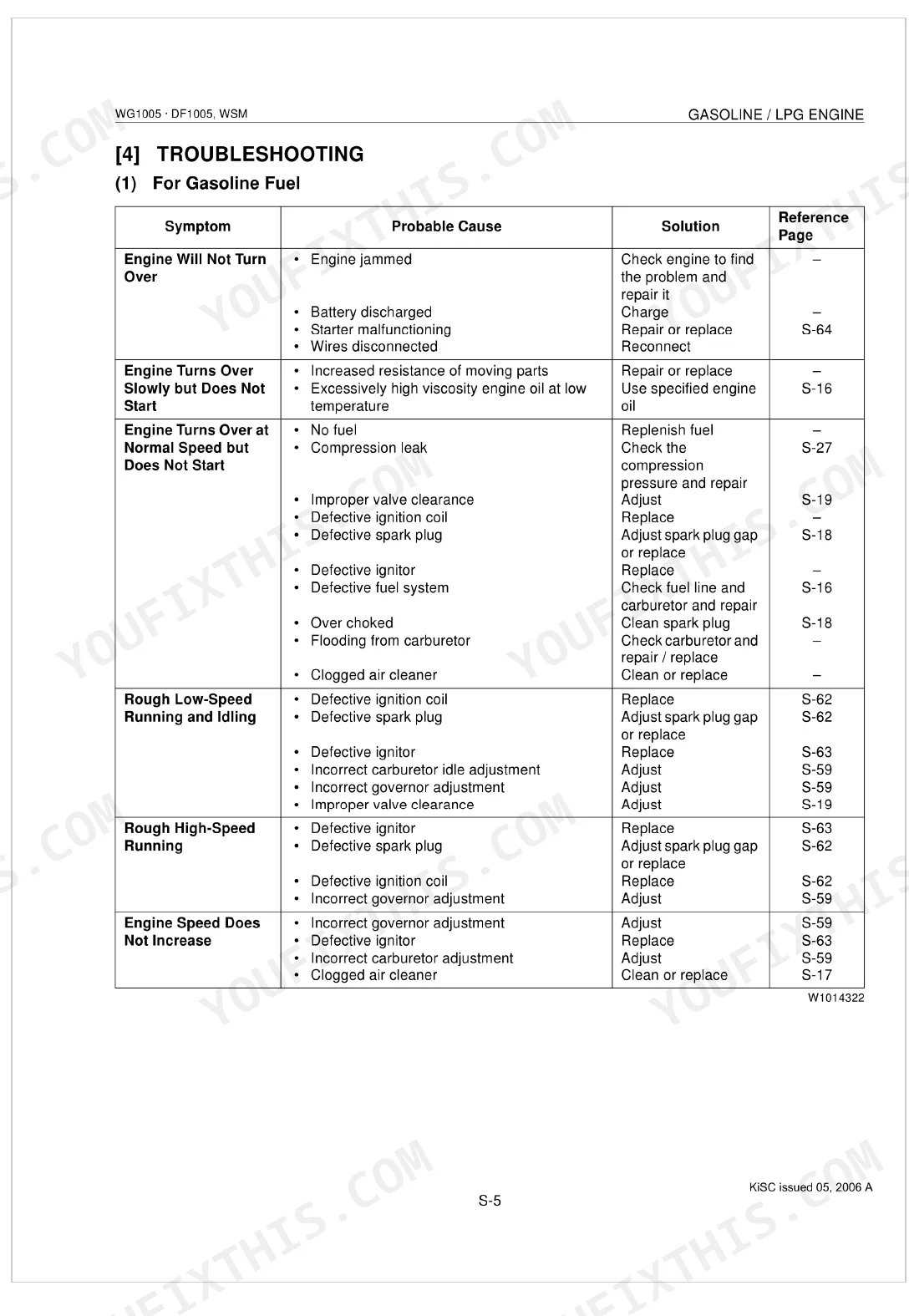
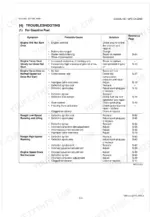
Kubota WG1005 engine turns over but won't start, no fire on gasoline p. 39
Check fuel delivery first: verify the fuel cut-off solenoid is energized (resistance should read 38 Ω at 20°C per page 46). Pull the spark plug and inspect the gap, reset to 0.7 mm (0.0276 in.) if worn. Confirm ignition spark by grounding the plug against the block and cranking. Walk the full no-start tree on page 39 before disassembling anything.
Manual Section: General (Servicing): Troubleshooting ProceduresEngine idles rough, surges at low speed, stumbles off idle p. 93
Remove the air cleaner and inspect the element. If it's past 100 hours, clean it; past 1000 hours or one year, replace it. Then check carburetor adjustment per page 93: governor linkage must move freely with no binding. Verify valve clearance is within 0.145 to 0.185 mm (0.0057 to 0.0073 in.) cold, since tight valves cause exactly this symptom at low load.
Manual Section: Fuel System (Servicing)Engine overheats, temperature climbs under load, coolant loss p. 90
Squeeze the upper radiator hose with the engine cold and check cap release pressure per page 90. Inspect fan belt deflection: push at mid-span and it should deflect 7.0 to 9.0 mm (0.28 to 0.35 in.) under moderate thumb pressure. Tighten or replace the belt if slack or glazed. Test the thermostat in hot water: it should begin opening between 69.5 and 72.5°C (157.1 to 162.5°F). Replace if it stays closed or sticks open.
Manual Section: Cooling System (Servicing)LPG-fueled engine cranks normally but refuses to start, no combustion p. 40
Verify the LPG shutoff valve at the tank is fully open and the vaporizer water line is hot enough to vaporize fuel. On DF1005 LPG, check the fuel cut-off solenoid resistance: spec is 28 Ω at 20°C (page 46). If solenoid passes, move to the LPG no-start chart on page 40 and check secondary chamber vacuum lock function on the vaporizer (page 55).
Manual Section: General (Servicing): Troubleshooting ProceduresLow power, engine bogs under load, exhaust pops on deceleration p. 61
Measure compression on all cylinders per page 41: factory spec is 1.27 MPa (185 psi). A cylinder more than 10% below the others points to rings or valves. If compression is good, adjust valve clearance to 0.145 to 0.185 mm (0.0057 to 0.0073 in.) cold and recheck spark plug gap at 0.7 mm (0.0276 in.). Inspect ignition timing with a timing light per page 96 before condemning the carburetor.
Manual Section: Engine Body (Servicing)Oil pressure warning light on at idle, pressure drops when engine warms p. 88
Confirm the oil level first and top up to 4.6 L (4.8 U.S.qts.) if it's low. Verify oil isn't overdue: change interval is every 50 hours, filter too. If level is correct, test oil pressure with a gauge at the sender port per page 88. Worn inner-to-outer rotor clearance in the oil pump is a common cause on higher-hour engines; disassemble and measure per the pump servicing specs in the lubricating system section.
Manual Section: Lubricating System (Servicing)Frequently Asked Questions
What are the recommended service intervals?
Service intervals are laid out in a maintenance check list. Engine oil gets changed every 50 hours, spark plugs cleaned every 100 hours, the fuel filter changed every 200 hours, and valve clearance adjusted every 1000 hours.
What fluids and capacities does this machine require?
Fuel is either Unleaded Automobile Gasoline or Standard Commercial LP Gas. Lubricating oil should be 'Better Than SF Class (API)', with a 4.6 L (4.8 U.S.qts.) capacity. Viscosity tracks ambient temperature: SAE 30 or 10W-30 above 25 °C, SAE 20 or 10W-30 from 0 °C to 25 °C, and SAE 10W or 10W-30 below 0 °C.
How to troubleshoot engine won't start?
If the engine turns over at normal speed but does not start, probable causes include no fuel, compression leak, or defective ignition components like the ignition coil, spark plug, or ignitor. Solutions involve replenishing fuel, checking compression pressure (S-27), adjusting valve clearance (S-19), or replacing defective parts like the ignition coil or ignitor (S-63). For LPG fuel, check for no LPG fuel, a defective vacuum lock system, or an incorrect throttle lever position.
What torque specifications are listed?
The manual lists various torque specifications for special and general use screws, bolts, and nuts. For example, cylinder head cover cap nuts should be tightened to 6.9 to 8.8 N-m (5.1 to 6.5 ft-lbs), cylinder head screws to 63.7 to 68.6 N-m (47.0 to 50.6 ft-lbs), and connecting rod screws to 41.2 to 46.1 N-m (30.4 to 34.0 ft-lbs). Spark plugs require a torque of 24.5 N-m (18.1 ft-lbs).
What do I get after purchasing this Kubota WG1005, DF1005 manual?
It's a 106-page searchable PDF you can download right after checkout. Pull it up on your phone under the hood, on a laptop, wherever. No shipping, no waiting.
Can I print this Kubota WG1005, DF1005 manual?
No restrictions at all. Print individual pages, full chapters, or the entire manual. The PDF is completely unlocked.
Does this Kubota WG1005, DF1005 manual include wiring diagrams?
Yes. The full electrical schematics are included, with wire colors, connector locations, and circuit descriptions.
Document Quality
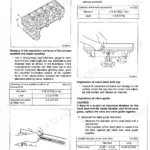
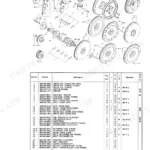
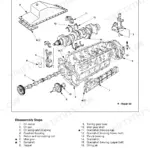
This document is a scanned PDF with an OCR layer, enabling you to search and copy the full text content. The text throughout the manual is consistently crisp and easy to read, with no blurriness or fading observed. Diagrams and illustrations are clear raster images, and their labels are well-defined and perfectly legible, even for smaller details. The page condition is very good, showing clean, well-aligned scans without any noticeable stains, marks, or skewed content. No significant blank or filler pages are present in this document.

Reviews
There are no reviews yet.