
The factory operating reference for the RTV-X1100C runs 124 pages (OEM #K7731-7121-6), covering safe handling, daily maintenance, and cargo loading. Its instrument panel section decodes every dashboard symbol, and you'll also find pre-operation walk-around checklists, cold-weather starting procedures, and cargo bed payload limits. Service intervals span 50-hour greasing through the 3,000-hour injection pump inspection, plus troubleshooting charts for engine, battery, and drivetrain faults and full cab operation for the A/C, wipers, and door systems. Two figures worth knowing before the first run: the fuel tank holds 30 L (7.9 U.S. gal.), and steel wheel fasteners torque to 108-130 N-m. Stop forum-hunting for basic numbers. Every section is bookmarked and keyword-searchable, so the right spec opens on any device the moment you reach for it.
What's Inside This Kubota RTV-X1100C Manual
| System | Pages | Key Topics |
|---|---|---|
| Universal Symbols | 3 | Safety Alert Symbol, Seat Belt, Diesel Fuel, Fuel-Level, Hourmeter/Elapsed Operating Hours, Engine Coolant-Temperature, Brake Fluid, Parking Brake |
| Safe Operation | 11-20 | Before Operating The Vehicle, Hauling Loads In The Cargo Bed, Operating Hydraulic Outlet Driven Equipment, Parking The Vehicle, Transporting, Servicing The Vehicle, Danger |
| Servicing Of Vehicle | 21 | Vehicle identification plate, Product identification number, Engine serial number, Transmission assy serial number |
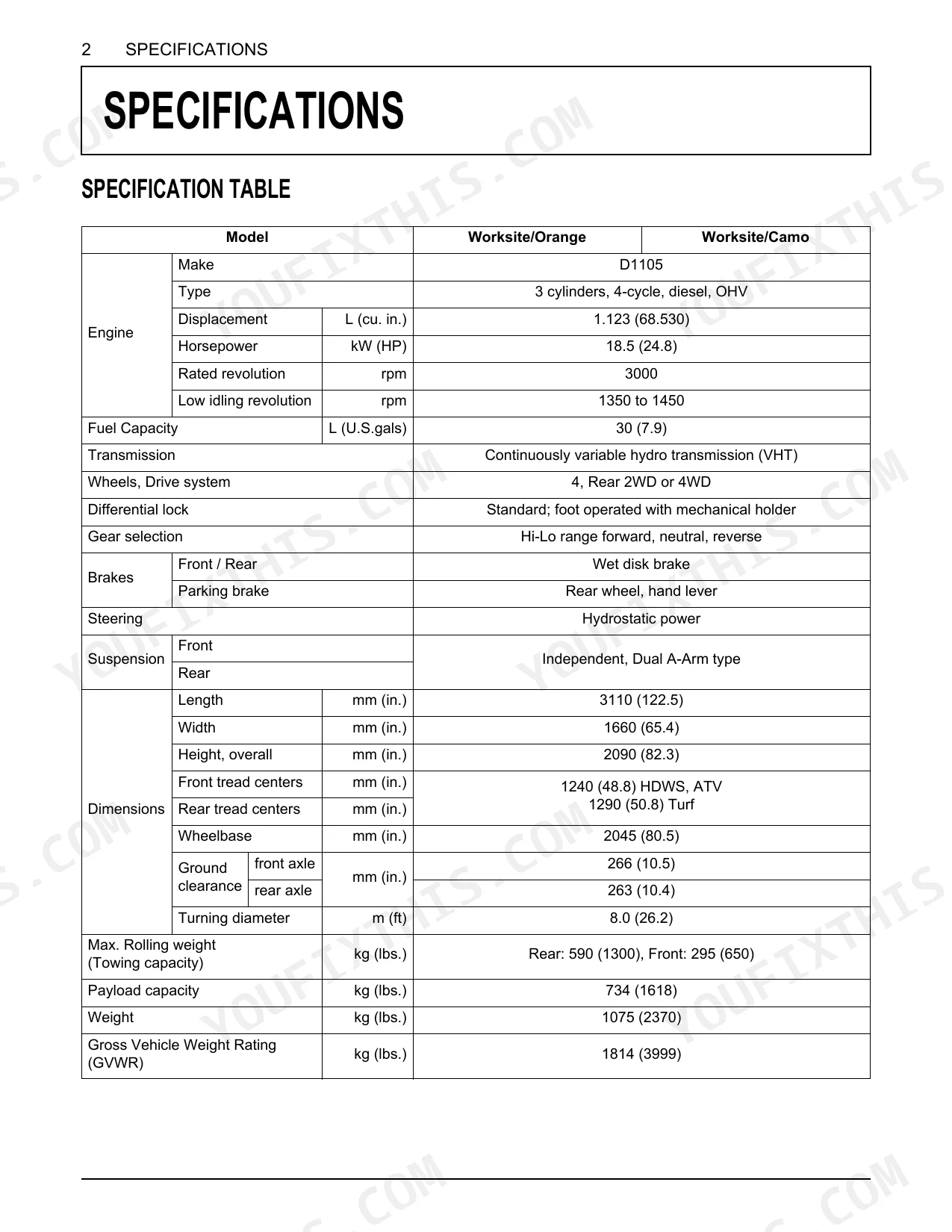
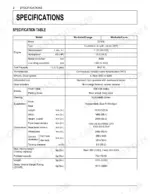
| Specifications | 22-23 | Specification Table, Traveling Speeds |
| Vehicle Limitations | 24 | Max. Cargo loading weight, Permissible Cargo load, Cargo bed capacity, Payload capacity, Rolling weight, Tongue weight |
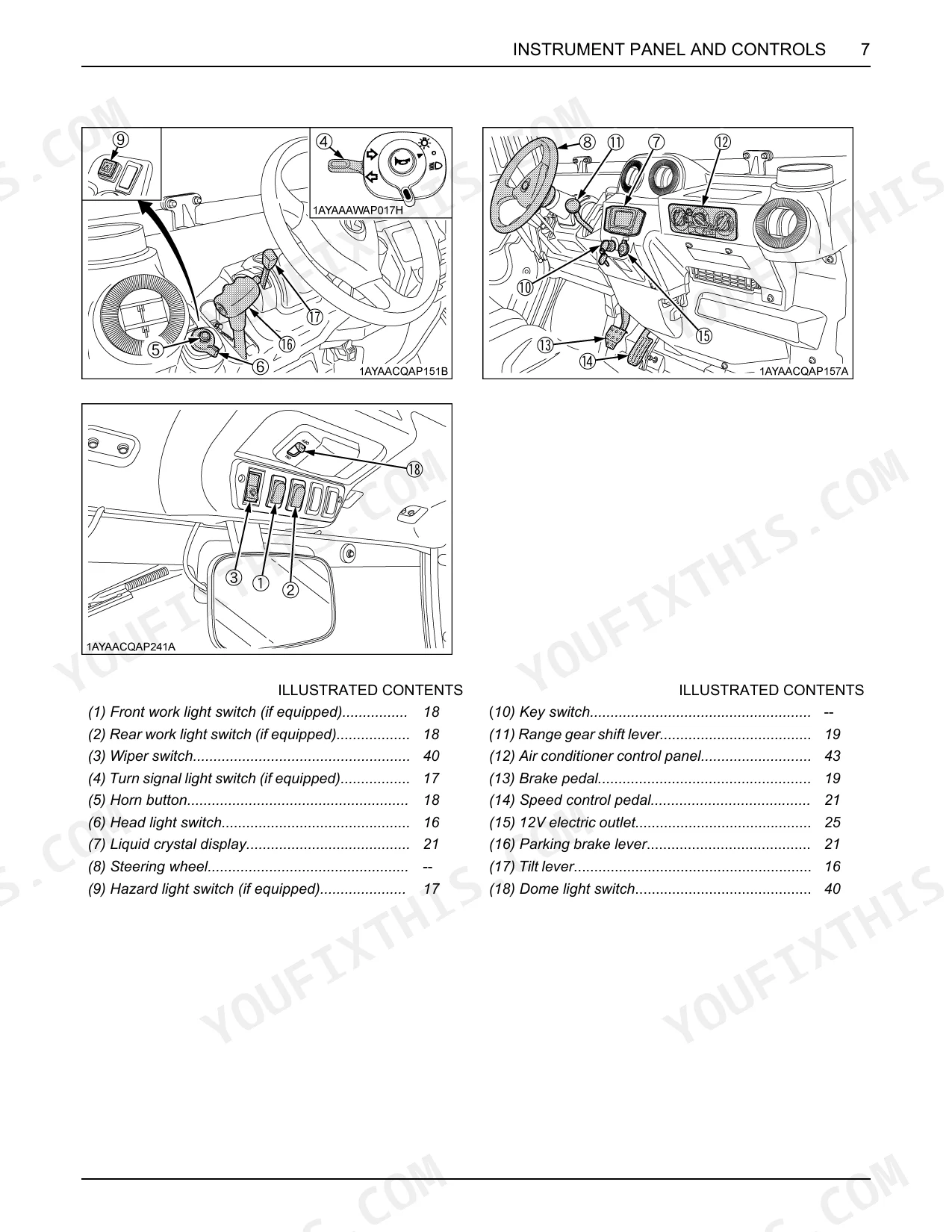
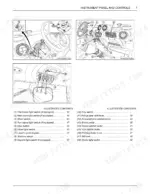
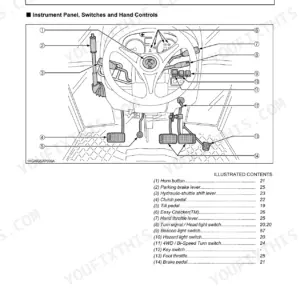
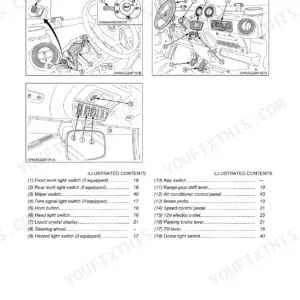
| Instrument Panel And Controls | 25-28 | Location Of Parts, Illustrated Contents |
| Pre-Operation Check | 29 | Daily Check, Check Item, Care Of Danger, Warning And Caution Labels |
| Operating The Engine | 30-34 | Starting The Engine (Cold Weather Starting, Engine Hand Throttle, Block Heater), Stopping The Engine, Warming Up (Warm-Up Transmission Oil In The Low Temperature Range) |
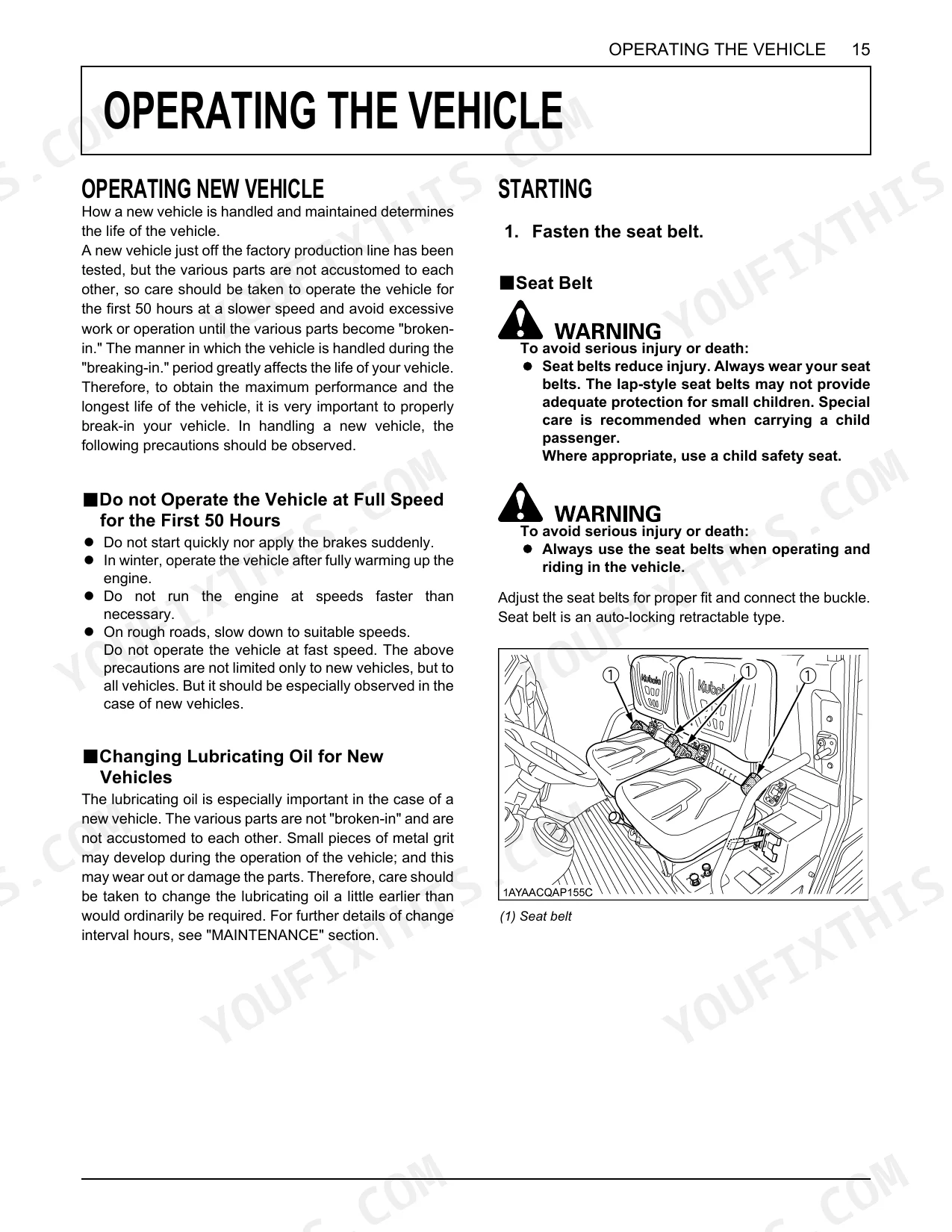
| Operating The Vehicle | 35-50 | Operating New Vehicle (Do Not Operate The Vehicle At Full Speed For The First 50 Hours, Changing Lubricating Oil For New Vehicles) |
| Cargo Bed | 51-56 | Hydraulic Outlet |
| Tires And Wheels | 57-58 | Tires (Inflation Pressure, Tire Type And Use), Wheels, Shock Absorbers (Shock Absorber Spring Adjustment) |
| Cab Operation | 59-66 | Door And Window (Locking And Unlocking The Door, Opening The Door, Opening And Closing The Sliding Window), Dome Light |
| Towing And Transporting | 67-68 | Rear Trailer Hitch, Front Trailer Hitch, Winch Mount Bracket |
| Maintenance | 69-75 | Service Intervals, Lubricants, Fuel And Coolant |
| Periodic Service | 76-117 | How To Open The Hood And Tilt The Seat, How To Raise The Cargo Bed (Raising And Lowering The Cargo Bed), Jack-Up Point (Front End, Rear End) |
| Storage | 118 | Vehicle Storage, Removing The Vehicle From Storage, Important |
| Troubleshooting | 119-121 | Engine Troubleshooting, Battery Troubleshooting, Machine Troubleshooting |
| Options | 122 | Backup Beeper, Bed Liner, Fabric Cover, Front Mud Guard, Front Trailer Hitch & Pin, Front Work Light, Rear Trailer Hitch & Pin, Rear Work Light |
Quick Reference Specifications
| Specification | Value | Page |
|---|---|---|
| Wheel fastener torque (Aluminum wheel) | 90 to 110 N-m (9.2 to 11.2 kgf-m) (66.4 to 81.1 lbf-ft) | p. 69 |
| Wheel fastener torque (Steel wheel) | 108 to 130 N-m (11.1 to 13.2 kgf-m) (79.7 to 95.8 lbf-ft) | p. 69 |
| Fuel Capacity | 30 L (7.9 U.S.gals.) | p. 72 |
| Coolant (with reserve tank) | 7.9 L (8.3 U.S.qts.) | p. 72 |
| Engine start system check | every 50 hrs | p. 69 |
| Greasing | every 50 hrs | p. 69 |
| Engine Horsepower | 18.5 kW (24.8 HP) | p. 22 |
| Max. Cargo Load | 500 kg (1102 lbs.) | p. 23 |
| Tire Inflation Pressure | 140 kPa (20 psi) | p. 57 |
| Engine Oil Capacity (with filter exchanged) | 4.1 L (4.3 U.S.qts.) | p. 72 |
| Transmission Oil Capacity | 7.0 L (1.8 U.S.gals.) | p. 72 |
| Hydraulic Tank Oil Capacity | 18.0 L (19.0 U.S.qts.) | p. 72 |
Kubota RTV-X1100C Common Problems This Manual Covers
Transmission engages roughly, or the machine won't move when you press the accelerator pedal p. 119
Check the transmission fluid level before you operate the vehicle, confirming the case holds 7.0 L (1.8 U.S.gals.) of the specified fluid. The troubleshooting steps on page 119 also cover a parking brake that hasn't fully released and a hydraulic lever left in the wrong position.
Manual Section: TroubleshootingEngine coolant temperature gauge spikes into the red zone and engine shuts down during heavy load operation p. 119
Inspect the radiator and cooling passages for blockages, and confirm the coolant level with the reserve tank sits at 7.9 L (8.3 U.S.qts.). Page 90 covers the alternator belt: deflection should measure 7 to 9 mm (0.28 to 0.34 in.) so the water pump turns at proper speed.
Manual Section: Periodic ServiceStarter clicks but will not turn over and instrument panel lights appear dim during cold weather startup p. 119
Test the battery voltage and check the terminals for corrosion. Page 119 walks through the weak-battery case under engine troubleshooting. Make sure the crankcase carries 4.1 L (4.3 U.S.qts.) of oil at the correct winter viscosity, which keeps cranking resistance down.
Manual Section: TroubleshootingBrake pedal feels spongy or requires excessive travel before slowing the utility vehicle on steep inclines p. 99
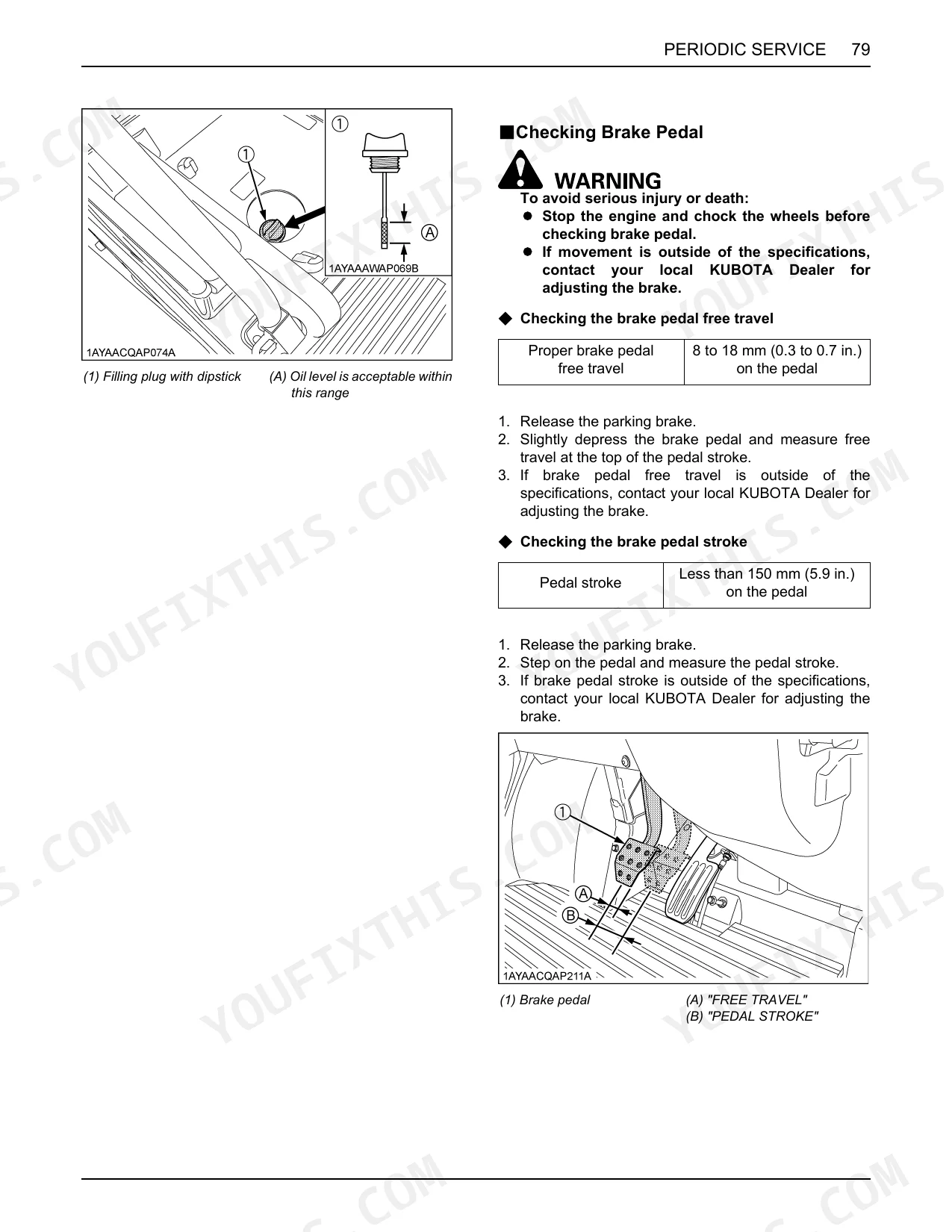
Measure the brake pedal free travel as shown on page 99, then adjust the linkage until it falls between 8 to 18 mm (0.3 to 0.7 in.). Inspect the brake fluid reservoir and confirm the system holds its rated capacity before you head out.
Manual Section: Periodic ServiceFrequently Asked Questions
What are the recommended service intervals?
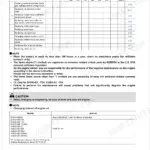
Intervals are laid out in a single chart. The engine start system and greasing come up every 50 hours; the muffler (spark arrester) and wheel fastener torque every 100 hours. Engine oil and its filter get changed at 200 hours, the air cleaner element at 1000 hours or 1 year, and the cooling system flush plus coolant change at 2000 hours or 2 years.
What fluids and capacities does this machine require?
Each system takes a specific fill. Fuel capacity is 30 L (7.9 U.S.gals.) of No. 2-D diesel. The coolant system with reserve tank holds 7.9 L (8.3 U.S.qts.) of fresh clean water with anti-freeze. The engine crankcase, filter exchanged, takes 4.1 L (4.3 U.S.qts.) of API Service Classification CF or better oil. Hydraulic tank oil runs 18.0 L (19.0 U.S.qts.) of KUBOTA UDT or SUPER UDT fluid, and brake fluid (reservoir and lines) is 0.4 L (0.4 U.S.qts.) of KUBOTA DOT3 GENUINE BRAKE FLUID.
How to troubleshoot engine won't start?
Several causes are common. No fuel flow means checking the fuel tank and filter, and replacing the filter if needed. Air or water in the fuel system calls for checking that the fuel line coupler bolt and nut are tight, then bleeding the system. In cold weather, thicker oil slows engine revolution, so switch to a viscosity suited to the temperature. A weak battery needs its terminals cleaned and a charge, or replacement once its life is up.
What are the hydraulic system specifications?
Hydraulic tank oil capacity is listed as 18.0 L (19.0 U.S.qts.), with KUBOTA UDT or SUPER UDT fluid recommended. The manual also explains the hydraulic outlet lever and its "IN" and "OUT" positions for the yellow and white ports, but it gives no pressure or flow rate figures for the hydraulic system itself.
What torque specifications are listed?
Torque figures appear for several fasteners. Aluminum wheels call for 90 to 110 N-m (9.2 to 11.2 kgf-m, 66.4 to 81.1 lbf-ft) and steel wheels for 108 to 130 N-m (11.1 to 13.2 kgf-m, 79.7 to 95.8 lbf-ft). The toe-in adjustment lock nut tightens to 74 to 84 N-m (7.6 to 8.5 kgf-m, 55 to 61 lbf-ft).
How will I receive this Kubota RTV-X1100C Owner's Manual?
The download is instant. Right after payment you'll have the full 124-page searchable Owner's Manual, ready to open on a laptop, tablet, or phone out in the shop.
Can I print specific sections of this Kubota RTV-X1100C Owner's Manual?
Yes. Print as many copies as you like; there are no restrictions. Plenty of mechanics print just the section they need and carry it to the shop floor.
Document Quality
This document is a scanned PDF, providing an OCR layer that allows you to search and copy the text. The text quality is generally crisp and readable, though some minor scanning artifacts are present. Diagrams and illustrations are raster images, clear enough for labels to be read, but they pixelate when magnified. Pages are mostly clean with occasional faint background specks and minor skewing, and there are a few notable blank pages, such as page 10.

Reviews
There are no reviews yet.