
Need the factory procedures for your Kubota SVL65-2 Compact Track Loader? This 138-page operator manual PDF walks you through every startup checklist, operating procedure, and service interval Kubota built into the machine. Inside: 17 pages of safety content, including ROPS and FOPS requirements, OPC function, and emergency exit steps, plus a full instrument panel breakdown with every warning indicator explained, from the DPF regeneration light to hydraulic oil temperature. You get 29 pages of maintenance procedures organized by interval, daily pre-start checks through every 3,000 service hours, and a troubleshooting section with a complete error code list for engine and system faults. Confirm engine oil at 8.5 liters with filter and top off the 82-liter fuel tank before the first morning startup. Your machine is down. Get the right answer fast: bookmarked by section, searchable by keyword, open on any device.
What's Inside This Kubota SVL65-2 Operator Manual
| System | Pages | Key Topics |
|---|---|---|
| Safe Operation | 11-28 | ROPS and FOPS, Parking the machine, Loading and transporting the machine, Maintenance, Emergency exit, Safety labels |
| Service of the Machine | 29-30 | Dealer Service (Warranty Policy, Procedure for Scrapping the Machine) |
| Technical Data | 31 | Specification Table |
| Machine Parts | 32-33 | Bucket, Tilt cylinder, Armrest, Drive motor, Rubber track, Lift arm |
| Instrument Panel and Switch | 34-46 | Instrument Panel (Fuel Gauge Indicator, Low Fuel Warning Light, Coolant Temperature Gauge, Checking the Coolant Temperature Gauge, Glow Plug Indicator, Parking Brake Warning Light, Bucket-Floating Indicator, Master Warning Light, Engine Oil Pressure Indicator, Battery Charge Warning Light, Hydraulic Oil Temperature Indicator, Hour Meter, Diesel-Particulate-Filter Regeneration Indicator, Engine Rev Up Indicator, Air Cleaning Warning Indicator) |
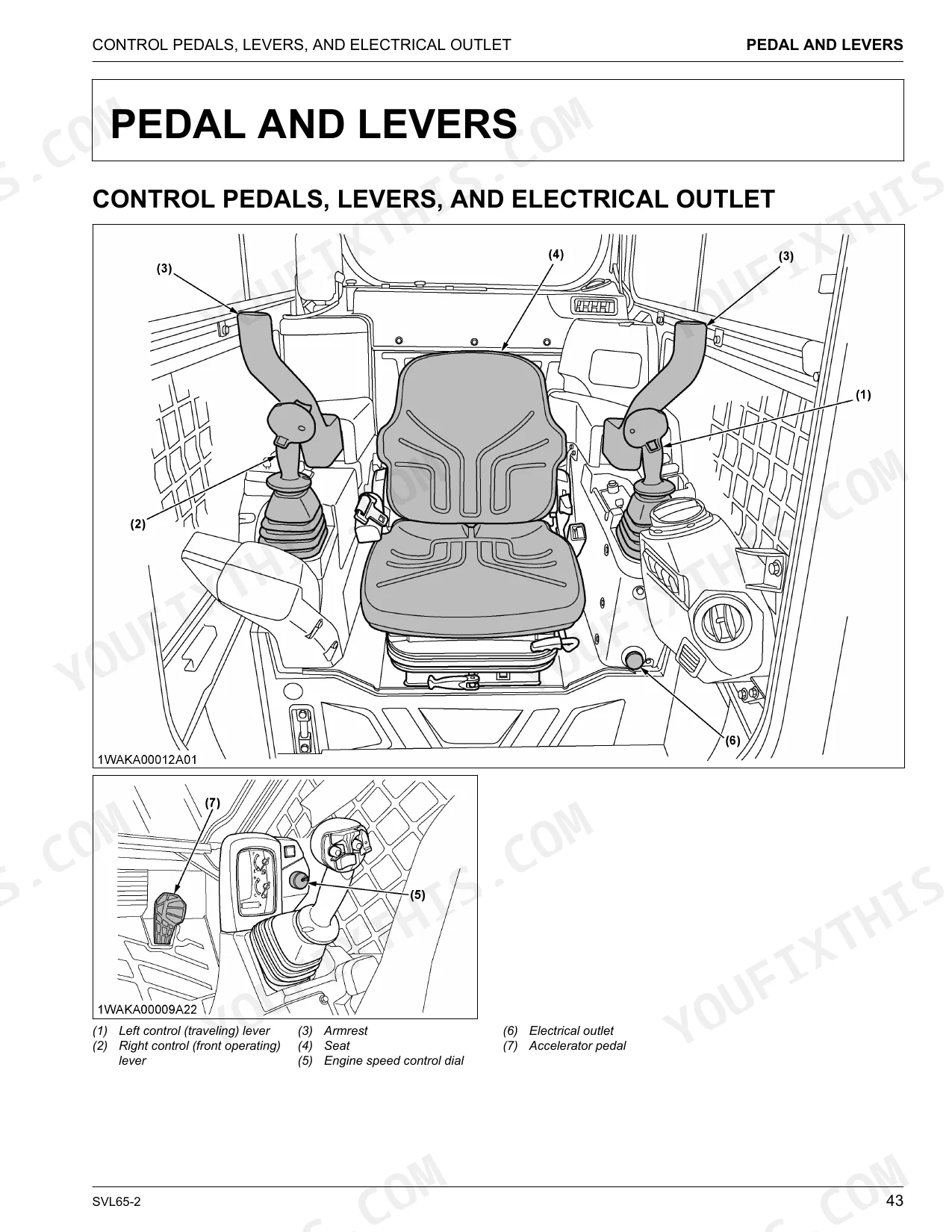
| Pedal and Levers | 47 | Control Pedals, Levers, and Electrical Outlet |
| Safety Features | 48-49 | How to Use the Emergency Exit, OPC Function, How to Use and Check the Function of the Armrest, How to Use and Check the Seat Function, How to Check the Reverse Alarm |
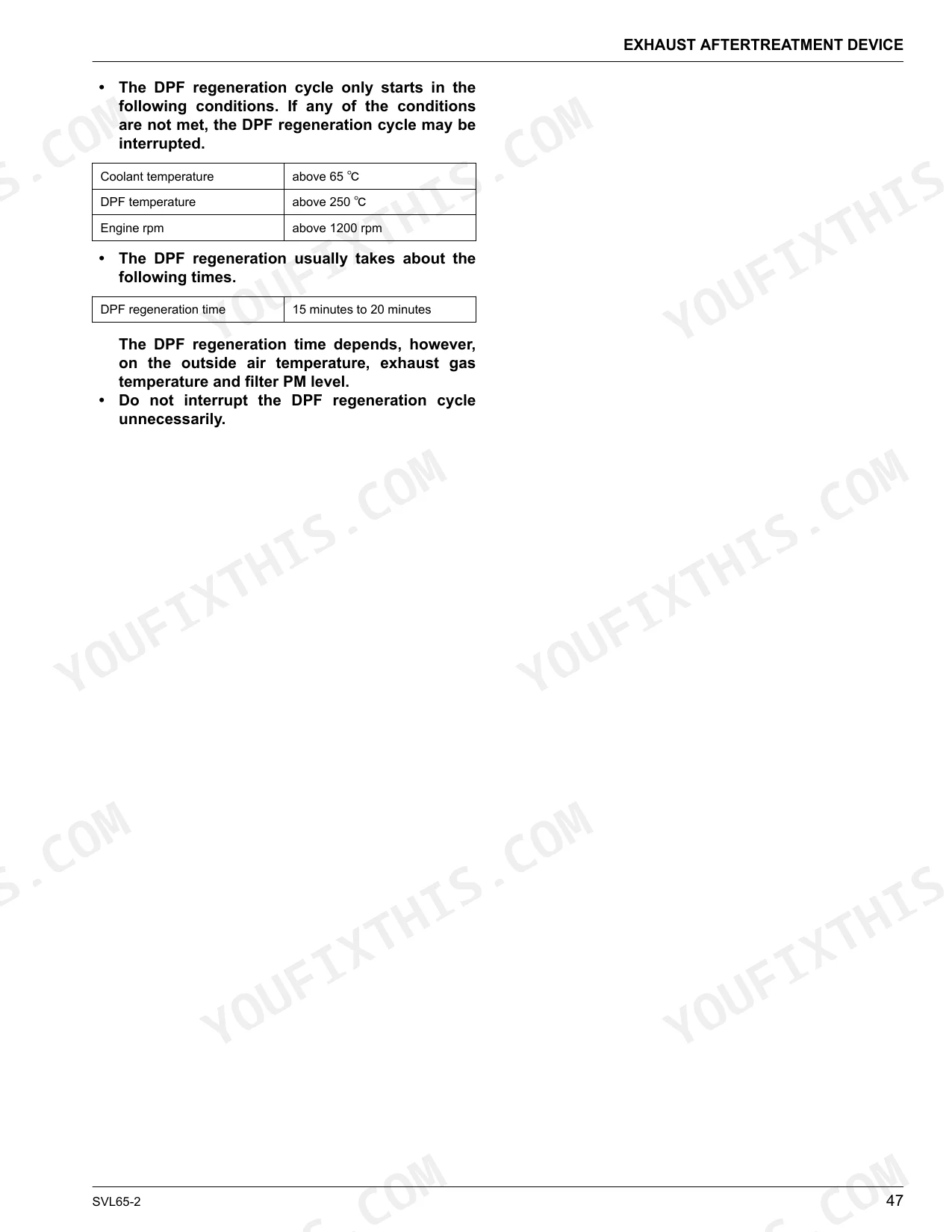
| Exhaust Aftertreatment Device | 50-51 | Catalyst-Containing Diesel-Particulate-Filter Device, Regeneration of Diesel-Particulate-Filter |
| Air Conditioner | 52-54 | Air Flow of the Air Conditioner, Air Control Vent, How to Use the Control Panel, Operating the Control Panel |
| Operation | 55-67 | Cab Type Machine (Interior Lamp, How to Use the Wiper/Washer Switch [Closed Cab Model], Opening and Closing the Cab Door [Closed Cab Model], Opening and Closing the Side Cab Window [Closed Cab Model]) |
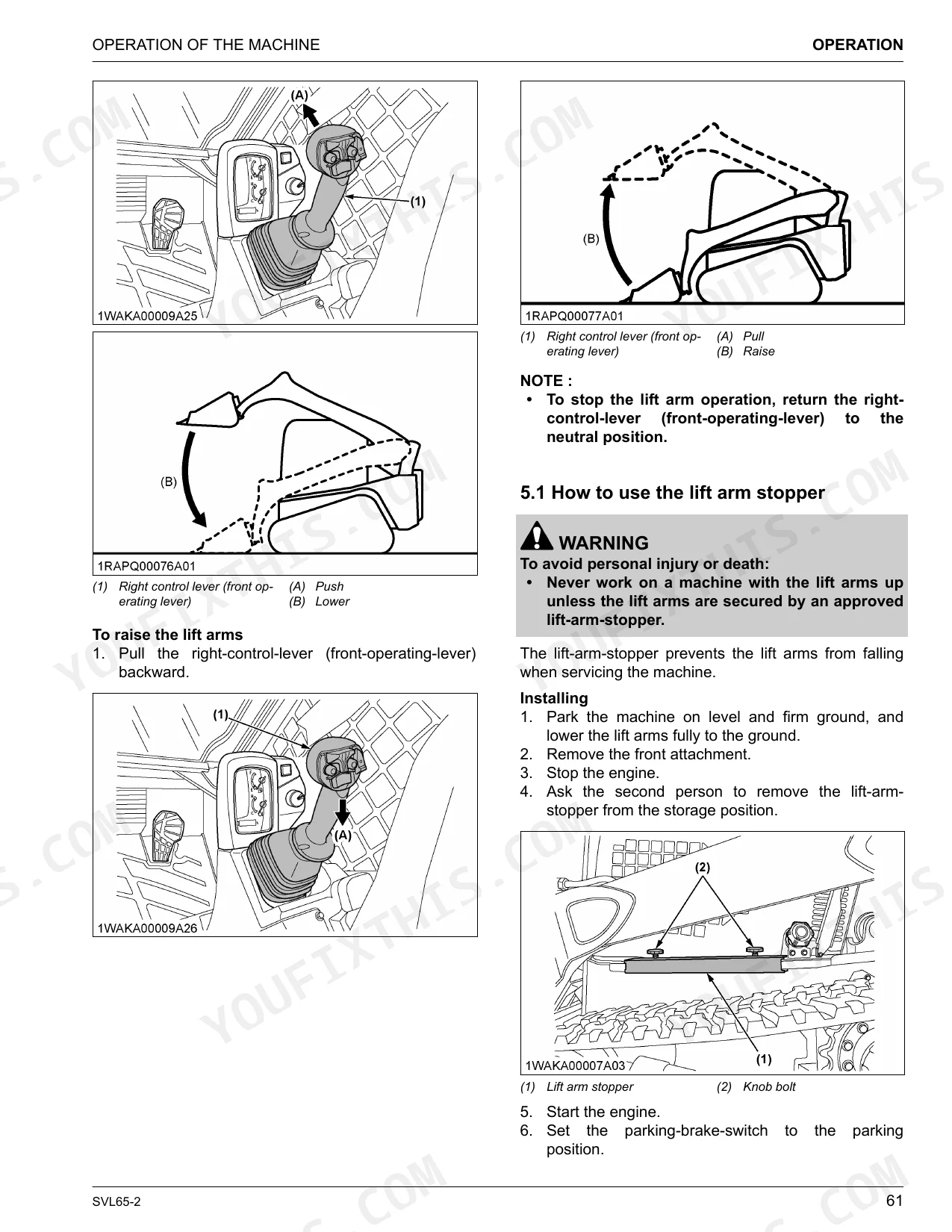
| Auxiliary Hydraulic | 68-70 | How to Use the Auxiliary Hydraulic Control (Operating: Attachment Control Device) |
| Quick-Hitch | 71-74 | How to Use the Mechanical Quick-Hitch, How to Use the Hydraulic Quick-Hitch |
| Machine Precaution | 75-77 | Important Information on Machine Operation (Caution While Traveling, Precaution When Traveling in High Speed, Precautions When Traveling on Inclines, Parking on an Incline, Prohibited Actions for the Machine, Prevention of Slippage of Rubber Tracks) |
| Lifting | 78-80 | Lifting the Machine |
| Transporting | 81-83 | Loading the Machine on a Transport Vehicle, Towing an Operable Machine, Towing an Inoperable Machine |
| Maintenance | 84-112 | Maintenance Intervals |
| Track | 113-114 | Tracks |
| Fuse | 115-117 | Fuses (Replacing the Fuse, Fuse Capacities and Circuits, Electrical Outlet, Slow Blow Fuse, Replacing the Bolted Slow Blow Fuse) |
| Troubleshooting | 118-125 | Troubleshooting of the Engine and Other Systems, List of the Error Code Numbers |
| Cold Weather | 126 | Preparation for Operation of the Machine in Cold Weather, Storing the Machine After Completion of Work in Cold Weather |
| Long Storage | 127-128 | Storing the Machine for a Longer Period of Time, Operating the Machine After Storing for a Long Period of Time (Periodic Replacement of Important Component Parts) |
| Recommended Oils | 129-132 | Greases, and Fuels, Biodiesel Fuel |
| Appendices | 133-134 | Main Dimensions of the Machine |
Quick Reference Specifications
| Specification | Value | Page |
|---|---|---|
| Cab lock bolts tightening torque | 77.5 N⋅m to 90.2 N⋅m | p. 89 |
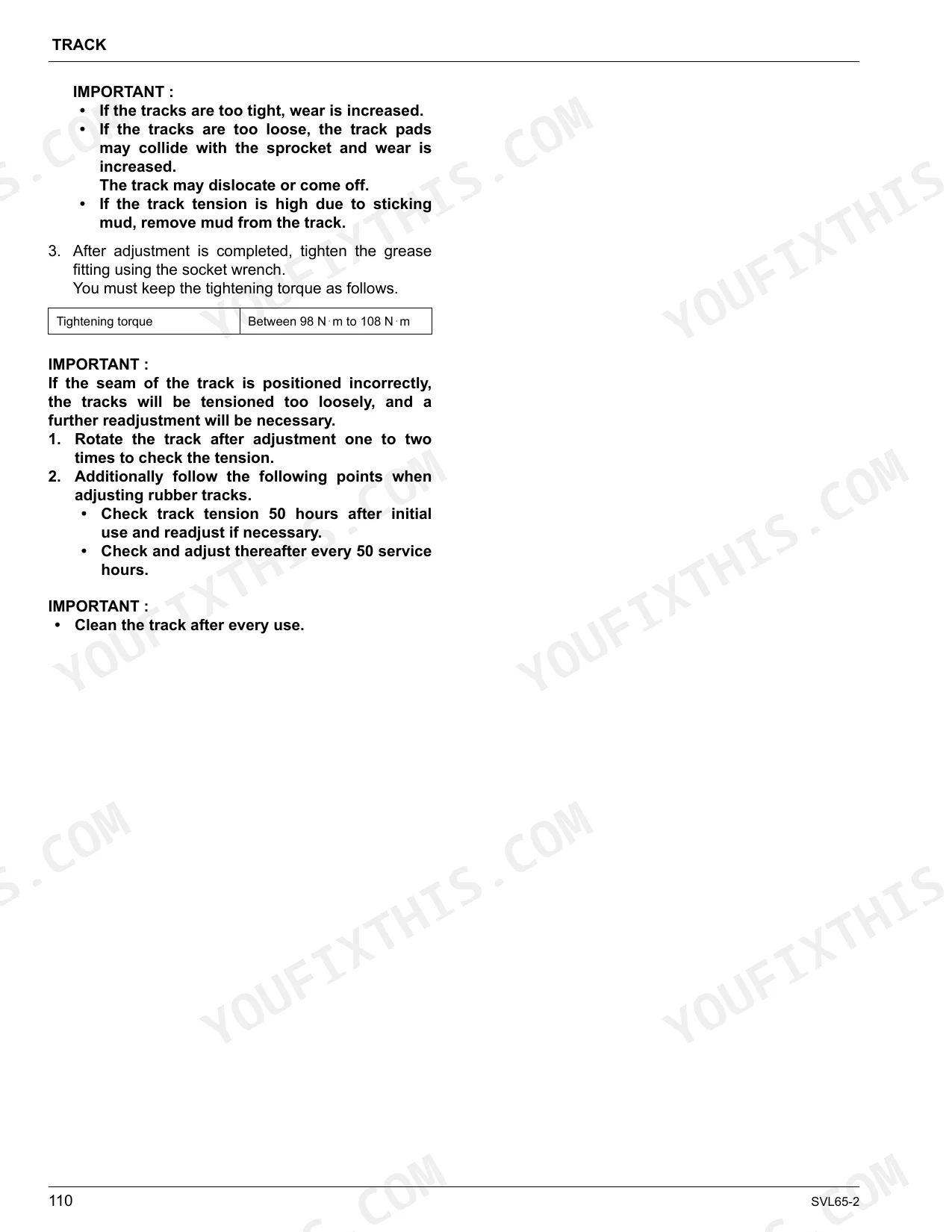
| Track grease fitting tightening torque | Between 98 N⋅m to 108 N⋅m | p. 114 |
| Operating weight (Closed Cab) | 3885 kg | p. 31 |
| Fuel tank capacity | 82 L | p. 31 |
| Engine oil volumes with engine oil filter | 8.5 L | p. 104 |
| Cooling water capacity | 9.5 L | p. 110 |
| Hydraulic oil change interval | every 1000 Hrs. | p. 84 |
| DPF cleaning interval | 3000 hours | p. 84 |
| Track tension clearance | 20 mm to 30 mm | p. 98 |
| V-belt deflection | About 4.0 mm to 5.0 mm | p. 101 |
| Max. pressure (attachments) | 22.5 MPa (230 kgf/cm2) | p. 31 |
| Rated operating capacity | 953 kg | p. 31 |
Kubota SVL65-2 Common Problems This Manual Covers
Kubota SVL65-2 master warning light flashes during operation, machine slows or loses drive p. 34
Check the indicator descriptions on page 34 to identify which warning is active. If the hydraulic oil temperature indicator is lit, stop work and let the machine idle; hydraulic tank holds 20 L, so inspect the sight glass and top off if low. Verify the master warning is not triggered by a blown fuse; fuse locations are on page 115.
Manual Section: Electrical System MalfunctionsEngine cranks slowly or won't start on cold mornings, glow plug light stays on p. 126
Check engine oil viscosity against the cold-weather recommendations on page 126 before cranking. Verify the battery terminals are clean and tight. Watch the glow plug indicator on page 34 and wait for it to extinguish fully before turning the key. Fuel tank holds 82 L; running low in cold weather makes hard starts worse.
Manual Section: Engine Starting and Operation DifficultiesDPF regeneration indicator light stays on or flashes, engine power feels reduced p. 50
Check the regeneration indicator meaning on page 50. If the DPF regeneration indicator is flashing, move to an open area and ensure engine RPM is sufficient for the automatic regeneration cycle to start, as described on page 38 and 51. If the engine RPM is too low, rev up the engine until the engine-rev-up indicator goes out, and DPF regeneration will automatically start. DPF cleaning is scheduled every 3,000 hours on page 84. Avoid repeated short operating cycles in enclosed spaces; incomplete combustion accelerates filter loading between service intervals.
Manual Section: Exhaust Aftertreatment DeviceBoom and bucket controls unresponsive, hydraulic functions not working after entering cab p. 48
Verify the armrest is fully lowered: the OPC function disables hydraulic output with the armrest raised. Confirm your full weight is on the seat, as the seat sensor must be engaged before controls activate. Check the hydraulic unlock switch per page 48. Hydraulic tank capacity is 20 L; inspect the sight glass and top off if below MIN.
Manual Section: Hydraulic System Low Power or No MovementMachine pulling to one side while driving, rubber track appears loose or uneven p. 113
Inspect the track sag at the midpoint between the front and rear idlers. Correct clearance is 20 mm to 30 mm, measured at the center of the track per page 98. Also check for stones or debris wedged in the undercarriage, as blockage is listed as a primary cause of deviation on page 118.
Manual Section: Drive System DeviationCoolant temperature gauge climbing into red zone, high-temp warning light illuminated p. 118
Stop heavy work immediately and let the engine idle at low throttle before shutdown. Check the coolant level in the reservoir; total system capacity is 9.5 L. Inspect the radiator screen for mud or debris and clean if blocked. Verify V-belt deflection is 4.0 mm to 5.0 mm per page 101. Consult overheating causes on page 118.
Manual Section: Engine Overheating and Cooling System IssuesFrequently Asked Questions
What are the recommended service intervals?
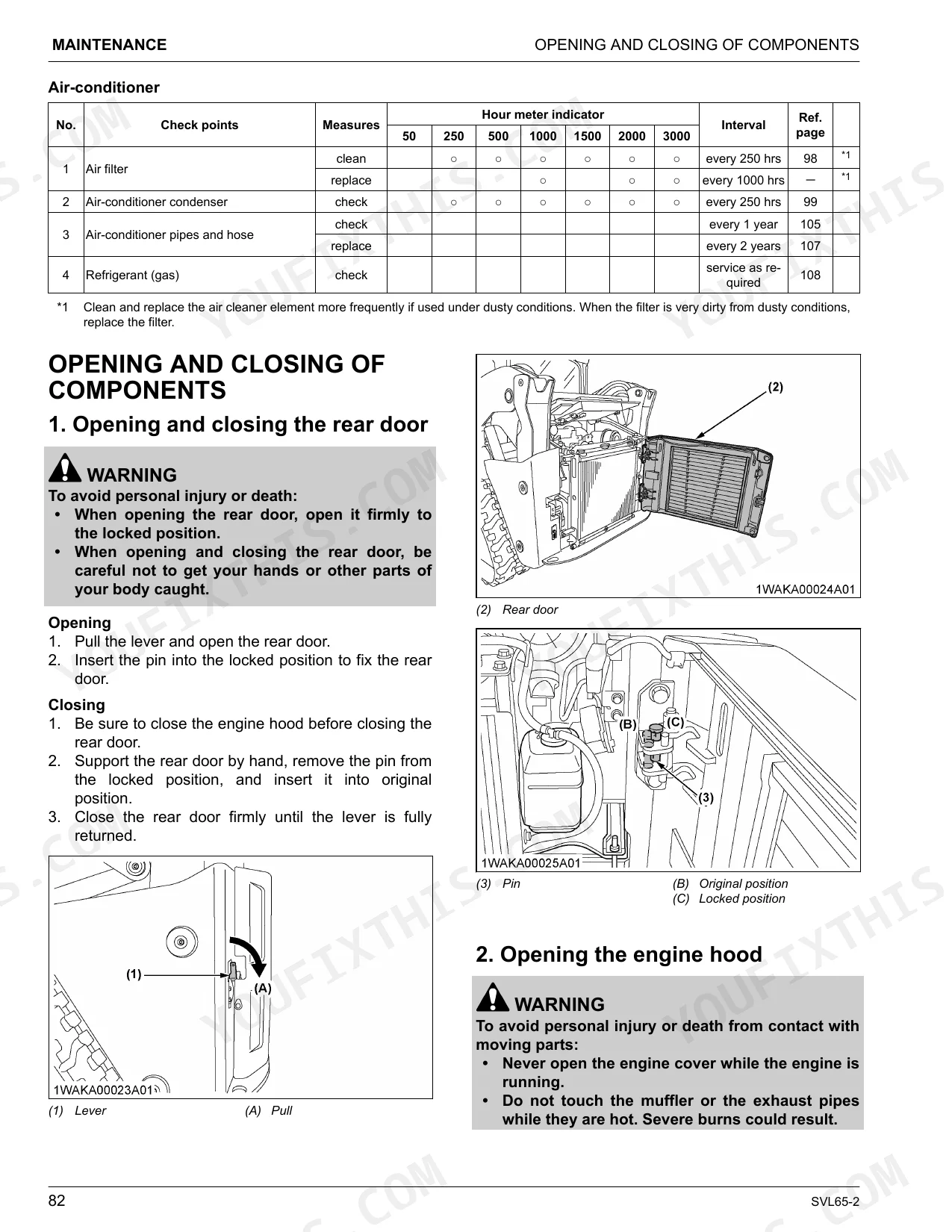
The manual provides a comprehensive service interval chart. For example, coolant level should be checked daily (every 10 hrs), engine oil changed every 250 hours, and hydraulic oil changed every 1000 hours. The V-belt tension should be adjusted every 250 hours.
What fluids and capacities does this machine require?
The machine requires specific fluids and capacities. The fuel tank capacity is 82 L. Engine oil volumes with the engine oil filter are 8.5 L, and the drive unit oil capacity is approximately 1.0 L. The hydraulic tank holds 20 L, with a whole oil volume of 48 L. Recommended oils include SAE 90 gear oil and DPF-compatible engine oil (CJ-4).
How to troubleshoot engine won't start?
If the engine fails to start, check if the fuel is too viscous or if there's air/water in the fuel system. Ensure the fuse is not blown out and the battery is not dead. If the engine fails to start within 10 seconds, wait 20 seconds or longer before attempting to restart.
What are the hydraulic system specifications?
The hydraulic system specifications include a maximum displacement (theoretical) of 65.8 L/min for Standard Flow and 102.2 L/min for High-Flow. The maximum pressure for attachments is 22.5 MPa (230 kgf/cm2).
What torque specifications are listed?
The manual lists specific torque specifications for certain components. The tightening torque for the cab lock bolts is between 77.5 N·m to 90.2 N·m. For the track grease fitting, the tightening torque should be between 98 N·m to 108 N·m.
How quickly can I access this Kubota SVL65-2 manual after buying?
Instant PDF download. You get the full 138-page searchable Operator Manual immediately after payment. Open it on your laptop, tablet, or phone right in the shop.
Am I able to print pages from this Kubota SVL65-2 manual?
None at all — the PDF is DRM-free. Print whatever sections you need to take out to the shop. Standard letter or A4 paper works.
Document Quality
This PDF is a scanned document with an OCR layer, allowing you to search and copy the full text. The text is crisp and easy to read throughout the manual. Diagrams and illustrations are clear raster images, with all labels readable at standard viewing sizes. Pages are clean, free of scan artifacts or marks, and consistently aligned. There are a few notable blank pages (e.g., pages 10, 24, 28) which serve as filler.


Reviews
There are no reviews yet.