
This Kubota V3300DI-E2B and V3300DI-T-E2B Shop Manual (OEM #9Y011-02964) keeps to one job: rebuilding and servicing the 3318 cm³, 4-cylinder diesel to factory spec. Eighty pages walk through disassembly, assembly, and servicing of the cylinder head, E-CDIS direct injection system, built-in dynamic balancer, turbocharger, and lubricating system. Another 40 pages of exploded views map every component relationship before you pull a single bolt. Troubleshooting charts, clearance tables, and a full tightening torque section (general and special-use fasteners) round out the servicing chapter. Fill the sump to 13.2 liters, change the oil at 50 hours and every 250 after that, and follow the maintenance checklist through every interval from daily checks to 3,000-hour service. The whole thing is bookmarked by section, so you can search any spec by keyword on your tablet and get to work.
What's Inside This Kubota V3300DI-E2B, V3300DI-T-E2B Manual
| System | Pages | Key Topics |
|---|---|---|
| Record of Revisions | 3 | Correction Of Workshop Manual (Model Name: Old Engine Serial Number, New Engine Serial Number), Battery Specific Gravity, Governor, Check The Fuel Leakage Of The Overflow Pipe |
| Safety First | 4-7 | Danger, Warning, Caution, Important, Note, Before Servicing And Repairing, Safety Starting, Safety Working |
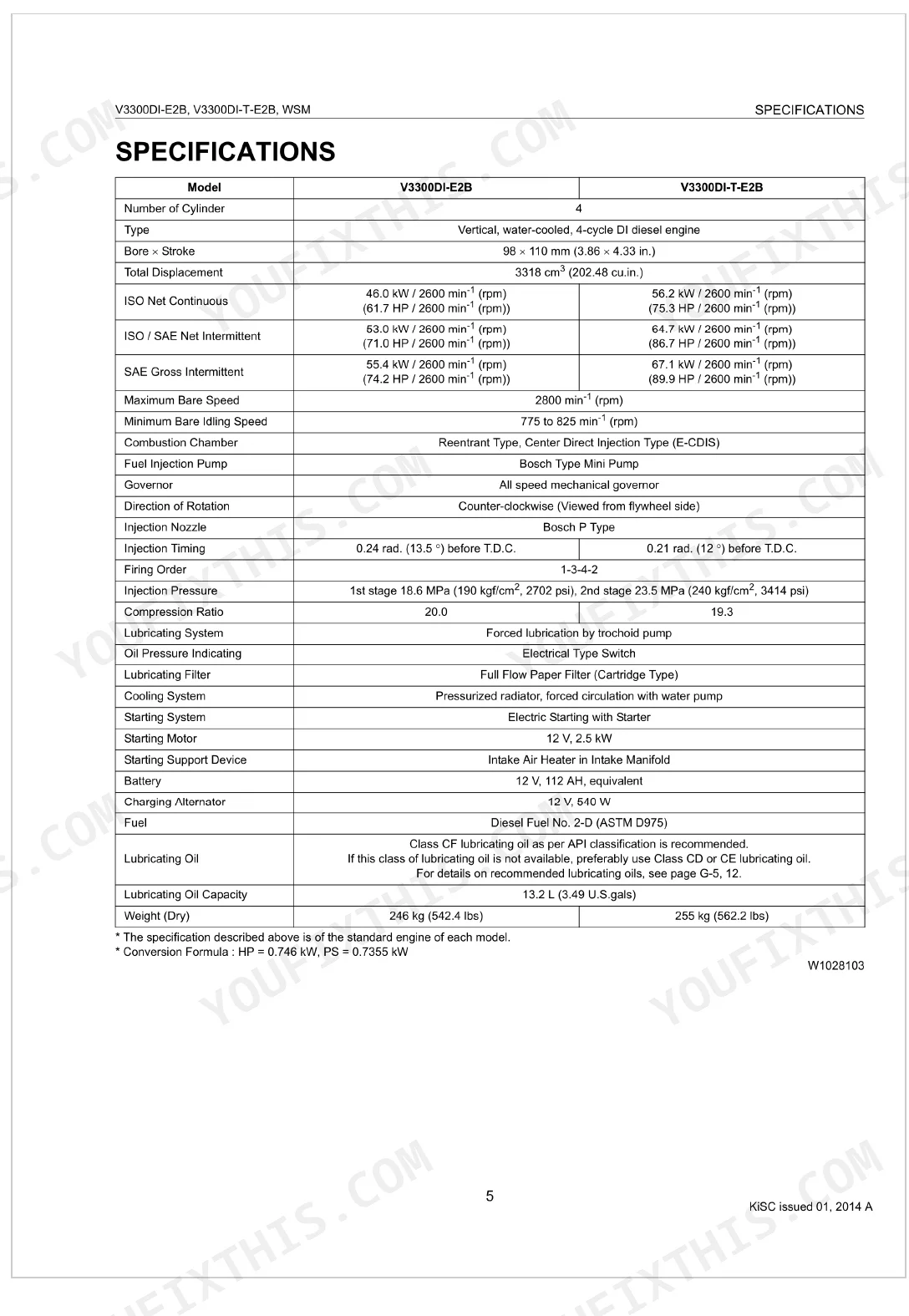
| Specifications | 8 | Model, Engine Type, Performance Data, Fuel System, Lubricating System, Cooling System, Starting System, Lubricating Oil |
| Performance Curves | 9-10 | V3300DI-E2B Performance Data (SAE-J1349 Curves, ISO-3046, 2534 Curves), Curve Legend, V3300DI-T-E2B Performance Data (SAE-J1349 Curves |
| Dimensions | 11 | V3300DI-E2B Dimensions, V3300DI-T-E2B Dimensions, Measurement Unit |
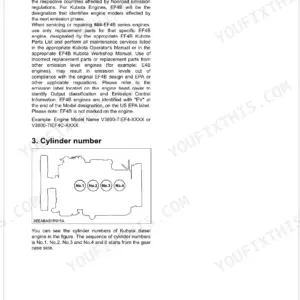
| General | 12-53 | Engine Identification (Model Name and Old Engine Serial Number, Model Name and New Engine Serial Number, Cylinder Number), Maintenance Check List |
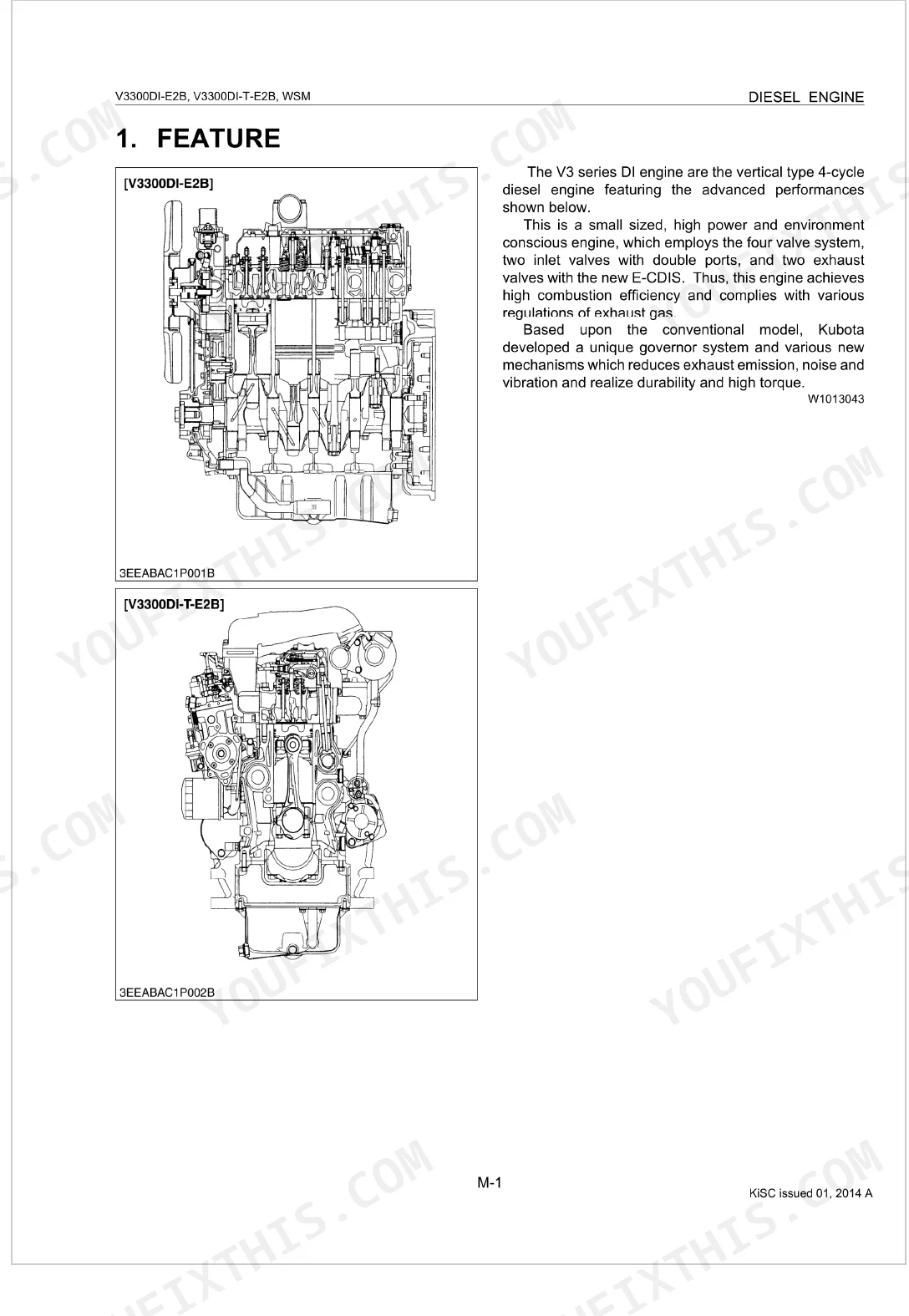
| Mechanism | 54-68 | Feature, Engine Body (Cylinder Block, Half-Floating Head Cover, Cylinder Head, Center Direct Injection System, Piston, Built-In Dynamic Balancer), Lubricating System (Oil Cooler) |
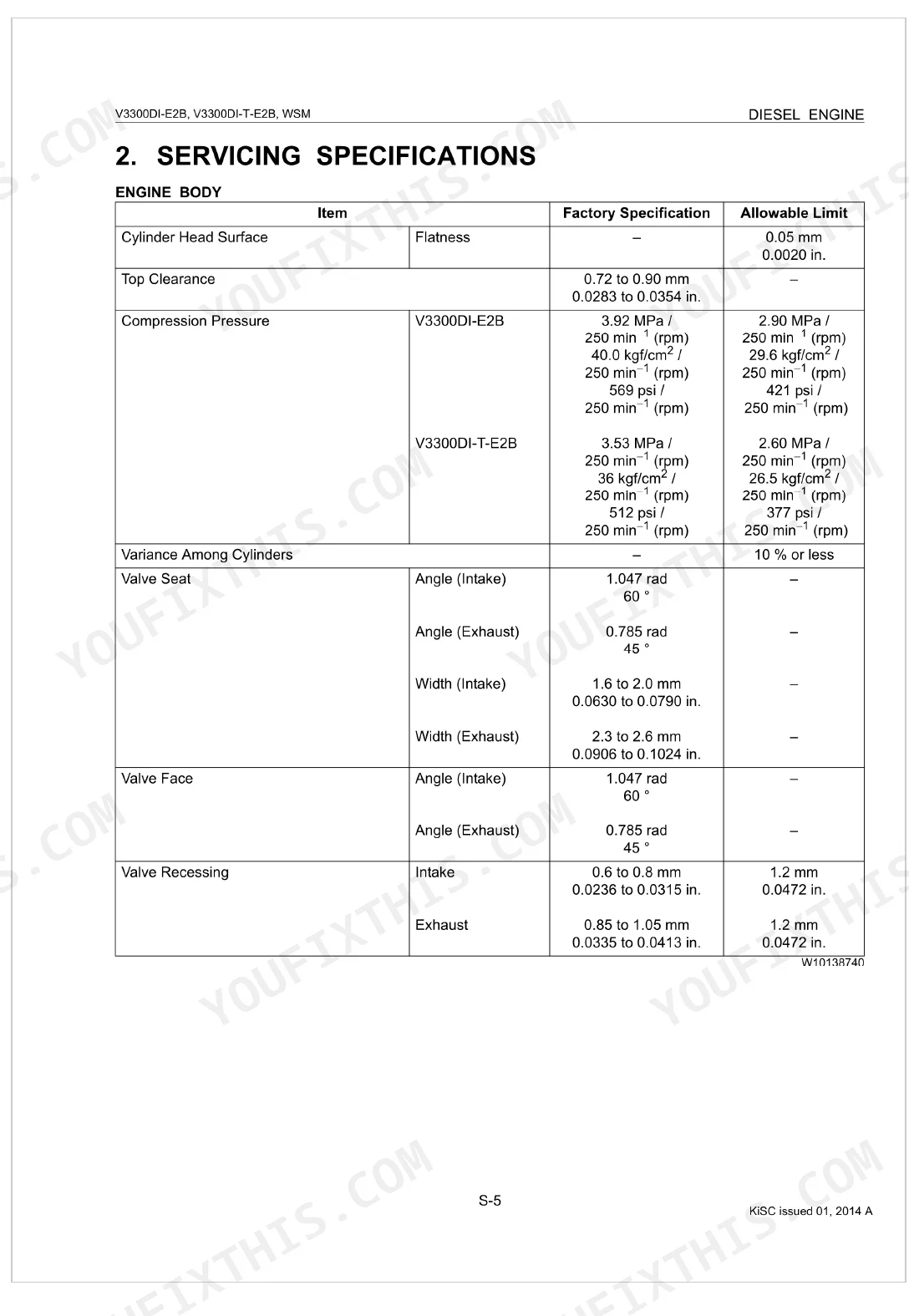
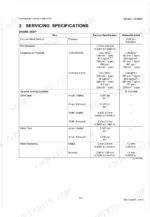
| Servicing | 69-147 | Troubleshooting, Servicing Specifications, Tightening Torques, Tightening Torques for Special Use Screws, Bolts and Nuts, Checking, Disassembling and Servicing, Lubricating System |
Quick Reference Specifications
| Specification | Value | Page |
|---|---|---|
| All Models | ||
| Engine oil capacity | 13.2 L (3.49 U.S.gals) | p. 8 |
| Changing engine oil interval | Initial 50 hrs, Every 250 hrs | p. 18 |
| Number of Cylinders | 4 | p. 8 |
| Total Displacement | 3318 cm³ | p. 8 |
| Lubricating Oil Capacity | 13.2 L | p. 8 |
| Charging Alternator | 12 V, 540 W | p. 8 |
| Engine Oil Change Interval | Every 250 hours | p. 18 |
| Oil Filter Cartridge Replacement Interval | Every 250 hours | p. 18 |
| Radiator Coolant Replacement Interval | Every 2 years | p. 18 |
| Engine Oil Drain Plug Torque | 20.0 to 24.5 N·m | p. 22 |
| V3300DI-E2B | ||
| Compression Ratio | 20.0 | p. 8 |
| V3300DI-T-E2B | ||
| Compression Ratio | 19.3 | p. 8 |
Kubota V3300DI-E2B, V3300DI-T-E2B Common Problems This Manual Covers
Kubota V3300DI engine cranks but won't fire, no fuel reaching the injectors after sitting
Confirm the fuel shutoff valve is open and the tank holds fuel. Crack the injection pump bleed screw and crank until solid fuel flows, clearing trapped air from the lines. Inspect the fuel filter for clogging; clean it at every 250-hour service (page 18). Make sure the stop solenoid wiring connector is fully seated.
Manual Section: Engine Does Not StartEngine temperature gauge climbs into the red, coolant boiling out of the overflow tube
Check the coolant level cold, then test the radiator cap for correct sealing pressure. Inspect fan belt deflection; spec is 10 to 12 mm at the midpoint between pulleys (page 23), since a slipping belt starves the water pump. Clear debris from the radiator core and flush the interior at the 500-hour interval. If overheating persists under normal loads, check injection timing.
Manual Section: Engine OverheatedEngine hunts and surges at idle, RPM fluctuates without any load change
Inspect the fuel filter for partial clogging; clean at every 250-hour service (page 18). Check fuel lines and fittings for small air leaks, since a pinhole ingests air and causes intermittent lean stumble. Confirm the governor linkage moves freely without binding. If surging continues, have the injection pump checked at the 3,000-hour interval.
Manual Section: Engine Revolution Is Not SmoothBlack smoke thickens from the exhaust under load, engine feels flat and down on power
Remove and inspect the air cleaner element; replace it after 6 cleanings or annually (page 18). A blocked intake is the leading cause of black smoke under load. On the V3300DI-E2B, verify injection timing is 0.22 to 0.25 rad (page 34). On the T-E2B, confirm the turbocharger inlet hose is intact and the waste oil drain is clear.
Manual Section: Exhaust Gas Issues (Oil Leak, Black/Dark Gray)Low oil pressure warning light at idle, pressure recovers only at higher RPM
Verify the oil level and the correct oil grade; sump capacity is 13.2 L (page 8), and wrong viscosity is a frequent cause of idle pressure drop. Inspect the oil strainer for clogging and check the relief valve for debris holding it cracked open. Replace the oil filter at every 250-hour service (page 18).
Manual Section: Low/High Oil PressureBattery won't hold a charge, engine hard to crank after sitting overnight
Measure fan belt deflection first; spec is 10 to 12 mm at the midpoint between pulleys (page 23), since a slipping belt keeps the 12 V, 540 W alternator from fully recharging (page 8). Check battery electrolyte level every 250 hours (page 18) and top up with distilled water. If belt tension and electrolyte are both correct, test the rectifier diodes.
Manual Section: Battery Quickly DischargedFrequently Asked Questions
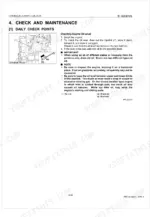
What are the recommended service intervals?
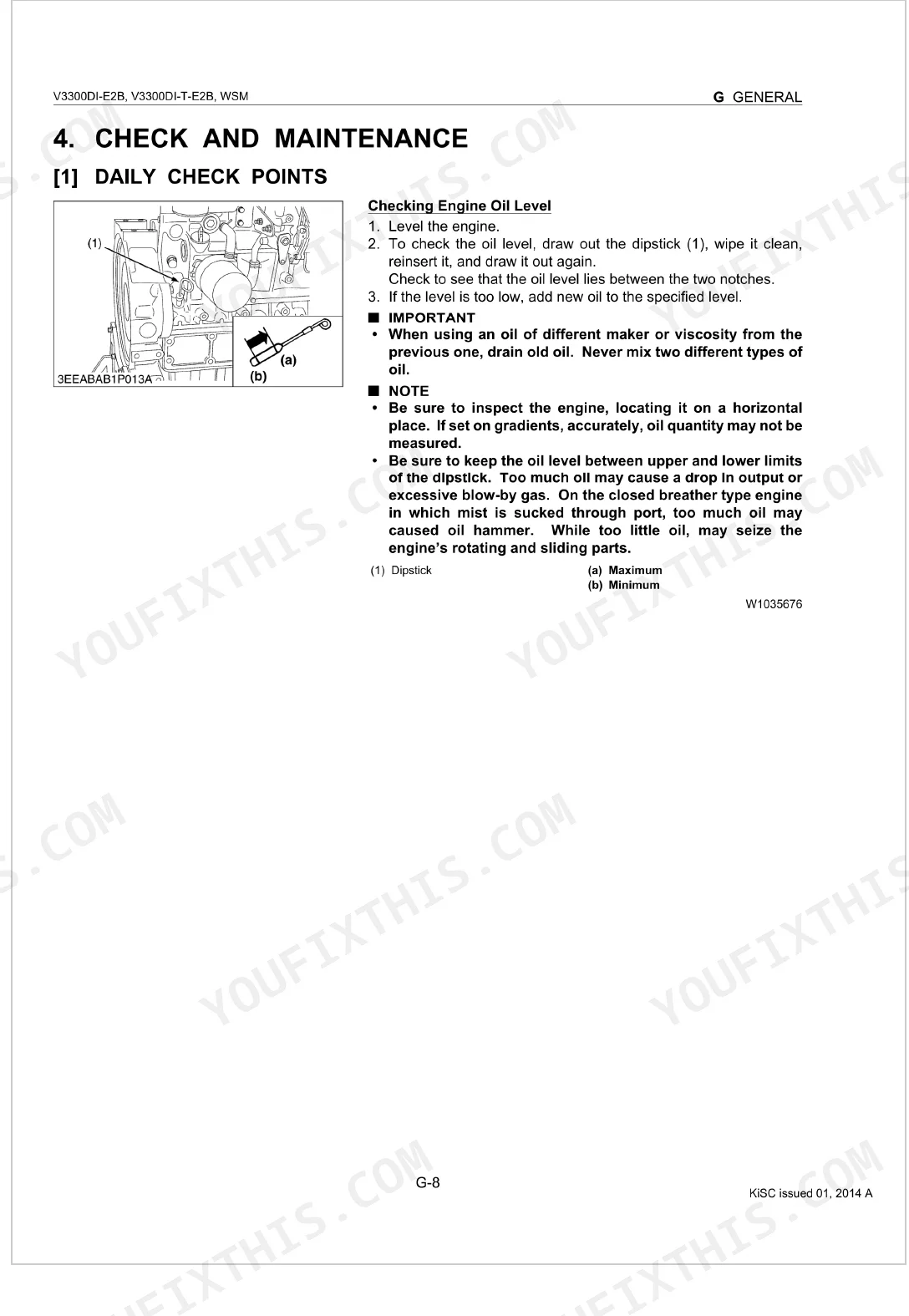
A full maintenance checklist lays out service intervals by component. Engine oil, for instance, gets changed first at 50 hours, then every 250 hours after that. The fuel filter cartridge is checked every 250 hours and replaced every 500.
What fluids and capacities does this machine require?
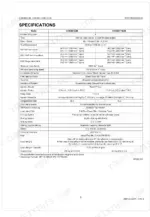
This engine runs on Diesel Fuel (ASTM D975). Lubricating oil capacity is 13.2 L (3.49 U.S.gals), with recommended oil classes CF, CF-4, or CG-4. Cooling is handled by a pressurized radiator with forced circulation and a water pump.
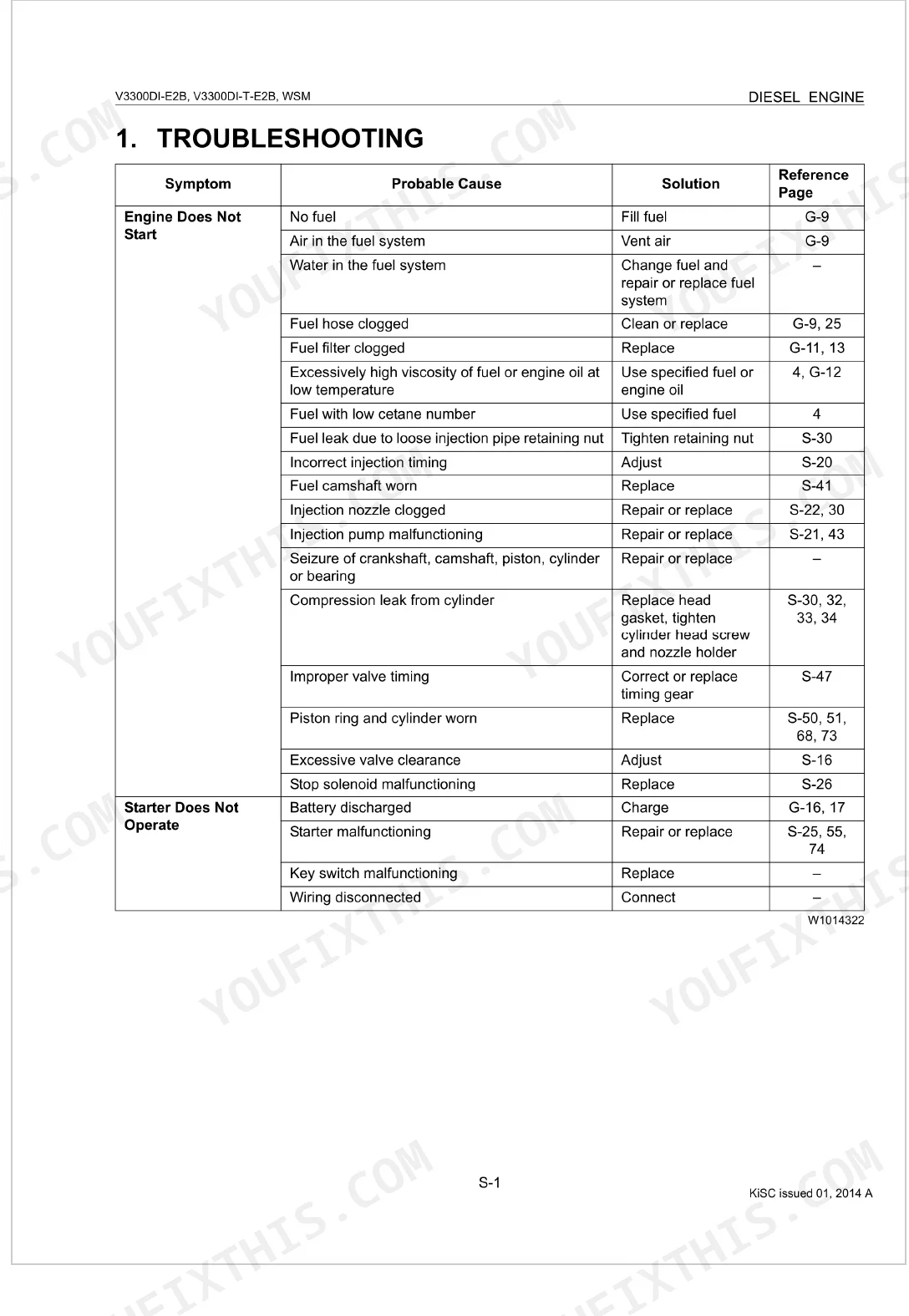
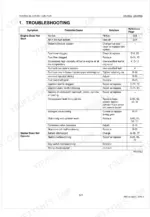
How to troubleshoot engine won't start?
If the engine does not start, check for no fuel (fill fuel, see page G-9), vent air (vent air, see page G-9), or a clogged fuel hose (clean or replace, see page G-9, 25). Other causes include a discharged battery (charge, see page G-16, 17) or disconnected wiring (connect).
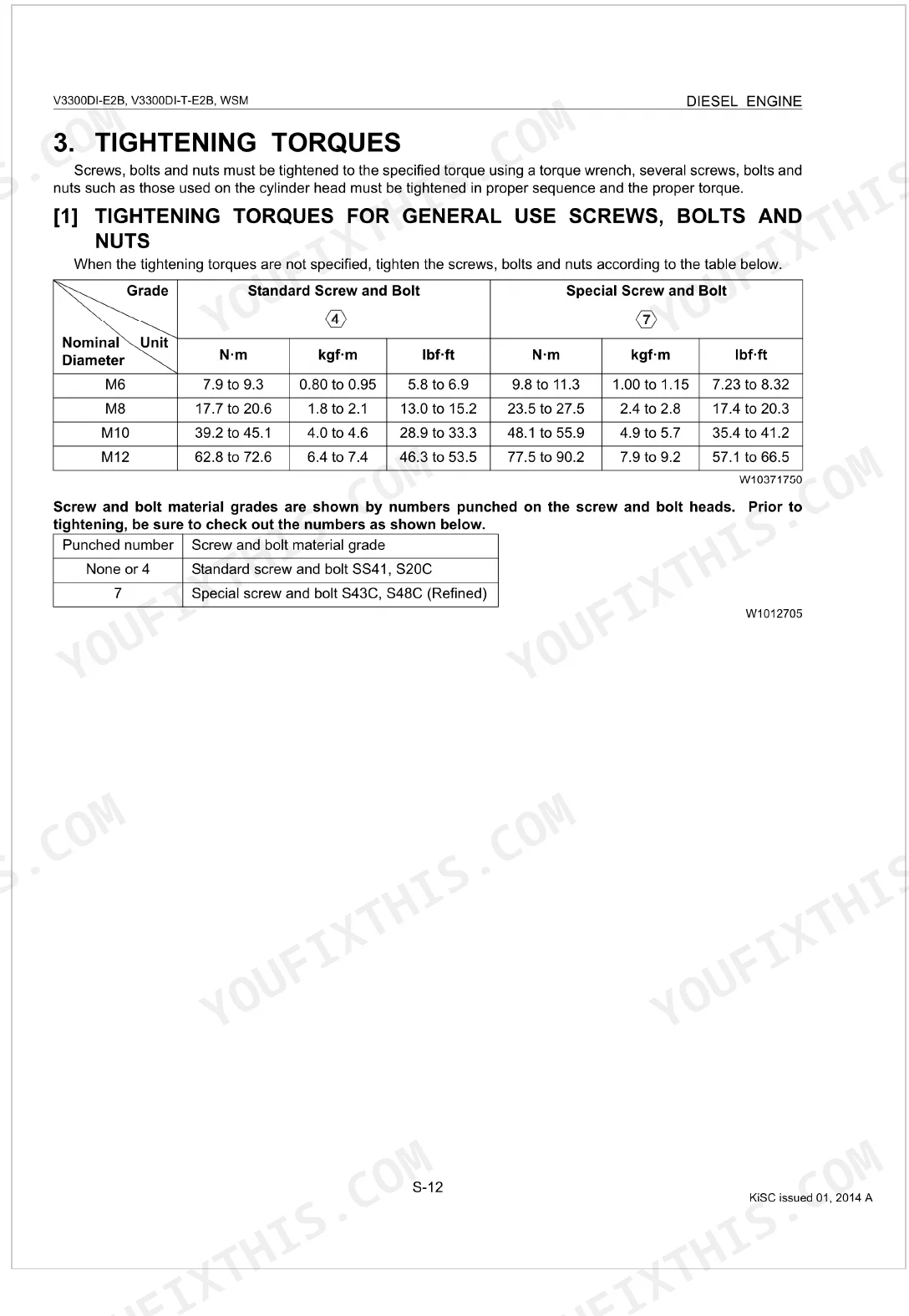
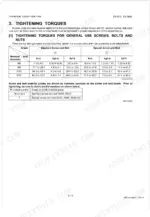
What torque specifications are listed?
The manual provides extensive tightening torque specifications. For general use, M6 screws require 7.9 to 9.3 N·m (5.8 to 6.9 lbf·ft), M8 screws require 17.7 to 20.6 N·m (13.0 to 15.2 lbf·ft), and M10 screws require 39.2 to 45.1 N·m (28.9 to 33.3 lbf·ft). Specific components like the cylinder head cover screw have a torque of 98.1 to 107.9 N·m (72.3 to 79.6 lbf·ft).
What are the common electrical problems?
Common electrical problems include a quickly discharged battery, which can be caused by insufficient battery electrolyte (fill distilled water and charge, see page G-16, 17), a slipping fan belt (adjust belt tension or replace, see page G-10, 13), or disconnected wiring (connect). Damage to the rectifier, alternator, or battery itself are also listed as probable causes.
How quickly can I access this Kubota V3300DI-E2B, V3300DI-T-E2B manual after?
Immediate download of the complete 147-page searchable Shop Manual. Read it on any device, from the laptop at your desk to the phone out in the field.
Can I print this Kubota V3300DI-E2B, V3300DI-T-E2B manual?
Absolutely. No DRM or copy protection. Print the whole manual or just the pages you need. Any home or office printer works.
Document Quality
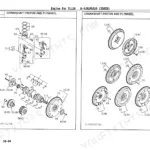
This document is a native digital PDF, allowing you to easily search and copy all text within the manual. The text is consistently crisp and clear throughout, ensuring excellent readability. All diagrams and illustrations, including technical drawings and engine schematics, are sharp and appear to be vector-based or very high-resolution raster images, with all labels perfectly readable at any zoom level. The pages are clean with no scan artifacts, stains, or skewed content, and there are no notable blank or filler pages.

Reviews
There are no reviews yet.