
You searched for a manual. You found six different types listed for the same machine. Which one do you buy?
This happens every day. A shop owner orders an operator’s manual when they need a service manual. A fleet manager buys a parts catalog thinking it has repair procedures. Money and time wasted.
Here’s how factory manuals work, what each type contains, and how to pick the right one for your job.
The Five Types of Factory Manuals
Every major equipment manufacturer produces the same basic set of documentation. The names vary by brand, but the categories are consistent across the industry.
1. Service Manual (Repair Manual, Workshop Manual, Shop Manual)
This is what mechanics reach for when something breaks. Disassembly and reassembly procedures, torque specifications, clearance tolerances, hydraulic pressure settings, electrical diagnostics. Step-by-step, system-by-system.
Different brands use different names for the same thing. John Deere calls them Technical Manuals (TM). Komatsu calls them Shop Manuals. Caterpillar uses SENR-prefixed Service Manuals. The content is the same: how to take it apart, fix it, and put it back together.
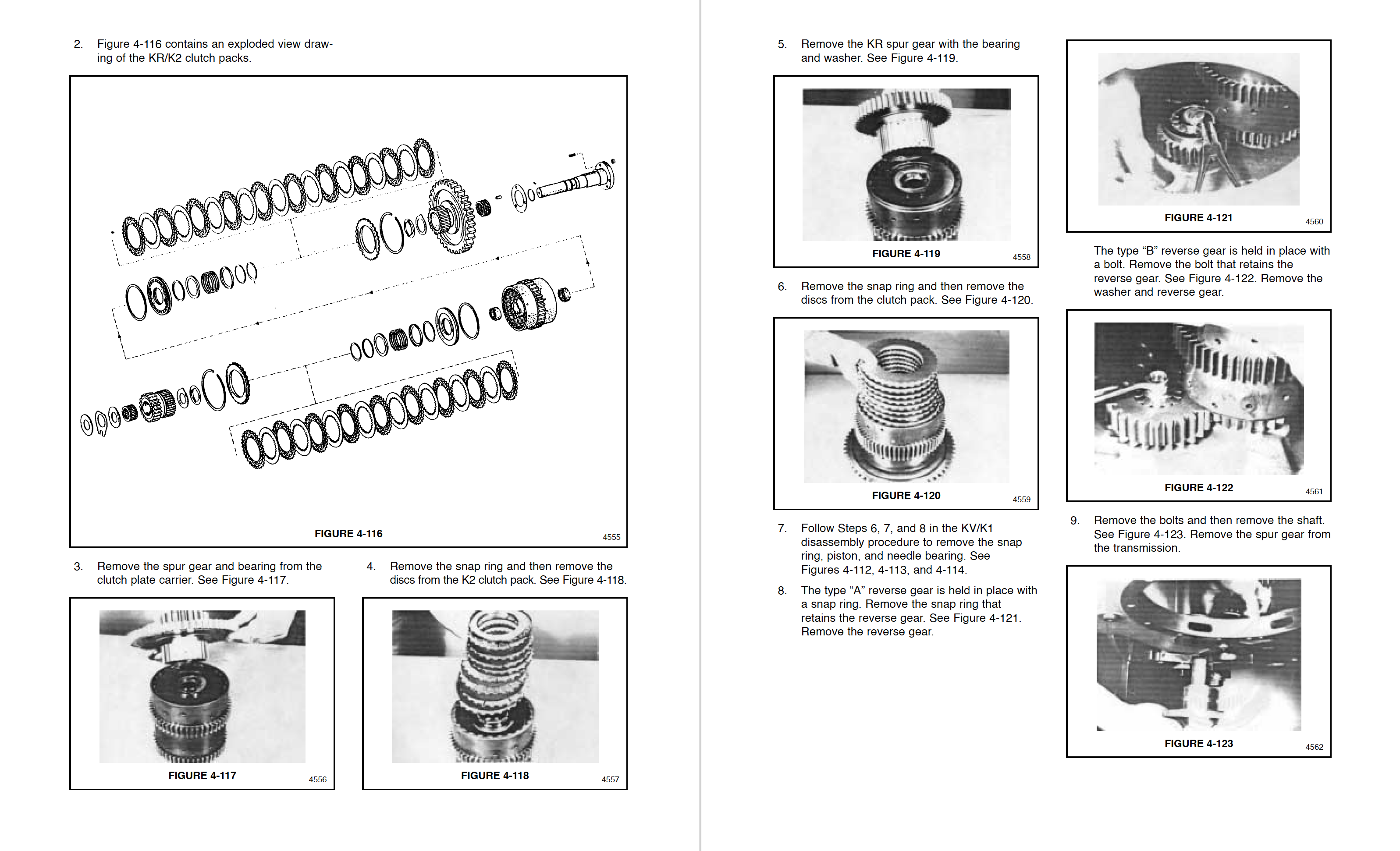
These are the largest manuals. A typical service manual runs 300 to 1,500+ pages depending on the machine. For example, the John Deere 6230/6330/6430 Repair TM or a Caterpillar 259B3 Compact Track Loader manual. Complex machines often require two or three volumes.
2. Operator’s Manual
Written for the person in the cab, not the person under the machine. Covers safe operation, control functions, daily fluid checks, grease points, maintenance intervals, cold weather procedures, and what the warning lights mean.
Operator manuals do not contain disassembly procedures, torque specs, or hydraulic schematics. They tell you when to change the oil. They don’t tell you how to rebuild the engine.
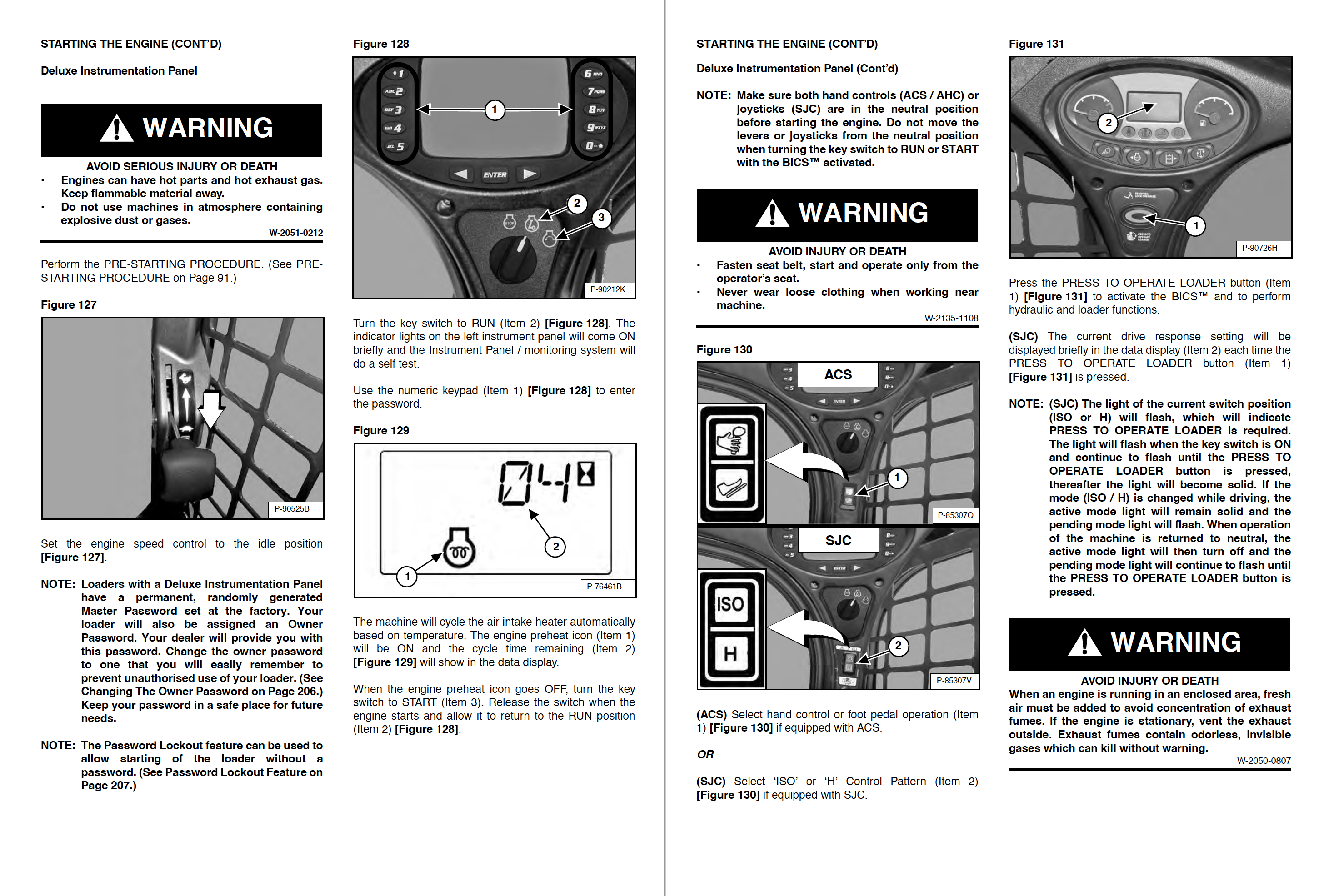
This is the most common source of buyer confusion. If you need to repair the machine, you need the service manual. The operator’s manual is a separate document with a separate part number. Deere labels them OMM (Operator, Maintenance, and Monitoring).
3. Parts Catalog
Exploded-view diagrams with every bolt, gasket, and bearing numbered. Part numbers, quantities per assembly, supersession notes. This is what you use to order the right part before you start the repair.
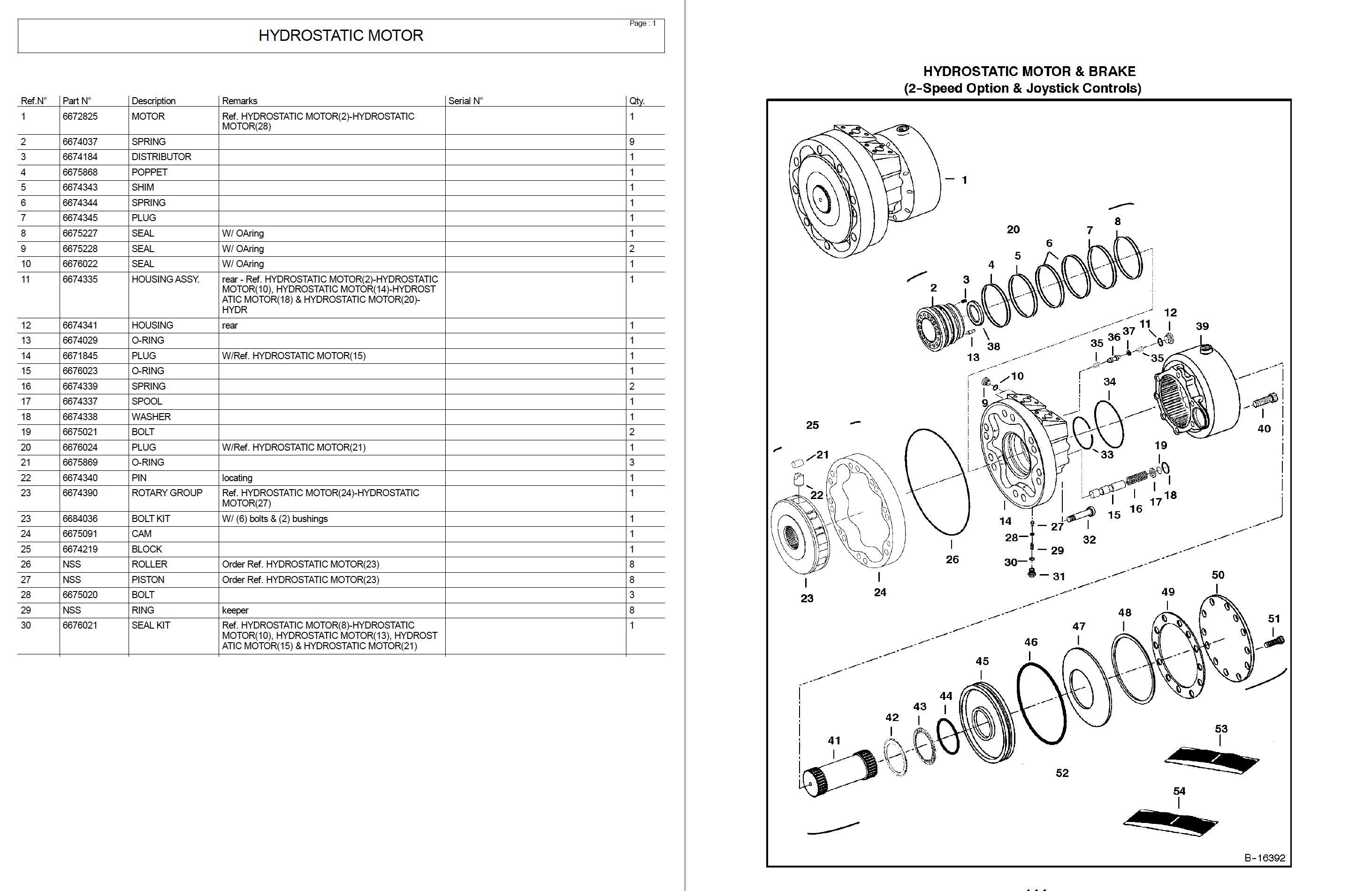
Parts catalogs are thin compared to service manuals. They average around 80 pages. Zero repair procedures inside. You need both: the parts catalog to order correctly and the service manual to install correctly.
Caterpillar publishes theirs through SISWeb. Deere uses PC-numbered Parts Catalogs available through Service ADVISOR. CNH brands (Case, New Holland) use eTIM. See our Hitachi parts manuals or New Holland parts manuals for examples.
4. Diagnostic Manual (Operation and Tests)
On simpler machines, diagnostics are a chapter in the service manual. On complex modern equipment, manufacturers publish a separate diagnostic volume.
John Deere does this routinely. For a large tractor or excavator, Deere publishes two TM numbers for the same machine: one Repair TM (how to disassemble) and one Operation and Tests TM (how to troubleshoot). For instance, the John Deere 318D/320D Skid Steer Operation and Test TM (TM11398) is a separate volume from the Repair TM. The diagnostic volume covers theory of operation, fault code definitions, sensor readings, and test procedures. A mechanic working on a modern Deere needs both.
5. Wiring and Hydraulic Schematics
Full electrical schematics: every circuit, connector location, wire color, pin number. Hydraulic circuit diagrams: pump routing, valve block connections, cylinder feeds, pressure specs.
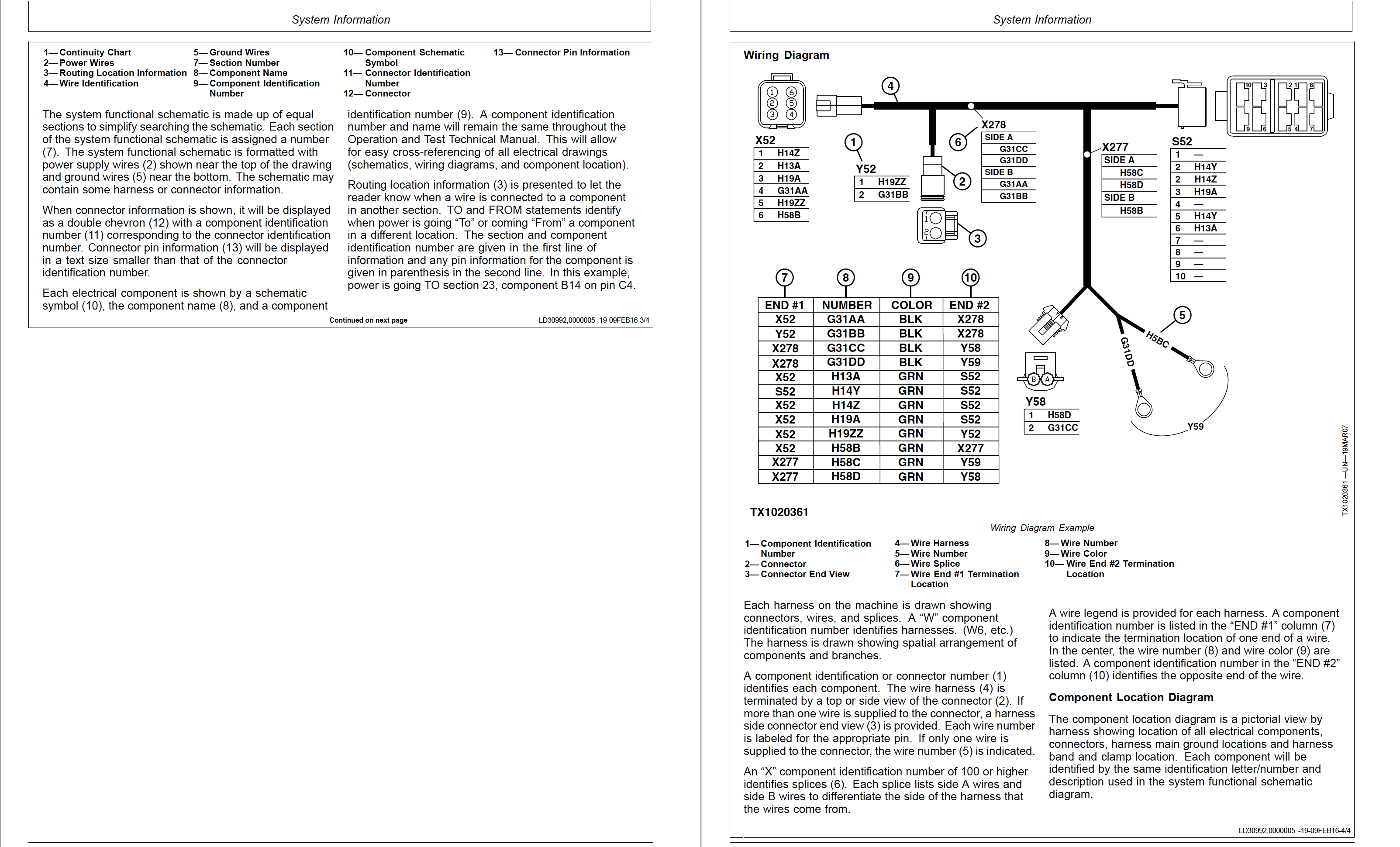
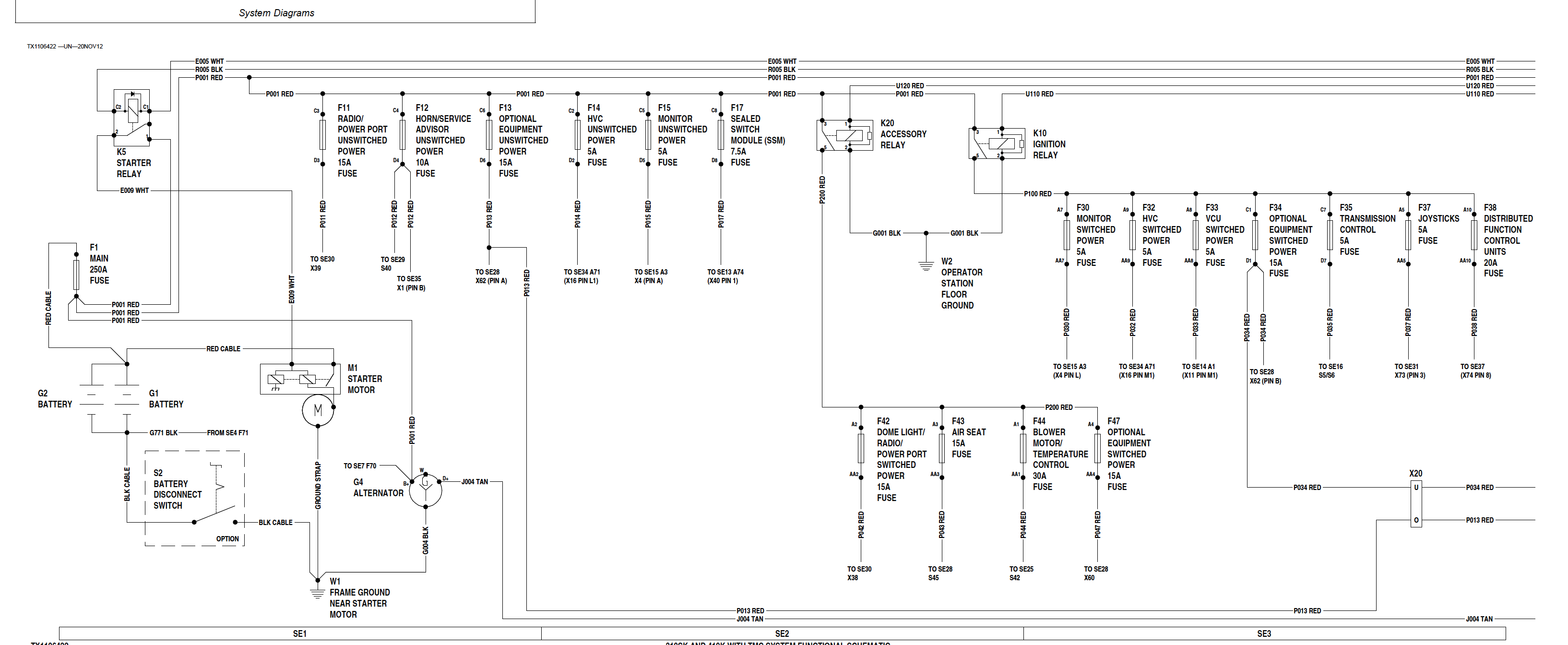
Sometimes these are sections within the service manual. On complex machines (large excavators, motor graders, cranes), they’re published as separate documents. Caterpillar frequently breaks out electrical schematics into separate RENR-prefixed documents. See our Caterpillar 216B3/226B3/259B3 Electrical and Hydraulic System manual for an example of a standalone schematics volume. Knowing whether your machine’s schematics are embedded or separate saves you from buying the wrong manual.
How John Deere Organizes Manuals
Deere has the most systematic manual structure in the industry. Every publication gets a prefix code:
- TM = Technical Manual (the service/repair manual)
- CTM = Component Technical Manual (covers a specific engine, transmission, or axle shared across multiple machines)
- OMM = Operator’s Manual
- PC = Parts Catalog
TM numbers are sequential and unique. TM1716 covers the 5210, 5310, 5410, and 5510 Tractors. The 840/940/1040/1140 Tractors TM (TM4353) and the 2355/2555/2755/2855N TM (TM4434) are from the same era. The number doesn’t encode the machine model. It’s just the order Deere assigned it. Older manuals are in the TM1000 range. Newer machines reach TM11000+.
Inside every Deere TM, content follows a numeric section-and-group system. Section 9010 is always Engine. Section 9020 is Power Train. Section 9025 is Hydraulic System. An experienced Deere mechanic picking up any TM knows exactly where to look, regardless of the machine model.
What makes Deere TMs distinctive: the Theory of Operation sections. Before explaining what to do, they explain why the system works the way it does. This matters when you’re troubleshooting something the manual doesn’t cover step-by-step.
Deere’s Service ADVISOR is the dealer-level diagnostic platform. Full access is restricted to authorized dealers. Customer Service ADVISOR gives equipment owners basic maintenance info and operator manuals, but not the full repair TM content or diagnostic tools. The PDF manuals we sell contain the same TM content that Service ADVISOR delivers to the dealer’s screen.
How New Holland and CNH Manuals Work
New Holland is part of CNH Industrial, which also owns Case IH, Case Construction, Steyr, and Kobelco. These brands share platforms, and their documentation reflects it.
CNH uses long numeric IDs for manuals. For example, the New Holland Workmaster 50/60/70 Repair Manual carries number 47866583. No prefix system like Deere’s TM codes. You identify the right manual by machine model and serial number range, not by memorizing a numbering scheme.
Because Case and New Holland share platforms, the same service manual sometimes covers both brands’ equivalent machines. The FPT engine family powers both New Holland and Case equipment. One engine service manual serves both.
eTIM (Electronic Technical Information Manuals) is CNH’s dealer-facing manual platform. Full access requires dealer credentials. The CNH EST (Electronic Service Tool) is the separate diagnostic software that connects to the machine for live fault codes and calibration. The PDF manuals we sell give independent shops the same eTIM technical content without the subscription.
Why There’s No Haynes Manual for Heavy Equipment
Haynes and Chilton exist because millions of identical Honda Civics justify the investment to write a third-party manual. A John Deere 744K Wheel Loader has thousands of units in service, not millions. The economics don’t work for a third-party publisher.
More importantly, heavy equipment systems are proprietary. Electronic control modules, hydraulic circuits, and diagnostic protocols don’t follow a public standard the way automotive OBD-II does. The factory manual is the only complete reference. There is no aftermarket equivalent.
This is why the factory manual matters:
- Torque specs and pressure settings are machine-specific. Generic guides don’t cover them.
- Wiring diagrams are proprietary. No public standard maps the electrical architecture of a Deere or Komatsu.
- Calibration procedures on modern machines with electronic controls require factory-specified sequences. Wrong order or wrong values can damage controllers.
- Tier 4 Final and EU Stage V engines have injection timing and aftertreatment procedures that only the factory documents correctly.
How We Categorize Manuals in Our Store
The industry has dozens of names for the same types of documentation. We simplified it into four categories that match how buyers actually search.
Repair Manuals
This is our largest category. Browse John Deere repair manuals, New Holland repair manuals, Case repair manuals, or Caterpillar repair manuals to see what’s inside. It includes everything a mechanic needs to fix the machine: service manuals, workshop manuals, shop manuals, technical manuals (Deere TMs and CTMs), diagnostic manuals, and troubleshooting manuals. Different manufacturers, different names, same purpose: take it apart, diagnose it, fix it, put it back together.
We group them under one name because that’s how mechanics search. Nobody types “workshop manual” vs “technical manual” when they need to rebuild a hydraulic pump. They search “repair manual.” Whether the OEM called it a TM, a Shop Manual, or a Service Manual, if it contains repair procedures, torque specs, and schematics, it’s in Repair Manuals.
Operator Manuals
These are strictly operator-level documentation. Controls, gauges, maintenance schedules, safety procedures. No disassembly, no torque tables, no schematics.
We keep them separate because buying an operator manual when you need a repair manual is the single most common mistake. Separating the categories makes the difference visible before checkout.
Parts Manuals
Exploded-view diagrams and part number tables. No repair procedures. You use these to identify and order the correct replacement part, then use the repair manual to install it.
Schematics
Wiring diagrams and hydraulic circuit diagrams published as standalone documents. Most service manuals include schematics in their electrical and hydraulic chapters. This category exists for the cases where the manufacturer published schematics as a separate volume.
How to Find the Right Manual for Your Machine
The model number alone is often not enough. Manufacturers revise machines mid-production. A manual valid for serial numbers 632968 through 664100 is not correct for a machine outside that range.
The correct sequence:
- Find your machine’s model number and serial number (stamped on the frame, usually near the cab door or on the data plate).
- Check the manual description for serial number coverage. Every factory manual lists the serial range it applies to.
- If you’re unsure, search by model number and compare the serial ranges listed on each manual.
Caterpillar uses a 17-character PIN (Product Identification Number). The serial number is the last 8 characters. Komatsu models include a generation code after the dash: PC200-8 is different from PC200-7, and the shop manuals are not interchangeable.
When in doubt, check the serial number. It’s the single most reliable way to match a machine to the correct manual. Not sure which manual fits your machine? Send us a message with your model and serial number. We’ll point you to the right one.
Quick Reference
| Manual Type | Who Uses It | Contains | Typical Pages |
|---|---|---|---|
| Service / Repair Manual | Mechanic | Repair procedures, torque specs, schematics | 300 to 1,500+ |
| Operator’s Manual | Operator | Controls, maintenance schedule, safety | 100 to 400 |
| Parts Catalog | Parts counter, mechanic | Part numbers, exploded diagrams | 60 to 200 |
| Diagnostic Manual | Mechanic, dealer tech | Fault codes, theory, test procedures | 500 to 1,500+ |
| Schematics | Electrical/hydraulic tech | Wiring diagrams, hydraulic circuits | 50 to 300 |
We carry repair manuals, parts catalogs, operator manuals, and schematics for John Deere, New Holland, Case, Caterpillar, Hitachi, Hyundai, Doosan, Takeuchi, and 20+ other brands. Every file is a searchable PDF with bookmarks. Buy it, download it, open it on a shop tablet.
Can’t find the manual you need, or not sure which type is right for your machine? Contact us. We respond fast, usually within a few hours. No ticket queues, no chatbots.