
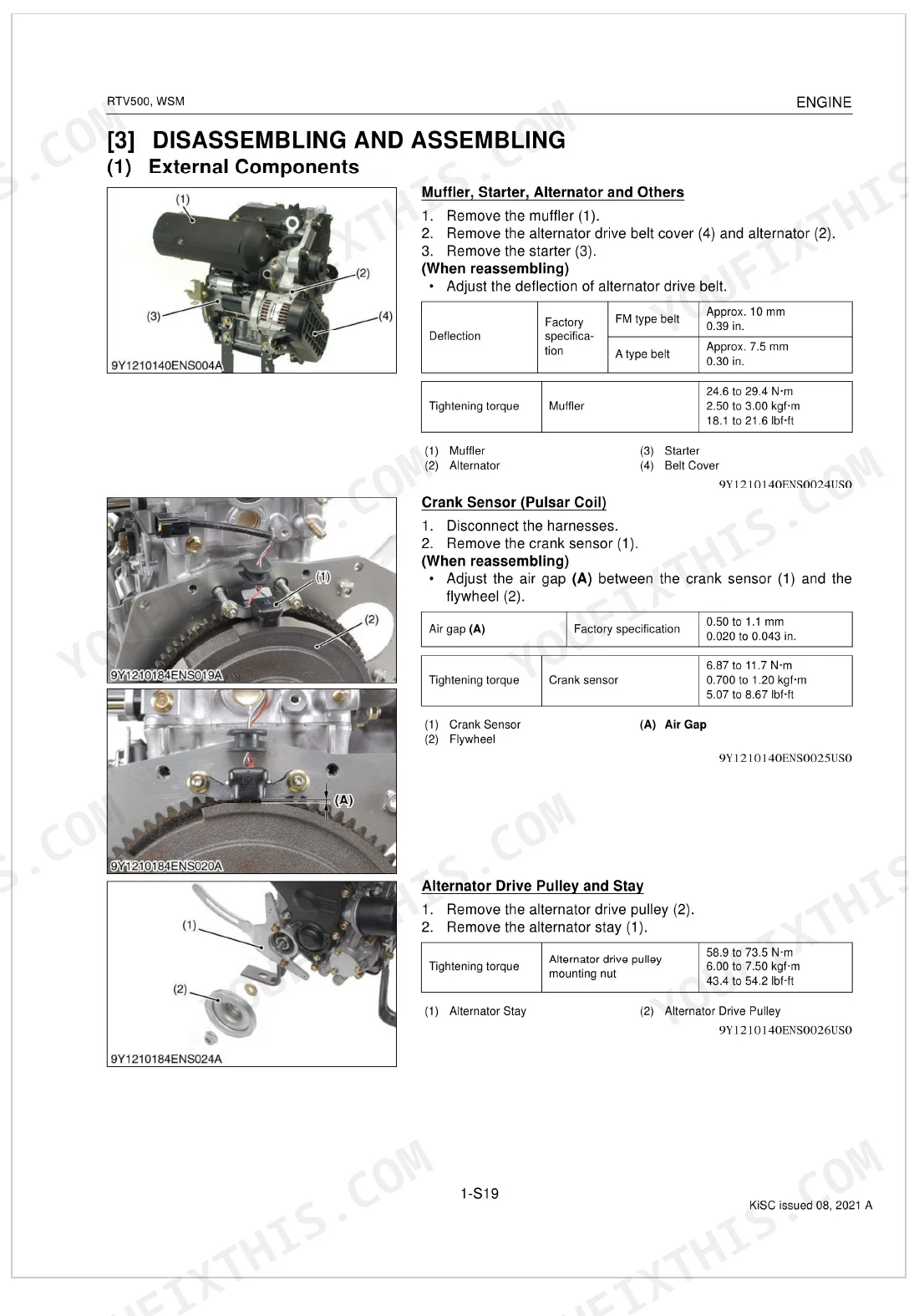
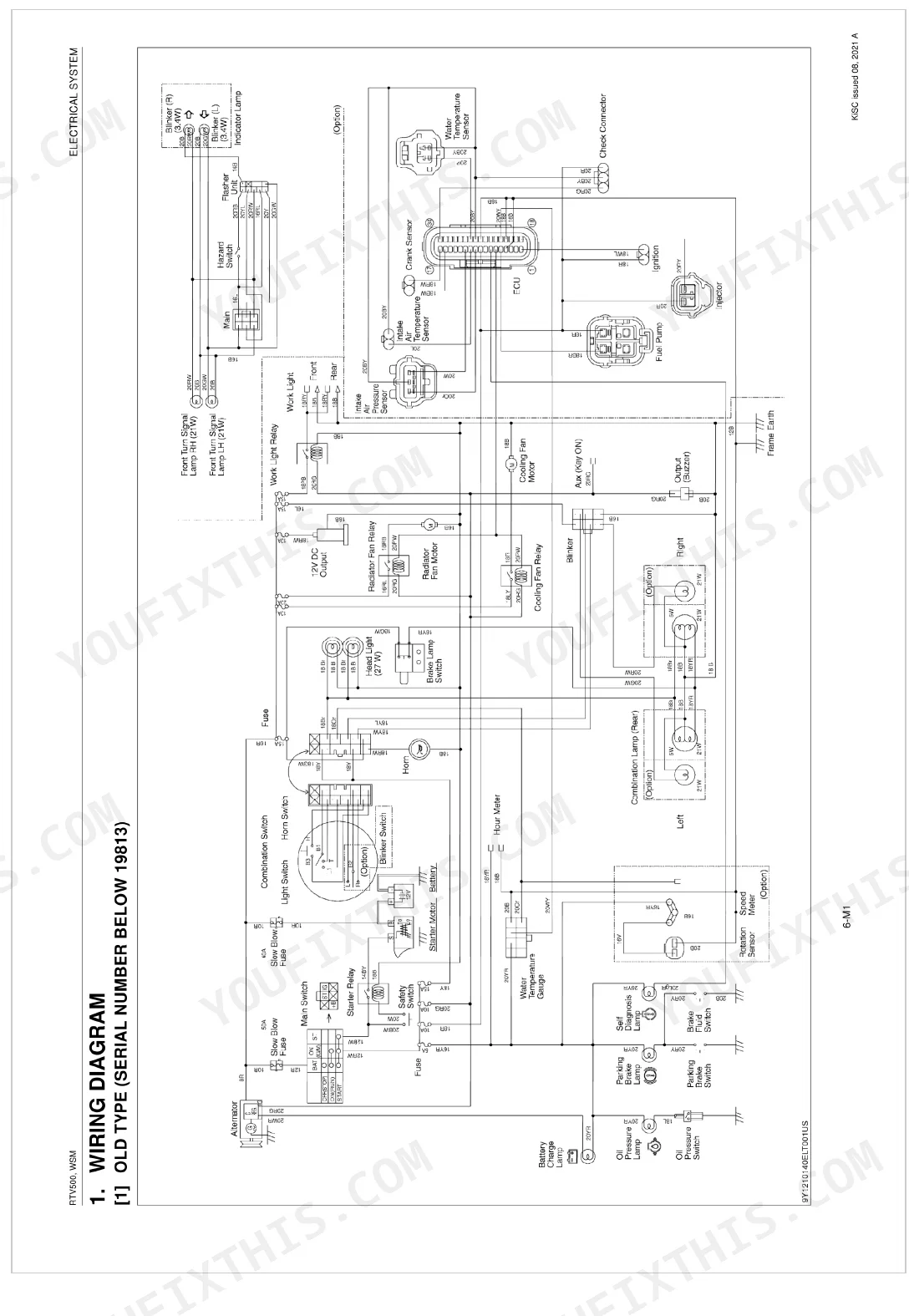
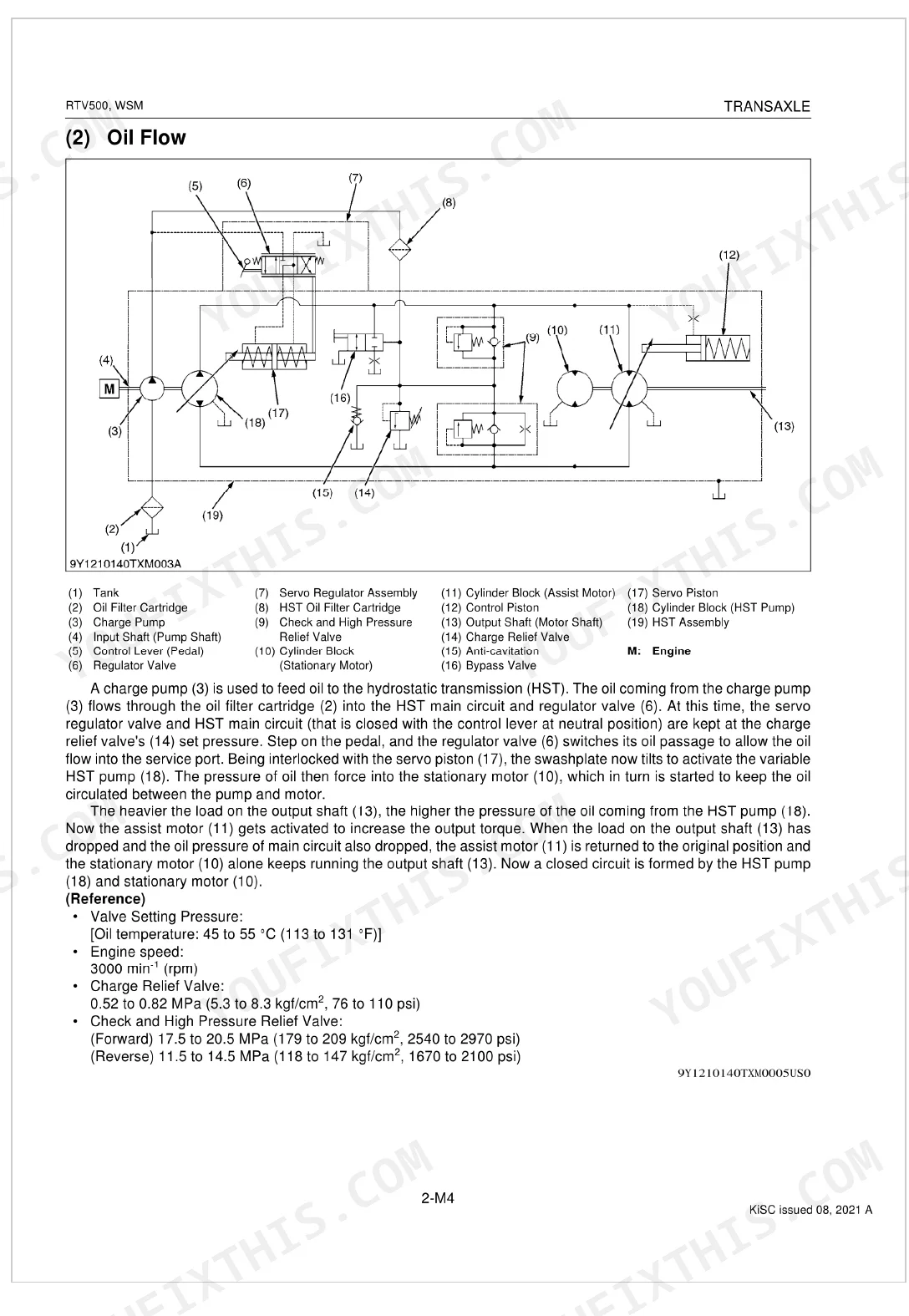
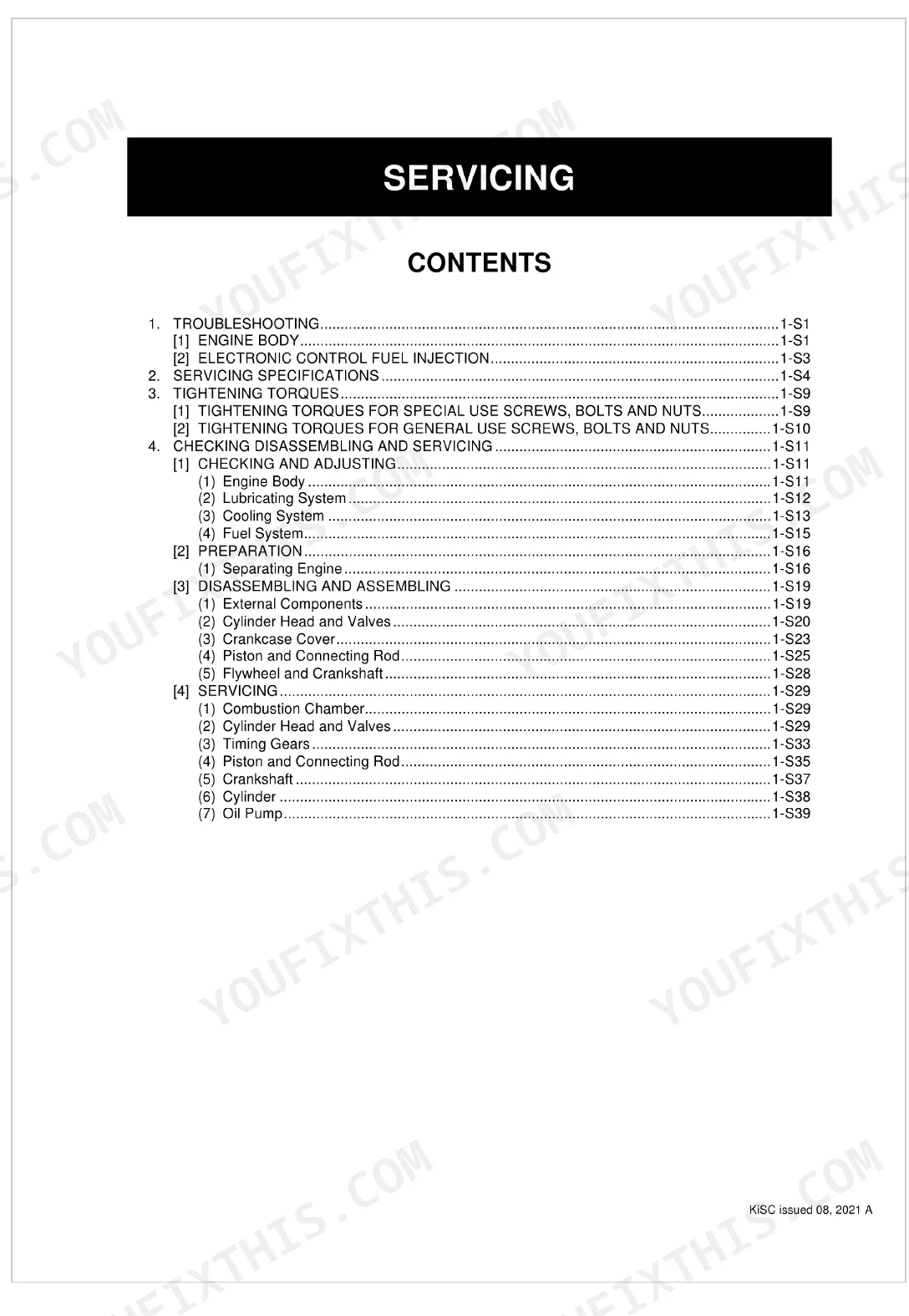
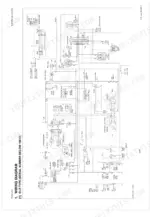
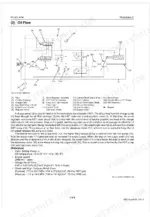
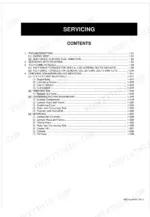
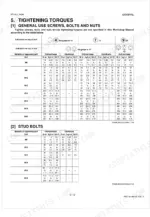
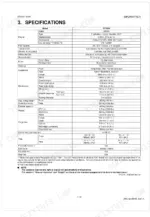
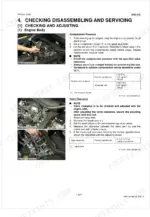
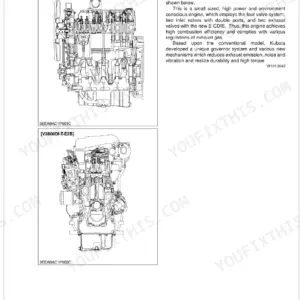
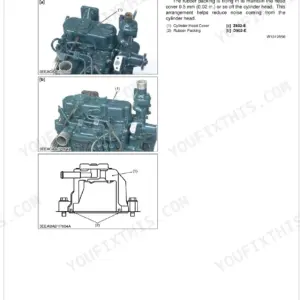
This is the factory Kubota RTV500 workshop manual PDF (OEM 9Y111-01409): 336 pages covering the utility vehicle from cylinder head teardown through HST transaxle rebuild to electrical diagnostics. It carries wiring diagrams for both serial variants (below 19813 and above 19814), hydraulic schematics tracing the full hydrostatic transmission circuit, and 100 pages of step-by-step disassembly and assembly. Troubleshooting charts span engine body faults, EFI diagnostics, and electrical failures, alongside maintenance schedules from the first 50-hour service out to 2,000 hours. The practical numbers are here too: the transaxle takes 8.5 L of fluid, and the rear wheel mounting screws torque to 108.4 to 121.9 N-m. Bookmarked by section and fully keyword-searchable, it pulls up on your phone right at the machine so you can stop guessing and start wrenching.
What's Inside This Kubota RTV500 Manual
| System | Pages | Key Topics |
|---|---|---|
| General | 21-85 | Product Identification (Engine Identification, Emission Label, Cylinder Number, Model Name and Serial Numbers, Wiring, Battery, Fuse, Connector, Handling of Circuit Tester, Color of Wiring) |
| Engine | 86-98 | Engine Body (Cylinder Head, Combustion Chamber, Camshaft, Crankcase, Piston and Piston Rings, Connecting Rod, Crankshaft, Balancer, Flywheel) |
| Engine Servicing | 99-138 | Troubleshooting (Engine Body, Electronic Control Fuel Injection), Servicing Specifications |
| Transaxle | 139-167 | Structure, Power Train (Hydrostatic Transmission, Linkage, Range Gear Shift Section, Front Wheel Drive Section, Rear Axle Section), Rear Suspension (Structure) |
| Transaxle Servicing | 168-209 | Troubleshooting, Servicing Specifications, Tightening Torques, Checking and Adjusting, Disassembling and Assembling (Preparation, HST Assembly, Transaxle Case), Servicing |
| Brakes | 210-217 | General Outline, Front Brake, Rear Brake, Master Cylinder, Brake Oil, Parking Brake |
| Brakes Servicing | 218-244 | Troubleshooting, Servicing Specifications, Tightening Torques, Checking and Adjusting (Brake Pedal, Brake Fluid, Brake Pad, Parking Brake Lever) |
| Front Axle | 245-248 | Structure Overview (Front: Axle, Suspension), Front Axle Component Description, Front Suspension Component Description (Function) |
| Front Axle Servicing | 249-269 | Troubleshooting, Servicing Specifications, Tightening Torques, Checking and Adjusting, Preparation, Front Suspension, Disassembling and Assembling, Servicing |
| Steering | 270-273 | Structure Overview (Steering Linkage, Manual Steering), Steering Linkage Description, Manual Steering Description |
| Steering Servicing | 274-279 | Troubleshooting, Tightening Torques, Disassembling and Servicing (Preparation, Disassembling and Assembling) |
| Electrical System | 280-301 | Wiring Diagram (Old Type, New Type), Starting System (Starter, Safety Switch), Alternator, IC Regulator |
| Electrical System Servicing | 302-336 | Troubleshooting, Charging System, Cooling System, Servicing Specifications, Tightening Torques, Checking, Disassembling and Adjusting, Main Switch |
Quick Reference Specifications
| Specification | Value | Page |
|---|---|---|
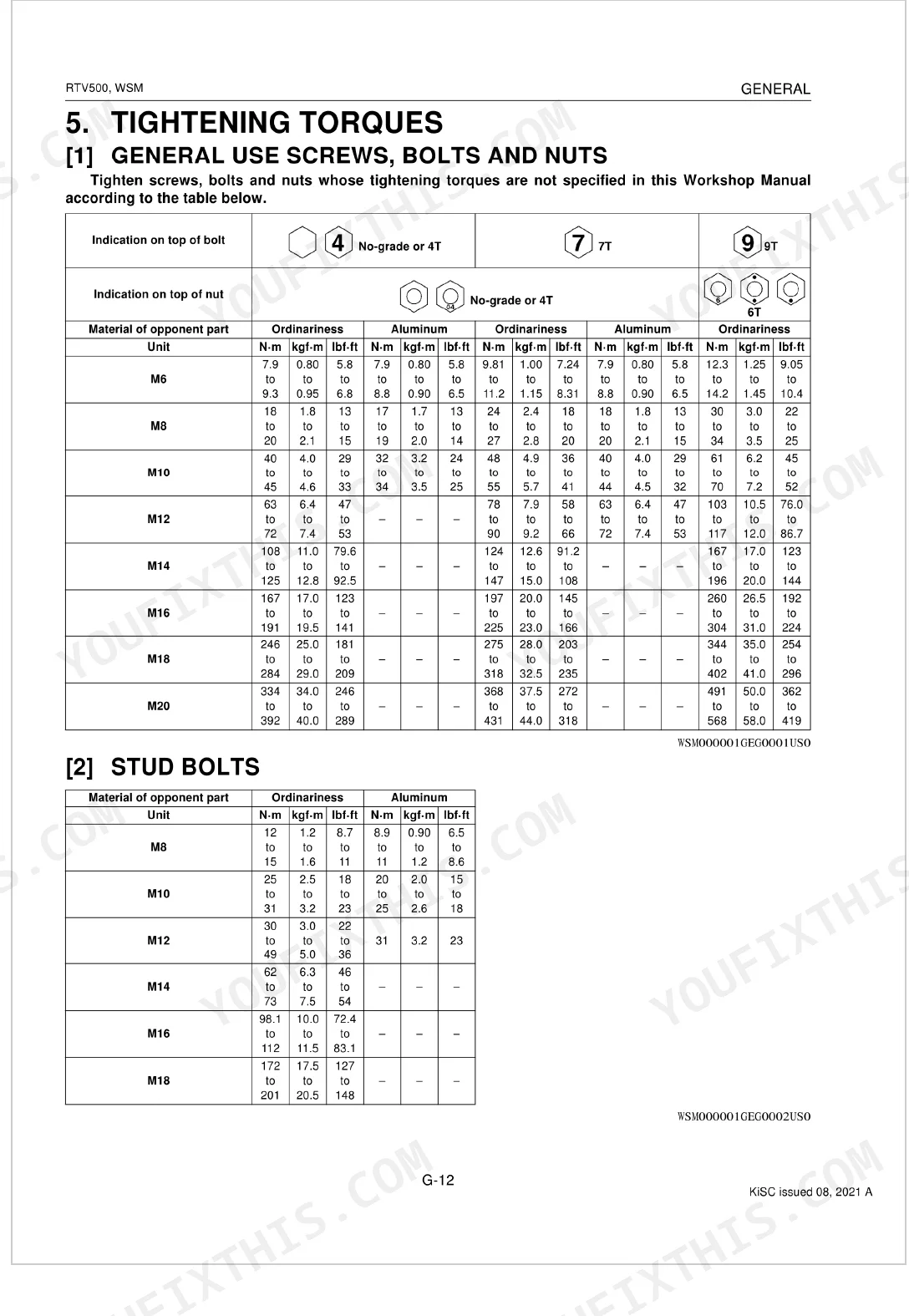
| Lock nut torque | 39 to 45 N-m | p. 35 |
| Rear wheel mounting screw torque | 108.4 to 121.9 N-m | p. 35 |
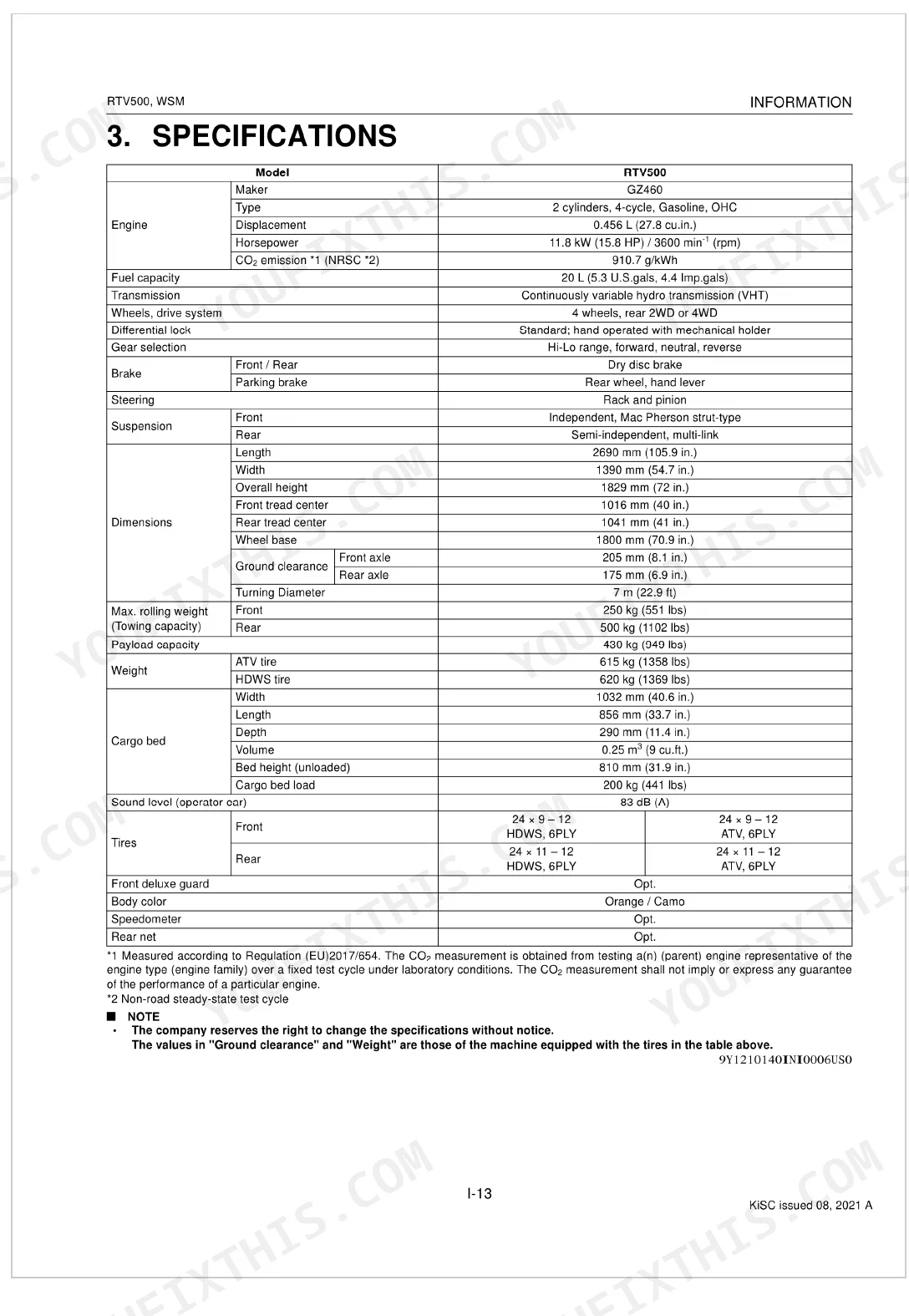
| Engine Oil Capacity (Filter Exchanged) | 1.35 L | p. 33 |
| Transmission Fluid Capacity | 8.5 L | p. 33 |
| Coolant Capacity (with recovery tank) | 1.8 L | p. 33 |
| Engine Oil Pressure (At Idle Speed) | More than 98 kPa | p. 106 |
| Engine Oil Pressure (At Rated Speed) | 200 to 390 kPa | p. 106 |
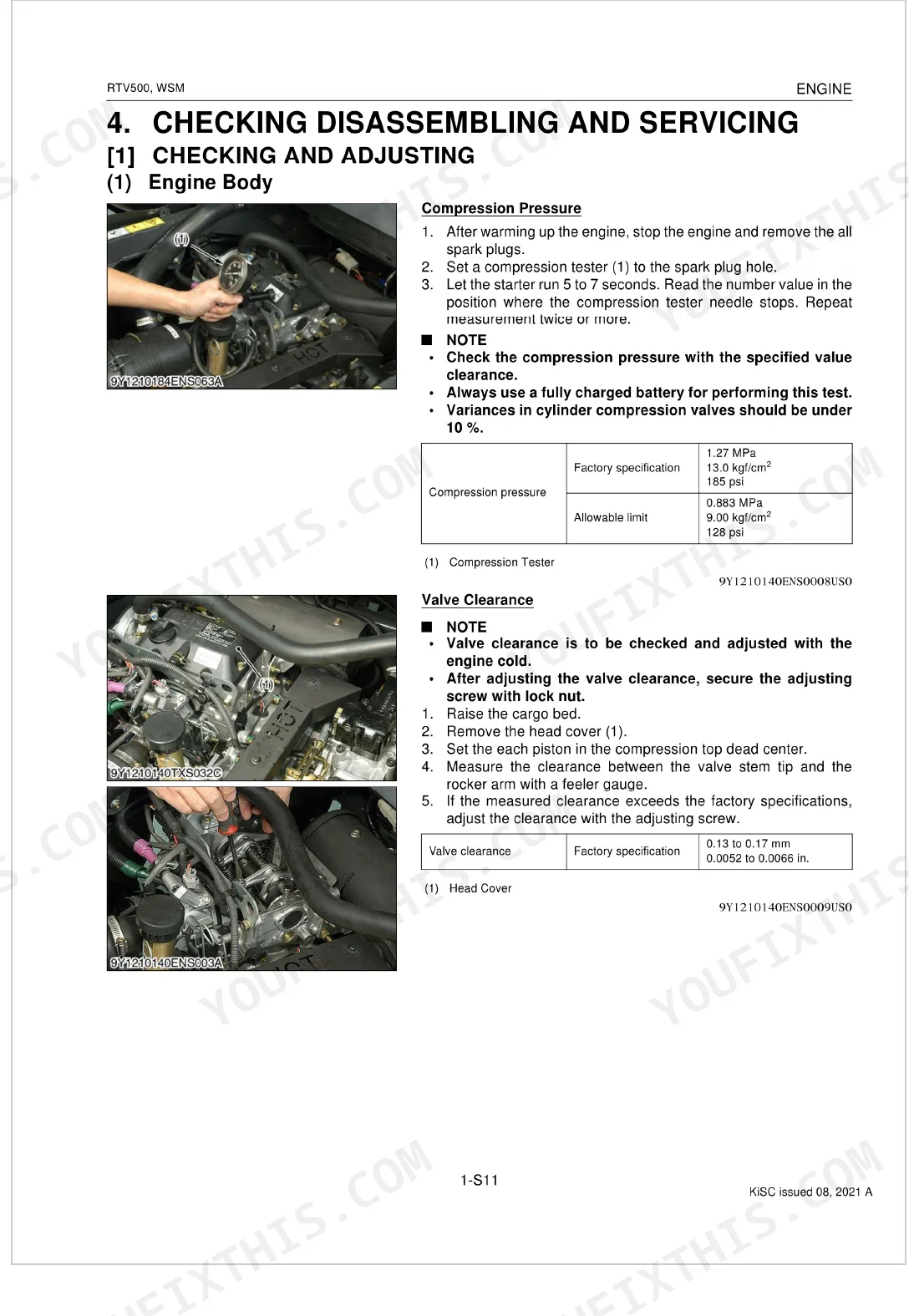
| Valve Clearance (Cold) | 0.13 to 0.17 mm | p. 103 |
| Brake Pedal Free Travel | 7 to 14 mm | p. 223 |
| Brake Pad Thickness (Front) | 3.94 mm | p. 221 |
| Brake Disc Thickness (Front) | 5.3 to 5.7 mm | p. 221 |
| Parking Brake Lever Free Play | 1 notch | p. 221 |
Kubota RTV500 Common Problems This Manual Covers
Kubota RTV500 engine overheating, temperature gauge climbing into red zone at normal load p. 99
Check coolant level; the system holds 1.8 L including the recovery tank (page 33). Inspect the radiator fins for mud or debris and clean with compressed air. Verify the electric cooling fan spins up when the engine reaches operating temperature. Replace coolant every 2 years per the maintenance schedule on page 39.
Manual Section: Engine Body TroubleshootingHST transmission won't move machine in either direction, pedal has no response p. 168
Confirm the transmission fluid level; capacity is 8.5 L (page 33). Inspect the HST linkage rods for bends or disconnected joints. Check that the fluid isn't milky or burnt smelling. Trace the flow paths against the hydraulic schematic on page 144. Change the fluid every 400 hours per page 39 if you find contamination.
Manual Section: Transaxle Hydrostatic Transmission TroubleshootingEngine won't start or cranks slowly in cold weather, no codes showing p. 303
Verify battery terminals are clean and tight. Check valve clearance with the engine cold: spec is 0.13 to 0.17 mm (page 103). Inspect fuel quality and confirm the tank has adequate supply. Run through the Electronic Control Fuel Injection cold-start diagnostics on page 303 to pinpoint a sensor or injector fault before condemning the starter.
Manual Section: Electronic Control Fuel Injection TroubleshootingBrake pedal goes to the floor or feels spongy, stopping distance noticeably longer p. 218
Measure brake pedal free travel: spec is 7 to 14 mm (page 223). If travel is correct but pedal feels soft, bleed the hydraulic circuit starting at the wheel farthest from the master cylinder. Inspect front pad thickness; minimum is 3.94 mm (page 221). Replace brake fluid every 1,000 hours per page 40.
Manual Section: Brakes TroubleshootingOil pressure warning light stays on at idle, oil level looks correct on dipstick p. 99
Top up the oil immediately after checking the level; capacity with a filter change is 1.35 L (page 33). Connect a mechanical gauge to confirm readings: idle pressure must exceed 98 kPa and rated-speed pressure should read 200 to 390 kPa (page 106). If pressure stays low with the level correct, inspect the oil pump and relief valve per page 99.
Manual Section: Engine Body TroubleshootingFrequently Asked Questions
What are the recommended service intervals?
Greasing, the engine start system, and the VHT neutral spring all get attention every 50 hours. Engine oil is checked at that same 50-hour mark and replaced at 200 hours; transmission oil is replaced every 400 hours. Inspect the radiator hose and clamp once a year.
What fluids and capacities does this machine require?
Fuel is 20 L (5.3 U.S.gals) of unleaded gasoline, 87 octane or higher. The engine crankcase holds 1.6 L (1.7 U.S.qts) with a filter change, using KUBOTA Engine oil API Service Classification SG, SH, SJ or higher. The transmission case takes 8.5 L (2.2 U.S.gals) of KUBOTA UDT or SUPER UDT-2 fluid, and the brake system needs 0.21 L (0.22 U.S.qts) of KUBOTA DOT3 GENUINE BRAKE FLUID.
How to troubleshoot engine won't start?
Start with the battery: low capacity is the usual culprit, so charge or replace it (G-30). Other causes include faulty wiring (G-28), a damaged main switch (6-S10), or a blown 10 A fuse (G-30). Also confirm there's gasoline in the tank (G-33) and rule out a defective ECU (6-S20).
What are the hydraulic system specifications?
The Check and High Pressure Relief Valve has a forward setting pressure of 17.5 to 20.5 MPa (2540 to 2970 psi), measured at an engine speed of 3000 min⁻¹ and oil temperature of 45 to 55 °C. Under the same conditions, the Charge Relief Valve is set to 0.52 to 0.82 MPa (76 to 110 psi). A hose size 06 fitting torques to 45.2 to 52.9 N-m (33.3 to 39.0 lbf-ft).
How quickly can I access this Kubota RTV500 manual after buying?
A 336-page Workshop Manual in searchable PDF format, available the moment you finish checkout. Open it on a computer, tablet, or phone with no shipping wait.
Is this Kubota RTV500 Workshop Manual printable?
Yes. Print as many copies as you like, with no restrictions. Plenty of mechanics print just the section they need and carry it to the shop floor.
Are there wiring harness diagrams in this Kubota RTV500 manual?
Yes, this Kubota RTV500 Workshop Manual includes complete electrical wiring diagrams, wire routing, and connector pinouts.
Document Quality
This document is a scanned PDF with an OCR layer, so you can search and copy the full text. The main body text is crisp and easy to read. Diagrams and illustrations are primarily raster images, which may show some pixelation when zoomed in, but their labels remain readable. Pages are clean with no significant scan artifacts, stains, or skewed content. A few blank pages are included as section dividers.


Reviews
There are no reviews yet.