
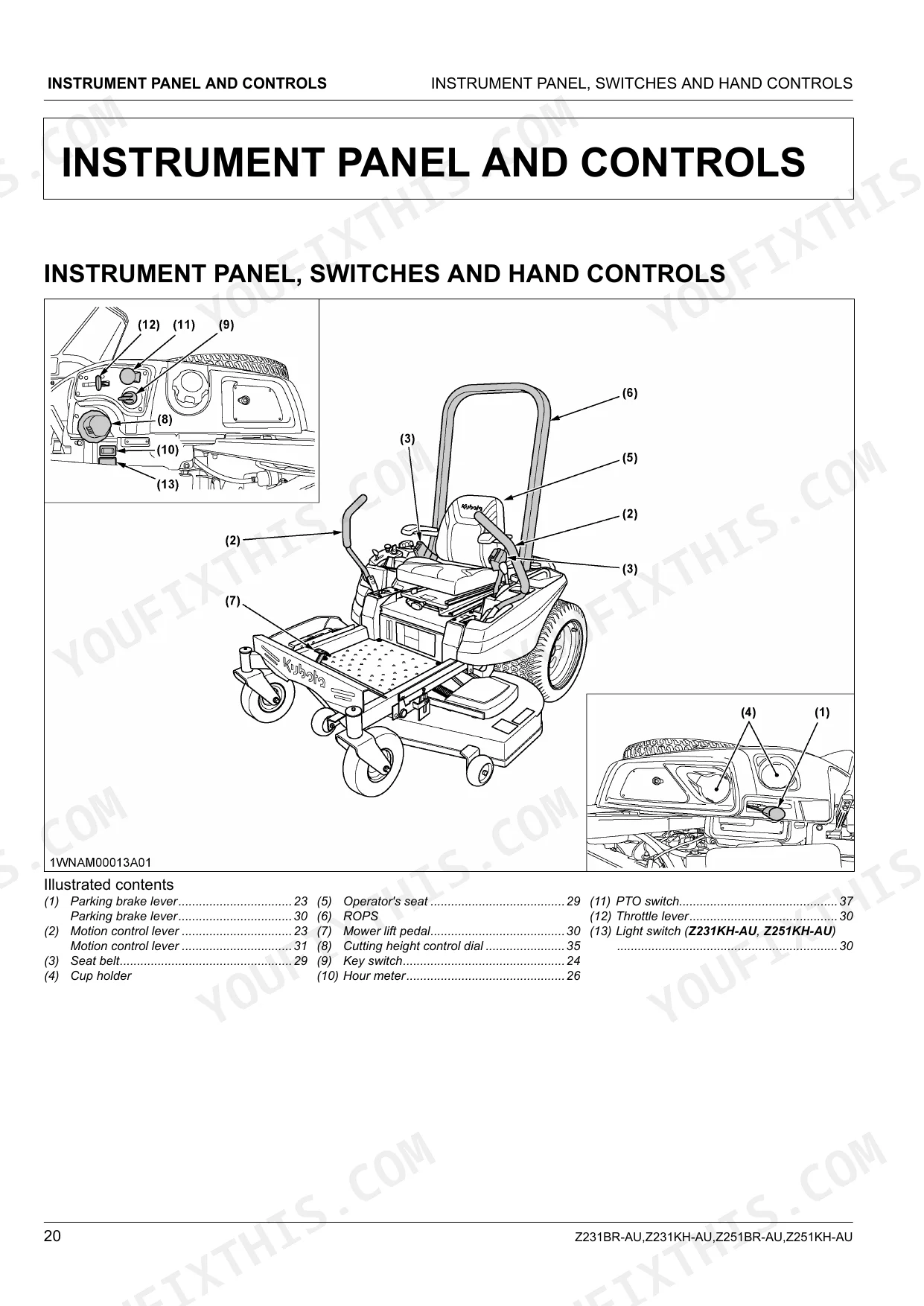
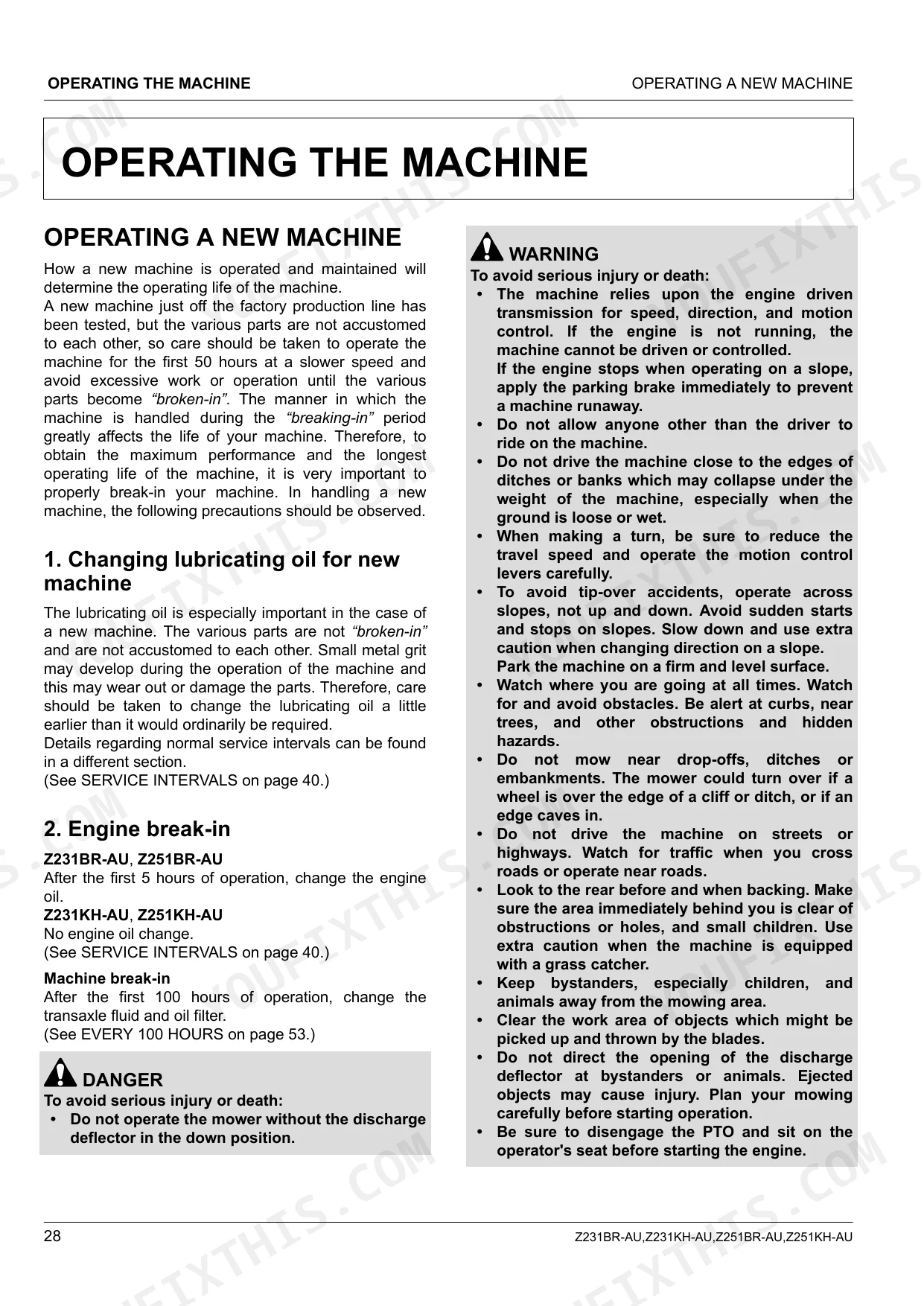
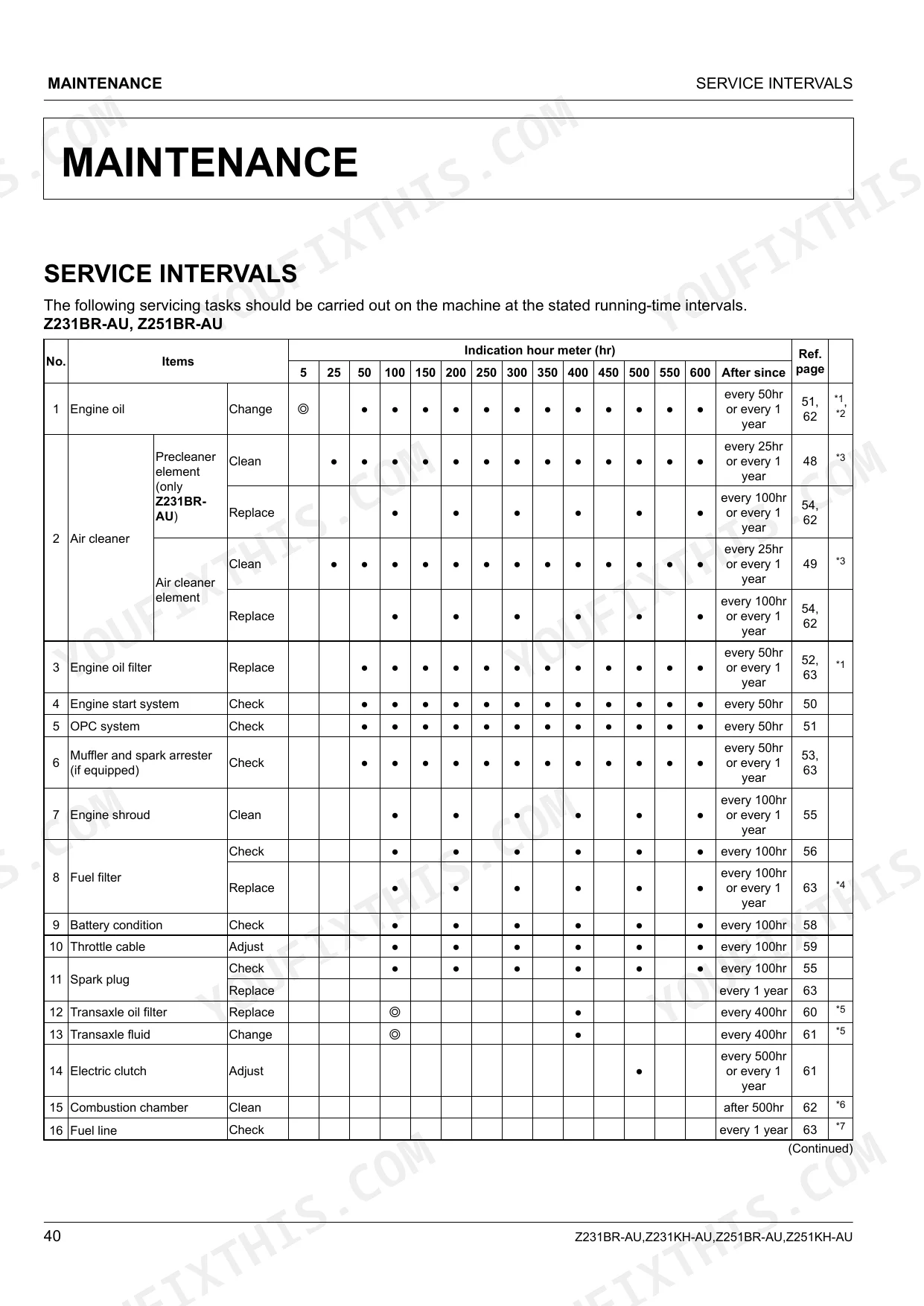
Built for all four variants: Z231BR-AU, Z231KH-AU, Z251BR-AU, and Z251KH-AU, this 89-page operator manual (OEM #K3014-7127-1) is the factory reference from first startup through end-of-season storage. The opening 10 pages cover safe operation: ROPS deployment, slope limits, and guidance written specifically for operators 60 and older. From there it moves into a full instrument panel walkthrough with every switch and control labeled, a towing and implement weight table, and 27 pages of scheduled service mapped to the 25-, 50-, 100-, 400-, and 500-hour marks. Capacities are spelled out before the season starts: 16.3 L in the fuel tank, 1.8 L in the crankcase, and 4.8 L across both transaxles. Every section is bookmarked, so pulling up an answer on your phone takes under a minute.
What's Inside This Kubota Z231–Z251 Series Operator Manual
| System | Pages | Key Topics |
|---|---|---|
| Safe Operation | 8-17 | General, Before Operating the Machine, ROPS, Safety for Children, Operators, Age 60 Years and Older, Operating on Slopes, Stopping the Machine |
| Servicing of Machine | 18-19 | Date Of Purchase, Name Of Dealer, To Be Filled In By Purchaser, Machine Identification Plate, Product Identification Number, Engine Serial Number, ROPS Serial Number |
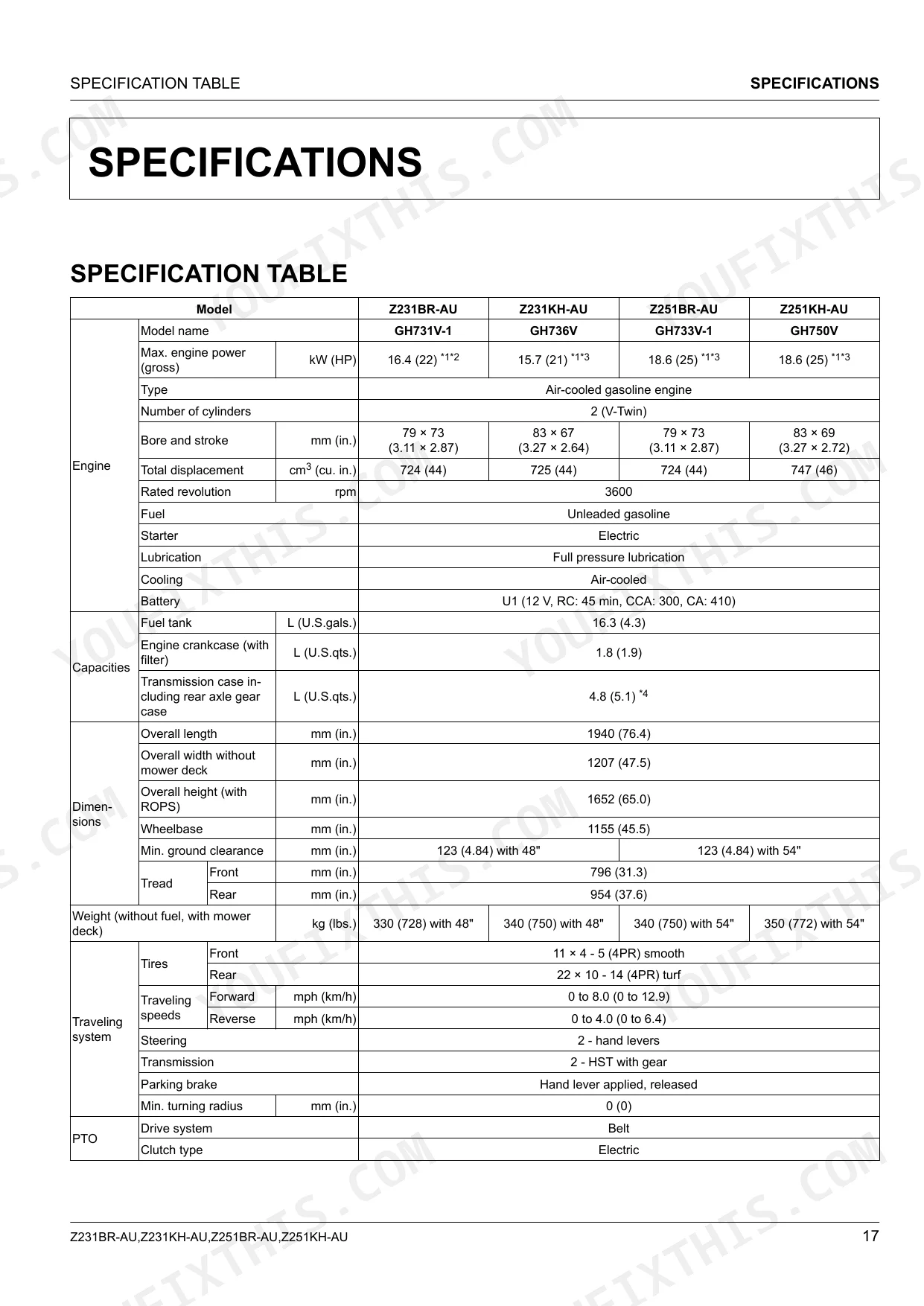
| Specifications | 20-21 | Specification Table (Model, Engine, Capacities, Dimensions, Weight, Tires, Traveling Speeds, Traveling System, PTO) |
| Implement Limitations | 22 | Terms of Use, Weight Limit Table, Maximum Loading Weight, Maximum Total Weight, Tongue Weight W1, Towing Capacity W2 |
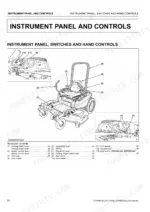
| Instrument Panel and Controls | 23-24 | Instrument Panel, Switches and Hand Controls |
| Mower Mounting | 25 | Mounting the Mower Deck, Mower, Dismounting the Mower Deck |
| Operating the Engine | 26-30 | Getting On and Off the Machine Safely, Starting the Engine |
| Operating the Machine | 31-37 | Operating a New Machine (Changing Lubricating Oil for New Machine, Engine Break-In) |
| Operating the Mower | 38-40 | Mowing Tips, Cutting Height |
| Tires and Wheels | 41-42 | Tires, Inflation Pressure (Tire Sizes, Recommended Inflation Pressure), Wheels, Removing The Front Caster Wheels |
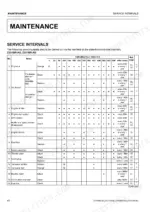
| Maintenance | 43-46 | Service Intervals, Z231Br-Au |
| Periodic Service | 47-69 | Raising and Lowering the Operator's Seat, Daily Check (Fuel Line, Hydraulic Hose, Engine Valve Clearance, Fuse, Blade, Mower Belt) |
| Adjustment | 70-76 | Motion Control Lever (HST Neutral, Maximum Speed, Alignment, Checking the Alignment, Aligning the Motion Control Levers) |
| Storage | 77 | Storing the Machine, Repair Parts As Necessary, Check Bolts And Nuts And Tighten As Necessary, Apply Grease Or Engine Oil To Parts Most Likely To Rust |
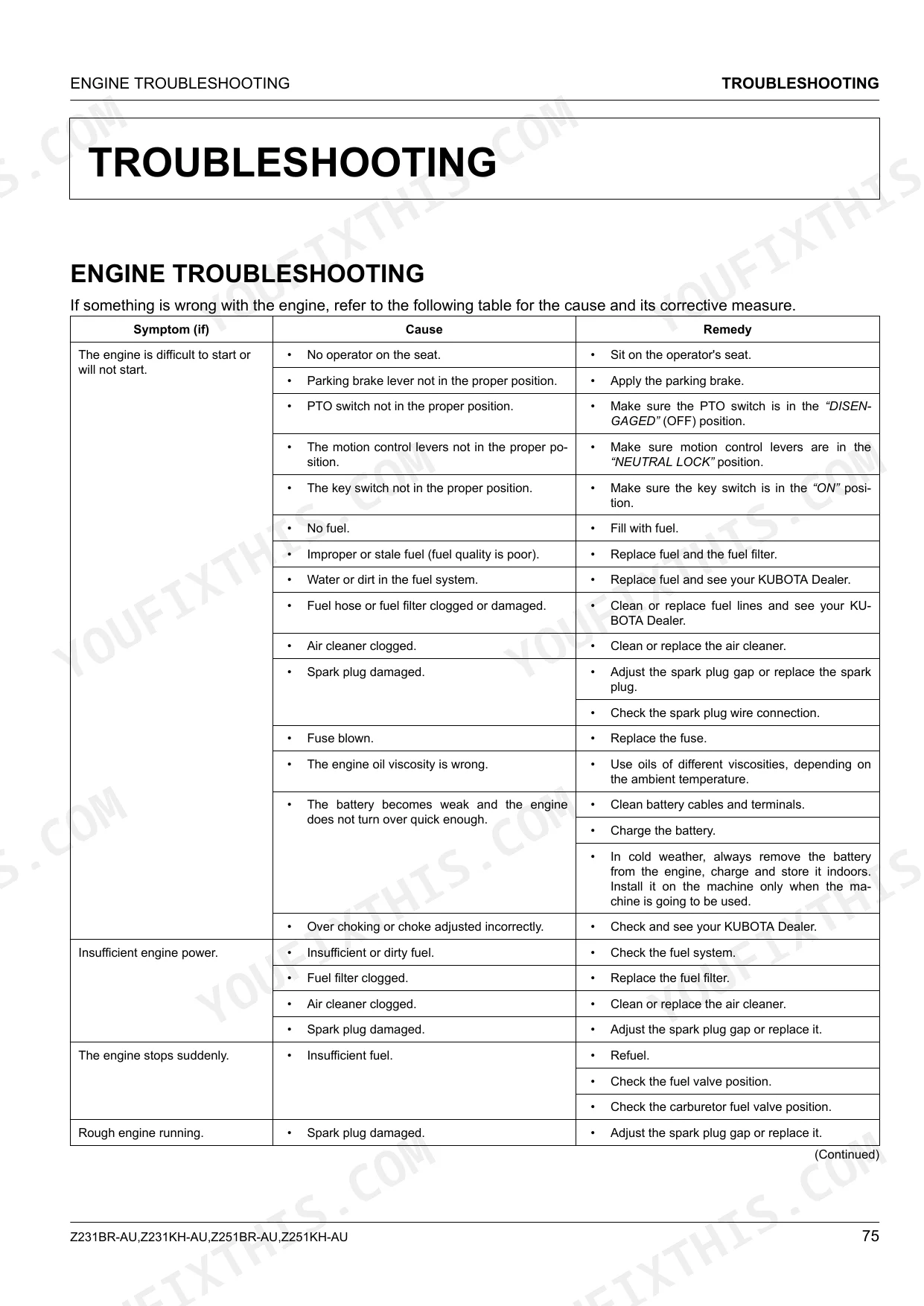
| Troubleshooting | 78-82 | Engine Troubleshooting, Battery Troubleshooting, Machine Troubleshooting |
Quick Reference Specifications
| Specification | Value | Page |
|---|---|---|
| Rear wheel bolt tightening torque | 108.5 to 130.2 N·m (80 to 96 lbf·ft 11.1 to 13.3 kgf·m) | p. 41 |
| Front caster wheel nut tightening torque | 48 to 56 N·m (36 to 41 lbf·ft 4.9 to 5.7 kgf·m) | p. 42 |
| Fuel tank capacity | 16.3 L | p. 20 |
| Engine crankcase oil capacity (with filter) | 1.8 L | p. 20 |
| Transmission case oil capacity (including rear axle gear case) | 4.8 L | p. 20 |
| Front tire inflation pressure | 170 kPa | p. 41 |
| Rear tire inflation pressure | 110 kPa | p. 41 |
| Electric clutch air gap | 0.4 mm | p. 65 |
| Blade bolt tightening torque | 103 to 118 N·m | p. 68 |
| Motion control lever alignment gap | 0 to 2 mm | p. 71 |
| Mower deck side-to-side level difference | Less than 3 mm | p. 72 |
| Mower deck front-to-rear level difference | Less than 6 mm | p. 73 |
Kubota Z231–Z251 Series Common Problems This Manual Covers
Kubota Z231BR-AU engine cranks but won't start, no fuel reaching carburetor p. 78
Open the fuel shutoff valve and confirm the tank has fuel; capacity is 16.3 L. Inspect the fuel filter for blockage and replace it every 100 hours or annually. The seat safety switch also has to be engaged: you must be seated with the motion control levers in neutral before the engine will fire. The starting sequence is on page 26.
Manual Section: Engine TroubleshootingMachine won't move forward or reverse after engine starts normally p. 80
Move both motion control levers out of the locked park position and make sure the brake is fully released. The troubleshooting chart on page 80 covers the 'machine not moving' condition. Confirm the transmission case oil level is correct: total capacity is 4.8 L including the rear axle gear case. A machine that drifts on its own usually means the HST neutral adjustment on page 70 is out of spec.
Manual Section: Machine TroubleshootingMower blades not rotating after engaging the PTO switch p. 81
Run the engine at full throttle before engaging the blade switch. Measure the electric clutch air gap on page 65; the spec is 0.4 mm, and a worn gap stops full engagement. Inspect the mower belt for breakage or slipping, since a glazed or cracked belt won't transfer power even when the clutch energizes. The mower troubleshooting table is on page 81.
Manual Section: Mower TroubleshootingUneven cut with streaking or missed strips of grass across the lawn p. 81
Park on a flat surface and check the mower deck side-to-side level: the difference must be less than 3 mm per the spec on page 72. Front-to-rear slope should stay under 6 mm (page 73). Inspect each blade for nicks, bends, or dullness, since a blade dull on one end alone will streak. Match ground speed to the grass height and slow down in thick growth.
Manual Section: Mower TroubleshootingEngine overheating warning, temperature climbing during normal mowing operation p. 78
Stop mowing right away and let the engine idle for 2 minutes before shutdown; never cut power abruptly when it's hot. Check the engine oil level, since capacity with filter is 1.8 L and low oil kills cooling fast. Clear grass clippings packed around the cooling fins and air intake screen. The precleaner element should be clean too, so inspect it every 25 hours. Engine troubleshooting is on page 78.
Manual Section: Engine TroubleshootingBattery dead or starter motor turns over slowly on first use of the day p. 80
Check the battery terminal connections for corrosion, then clean with a wire brush and retighten. The battery is 12V nominal (page 15); read resting voltage with a multimeter. Below 12.4V after an overnight rest means it needs a full charge before use. The battery troubleshooting table on page 80 covers weak-battery and electrolyte level checks. During long off-season periods, store the machine with the battery on a maintainer.
Manual Section: Battery TroubleshootingFrequently Asked Questions
What are the recommended service intervals?
A service interval table lays it out. Engine oil gets changed every 50 hours or once a year, and the air cleaner element is cleaned every 25 hours or annually. The transaxle oil filter needs replacing every 400 hours, and spark plugs every 1 year.
What fluids and capacities does this machine require?
The machine's fuel tank has a capacity of 16.3 L (4.3 U.S. gals.) and requires unleaded gasoline with a minimum of 87 octane/87AKI. The engine crankcase holds 1.8 L (1.9 U.S.qts.) of API service Classification SG, SH, SJ or higher engine oil. The transmission case, including the rear axle gear case, requires 4.8 L (5.1 U.S.qts.) of API service Classification SL SAE20W-50 engine oil.
How to troubleshoot engine won't start?
When the engine is hard to start or won't start, confirm the operator is on the seat, the parking brake is applied, and the PTO switch sits in the "DISENGAGED" (OFF) position. Also check for empty, stale, or wrong fuel and a clogged air cleaner. Fixes include filling with fuel, replacing fuel and filter, or cleaning the air cleaner, as detailed on page 78.
What are the hydraulic system specifications?
Transmission is listed as 2-HST with gear. The transmission case, including the rear axle gear case, holds 4.8 L (5.1 U.S.qts.) and takes API service Classification SL SAE20W-50 engine oil. The manual gives no further hydraulic specs such as pressure or flow rates.
What torque specifications are listed?
General torque values are given for both American standard cap screws (GR.5, GR.8) and Metric cap screws (Class 8.8, Class 10.9). An M8 Class 8.8 bolt, for example, tightens to 23.6-27.4 N·m (17.4-20.2 lbf·ft). The full tightening torque chart on pages 75 and 76 lists values for various thread sizes and bolt head sizes.
How quickly can I access this Kubota Z231–Z251 Series manual after buying?
An 89-page operator manual in searchable PDF format, ready the moment you complete checkout. View it on a computer, tablet, or phone, with no shipping wait.
Am I able to print pages from this Kubota Z231–Z251 Series manual?
Yes, print as many copies as you want; there are no restrictions. Plenty of mechanics print just the section they need and take it to the shop floor.
Document Quality
This document is a scanned PDF, but it includes an OCR layer, so you can search and copy the full text content. The text quality is clear and readable throughout the manual, and the diagrams are raster images with legible labels. All pages are clean, without any scan artifacts or marks, though there is one blank page (page 7) included. Additionally, the last few pages are high-quality marketing materials with crisp text and sharp photographs.


Reviews
There are no reviews yet.