
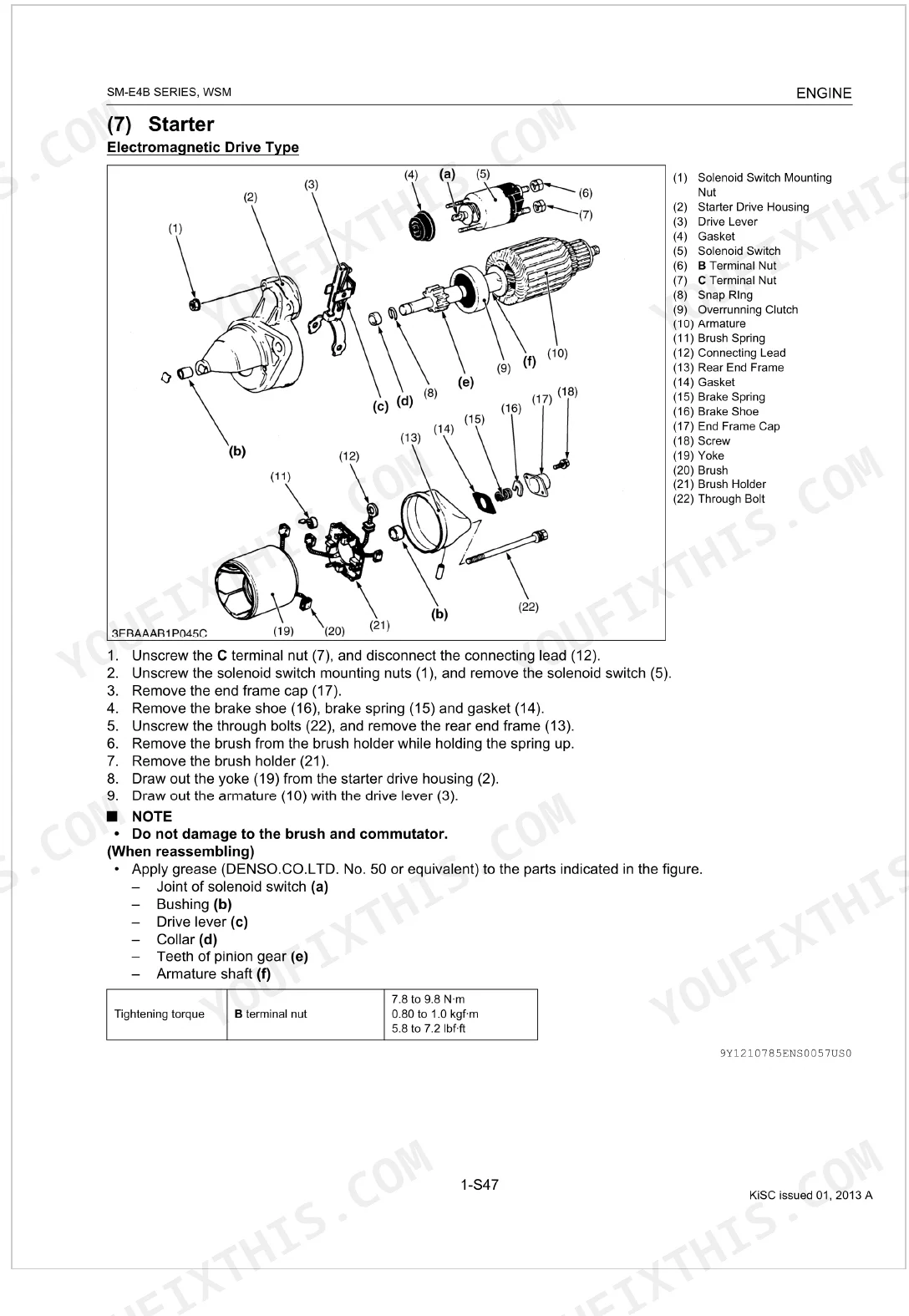
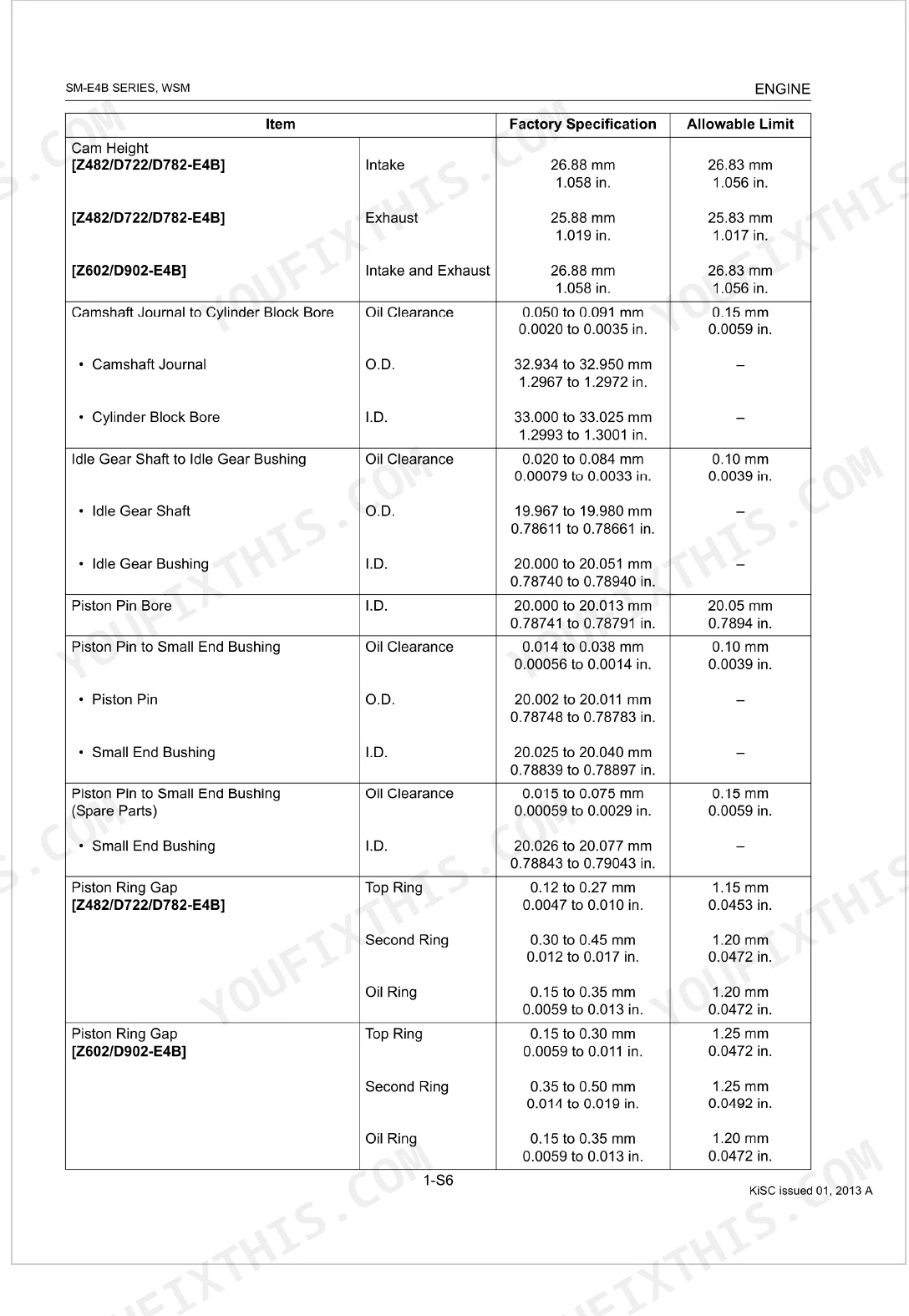
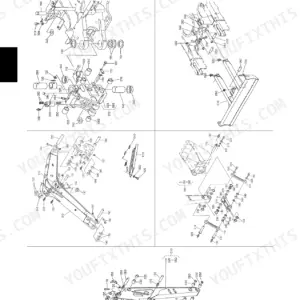
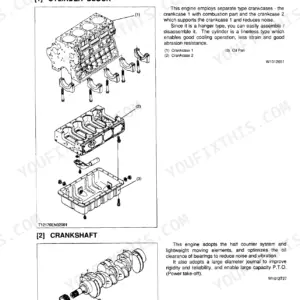
Kubota's factory WSM (OEM #9Y111-07850) for the SM-E4B diesel series: Z482-E4B, Z602-E4B, D722-E4B, D782-E4B, and D902-E4B. Across 138 pages it lays out a maintenance program from daily checks through 3000-hour intervals, troubleshooting charts, clearance and test-value tables, servicing specifications, tightening torque references for general and special fasteners, and exploded views of the engine body, pistons, and cooling fins. The mechanism section breaks down the half-floating head cover, closed breather, and oil pan setups specific to each variant. Torque the M12 x 1.25 drain plug to 33-37 N-m; a D902-E4B oil pan holds 3.7L at the 101 mm depth. Stop digging through forum threads for a number that should take 30 seconds to find. Everything's bookmarked by section, so you can open it on your phone, search a keyword, and get back to the machine.
What's Inside This Kubota Z482-E4B & variants Manual
| System | Pages | Key Topics |
|---|---|---|
| Workshop Manual | 1-2 | Wsm, Diesel Engine, SM-E4B Series, Kubota |
| Information | 3-19 | Safety First, Specifications, Performance Curves, Dimensions |
| General | 20-58 | Engine Identification (Model Name and Engine Serial Number, Cylinder Number), Maintenance Check List |
| Mechanism | 59-63 | Engine, Contents, Engine Body (Half-Floating Head Cover, Closed Breather, Piston, Oil Pan), Cooling System (Cooling Fin) |
| Servicing | 64-138 | Troubleshooting, Servicing Specifications, Tightening Torques (General Use Screws, Bolts and Nuts, Special Use Screws, Bolts and Nuts), Checking |
Quick Reference Specifications
| Specification | Value | Page |
|---|---|---|
| Z482-E4B | ||
| Engine oil capacity (Oil Pan Depth 101 mm / 3.98 in.) | 2.1 L (0.55 U.S.gals) | p. 30 |
| Engine oil capacity (Oil Pan Depth 121 mm / 4.76 in.) | 2.5 L (0.66 U.S.gals) | p. 30 |
| D722-E4B | ||
| Engine oil capacity (Oil Pan Depth 101 mm / 3.98 in.) | 3.2 L (0.85 U.S.gals) | p. 30 |
| Engine oil capacity (Oil Pan Depth 121 mm / 4.76 in.) | 3.8 L (1.0 U.S.gals) | p. 30 |
| All Models | ||
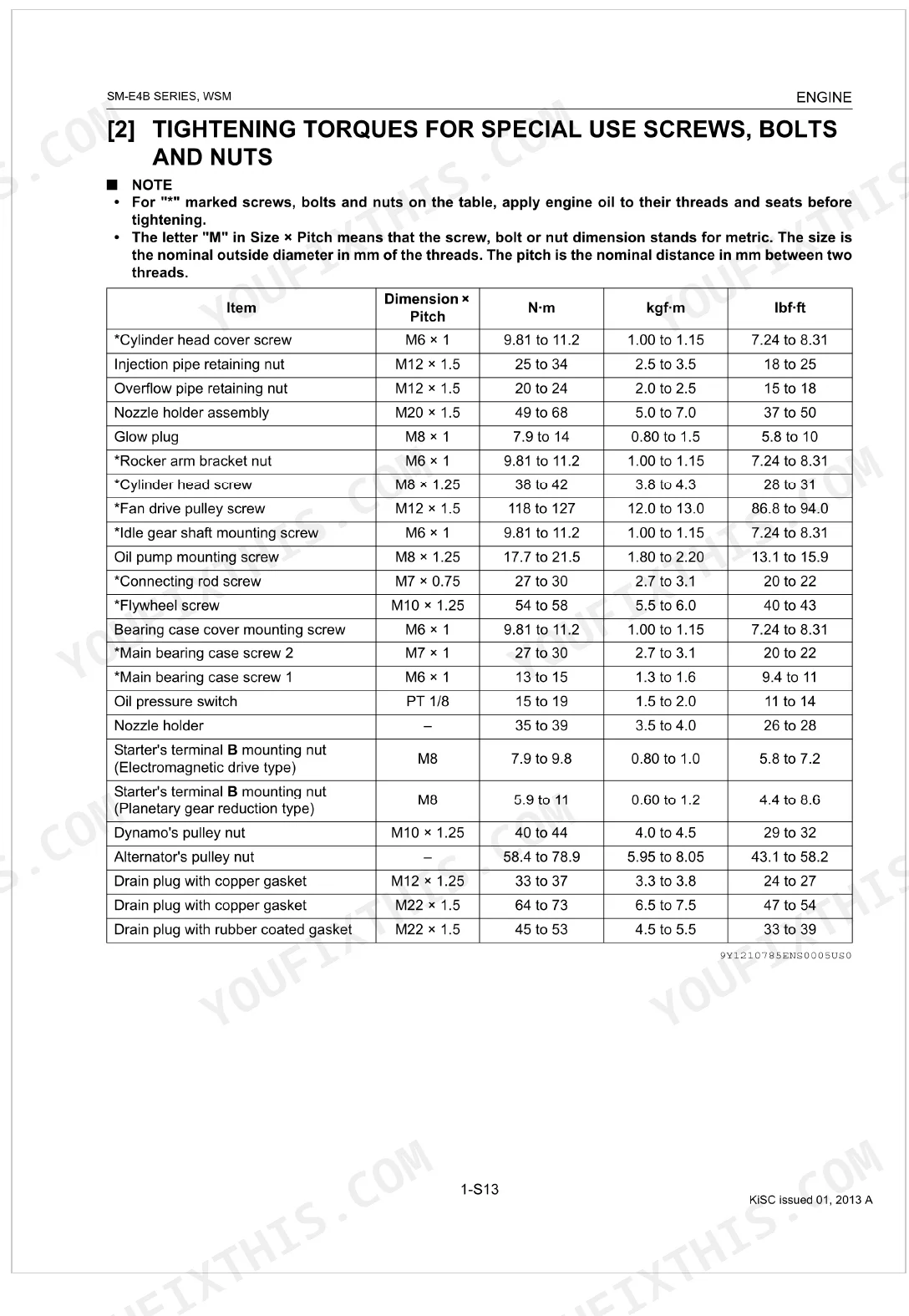
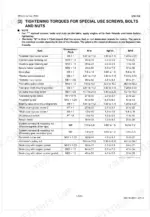
| Drain plug with copper gasket (M12 x 1.25) tightening torque | 33 to 37 N-m / 3.3 to 3.8 kgf·m / 24 to 27 lbf·ft | p. 77 |
| Drain plug with copper gasket (M22 x 1.5) tightening torque | 64 to 73 N-m / 6.5 to 7.5 kgf·m / 47 to 54 lbf·ft | p. 77 |
| Drain plug with rubber coated gasket (M22 x 1.5) tightening torque | 45 to 53 N-m / 4.5 to 5.5 kgf·m / 33 to 39 lbf·ft | p. 77 |
| Cylinder head cover screw tightening torque | 9.81 to 11.2 N-m / 1.00 to 1.15 kgf·m / 7.24 to 8.31 lbf·ft | p. 77 |
| Injection pipe retaining nut tightening torque | 25 to 34 N-m / 2.5 to 3.5 kgf·m / 18 to 25 lbf·ft | p. 77 |
| Overflow pipe retaining nut tightening torque | 20 to 24 N-m / 2.0 to 2.5 kgf·m / 15 to 18 lbf·ft | p. 77 |
| Nozzle holder assembly tightening torque | 49 to 68 N-m / 5.0 to 7.0 kgf·m / 37 to 50 lbf·ft | p. 77 |
| Glow plug tightening torque | 7.9 to 14 N-m / 0.80 to 1.5 kgf·m / 5.8 to 10 lbf·ft | p. 77 |
Kubota Z482-E4B & variants Common Problems This Manual Covers
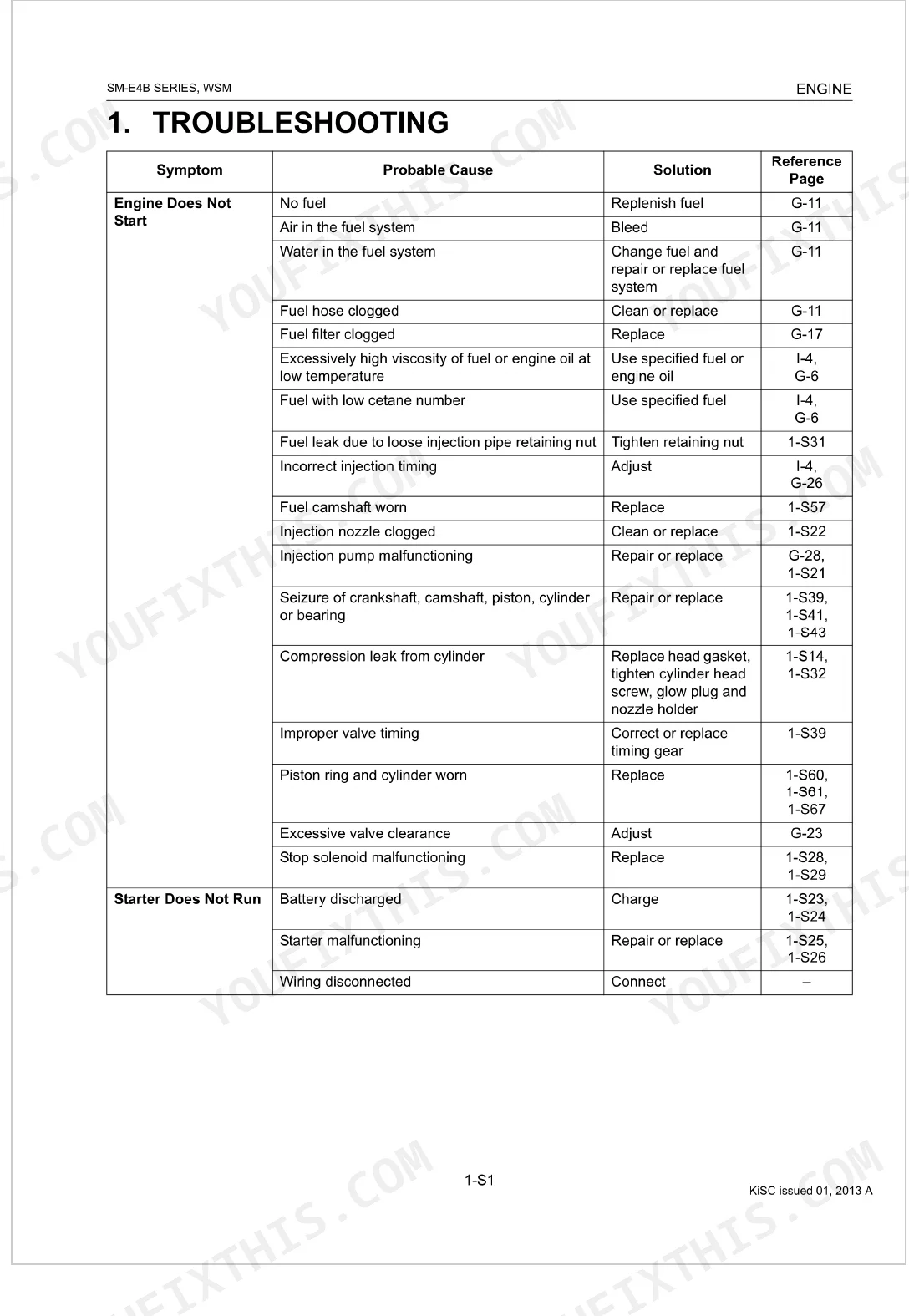
Kubota Z482-E4B diesel engine won't start or turns over slowly in cold weather
Test glow plug continuity and battery electrolyte level; the maintenance schedule on page 26 calls for electrolyte inspection every 50 hours. Test each glow plug and torque any replacements to 7.9 to 14 N-m (page 77). If it still won't crank, inspect fuel lines for air ingestion and confirm the shutoff solenoid energizes fully before another restart attempt.
Manual Section: Engine TroubleshootingEngine runs rough, misfires, or revolution is not smooth at operating speed p. 68
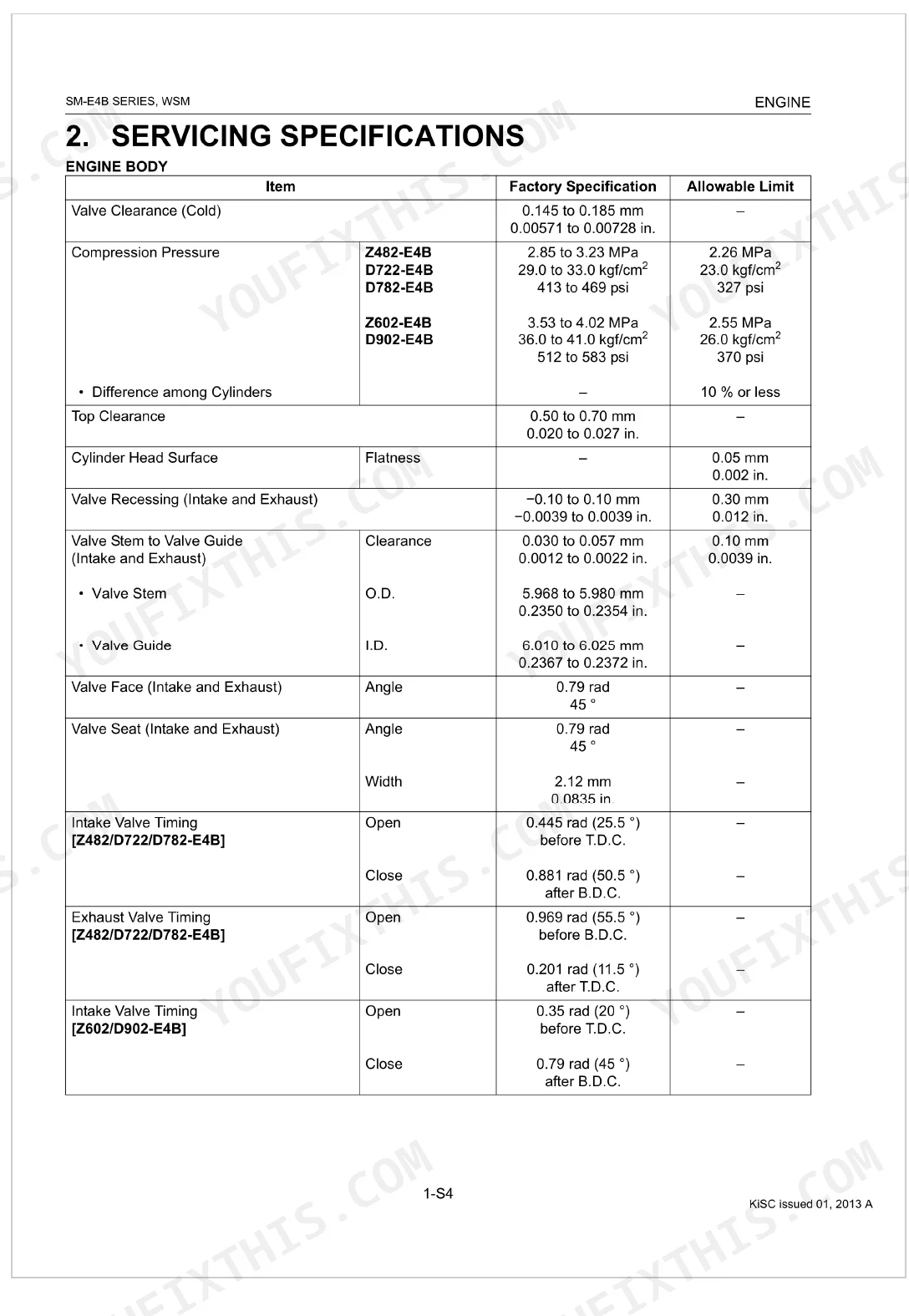
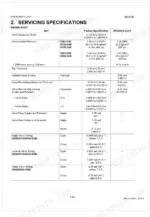
Measure valve clearance with the engine cold; correct spec is 0.145 to 0.185 mm (page 68), due every 800 hours per the maintenance schedule on page 26. Torque rocker arm bracket nuts to 9.81 to 11.2 N-m (page 77). With the valve train in spec, pull the injection nozzle for inspection at the 1500-hour mark and check the fuel system for air.
Manual Section: Engine TroubleshootingOil pressure warning light on, low oil pressure at idle or rated speed p. 73
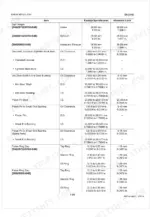
Verify oil level and condition first, then connect a mechanical gauge: idle pressure must exceed 49 kPa and rated-speed pressure should read 197 to 441 kPa (page 73). If pressure stays low with correct oil level, inspect the oil pressure switch, torqued to 15 to 19 N-m (page 77), and look for a worn pump or a bypassing oil filter.
Manual Section: Engine TroubleshootingPersistent white or blue exhaust smoke visible during warmup or at full operating load
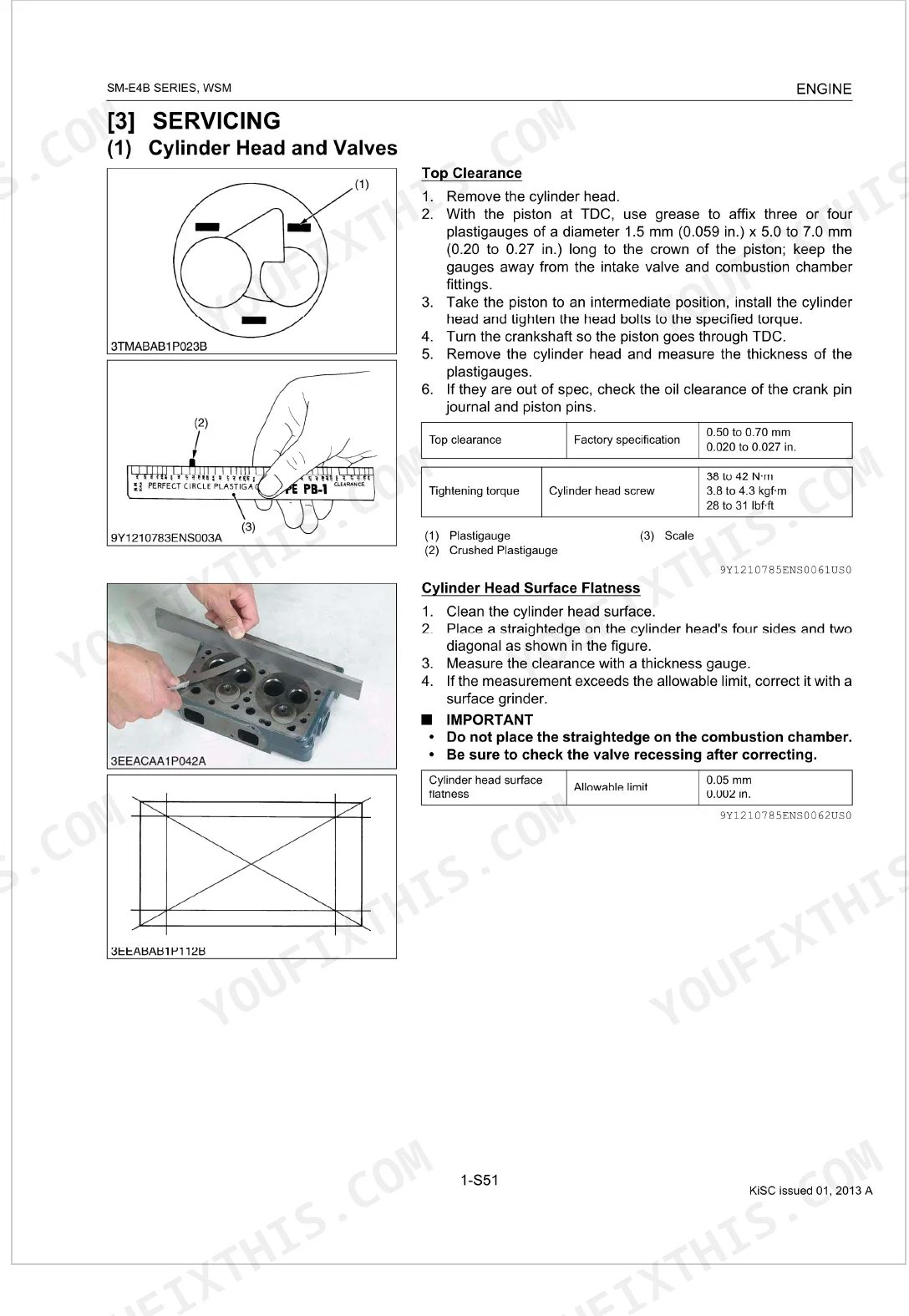
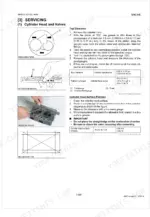
Separate blue smoke (oil burning) from white smoke (coolant intrusion or incomplete combustion) using the troubleshooting charts. For blue smoke, inspect the valve seals and measure cold valve clearance; spec is 0.145 to 0.185 mm (page 68). White smoke with coolant loss points to a failed head gasket; measure cylinder head surface flatness, allowable limit 0.05 mm (page 68).
Manual Section: Engine TroubleshootingCoolant temperature climbs to red zone and engine overheats under normal working load p. 73
Check fan belt tension first; deflection spec is 7.0 to 9.0 mm (page 73). Confirm coolant level and test the thermostat: it should start opening at 69.5 to 72.5°C (page 73). Per the maintenance schedule on page 26, inspect radiator hoses and clamp bands every 200 hours and replace them every 2 years. Clear debris from the cooling fins before the engine goes back to work.
Manual Section: Engine TroubleshootingFrequently Asked Questions
What are the recommended service intervals?
The manual lays out a maintenance check list with recommended service intervals for each task. Checking fuel hoses and clamp bands is recommended every 50 hours; engine oil and the oil filter cartridge change after the initial 50 hours, then every 100 or 150 hours depending on oil pan depth. The air cleaner element gets cleaned every 50 hours and replaced after 6 cleanings (approx. 300 hours), while the fan belt is replaced every 500 hours.
What fluids and capacities does this machine require?
This engine takes Class CF lubricating oil per API classification, with capacity varying by oil pan depth: 2.1 L (0.55 U.S.gals) for the 101 mm (3.98 in.) pan and 2.5 L (0.66 U.S.gals) for the 121 mm (4.76 in.) pan on the Z482-E4B. Fuel is Diesel Fuel No.2-D (ASTM D975) with a minimum cetane rating of 45. The cooling system uses clean water mixed with anti-freeze, keeping the anti-freeze ratio under 50%.
How to troubleshoot engine won't start?
When the engine won't start, the manual points to a handful of causes. Common ones are no fuel or air in the fuel system (replenish or bleed, page G-11) and a clogged fuel filter (replace, page G-17). Others include incorrect injection timing (adjust, page G-26), a malfunctioning injection pump (repair or replace, page G-28), and a compression leak from the cylinder (replace the head gasket, page 1-S32).
What torque specifications are listed?
Torque values are split between general and special use fasteners. A general M6 (No-grade or 4T) bolt takes 7.9 to 9.3 N-m (0.80 to 0.95 kgf-m, 5.8 to 6.8 lbf-ft). Specific parts include the cylinder head cover screw (M6 x 1) at 9.81 to 11.2 N-m (1.00 to 1.15 kgf-m, 7.24 to 8.31 lbf-ft) and the nozzle holder assembly (M20 x 1.5) at 49 to 68 N-m (5.0 to 7.0 kgf-m, 37 to 50 lbf-ft).
What are the common electrical problems?
On the electrical side, a starter that won't run usually traces to a discharged battery (charge it, page 1-S23), a faulty starter (repair or replace, page 1-S25), or disconnected wiring. A battery that discharges quickly can come from low electrolyte (top up with distilled water and charge, page G-15), a slipping fan belt (adjust tension or replace, page G-19), or a defective rectifier or alternator (replace, pages 1-S73 and 1-S72).
How will I receive this Kubota Z482-E4B & variants Workshop Manual?
Immediate download of the complete 138-page searchable Workshop Manual. Use it on any device, whether that's a laptop at your desk or a phone out in the field.
Can I print this Kubota Z482-E4B & variants manual?
Yes, print as many copies as you want; there are no restrictions. Plenty of mechanics print just the section they need and take it to the shop floor.
Document Quality
This document is a scanned PDF, but it includes an OCR layer, so you can search and copy the full text content. The text throughout is crisp and consistently easy to read, with no blurriness or fading. All diagrams, illustrations, and tables are clear raster images with readable labels and measurements, ensuring you can easily interpret the visual information. The pages are clean, free of scan artifacts, stains, or skewed content, and there are no notable blank or filler pages.


Reviews
There are no reviews yet.