
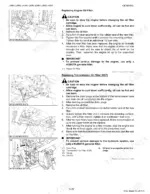
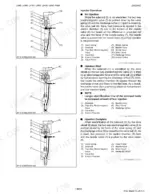
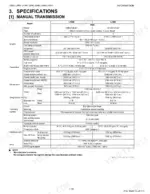
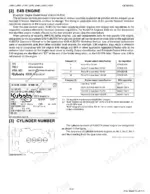
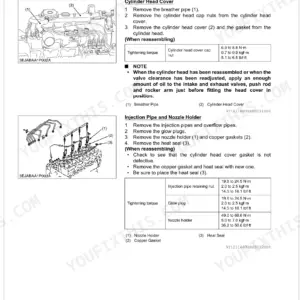
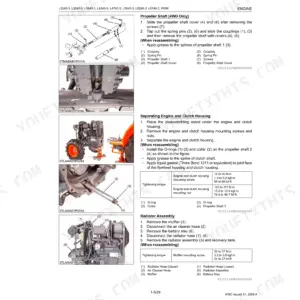
Every one of these 801 pages comes straight from Kubota's factory: this Kubota L3560 workshop manual PDF (OEM #9Y111-08242) covers the L3560, L4060, L4760, L5060, L5460, and L6060 tractor lineup. Inside, you get 54 pages of hydraulic schematics with full three-point hitch and loader circuit routing, 16 pages of wiring diagrams with complete CAN bus and electrical circuit data, 151 pages of step-by-step disassembly and assembly procedures, and 25 pages of test values spanning engine through cabin. Torque tables, 34 pages of troubleshooting, 8 pages of error codes, and 17 pages of calibration data fill out the rest. Set valve clearance to 0.18-0.22 mm cold, then verify compression holds 2.95 to 3.23 MPa. Your machine is down. Grab the PDF, search by keyword, and walk to the tractor with the right answer already on your screen.
What's Inside This Kubota L3560–L6060 Series Manual
| System | Pages | Key Topics |
|---|---|---|
| I Information | 5-27 | Safety First, Safety Decals, Specifications, Traveling Speeds, Dimensions |
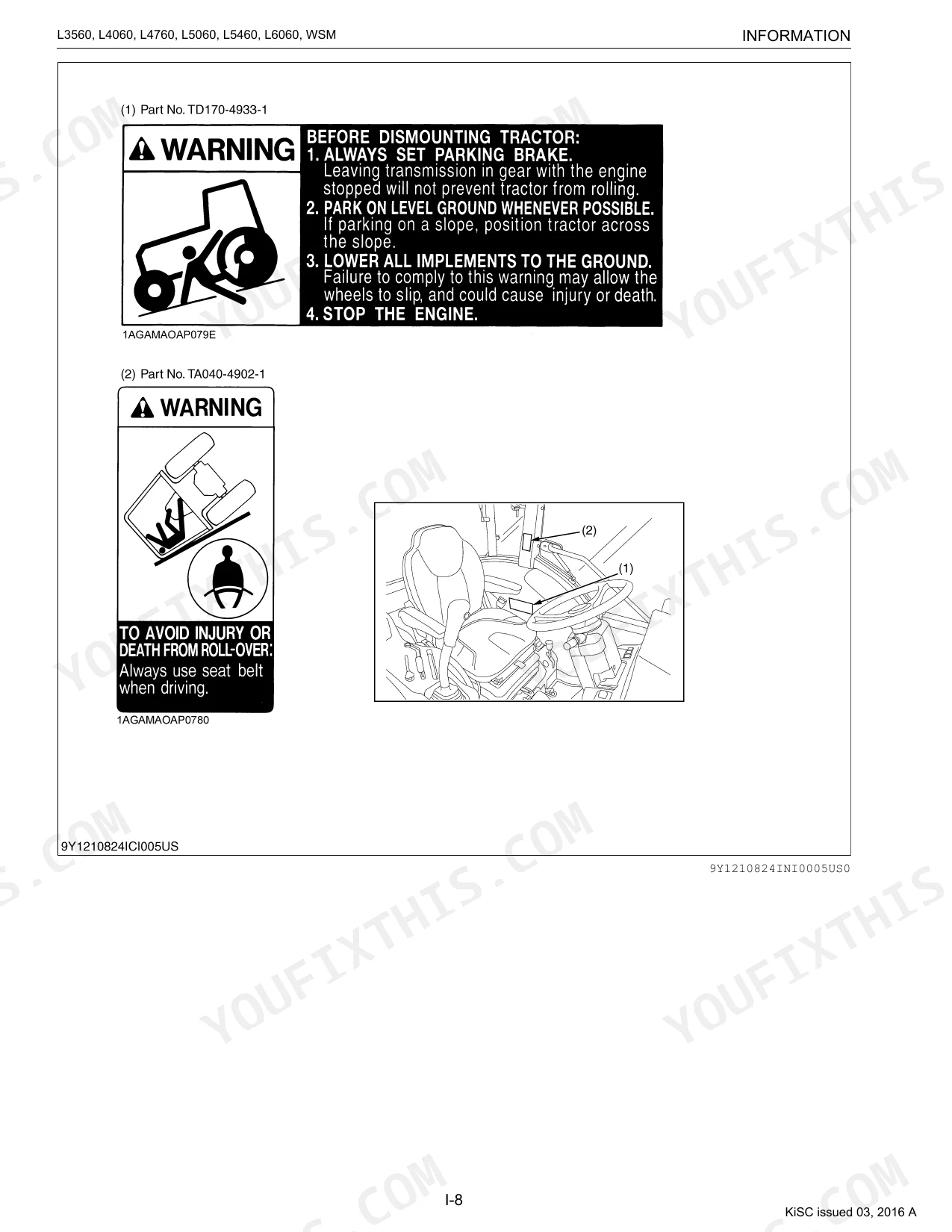
| G General | 28-113 | Tractor Identification, General Precautions, Handling Precautions for Electrical Parts and Wiring, Lubricants, Fuel and Coolant, Tightening Torques, Maintenance |
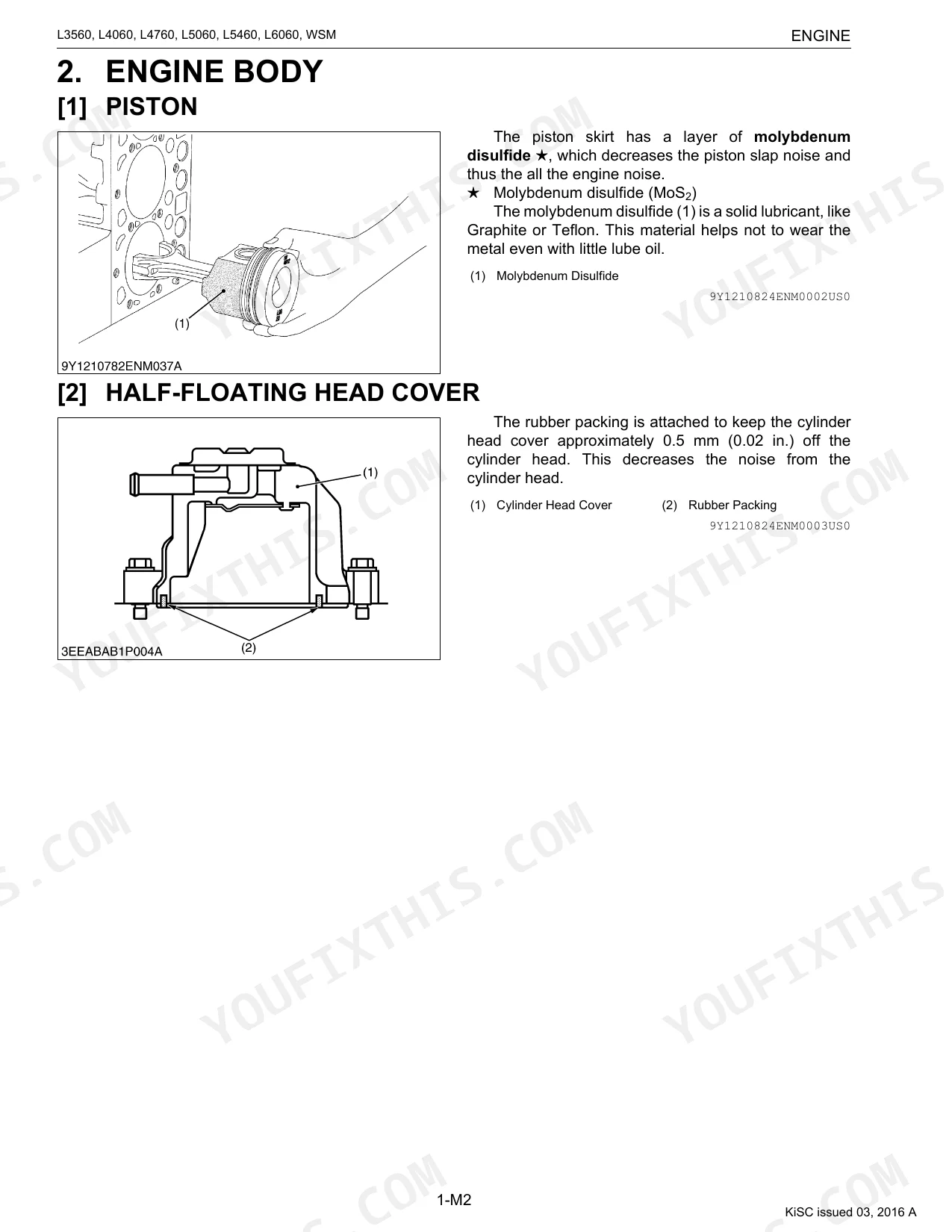
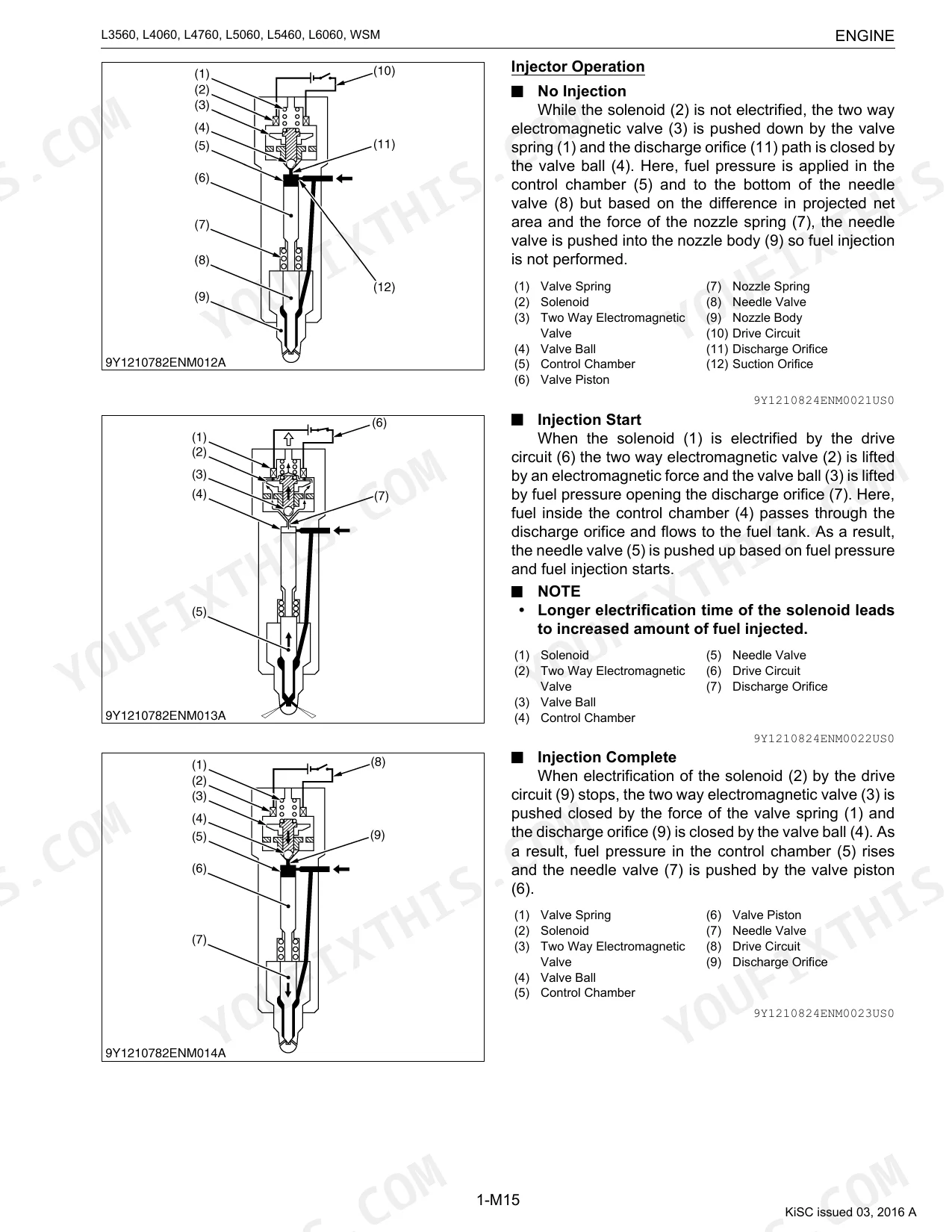
| 1 Engine | 114-240 | Features, Engine Body, Lubricating System, Cooling System, Fuel System, EGR System, After Treatment System |
| 2 Clutch | 241-274 | Troubleshooting, Servicing Specifications, Tightening Torques, Checking and Adjusting, Preparation, Disassembling and Assembling |
| 3 Transmission | 275-453 | Troubleshooting, Servicing Specifications, Tightening Torques, Checking and Adjusting, Preparation, Disassembling and Assembling |
| 4 Rear Axle | 454-465 | Troubleshooting, Tightening Torques, Preparation, Disassembling and Assembling, Servicing |
| 5 Brakes | 466-485 | Troubleshooting, Servicing Specifications, Tightening Torques, Checking and Adjusting, Disassembling and Assembling, Servicing |
| 6 Front Axle | 486-510 | Troubleshooting, Servicing Specifications, Tightening Torques, Checking and Adjusting, Disassembling and Assembling, Servicing |
| 7 Steering | 511-527 | Structure, Hydraulic Circuit, Hydraulic Pump, Steering Controller, Steering Cylinder |
| 8 Hydraulic System | 528-584 | Structure, Hydraulic Pump, Three Point Hitch Hydraulic Circuit, Rear Hydraulic Block, Position Control Valve, Front Loader Control Valve Assembly |
| 9 Electrical System | 585-735 | Wiring Diagram, Electrical Circuit, Electronic Control Panel, Switches, Sensors, Engine Starting System and Stopping System, CAN (Controller Area Network) Communication |
| 10 Cabin | 736-801 | AIR CONDITIONER SYSTEM, OUTLINE OF AIR CONDITIONING SYSTEM, SYSTEM CONTROL, ELECTRICAL SYSTEM, Electrical Circuit, Compressor Relay, Blower Relays and Compressor Relay |
Quick Reference Specifications
| Specification | Value | Page |
|---|---|---|
| All Models | ||
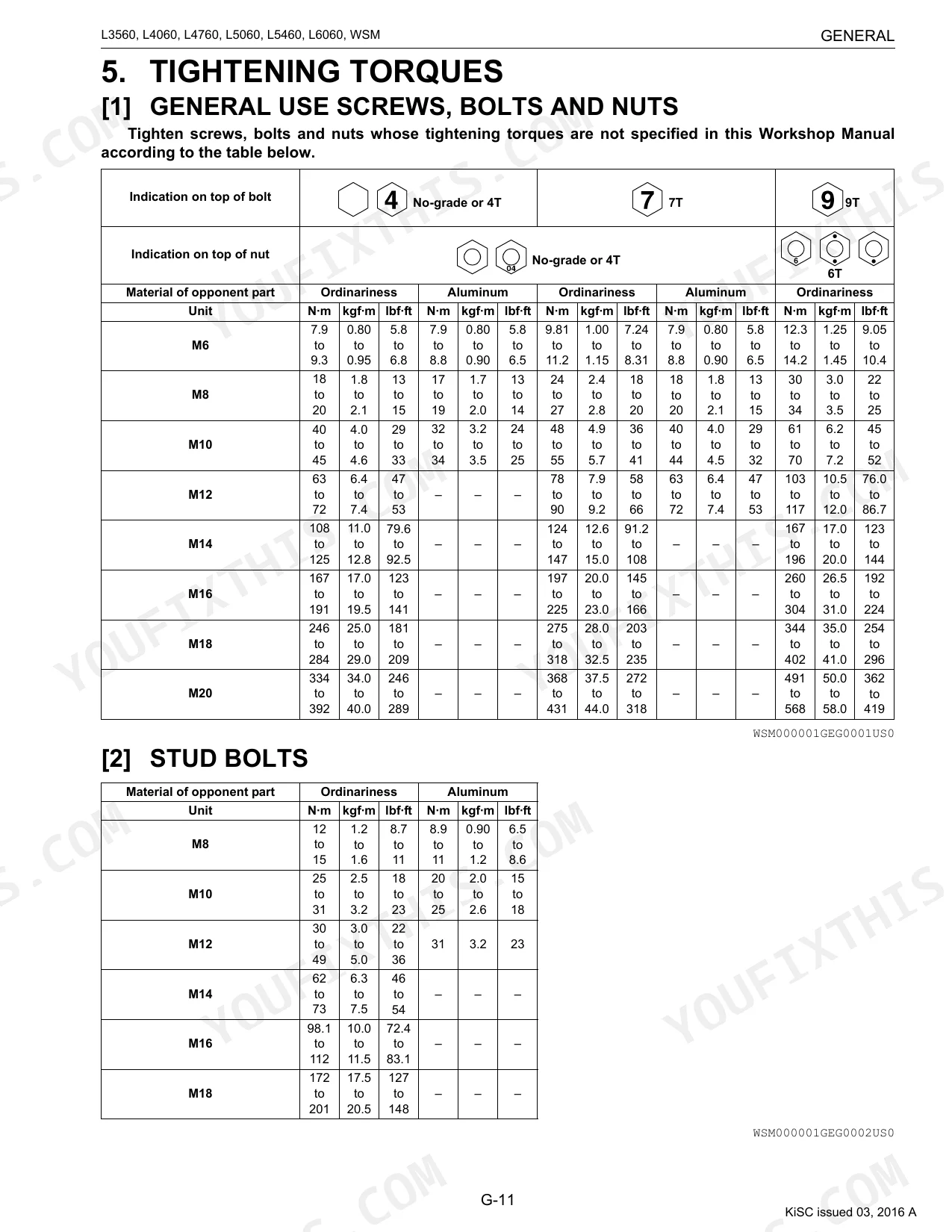
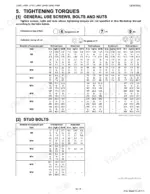
| M6 General Use Screws, Bolts and Nuts Tightening Torque | 7.9 to 9.3 N·m | p. 40 |
| M10 General Use Screws, Bolts and Nuts Tightening Torque | 40 to 45 N·m | p. 40 |
| Engine Valve Clearance (When Cold) | 0.18 to 0.22 mm | p. 151 |
| Engine Compression Pressure | 2.95 to 3.23 MPa | p. 151 |
| Engine Oil Pressure (At Rated Speed) | 300 to 440 kPa | p. 154 |
| Clutch Pedal Free Travel | 20 to 30 mm | p. 247 |
| Transmission GST System Pressure (Idling) | 2.30 to 2.50 MPa | p. 333 |
| Brake Pedal Free Travel | 15 to 20 mm | p. 472 |
| Front Axle Alignment Toe-in | 2 to 8 mm | p. 495 |
| Electrical Starter Terminal Nut Torque | 5.9 to 11 N·m | p. 648 |
| L3560, L4060 | ||
| Steering Relief Valve Setting Pressure | 10.7 to 11.7 MPa | p. 523 |
| L3560 | ||
| Hydraulic Pump for 3 Point Hitch Delivery at No Pressure (Manual Transmission and GST) | Above 31.5 L/min. | p. 562 |
Kubota L3560–L6060 Series Common Problems This Manual Covers
Kubota L-series three-point hitch won't reach maximum lift height or drops under load p. 528
Check hydraulic fluid level and inspect for contamination or low volume. Verify the position control linkage moves freely and isn't binding. On L3560 models, measure pump delivery at no pressure: it must exceed 31.5 L/min (page 562). Start diagnosis with the full symptom matrix in the Hydraulic System section (page 528) before pulling the rear hydraulic block.
Manual Section: Hydraulic System TroubleshootingEngine cranks over slowly or won't start on cold mornings, no combustion p. 148
Check the glow plugs and verify battery terminals are clean and tight. Inspect the fuel system for air intrusion if the machine sat over winter. Measure compression: spec is 2.95 to 3.23 MPa (page 151). Confirm engine oil is within its 400-hour change interval. Thick cold-weather oil reduces cranking speed and delays ignition.
Manual Section: Engine TroubleshootingClutch slips when pulling heavy loads, pedal feels normal but tractor loses drive p. 247
Verify clutch pedal free travel first: spec is 20 to 30 mm (page 247). Too little free travel keeps the disc partially engaged and burns it fast. Adjust at the pedal rod until free travel is in spec. If slipping continues, remove the clutch housing and inspect the disc and pressure plate for glazing or oil contamination.
Manual Section: Clutch TroubleshootingBrakes pull hard to one side when stopping, left and right pedals feel uneven p. 472
Measure brake pedal free travel on both sides: spec is 15 to 20 mm (page 472). Unequal adjustment between left and right pedals is the most common cause of directional pull. Adjust the shorter pedal to match, or reset both to mid-spec. Inspect brake linings for oil contamination, especially if the rear axle seal shows signs of weeping.
Manual Section: Brake TroubleshootingTransmission grinds or jumps out of gear during field work, hard to shift under load p. 275
Inspect the gear shift linkage for worn bushings or loose pivot pins before opening the case. Verify clutch adjustment: free travel must be 20 to 30 mm (page 247). On GST models, measure system pressure at idle; spec is 2.30 to 2.50 MPa (page 333). Low pressure means gears won't fully seat and will pop out under traction load.
Manual Section: Transmission Troubleshooting (General)Cab air conditioner runs but blows warm air, no cooling even at maximum setting p. 748
Check A/C compressor belt tension: spec is 10 to 12 mm deflection under thumb pressure (page 748). A slack belt starves compressor speed. Connect a manifold gauge set and verify high-side pressure is 1.27 to 1.66 MPa (page 748). Low refrigerant is the most common cause. Check all line fittings for oil staining to locate the leak.
Manual Section: Cabin Air Conditioning TroubleshootingFrequently Asked Questions
What are the recommended service intervals?
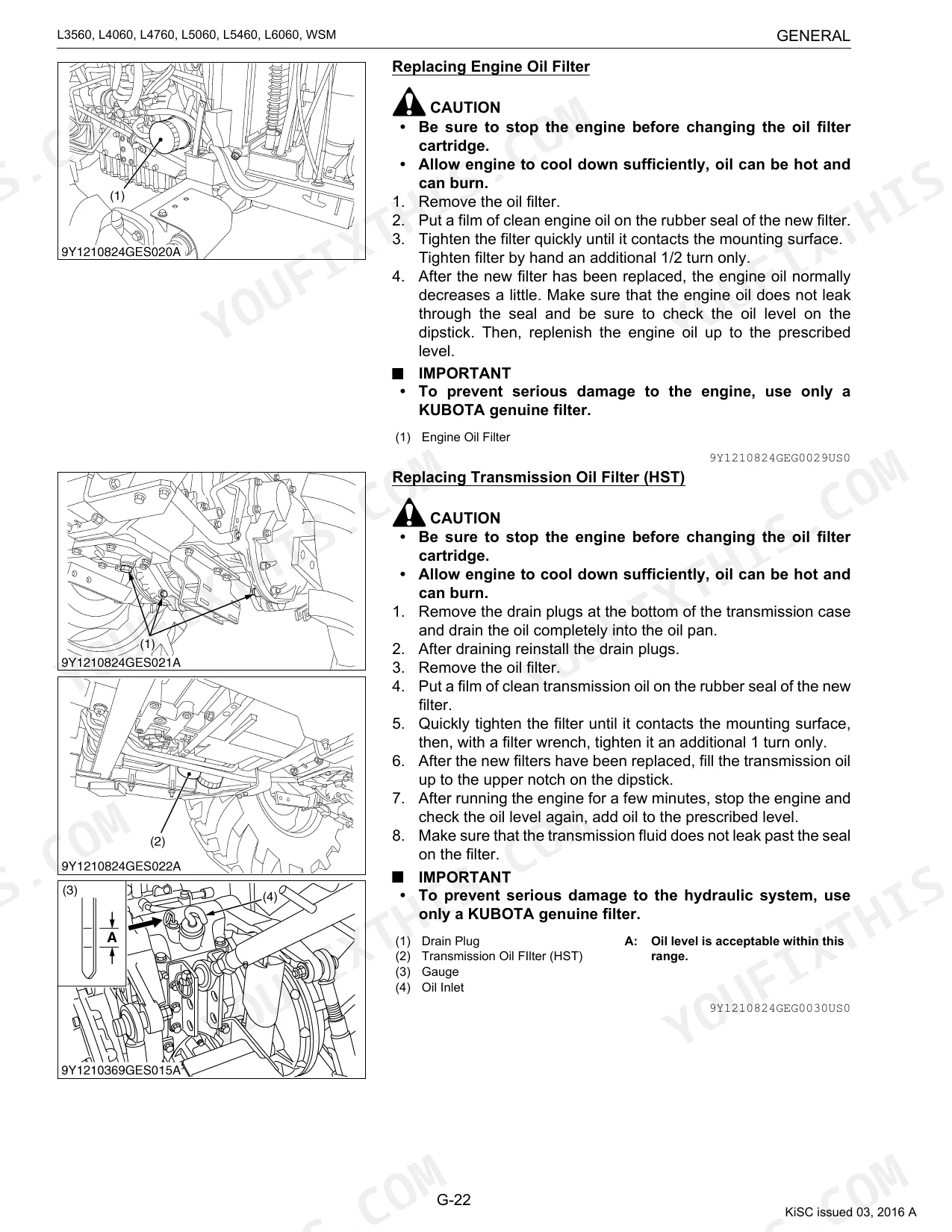
The manual provides a detailed maintenance schedule with various service intervals. For example, engine start system and wheel bolt torque should be checked every 50 hours. Battery condition, fan belt, and brakes are checked every 100 hours. Engine oil and oil filter are changed every 400 hours. Cooling system flush and coolant change are recommended every 2000 hours or 2 years.
What fluids and capacities does this machine require?
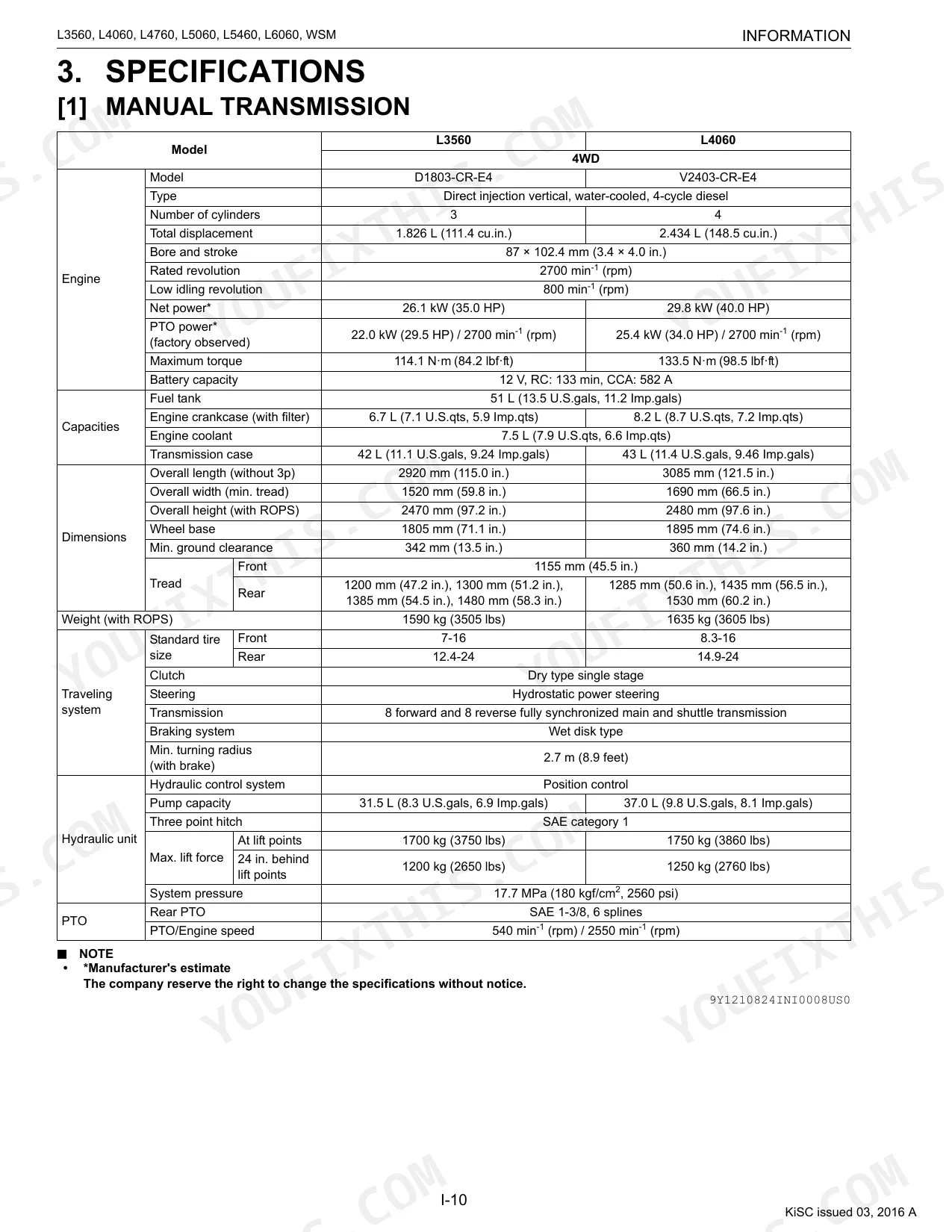
The machine requires No. 2-D S15 diesel fuel, fresh clean soft water with anti-freeze, KUBOTA SUPER UDT-2 fluid for the transmission, and SAE80/90 gear oil for the front axle. Capacities include a 51 L fuel tank, 6.7 L to 9.4 L for engine crankcase (with filter depending on model), 7.5 L to 8.2 L for engine coolant, 42 L to 45 L for transmission case, and 6.5 L to 9.0 L for front axle case.
How to troubleshoot engine won't start?
If the engine does not start, common issues include no fuel (fill fuel), air in the fuel system (bleed), or water in the fuel system (change fuel). Other causes could be a clogged fuel filter (replace), stuck/clogged injector (replace), or a malfunctioning fuel supply pump (replace). More severe issues like compression leaks or seized engine components may require repair or replacement.
What are the hydraulic system specifications?
The hydraulic system specifications vary by model and function. For power steering, the hydraulic pump delivery at rated pressure is above 18.2 L/min (allowable 16.2 L/min) for L3560, with a rated pressure of 10.7 to 11.7 MPa. For the three-point hitch, the pump delivery at rated pressure is above 30.9 L/min (allowable 27.6 L/min) for L3560, with a rated pressure of 17.1 to 18.1 MPa. The cylinder safety valve operating pressure is 19.6 to 22.6 MPa.
How will I receive this Kubota L3560–L6060 Series Workshop Manual?
You get a 801-page searchable PDF that downloads instantly after checkout. Open it on your laptop, tablet, or phone — bring it right to the shop floor.
Are there any print restrictions on this Kubota L3560–L6060 Series manual?
Yes, print as many copies as you want — there are no restrictions. Many mechanics print the section they need and bring it to the shop floor.
Does this Kubota L3560–L6060 Series Workshop Manual cover the hydraulic system?
Yes. The manual includes hydraulic circuit diagrams, system schematics, and component specifications with pressure ratings.
Document Quality
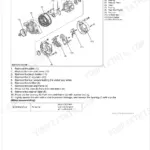
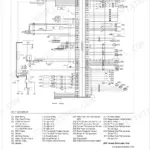
This document is a high-quality scanned PDF, and you can search the full text and copy content thanks to an accurate OCR layer. The text is consistently crisp and easy to read throughout. Diagrams and illustrations are clear raster images, with all labels perfectly readable. Pages are clean with no noticeable scan artifacts, stains, or skewed content. There are no notable blank or filler pages, ensuring a focused and efficient resource.


Reviews
There are no reviews yet.