
Looking for the factory operating guide that shipped with the M4700 and M5400? This is it: 72 pages covering startup sequences, the instrument panel walkthrough, PTO operation, three-point hitch setup, and a maintenance schedule that runs from daily checks through every-800-hour service. Six pages handle safety warnings for rollover, PTO injury, and drawbar hazards. Another 19 pages walk through maintenance by interval. A fluid capacities table and a troubleshooting section cover the usual engine faults: hard starts, overheating, colored exhaust. Rear wheel bolts torque to 260-304 N•m (191.8-224.2 ft-lbs), fronts to 168-196 N•m, both spelled out so you stop guessing which service falls at what hour. Bookmarked and searchable, it opens on a phone or tablet right at the machine, and any spec is a few taps away.
What's Inside This Kubota M4700, M5400 Operator Manual
| System | Pages | Key Topics |
|---|---|---|
| Before Operating the Tractor | 7 | Operating New Tractor, Starting |
| Operating the Tractor | 8 | Operating New Tractor, Starting |
| Parking the Tractor | 9 | PTO disengagement, Implement lowering, Control levers neutral, Parking brake, Engine stop, Key removal |
| Servicing the Tractor | 10 | Engine cool-off, Refueling procedure, Battery safety, Hydraulic fluid pressure, Tractor identification plate, Engine serial number |
| Danger, Warning and Caution Labels | 11-13 | Machine runaway, Roll-over, PTO injury, Drawbar injury, Engine fan and fanbelt, Hot surface contact |
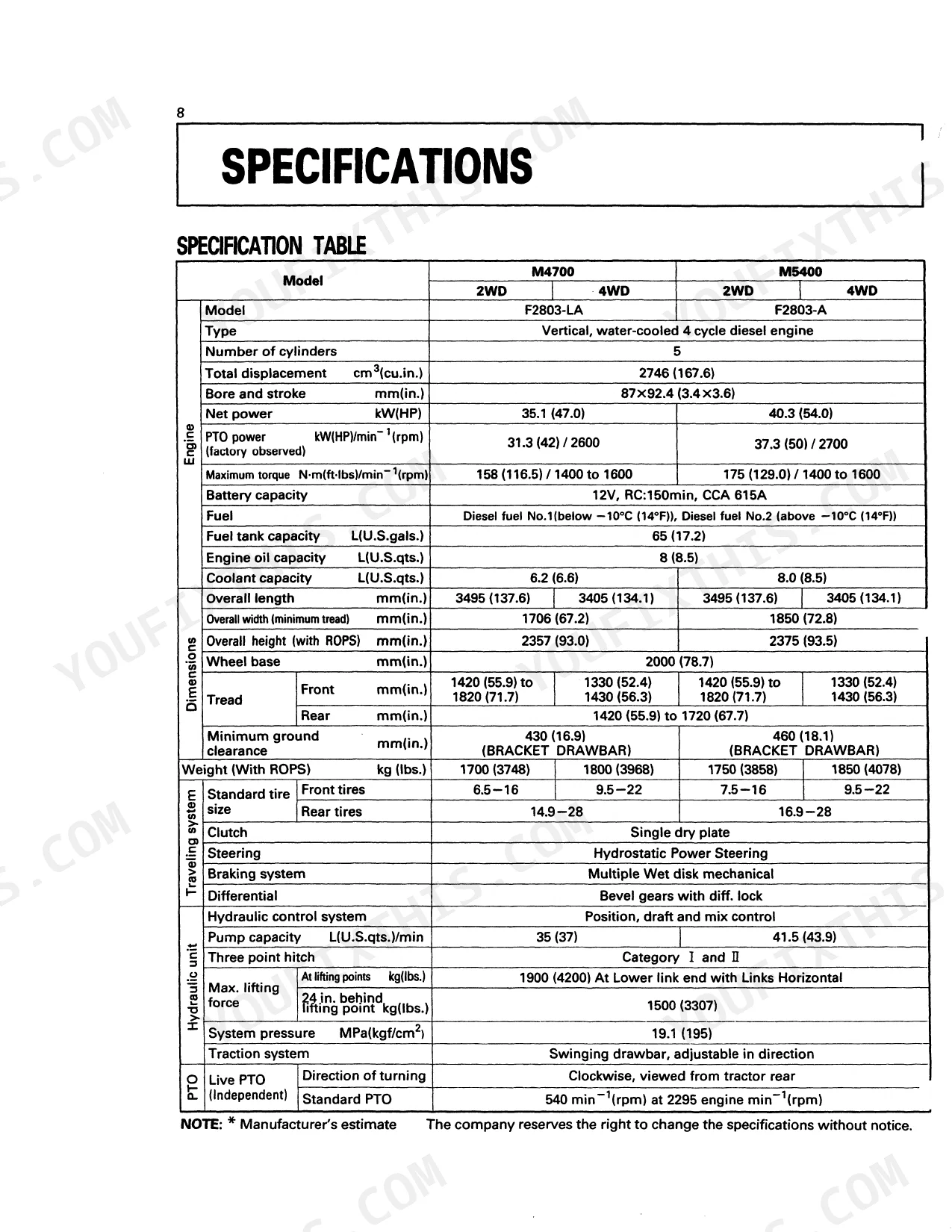
| Specifications | 14 | Specification Table, Traveling Speeds |
| Implement Limitations | 16-17 | Tread with farm tires, Actual figures, Lower link end max. hydraulic lifting capacity (Implement weight, Max. drawbar load, Trailer loading weight), M4700 |
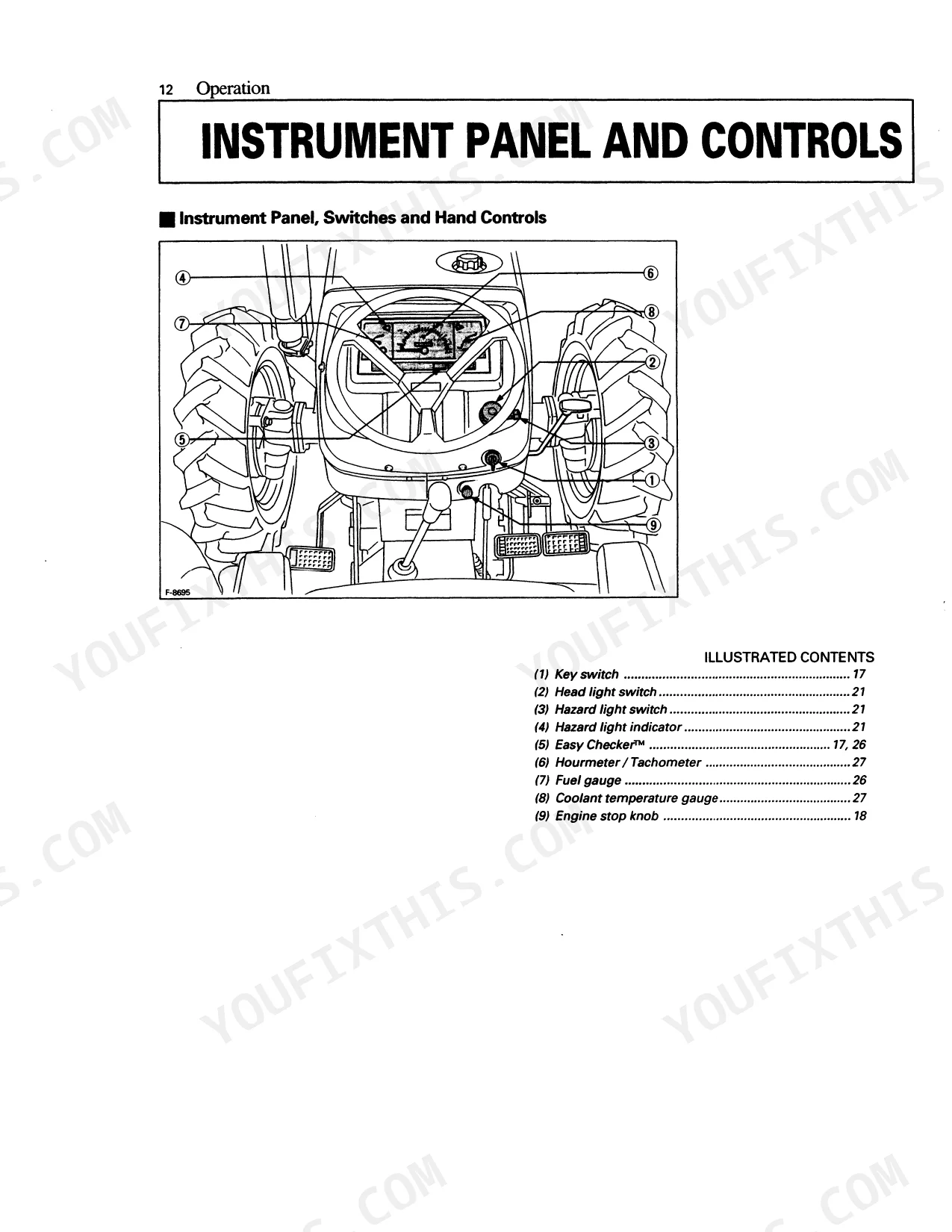
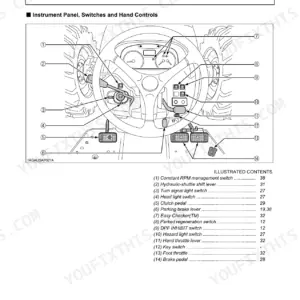
| Instrument Panel and Controls | 18-19 | Key switch, Easy Checker™, Hourmeter/Tachometer, Fuel gauge, Coolant temperature gauge, Engine stop knob |
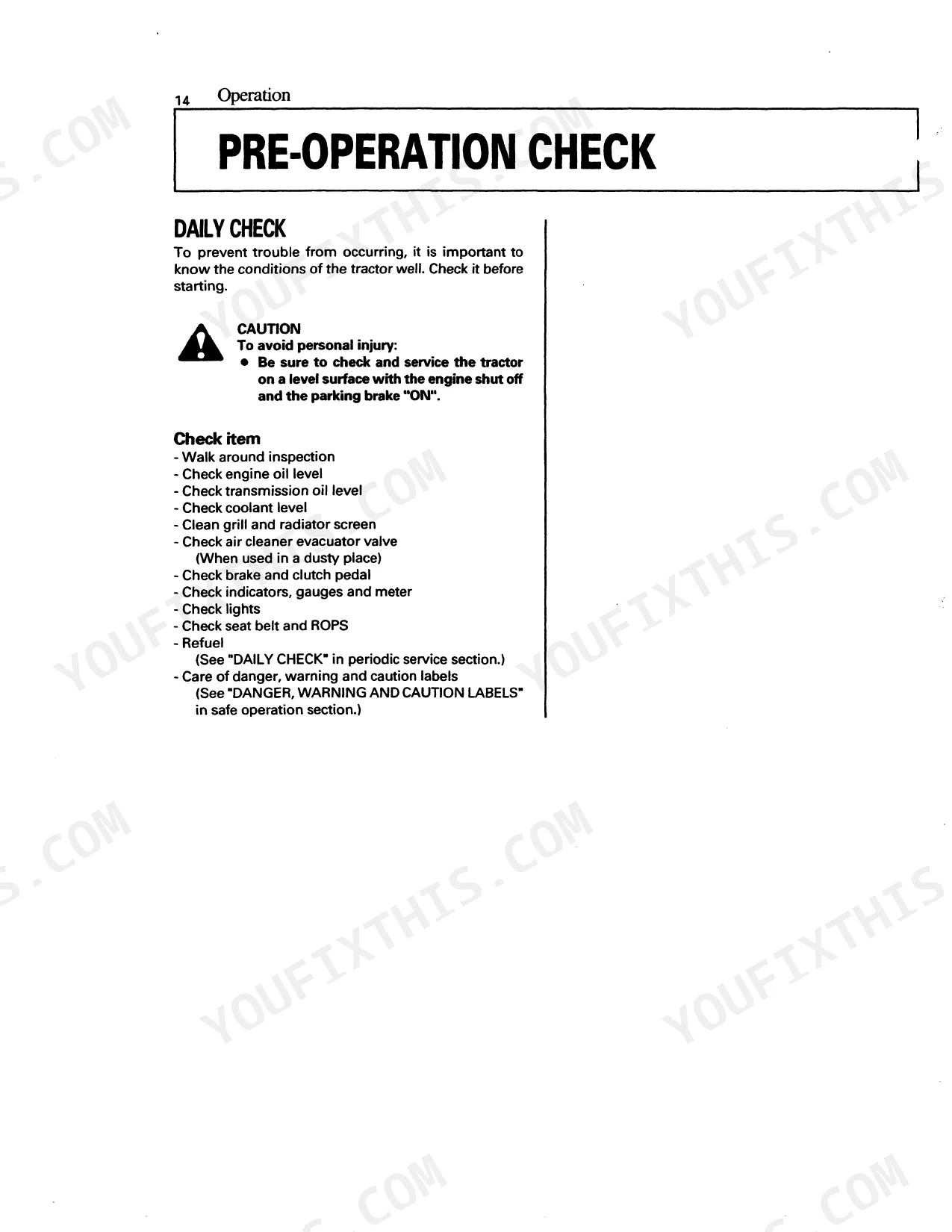
| Pre-Operation Check | 20 | Daily Check |
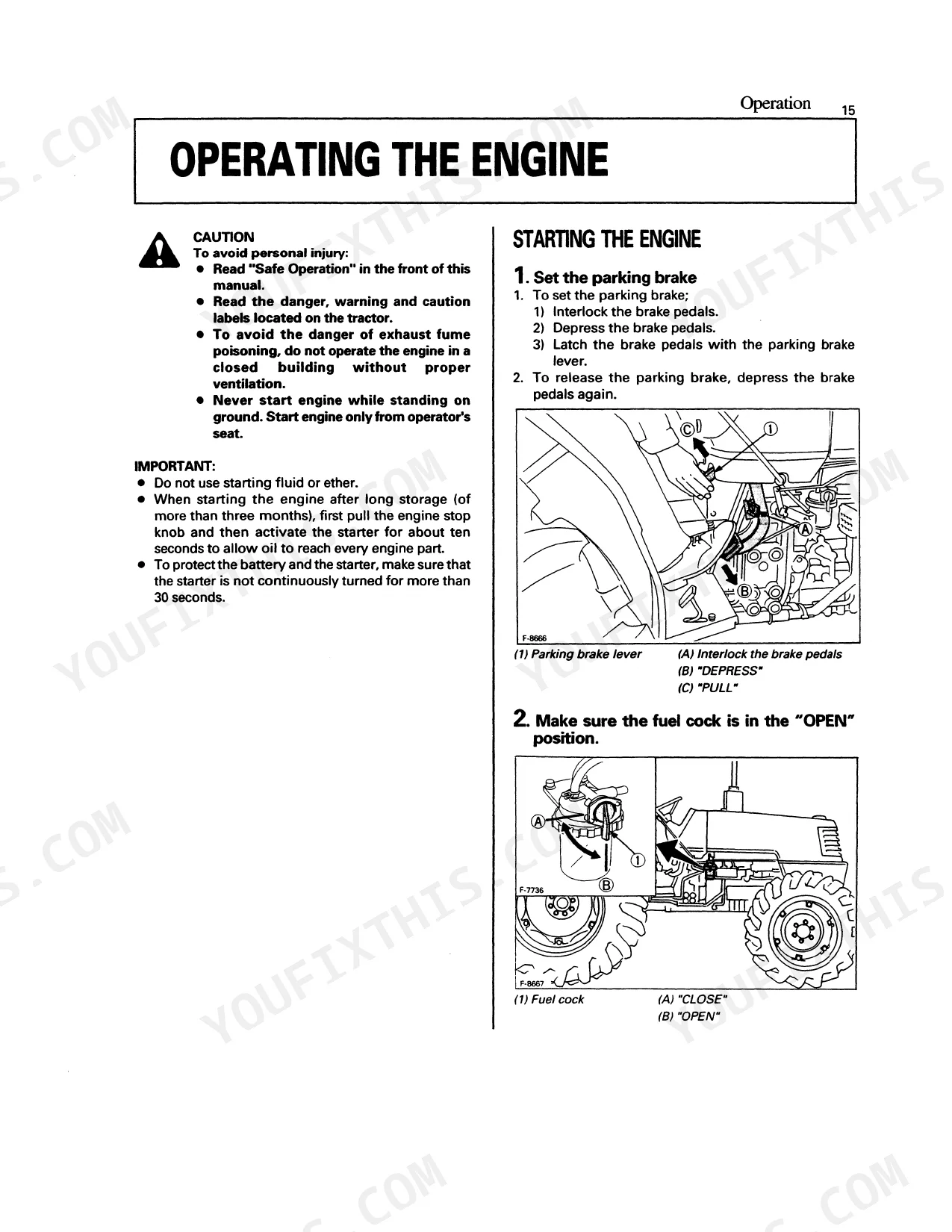
| Operating the Engine | 21-23 | Starting the Engine (Set the parking brake, Make sure the fuel cock is in the "OPEN" position), Make sure the engine stop knob is pushed in |
| Check During Driving | 32 | Engine sudden changes, Electrical charge, Fuel Gauge, Easy Checker™, Engine oil pressure, Coolant Temperature Gauge |
| Operating Techniques | 34-35 | Differential Lock, Road operation, Slopes and Rough Terrain, Power Steering |
| PTO | 36 | PTO Operation |
| Three-Point Hitch & Drawbar | 37 | Top Link, Lifting Rod, Telescopic Stabilizers, Lower Link, Drawbar, Tires, Wheels And Ballast (Wheel Adjustment) |
| Point Hitch | 38-39 | Top Link, Lifting Rod, Telescopic Stabilizers, Lower Link, Drawbar, Tires, Wheels And Ballast (Wheel Adjustment) |
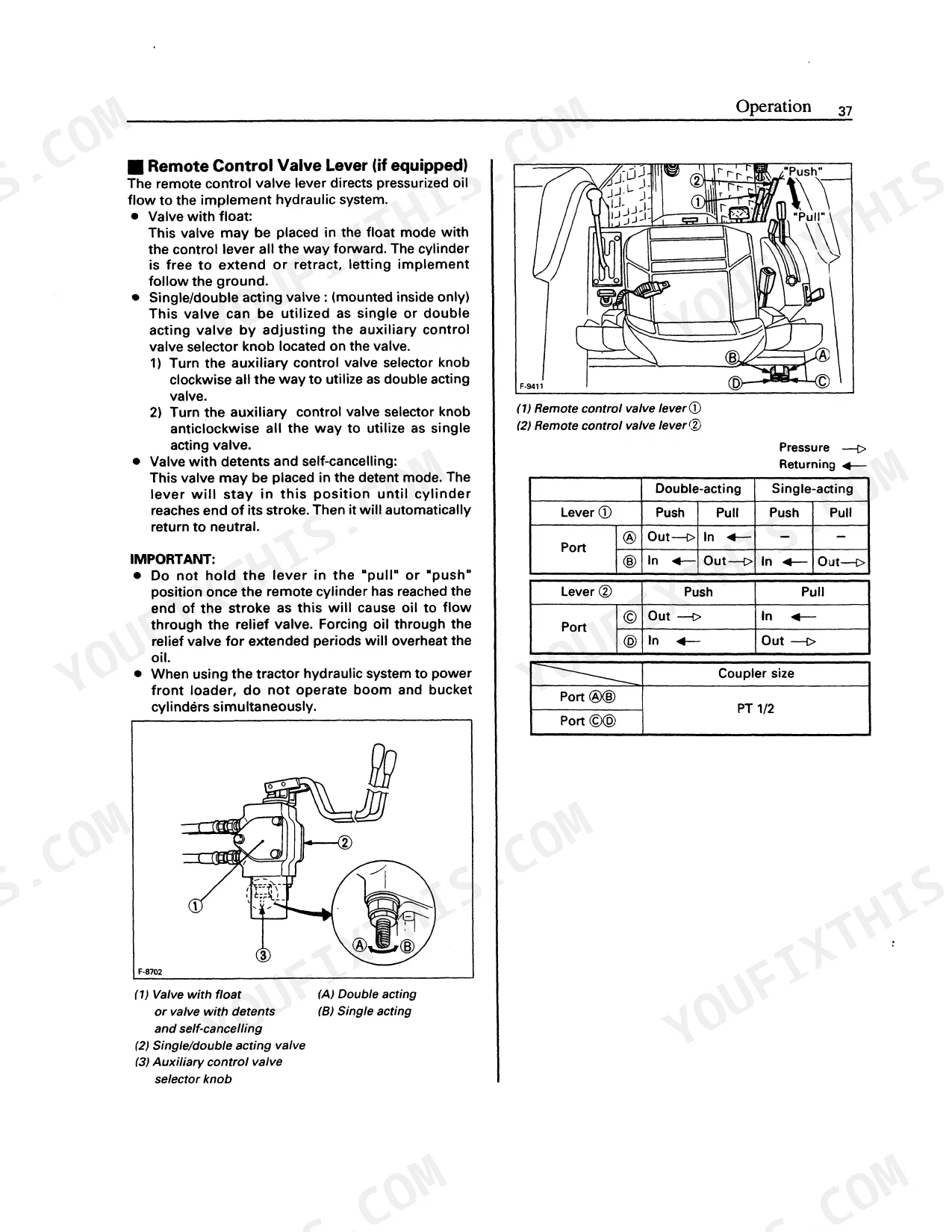
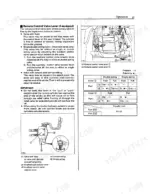
| Remote Hydraulic Control System (if equipped) | 42-44 | Remote Control Valve Coupler, Connecting procedure, Disconnecting procedure, Remote Control Valve Lever, Float mode, Single/double acting valve |
| Tires, Wheels and Ballast | 45-47 | Tires, Wheel Adjustment |
| Ballast | 48 | Tires, Wheel Adjustment |
| Maintenance | 49 | Service Intervals, Lubricants |
| Every 100 Hours | 55-58 | Engine oil change, Grease fittings lubrication, Battery condition check, Air cleaner primary element cleaning, Fuel filter element cleaning, Fan belt adjustment |
| Every 200 Hours | 59-61 | Replacing Engine Oil Filter, Replacing Hydraulic Oil Filter, Cleaning Magnetic Filter, Checking Radiator Hose and Clamp, Checking Power Steering Line, Adjusting Toe-in |
| Every 2 Years | 64 | Flush Cooling System and Changing Coolant, Anti-Freeze, Tractor Model Coolant Capacity |
| Service as Required | 65-66 | Replacing Radiator Hose, Replacing Power Steering Hose, Replacing Fuel Hose, Bleeding Fuel system, Draining Clutch Housing Water, Replacing Fuse (Protected circuit) |
| Storage | 67 | Tractor Storage, Removing the Tractor From Storage |
| Troubleshooting | 68 | Engine Troubleshooting (Engine is difficult to start or won't start, Insufficient engine power, Engine stops suddenly, Exhaust fumes are colored, Engine overheats) |
| Options | 69-72 | Under Muffler, SMV Emblem, Work Light, Double Acting Remote Hydraulic Control Valve, Clevis Type Swinging Drawbar, Rear Wheel Weights, Trailer electrical outlet, Front bumper |
Quick Reference Specifications
| Specification | Value | Page |
|---|---|---|
| Front wheel bolt torque | 168 to 196 N•m (17.1 to 20.0 kgf•m) (123.9 to 144.6 ft-lbs) | p. 54 |
| Rear wheel bolt torque | 260 to 304 N•m (26.5 to 31.0 kgf•m) (191.8 to 224.2 ft-lbs) | p. 54 |
| Battery capacity | 12V, RC:150min, CCA 615A | p. 14 |
| Battery condition check interval | every 100 Hr | p. 49 |
| Fuel filter element cleaning interval | every 100 Hr | p. 49 |
| Fuel filter element replacement interval | every 400 Hr | p. 49 |
| Air cleaner Primary element cleaning pressure | under 686kPa (7kgf/cm², 99 psi) | p. 51 |
| Air cleaner Primary element replacement interval | Once yearly or after every sixth cleaning | p. 51 |
| Engine oil filter replacement interval | every 200 Hr | p. 49 |
| Hydraulic oil filter replacement interval | every 200 Hr | p. 49 |
| Radiator hose and clamp replacement interval | every 2 years | p. 49 |
| Fan belt tension (deflection) | 7 to 9 mm (0.28 to 0.34 in.) | p. 52 |
Kubota M4700, M5400 Common Problems This Manual Covers
Kubota M4700 engine turns over slowly or will not start during morning pre-operation check. p. 54
Confirm the range gear shift lever and PTO clutch control lever sit in neutral before you turn the key. Check battery condition per page 56; if it's weak, swap in a 12V, CCA 615A unit. Clean the fuel filter element every 100 hours.
Manual Section: Checking Engine Start SystemEasy Checker warning lamp illuminates on the instrument panel while driving under heavy load. p. 32
Read the oil pressure warning lamp explanation on page 32, then shut the engine down at once and check the dipstick. If the level is low, fill the crankcase to its 8.0 L (8.5 U.S.qts.) capacity. Change the engine oil filter every 200 hours so flow stays clear.
Manual Section: Check During DrivingCoolant temperature gauge spikes to boiling point and engine overheats during continuous field operation. p. 68
Pull and clean the radiator screen if debris has packed it. Check fan belt tension on page 58 and adjust to 7 to 9 mm (0.28 to 0.34 in.) deflection. Flush the cooling system and renew the coolant every 2 years to keep heat moving.
Manual Section: TroubleshootingRear tire and wheel assembly vibrates or feels loose while traveling at road speeds. p. 45
Stop and retorque the rear wheel bolts before anything else. Tighten them crisscross to 260 to 304 N•m (191.8 to 224.2 ft-lbs) per page 54. Set rear tire pressure to 138 kPa (20 psi) before you head back onto the road.
Manual Section: Tires, Wheels and BallastFrequently Asked Questions
What are the torque specs for the Kubota M4700/M5400 wheel bolts?
Front wheels (2WD) take 124 to 147 N•m (12.6 to 15.0 kgf·m, 91.5 to 108.4 ft-lbs). Rear wheel figures vary: some bolts call for 259 to 304 N•m (26.4 to 31.0 kgf·m, 191.0 to 224.2 ft-lbs), others 168 to 196 N•m (17.1 to 20.0 kgf·m, 123.9 to 144.6 ft-lbs). Recheck and retighten the bolts often, especially on a new machine.
What are the replacement specifications for battery?
Battery capacity for the Kubota M4700/M5400 is 12V, RC:150min, CCA 615A, and the original is a maintenance-free type. If its performance falls off over time, the manual recommends consulting your local KUBOTA dealer for the replacement.
What are the replacement specifications for fuel filters?
Replace the fuel filter element every 400 hours. The manual also walks through a cleaning procedure for the element: remove the filter bowl, take it out, and rinse it in kerosene. For exact replacement part numbers or specifications beyond the service interval, your best bet is to check with a KUBOTA dealer.
Is this Kubota M4700, M5400 Operator Manual a digital download?
Yes. The full 72-page searchable Operator Manual downloads as a PDF the moment payment clears, ready to open on a laptop, tablet, or phone out in the shop.
Are there any print restrictions on this Kubota M4700, M5400 manual?
None. The PDF ships DRM-free, so print whatever sections you want to carry out to the shop. Standard letter or A4 paper both work fine.
Document Quality
This document is a scanned PDF with an OCR layer, allowing you to search and copy the full text content. The text throughout is crisp and generally easy to read. Diagrams and illustrations are scanned images, not vector graphics, but their labels are clear and legible. The pages are clean with no noticeable scan artifacts, stains, or skewing. Please note that pages 2, 6, 70, and 71 are intentionally blank.


Reviews
There are no reviews yet.