
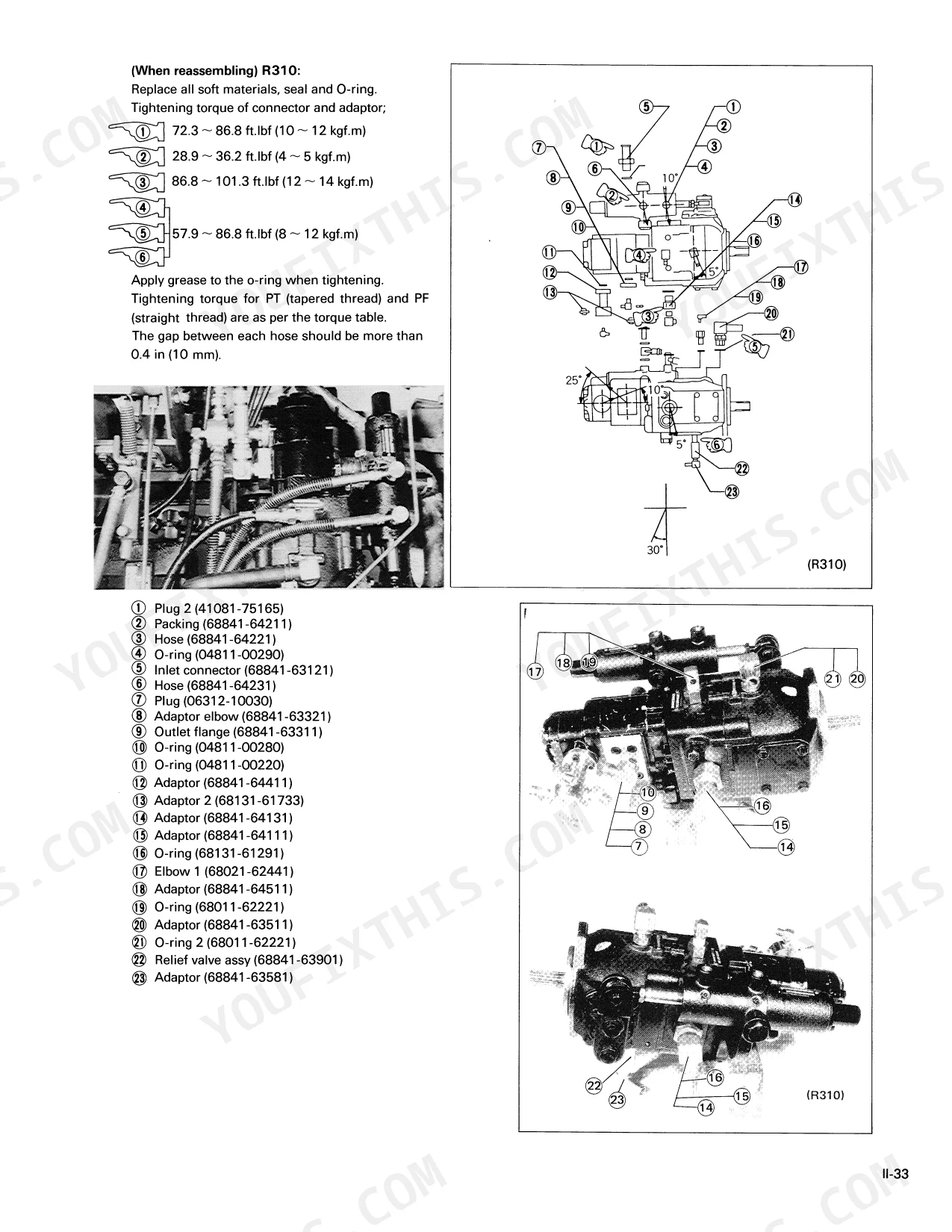
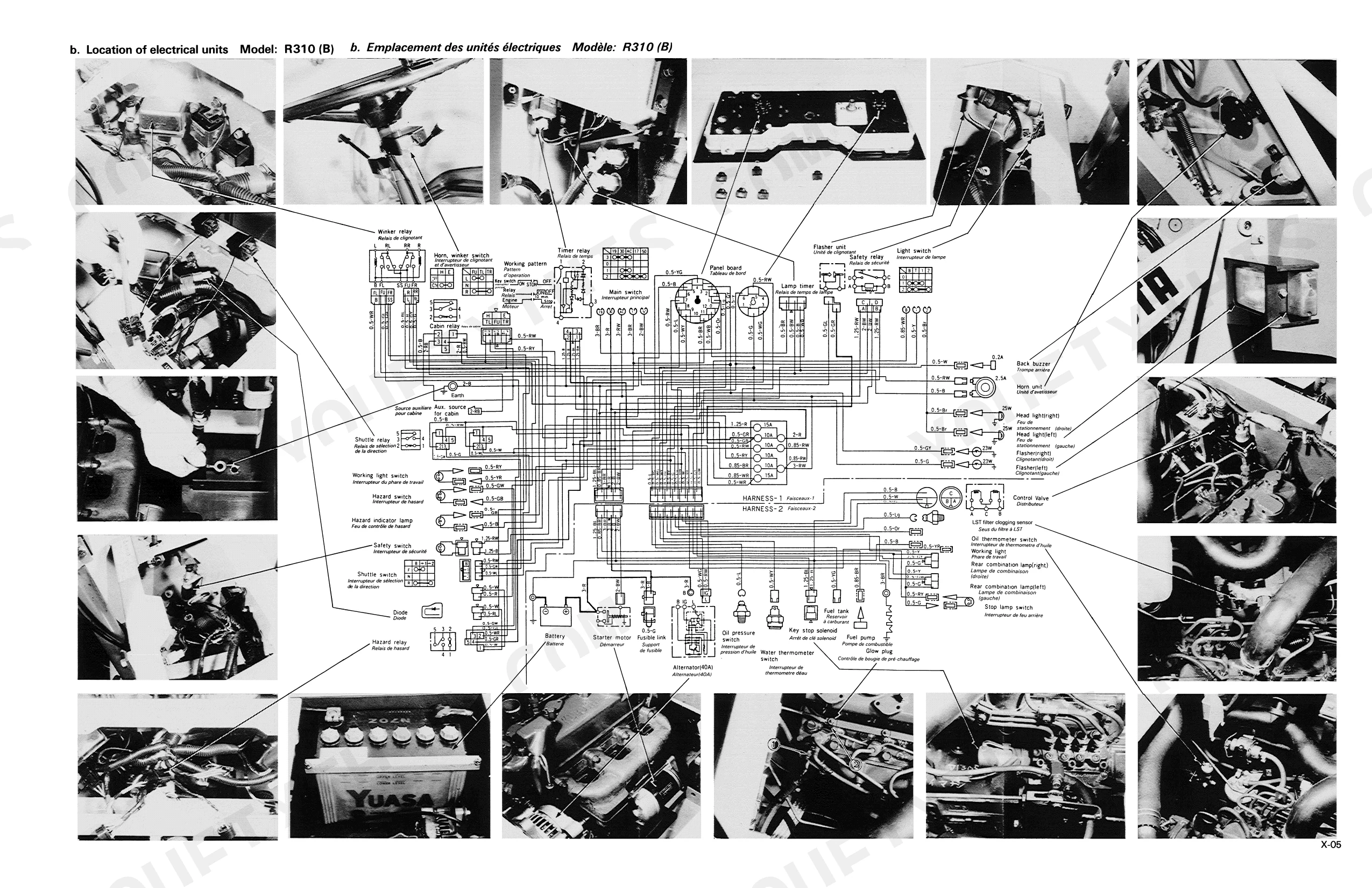
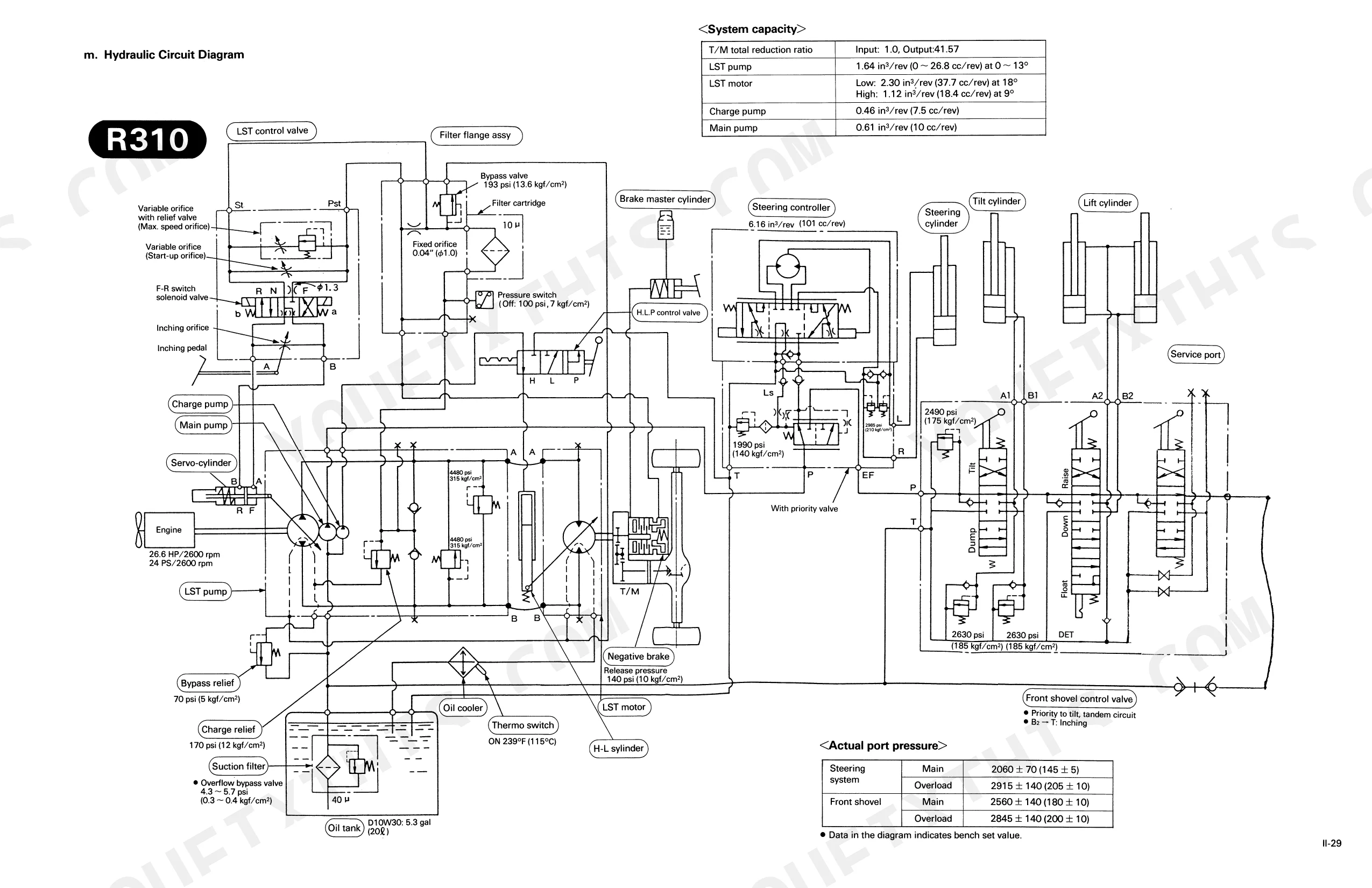
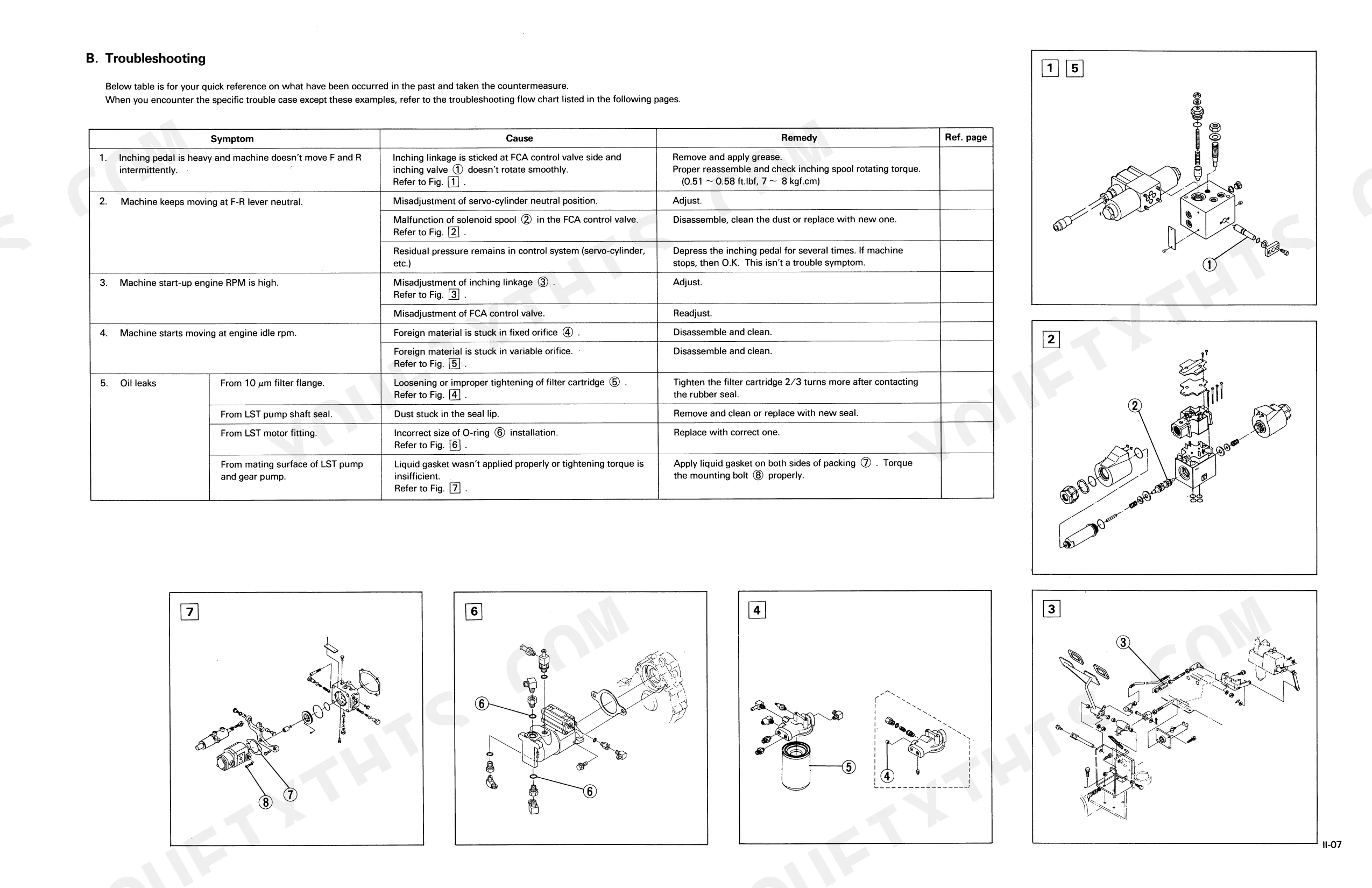
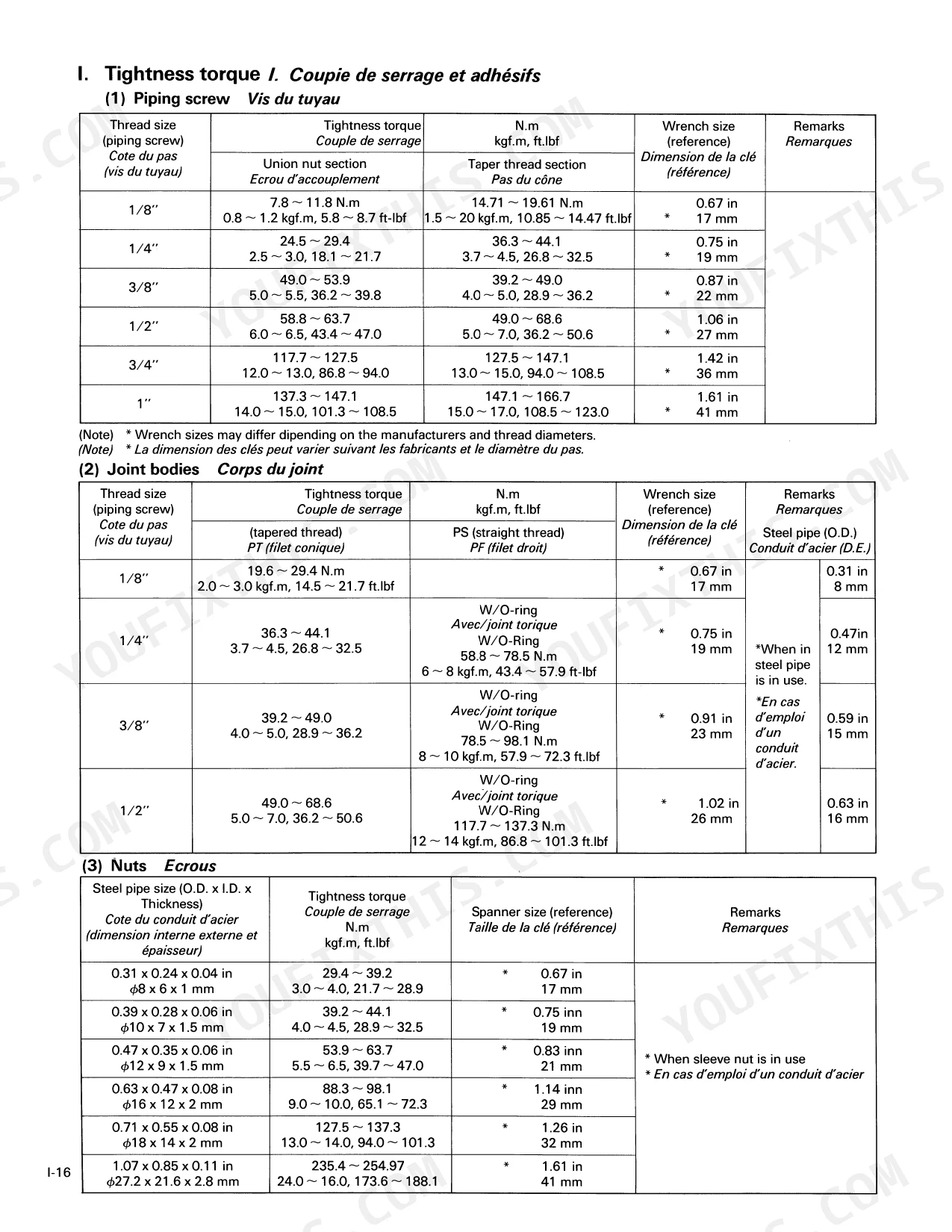
Need the factory data for your Kubota R310(B) or R410(B) wheel loader? This 448-page service manual PDF (OEM #97899-60152) walks through power train teardown, brake and steering adjustment, the front shovel loader, backhoe, engine service, and the full electrical system. Hydraulic schematics trace every circuit through the A-LST traction system and backhoe, while the wiring diagrams mark wire harness clamp locations and lay out complete electrical unit data. The reference tables run deep: 2 pages of tightening torques, 20 pages of troubleshooting, and 7 pages of exploded views for the reduction gear, differential axle, propeller shaft, and center pin assemblies. Torque your 1/2-inch piping screws to 68.8–83.4 N.m (50.8–61.4 ft.lbf), one of dozens of fastener tables lifted straight from the spec pages. Your machine is down. Download it once, jump to any section by bookmark, search by keyword: find the number, fix the loader.
What's Inside This Kubota R310(B), R410(B) Manual
| System | Pages | Key Topics |
|---|---|---|
| Section 0: Precautions | - | Safety Precautions for Servicing, Disassembling and Reassembling, Checks and Maintenance, Safety Levers and Appliances |
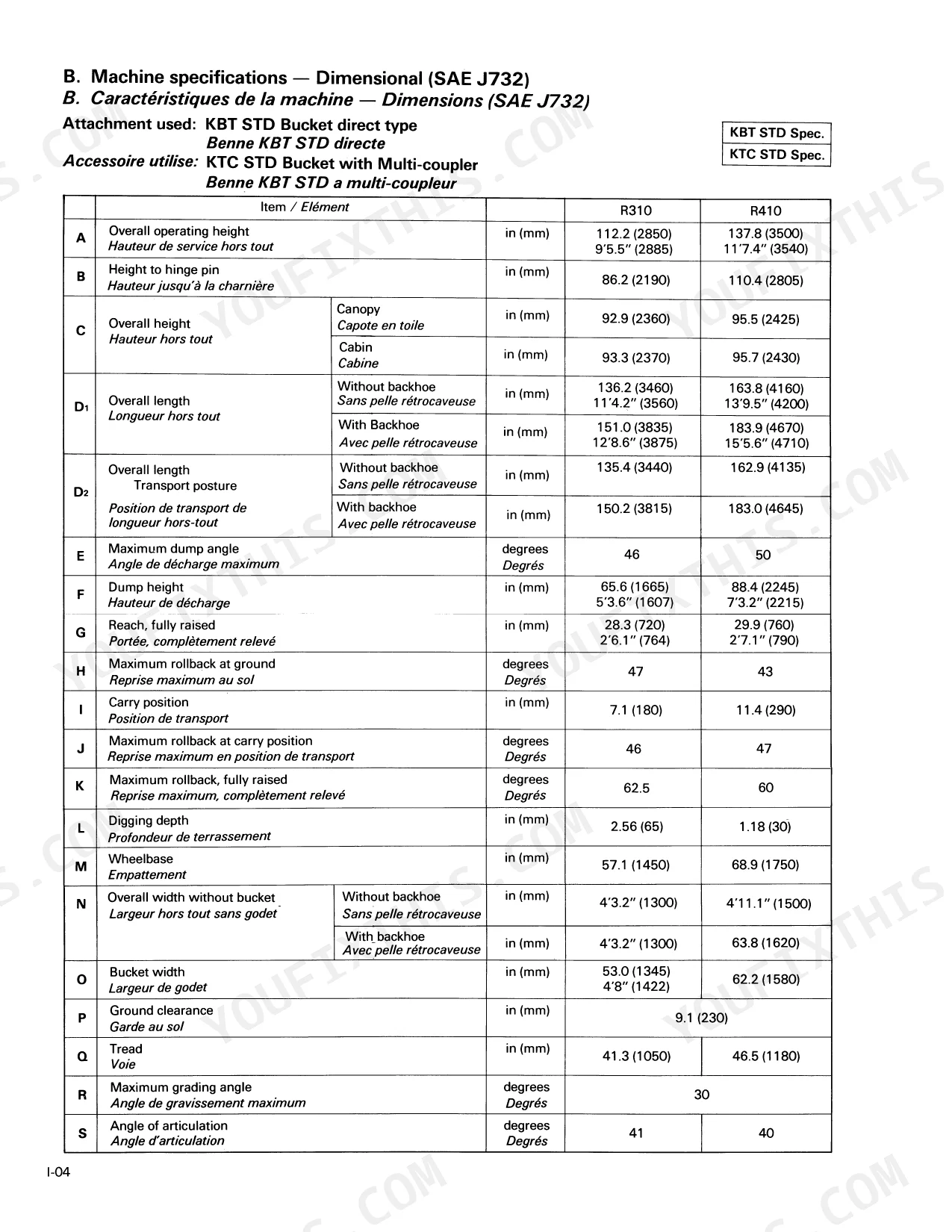
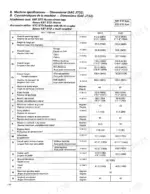
| Section I: General | - | Body, Engine and Backhoe Serial Numbers, Machine Specifications (Dimensional, Operational, Systematical), Routine Check Chart, Periodical Check and Maintenance Chart |
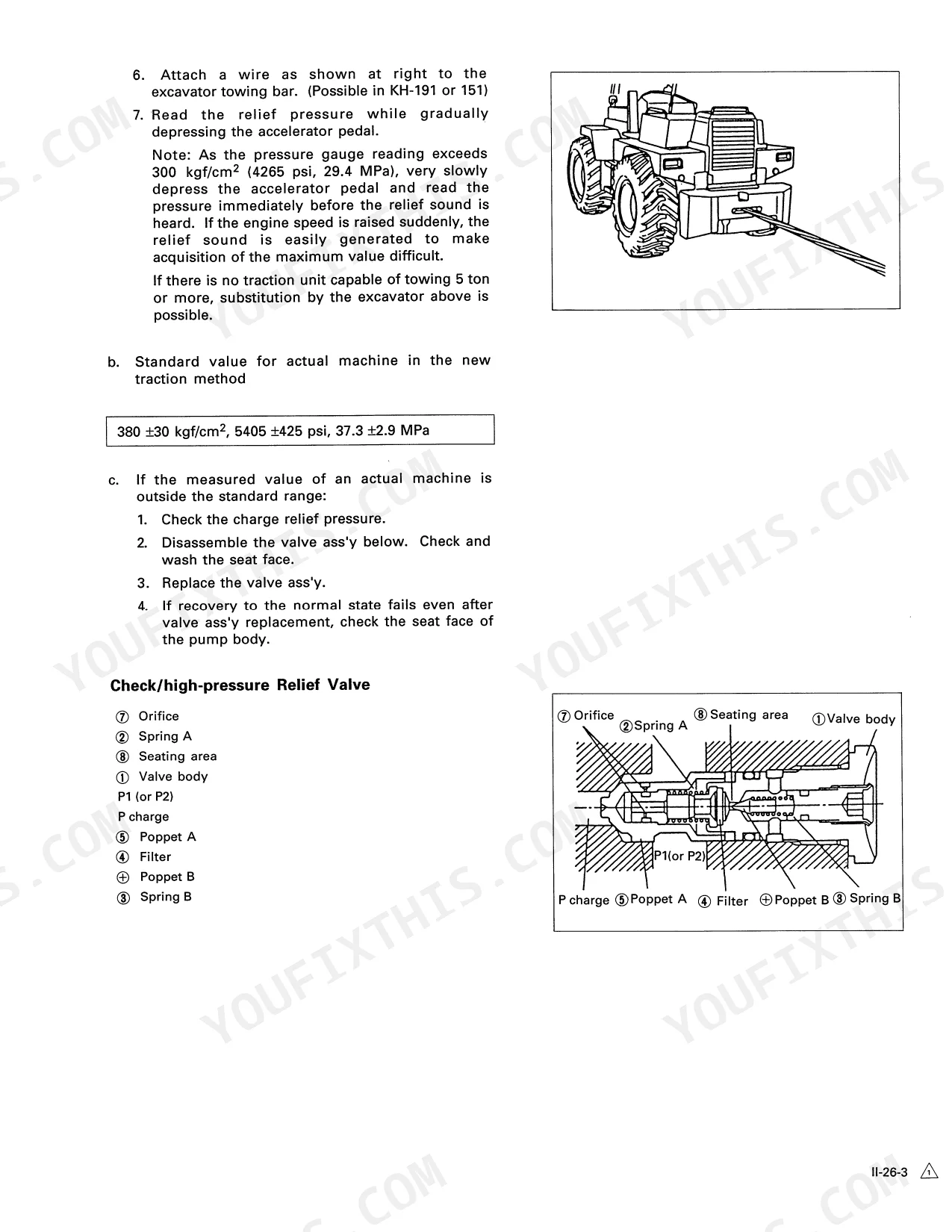
| Section II: A-LST System | - | Service Information (Traction Procedure), Specifications |
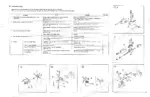
| Section III: Power Train | - | Specification, Servicing (Reduction Gear Case, Differential Axle, Propeller Shaft) |
| Section IV: Brake System | - | Specification, Testing & Adjustment (Pedal Stroke, Negative Brake Function, Braking Distance, Parking Brake Capacity) |
| Section V: Steering System | - | Specification, Testing & Adjustment (Main Relief Pressure, Overload Relief Pressure, Main Pump Flow Rate, Steering Wheel, Hoses and Fitting Installation) |
| Section VI: Front Shovel Loader | - | Specifications |
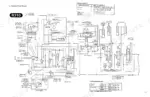
| Section VII: Backhoe | - | Mechanism (Oil Flow Chart, Hydraulic Circuit Diagram), Routine Maintenance |
| Section VIII: Structure | - | Specification (Center Pin & Bushing), Testing & Adjustment (Center Pin & Bushing Play), Servicing (Center Pin & Shaft, Hood, Rops/Fops Cab) |
| Section IX: Engine | - | Engine Performance Curve, Maintenance Standard, Tightening Torque, Service Information, Specification, Testing & Adjustment |
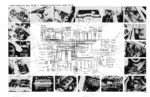
| Section X: Electrical | - | Data of Electrical Units, Location of Electrical Units, Electrical Circuit Diagram, Comparison of Electrical Wiring, Wire Harness Clamp Location |
| Section XI: Optional units & Attachments | - | List of Optional Unit & Attachment, Limited Slip Differential (LSD) |
Every system also includes troubleshooting.
Quick Reference Specifications
| Specification | Value | Page |
|---|---|---|
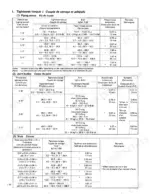
| Piping screw torque (1/8") | 7.8 – 11.8 N.m (5.8 – 8.7 ft.lbf, 0.8 – 1.2 kgf.m) | p. 29 |
| Piping screw torque (1/4") | 24.5 – 29.5 N.m (18.1 – 21.7 ft.lbf, 2.5 – 3.0 kgf.m) | p. 29 |
Kubota R310(B), R410(B) Common Problems This Manual Covers
Kubota R410 wheel loader bucket won't raise or lifts very slowly under load
Trace the flow path on the hydraulic circuit diagram, then inspect every loader lift fitting; torque any loose 3/8" piping screws to 49.0 – 58.9 N.m (36.2 – 43.4 ft.lbf). Confirm the hydraulic fluid sits at the full mark and the filter is clear. Test system relief pressure at the diagnostic ports.
Manual Section: Section VI: Front Shovel LoaderSteering wheel hard to turn or pulls to one side during travel
Inspect the steering hydraulic lines for kinks or leaks, then check every 1/2" piping connection and torque to 68.8 – 83.4 N.m (50.8 – 61.4 ft.lbf) if loose. Confirm main relief pressure at the test ports against the listed figures. Bleed air from the steering circuit and check the fluid level before returning to service.
Manual Section: Section V: Steering SystemEngine cranks slowly or fails to start when ambient temperature drops below freezing
Clean battery terminals of corrosion and test voltage under load; cold-start failures usually trace to weak batteries below 12.4V. Inspect glow plugs for continuity and confirm the fuel filter is not waxed. Review the engine troubleshooting procedures for the full start-fault decision tree before condemning the injection system.
Manual Section: Section IX: EngineBrake pedal spongy or goes to floor, machine won't hold on grade
Bleed the brake circuit starting at the wheel cylinder farthest from the master cylinder; check fluid level between bleeds and torque any loose 1/4" brake line fittings to 24.5 – 29.5 N.m (18.1 – 21.7 ft.lbf). Test braking distance per the adjustment procedure and verify pedal stroke falls within specification. Compare diagnostic test values if the system still fails to hold.
Manual Section: Section IV: Brake SystemExcessive play in articulation joint, clunking felt through steering wheel on turns
Measure center pin and bushing play with a dial indicator and compare it to the listed clearance limits. Replace the bushings if play exceeds spec. On reassembly, torque any 3/8" hydraulic fittings disturbed during disassembly to 49.0 – 58.9 N.m (36.2 – 43.4 ft.lbf) and confirm the articulation moves freely through its full range.
Manual Section: Section VIII: StructureElectrical warning lights on dash, machine won't start or shuts down unexpectedly
Verify battery voltage is at least 12.4V with the key off, then check all fuse positions and ground strap connections. Trace the fault on the wiring diagram to pin down open circuits or shorts before swapping components. Look over the sensor harness clamp locations for chafing that could cause intermittent shorts.
Manual Section: Section X: ElectricalFrequently Asked Questions
What are the recommended service intervals?
Intervals are laid out by hour. Every 50 hours, check battery liquid level, engine oil level, operating oil level, fuel level, and the brake fluid cup. Every 250 hours, drain and change the engine oil and replace the engine oil filter. Every 500 hours, change and replenish oil in the front and rear axle differentials, check fan belt tension, and clean or check the air cleaner element. Heavier jobs like changing the hydraulic oil suction filter or checking the alternator fall on a 1000-hour interval.
What fluids and capacities does this machine require?
Each system takes a specific fill. On the R310, the fuel tank holds 6.87 gal (26L), the engine oil pan 1.14 gal (4.3L), and the hydraulic system (without backhoe) 6.3 gal (24L). The brake fluid cup takes 0.08 gal (0.3L) of Hydraulic oil ISO VG 32. Oil specifications for different temperature ranges are also listed.
How to troubleshoot engine won't start?
When the engine won't start and the starter does not drive properly, suspect the pinion and ring gear failing to mesh, a slipping clutch, or excessive pinion gap. Fixes range from replacing worn parts like the pinion and ring gear to adjusting the pinion gap or swapping faulty electrical components such as the main switch or magnet switch. Also confirm the battery is well charged and the terminal contacts are clean.
What are the hydraulic system specifications?
Parameters vary by system. On the LST system, the charge pump flow rate is 4.9±0.1 gal/min for the R310 and 7.2±0.1 gal/min for the R410. The bench maximum high pressure relief setting is 4480±70 psi (315±5 kgf/cm²) on both models. Steering main relief pressure runs 1990±30 psi (140±3 kgf/cm²) on the R310 and 2135±70 psi (150±5 kgf/cm²) on the R410.
How quickly can I access this Kubota R310(B), R410(B) manual after buying?
Immediate download of the full 448-page searchable Service Manual. Open it on any device, whether that's a laptop at your desk or a phone out in the field.
Am I able to print pages from this Kubota R310(B), R410(B) manual?
Yes. The PDF carries no DRM restrictions, so print any page or section you need for the shop. It works with any standard printer.
Can I find wiring schematics in this Kubota R310(B), R410(B) manual?
Yes. You'll find full electrical schematics with wire routing diagrams, connector identification, and circuit descriptions.
Document Quality
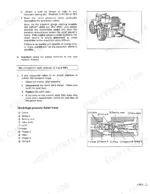
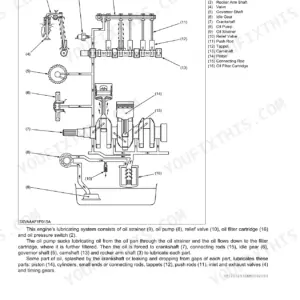
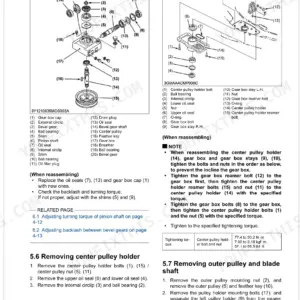
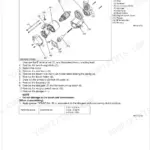
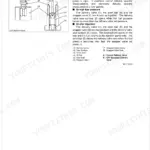
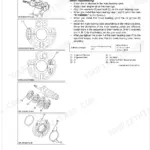
This document is a scanned PDF with an OCR layer, allowing you to search and copy the full text content. The main body text is crisp and consistently easy to read throughout. Diagrams and illustrations are primarily scanned images, which show some pixelation when zoomed, but labels are generally readable. Pages are clean with no scan artifacts or skewed content, though several blank pages are included between sections.

Reviews
There are no reviews yet.