

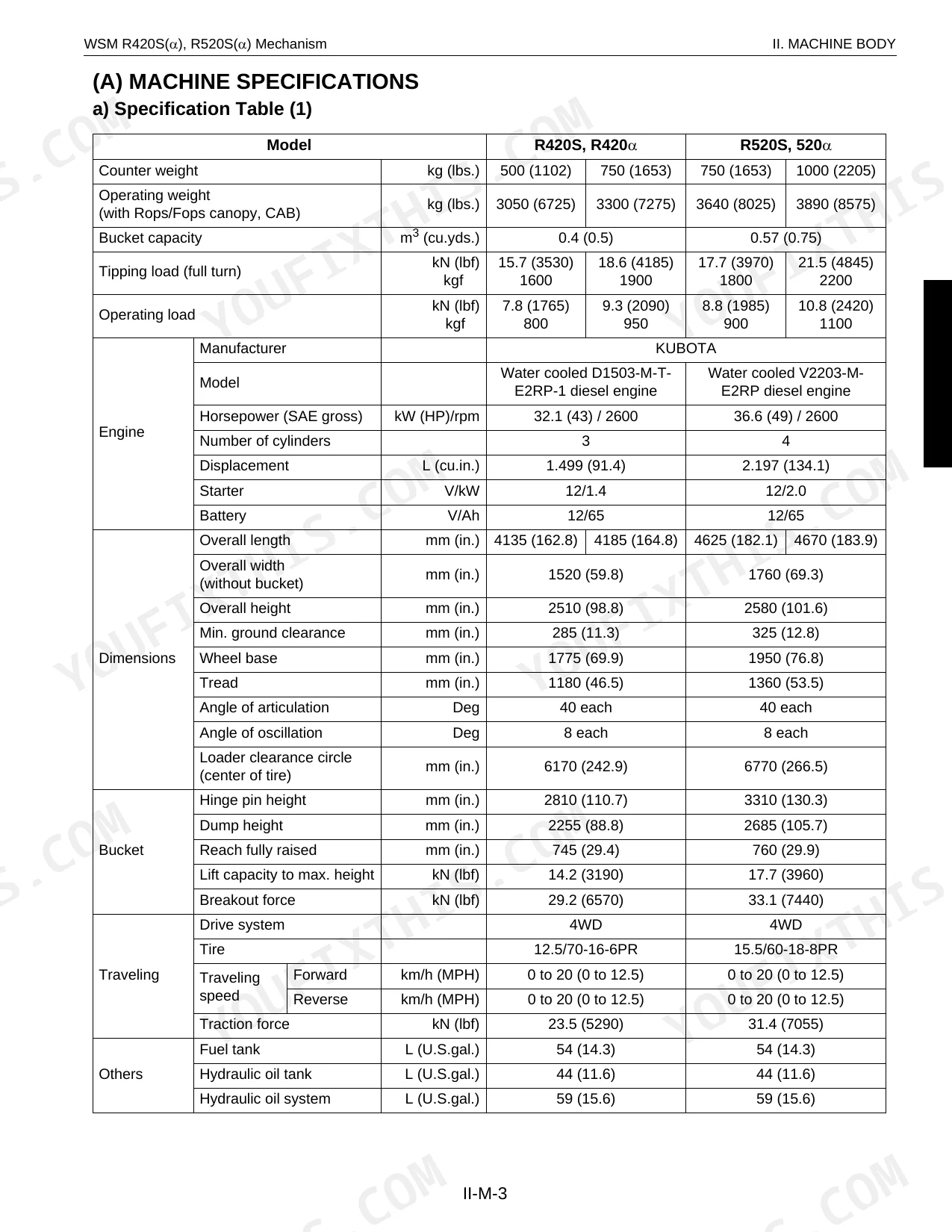
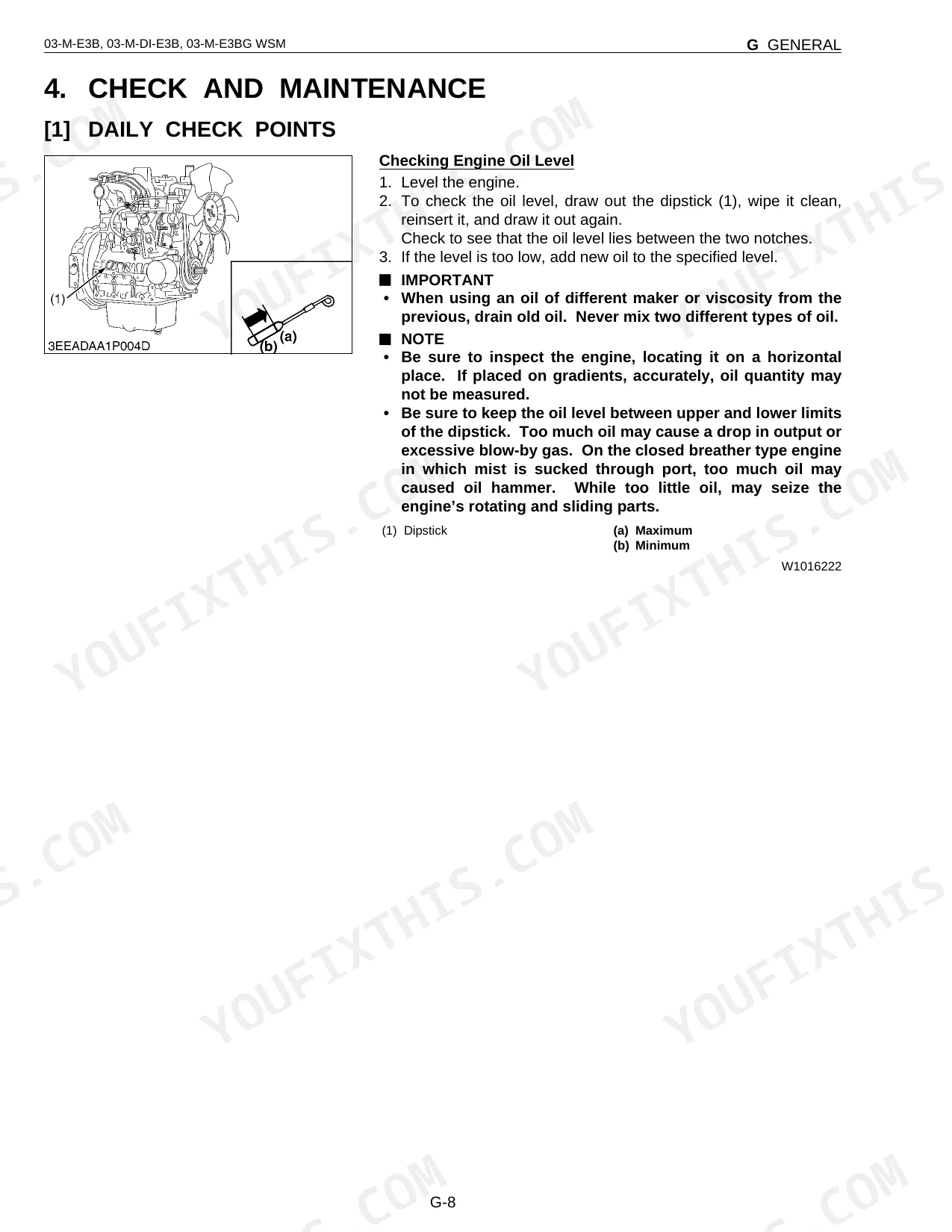

Need factory rebuild data for your Kubota R420S wheel loader? This OEM manual (part #97899-62060) was written around the R420α, R520α, R420S, and R520S, covering everything from the LST hydrostatic transmission to the Tier 4 emissions engine across 820 pages. Hydraulic circuit diagrams trace the full LST pump and DA valve routing, and the wiring schematics cover both PP- and EU-spec machines. Expect 100 pages of step-by-step service procedures, 15 pages of machine specifications, seven pages of hydraulic troubleshooting, 10 pages of exploded assembly views, torque tables, and error codes for electrical fault diagnosis. The hydraulic tank holds 42 L (11.1 U.S.gals); engine oil changes fall at 50-hour intervals, 7.0 L for the R420 or 9.5 L for the R520. With a loader sitting idle and losing money, you can pull the bookmarked, keyword-searchable file up on your phone or tablet before you pop the hood.
What's Inside This Kubota R420–R520 Series Manual
| System | Pages | Key Topics |
|---|---|---|
| I. General | 5-28 | Body and Engine Identifications Marks, Safety Precautions for Servicing, Disassembly and Reassembly (a) Safety measures before starting work, b) Safety measures during work |
| II. MACHINE BODY-Mechanism | 29-55 | Machine Specifications (a) Specification Table, b) Specification Table, Backhoe-version, c) Lifting Capacity), Development Concept of Model Change (a) Two Main Concepts |
| Ii. Machine Body & Front Attachment-Service | 56-117 | Machine Specifications (a) Specification Table: PP-version, b) Main Specification: EU-version, c) Dimensional Specifications, d) Specification Table: Backhoe, e) Parts Weight Table |
| III. ENGINE-Mechanism | 118-135 | Engine Specifications, Engine Performance Curve, New Emissions Control Engines (a) Outline, b) Engine List for Minor Change |
| III. ENGINE-Service | 136-354 | Specifications, Engine Assy Dismounting, Engine Accessories (a) Engine Rubber Mount, b) Radiator, Oil Cooler, c) Air Cleaner, d) Muffler, e) Muffler Installation |
| IV. HYDRAULIC SYSTEM-Mechanism | 355-391 | Circuit Diagram & Components (a) Hydraulic Circuit Diagram, b) Components Layout), Lst Pump (a) Function of LST Pump, b) Servo Cylinder, c) High-pressure Relief Valve |
| Iv. Hydraulic System-Service | 392-573 | Troubleshooting (a) Hydraulic system does not work, b) Weak lifting, any circuit, c) Slow lifting, d) Cylinder Fall, e) Does not travel in both the F and R directions |
| V. Brake System and Power Train-Mechanism | 574-589 | Outline, Parking Brake, Service Brake: Axle Brake, Negative Brake Releasing Method, Power Train Components (a) Front differential axle shaft assy |
| V. Brake System and Power Train-Service | 590-617 | Brake System (a) Negative Brake, b) Parking Valve), Power Train (a) Front Axle, b) Rear Axle, c) Differential Gear, d) Reduction Gear Case Assembly, e) Differential Ass'y Assembly |
| Vi. Electrical System-Mechanism | 618-623 | (A) Electrical Wiring: R420S/Α, R520S/Α, (B) Electrical Circuit Diagram |
| Vi. Electrical System-Service | 624-689 | Testing, Troubleshooting (a) Battery discharges quickly, b) Starter does not drive engine properly, c) Forward and reverse run not selectable, d) Low-speed hold not effective |
| VII. BACKHOE-Mechanism | 690-695 | (A) Oil Flow Chart of Backhoe, (B) Hydraulic Circuit Diagram |
| VII. BACKHOE-Service | 696-743 | Specifications (a) General Dimension, b) Operating Performance, c) Lifting Capacity, d) Hydraulic System Data, e) Bucket, Boom, Arm Data, f) Pin and Bushing Dimensions) |
| Viii. Supplement | 744-815 | Fundamentals of Wheel Loader (a) Glossary, b) Relevant Performance Data), Introduction of Lst System, Introduction of Steering System (a) Steering Performance |
| Conversion Tables | 816-820 | Length, Area, Volume, Flow/discharge, Force (Weight), Stress |
Quick Reference Specifications
| Specification | Value | Page |
|---|---|---|
| All Models | ||
| Battery liquid level check interval | Every 50 hrs | p. 16 |
| Fuel tank drain interval | Every 50 hrs | p. 16 |
| Hydraulic Oil Tank Capacity | 42 L (11.1 U.S.gals) | p. 59 |
| Fuel Tank Capacity | 54 L (14.3 U.S.gals) | p. 18 |
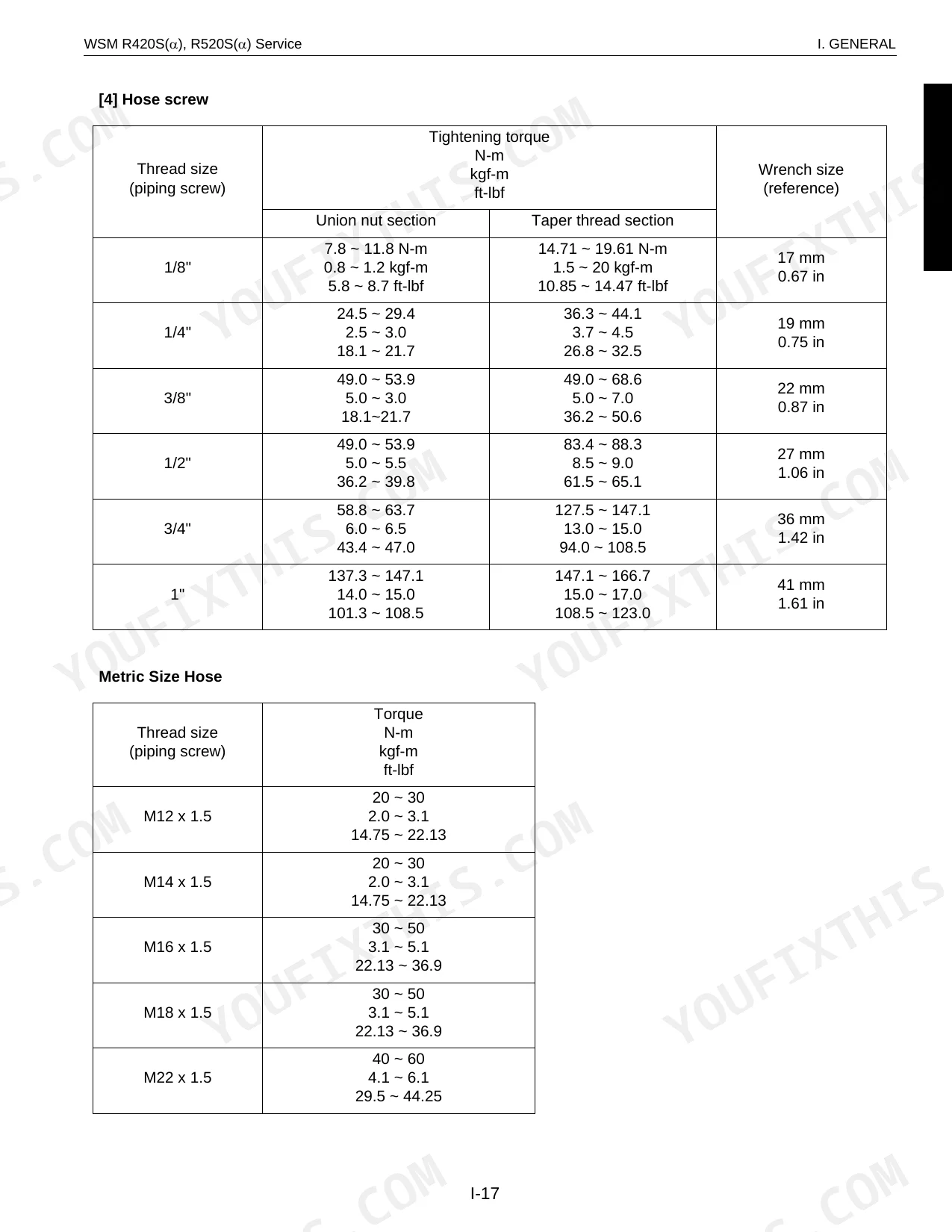
| Hose Screw Tightening Torque (1/8" Union nut section) | 7.8 ~ 11.8 N-m | p. 21 |
| M6 Bolt Tightening Torque (Standard Screw and Bolt) | 7.9 ~ 9.3 N-m | p. 24 |
| Engine Valve Clearance (When Cold) | 0.18 to 0.22 mm | p. 257 |
| R420S, R420α | ||
| Engine Oil Capacity (124 mm oil pan depth) | 7.0 L (1.8 U.S.gals) | p. 18 |
| R520S, R520α | ||
| Engine Oil Capacity (124 mm oil pan depth) | 9.5 L (2.5 U.S.gals) | p. 18 |
| R420S | ||
| Tire Pressure (Front/Rear) | 2.6 bar (36.9 ± 1.4 psi) | p. 26 |
| R520S | ||
| Tire Pressure (Front/Rear) | 2.2 bar (31.2 ± 1.4 psi) | p. 26 |
| D1503-M, D1703-M, D1803-M, V2003-M, V2203-M, V2403-M, V2403-M-T, D1703-M-BG, V2003-M-BG, V2003-M-T-BG, V2203-M-BG, V2403-M-BG | ||
| Engine Compression Pressure (When Cranking) | 3.24 to 3.72 MPa | p. 257 |
Kubota R420–R520 Series Common Problems This Manual Covers
Kubota R420α wheel loader engine cranks slowly or won't start in cold morning temperatures
Check the battery fluid level and test charge before a cold start; the maintenance schedule on page 16 lists battery checks every 50 hrs. Confirm glow plug operation by watching the preheat indicator. Review the cold-start troubleshooting steps and verify engine oil viscosity matches current ambient temperatures.
Manual Section: Engine Body TroubleshootingBucket lifts slowly or won't reach full height on the R420S or R520S, lift arms straining under load p. 392
Inspect hydraulic oil level; tank capacity is 42 L (11.1 U.S.gals). Verify suction filter, return filter, and LST oil filter cartridges are within their 500-hr service interval per page 16. Trace the weak-lifting circuit using the Hydraulic System-Service troubleshooting steps on page 392 and pressure-test the relief valve for proper setting.
Manual Section: Hydraulic System General TroubleshootingBattery drains overnight, starter spins weakly or won't engage at shift start p. 624
Test battery under load and check electrolyte level; inspect every 50 hrs per the maintenance schedule on page 16. Measure alternator output voltage and check for parasitic current draws in the wiring harness. Follow the battery-discharge and starter troubleshooting sequence on page 624. Inspect the alternator and starter motor at the 1,500-hr service interval.
Manual Section: Electrical System TroubleshootingEngine temperature gauge climbs into red zone during normal work cycles, coolant boiling
Measure fan belt deflection against the 7.0 to 9.0 mm spec on page 207. Inspect the radiator core for plugged fins and confirm coolant level in both the main and reserve tanks. Replace coolant twice a year, in Spring and Autumn, per page 17. Confirm the thermostat opens at the correct temperature.
Manual Section: Engine Body TroubleshootingForward and reverse travel cannot be selected, machine stays stationary when lever is moved p. 624
Verify the forward/reverse lever switch outputs and test wiring continuity at each coupler; annual electrical circuit inspection intervals are on page 16. Cross-reference the F/R selection circuit wiring diagram on page 623. Follow the forward-and-reverse-not-selectable troubleshooting sequence on page 624 and check for any blown fuses in the control circuit.
Manual Section: Electrical System TroubleshootingLoaded bucket slowly drifts down after lifting to transport height, cylinder creep visible p. 392
Hold the loaded boom at full raised height and watch for cylinder creep; confirmed internal bypass means seal replacement is needed. Check hydraulic oil condition and verify return filter and suction filter replacement at 500 hrs per page 16. Review the cylinder-fall troubleshooting steps on page 392 and test the main control valve spool for wear.
Manual Section: Hydraulic System General TroubleshootingFrequently Asked Questions
What are the recommended service intervals?
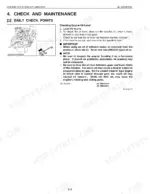
A Service Interval Chart lays out each maintenance item. Battery liquid level gets a check 'every 50 hrs', engine oil with a 90 mm oil pan depth changes 'every 50 hrs', and coolant is replaced 'Twice a year (Spring and Autumn)'.
What fluids and capacities does this machine require?
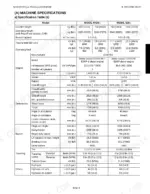
The fuel tank takes 54 L (14.3 U.S. gal.) of diesel. Engine oil pan capacity is 7.0 L (1.8 U.S. gals) for the D1503-M, D1703-M, D1803-M, and D1703-M-BG with a 124 mm (4.88 in.) oil pan depth. Hydraulic oil tank capacity runs 44 L (11.6 U.S. gal.), with a total hydraulic system capacity of 59 L (15.6 U.S. gal.).
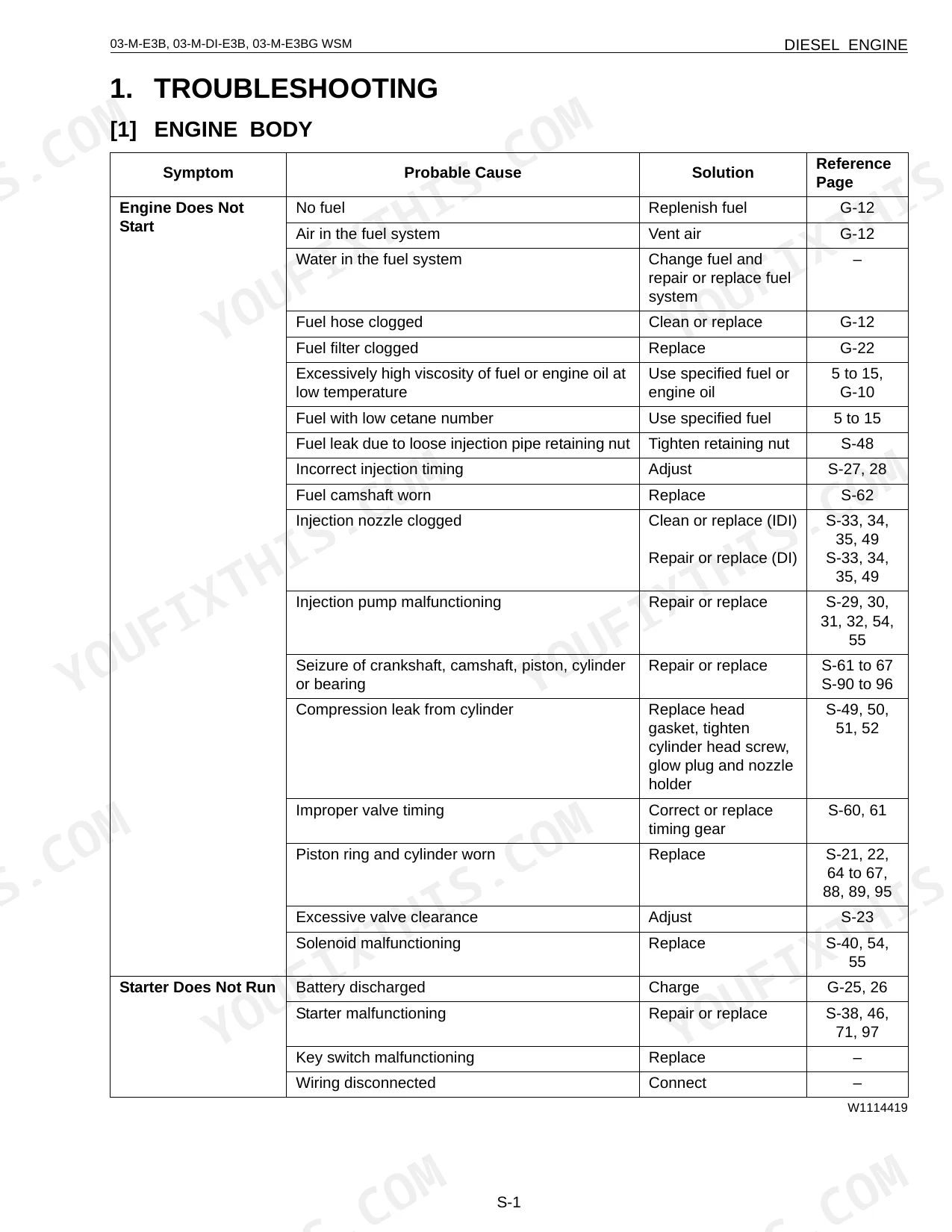
How to troubleshoot engine won't start?
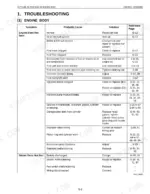
When the engine won't start, likely causes include 'No fuel' (Replenish fuel, page G-12), 'Air in the fuel system' (Vent air, page G-12), or 'Fuel hose clogged' (Clean or replace, page G-12). 'Incorrect injection timing' calls for adjustment instead (page S-27, 28).
What are the hydraulic system specifications?
At 2600 rpm, the LST pump delivers a theoretical 72.8 L/min (19.2 usgal). Main pump maximum delivery is 42.12 L/min (11.13 us gal.) on the R420S and R420α. The hydraulic tank holds 54 L (14.27 usgal), and the oil thermo switch trips at 110 ± 2°C (230 ± 35.6°K).
How quickly can I access this Kubota R420–R520 Series manual after buying?
Immediate download of the complete 820-page searchable workshop manual. Open it on any device: laptop at your desk or phone out in the field.
Am I able to print pages from this Kubota R420–R520 Series manual?
None at all. The PDF is DRM-free, so print whatever sections you need to take out to the shop. Standard letter or A4 paper works fine.
Are electrical wiring diagrams included in this Kubota R420–R520 Series manual?
Yes, they're included. This workshop manual provides complete wiring harness diagrams, electrical circuits, and connector pinouts.
Document Quality
This is a scanned PDF document with an OCR text layer, allowing you to search and copy the full text. The text is consistently crisp and easy to read throughout. Diagrams and illustrations are raster images, but their labels remain clear and readable. Pages are generally clean, with no notable scan artifacts, stains, or skewed content. There are a few blank pages present, serving as filler between sections.


Reviews
There are no reviews yet.