
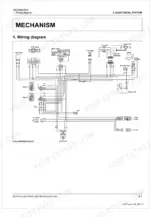
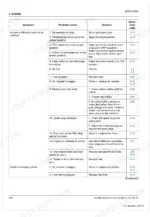
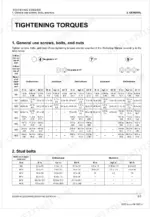
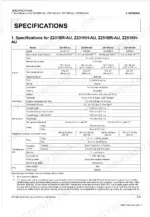
Covering OEM #9Y111-22201, this Kubota Z231-Z251 Series Service Manual spans 188 pages built around four AU-market zero-turns: the Z231BR-AU, Z231KH-AU, Z251BR-AU, and Z251KH-AU. Wiring diagrams trace the starting, charging, and PTO clutch circuits, while hydraulic schematics follow the full transaxle loop from pump through motor. The reference depth runs deep: 23 pages of tightening torques across metric, UNC/UNF, hydraulic fittings, and stud bolts; 50 pages of step-by-step procedures; and 11 pages of troubleshooting charts for the engine, transaxle, front axle, lift system, electrical system, and mower deck. Need numbers fast? Torque the electric clutch flange bolt to 62.8 N·m, fill the transmission case (filter, hose, and both tanks) to 4.8 L, and top the crankcase to 1.8 L. Every page is bookmarked and keyword-searchable, so you can find the fix on any device and get back to the machine.
What's Inside This Kubota Z231–Z251 Series Manual
| System | Pages | Key Topics |
|---|---|---|
| Supplementary Information | 3 | Model name and related manuals, Model name, Record of revisions, Main revised point and corrective measure |
| Record of Revisions | 4-10 | Main Revised Point And Corrective Measure, Last Digit Of The Code No, Month Of Revision, Reference Page |
| Safety | 11-21 | Safety First, Safety Decals |
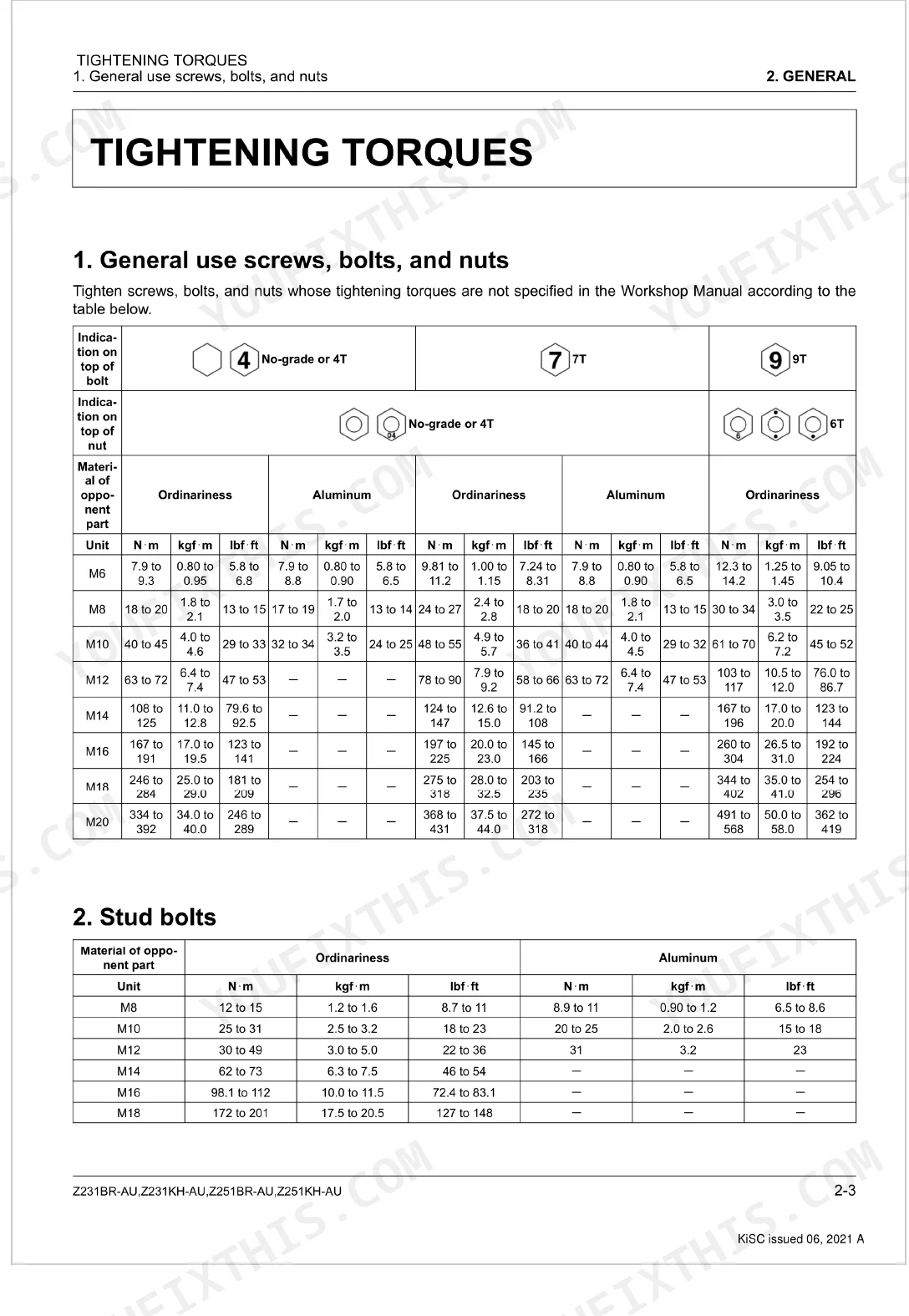
| General | 22-44 | Tightening Torques (Stud Bolts, Hydraulic Fittings, Metric Screws, Bolts and Nuts, American Standard Screws, Bolts and Nuts with UNC or UNF Threads, Plugs), Product Identification |
| Maintenance | 45-75 | Lubricants and Fuel, Service Intervals |
| Engine | 76-94 | Mechanism, Servicing |
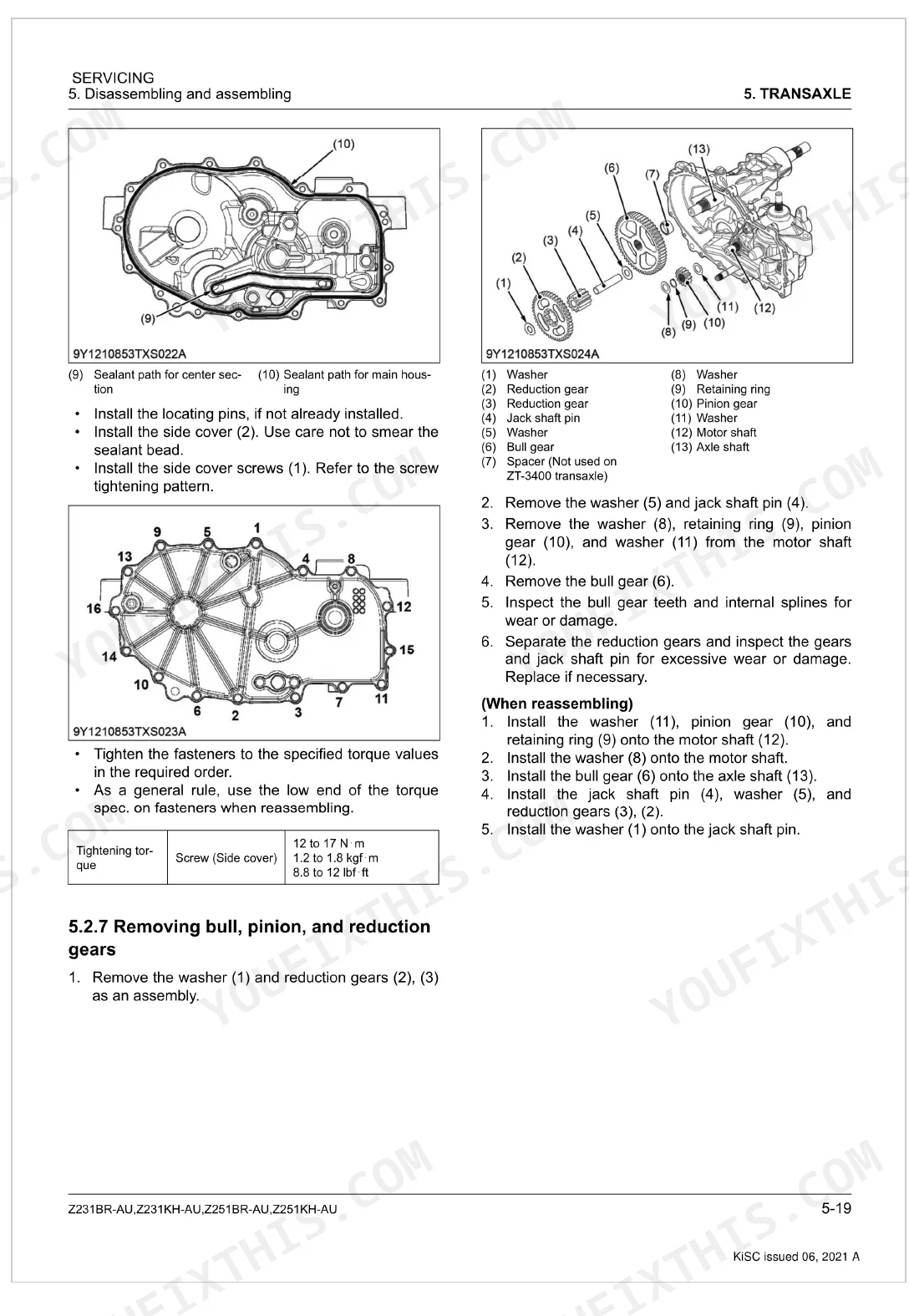
| Transaxle | 95-127 | Mechanism, Servicing |
| Front Axle | 128-134 | Mechanism, Servicing |
| Lift System | 135-143 | Mechanism, Servicing |
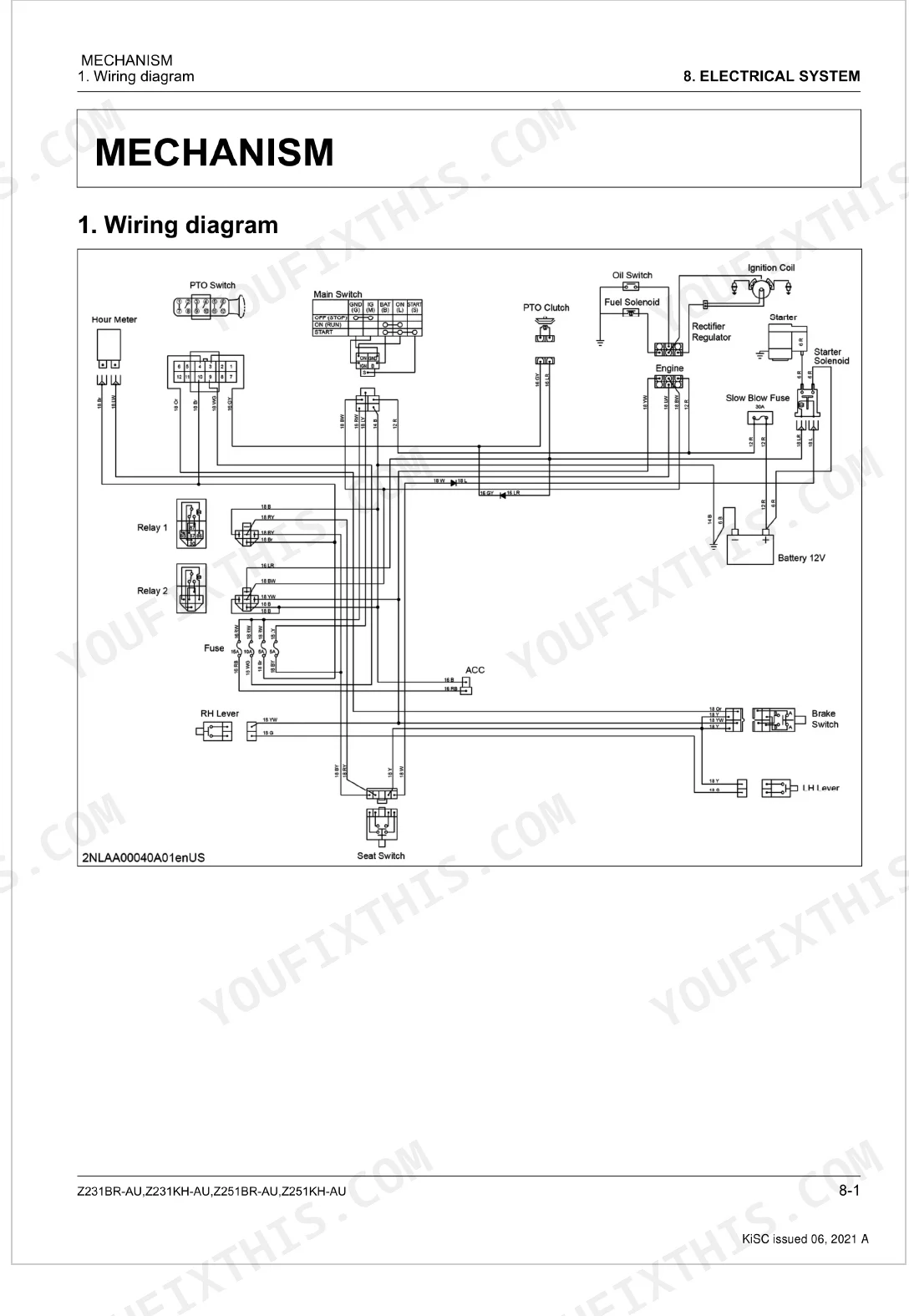
| Electrical System | 144-166 | Mechanism, Servicing |
| Mower | 167-188 | Mechanism, Servicing |
Quick Reference Specifications
| Specification | Value | Page |
|---|---|---|
| All Models | ||
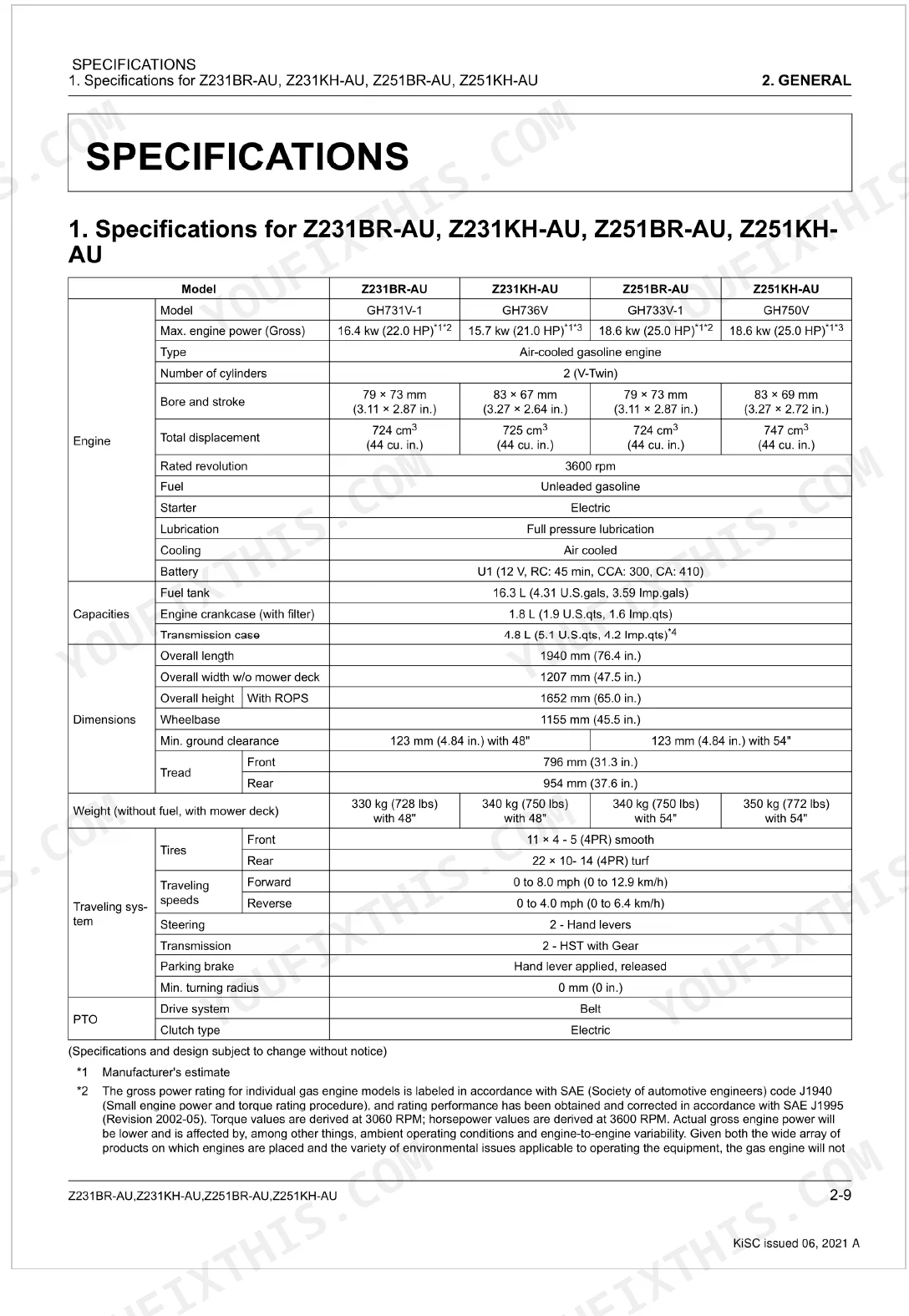
| Fuel tank capacity | 16.3 L (4.3 U.S. gals, 3.59 Imp.gals) | p. 46 |
| Engine crankcase capacity (with filter) | 1.8 L (1.9 U.S.qts) | p. 46 |
| Engine crankcase oil capacity (with filter) | 1.8 L | p. 46 |
| Transmission case fluid capacity (with filter, hose and tank) | 4.8 L | p. 46 |
| Flange bolt (Electric clutch) torque | 62.8 N·m | p. 86 |
| Hub retaining nut torque | 109 N·m | p. 105 |
| Blade bolt torque | 103 N·m | p. 175 |
| Front tire inflation pressure | 170 kPa (25 psi) | p. 55 |
| Rear tire inflation pressure | 110 kPa (16 psi) | p. 55 |
| Electric PTO clutch clearance | 0.35 mm | p. 156 |
| Z231BR-AU | ||
| Max. engine power (Gross) | 16.4 kw (22.0 HP) | p. 31 |
| Z231KH-AU | ||
| Max. engine power (Gross) | 15.7 kw (21.0 HP) | p. 31 |
Kubota Z231–Z251 Series Common Problems This Manual Covers
Kubota Z231BR-AU engine cranks but won't fire, hard to start in cold weather p. 82
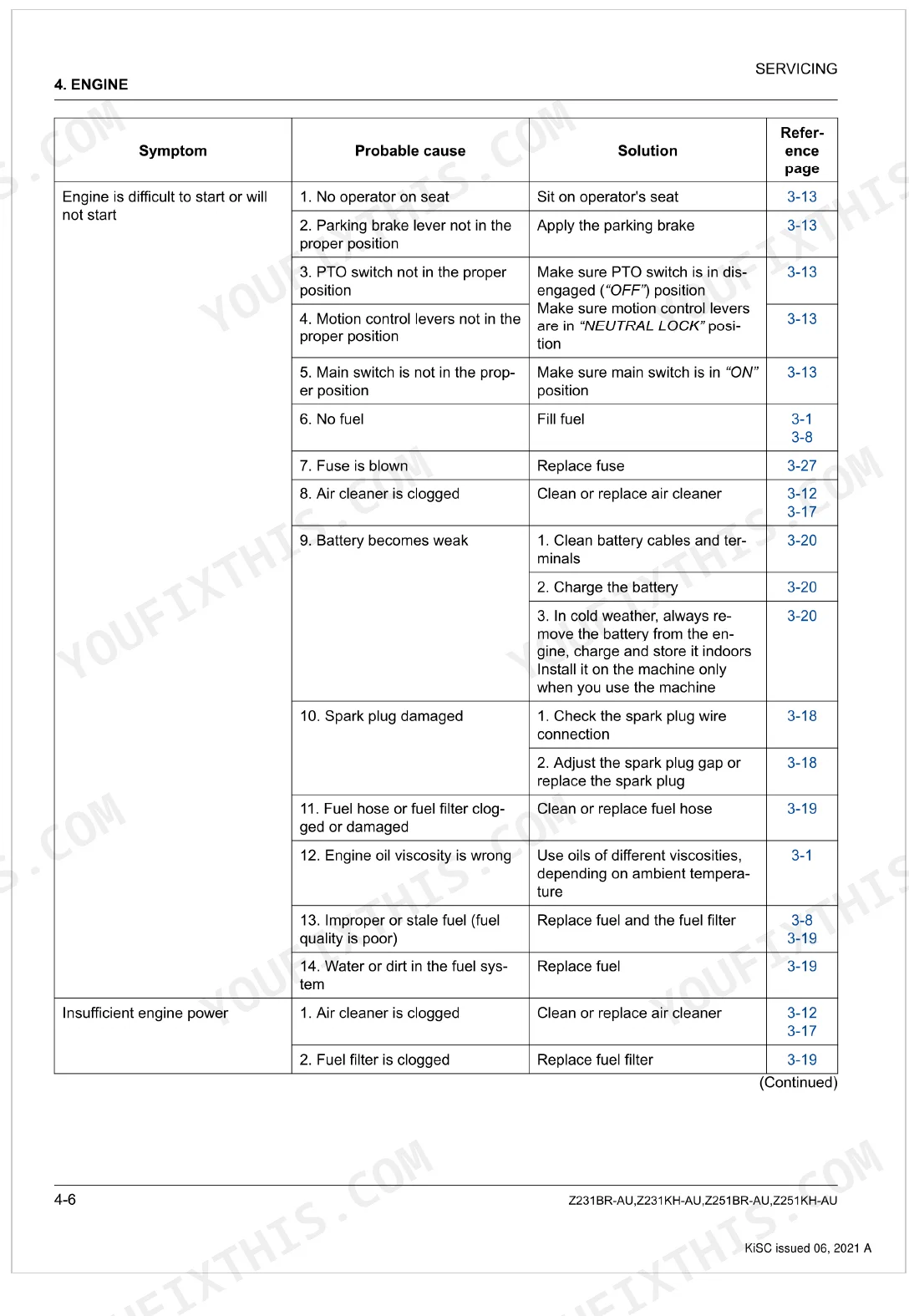
Check the fuel level first; tank capacity is 16.3 L (page 46). Inspect the spark plug for fouling or carbon buildup; replace annually per the schedule on page 48. Verify the fuel filter is clear and the choke plate closes completely. Work through the hard-start diagnostic sequence on page 82 with the PTO disengaged and the parking brake set.
Manual Section: EngineEngine is running but deck blades won't spin after engaging the PTO switch p. 156
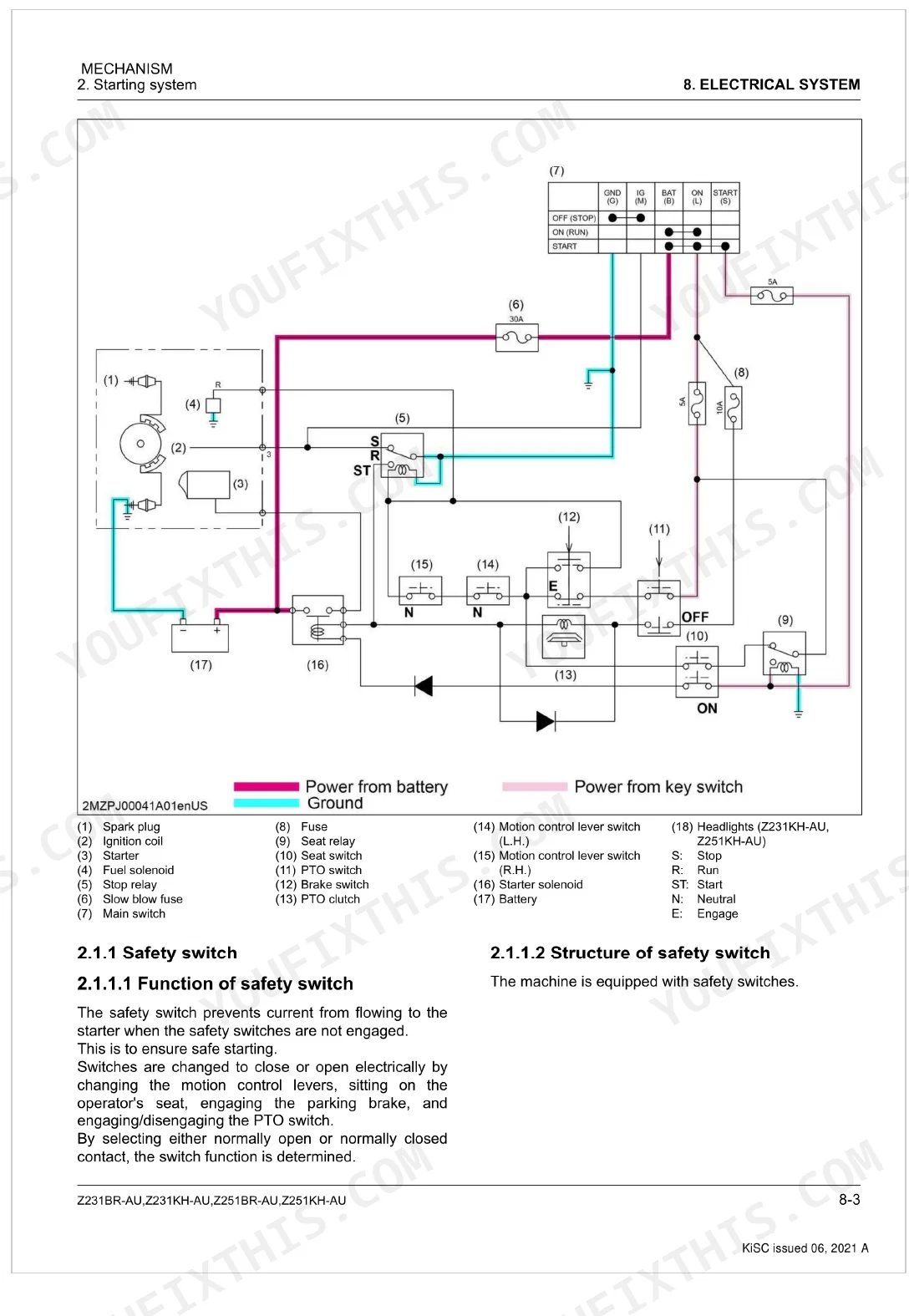
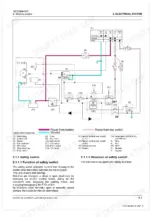
Verify all seat, parking brake, and PTO safety switches are closed before condemning the clutch. Measure the electric PTO clutch air gap; spec is 0.35 mm per page 156. If out of spec, adjust the three nuts evenly around the rotor. Test PTO switch output voltage and trace the interlock circuit from the wiring diagram on page 145.
Manual Section: Electrical SystemMachine pulls consistently to one side and won't track straight at low speed p. 107
Measure tire pressure before touching any drive components; fronts take 170 kPa (25 psi) and rears take 110 kPa (16 psi) per page 55. Unequal inflation is the most common cause of tracking drift. If tires check out, run the neutral and range calibration procedure on page 107 to reset the transaxle zero-point on both sides.
Manual Section: TransaxleUneven cut height and visible streaks of uncut grass after every mowing pass p. 175
Inspect both blades for bends, nicks, or wear; remove and sharpen or replace as needed. Reinstall blade bolts to 103 N·m per page 175. Check that the mower deck is level side-to-side and front-to-rear. Verify rear tire pressures are equal at 110 kPa (16 psi) per page 55, since unequal inflation tilts the deck and causes stripe patterns.
Manual Section: MowerTransaxle gets hot and smells of burnt oil after extended work on slopes p. 48
Drain and measure the transaxle fluid; total system capacity is 4.8 L including filter, hose, and both tanks per the spec on page 46. Check your hours against the oil filter replacement interval on page 48 and replace if past 400 hours. Inspect the cooling fins and transaxle case exterior for packed grass and debris, then clear any blockage before refilling.
Manual Section: TransaxleMower deck belt squealing loudly or throwing off pulleys in heavy wet grass p. 175
Examine the belt for cracking, glazing, or fraying and replace as required per the maintenance schedule. Check that the idler tension arm pivots freely and the spring is not stretched or broken. Torque the tension arm lock nut to 77.4 to 90.2 N·m per page 175. Verify the discharge chute is clear, since a plugged chute overloads the belt and shortens its life.
Manual Section: MowerFrequently Asked Questions
What are the recommended service intervals?
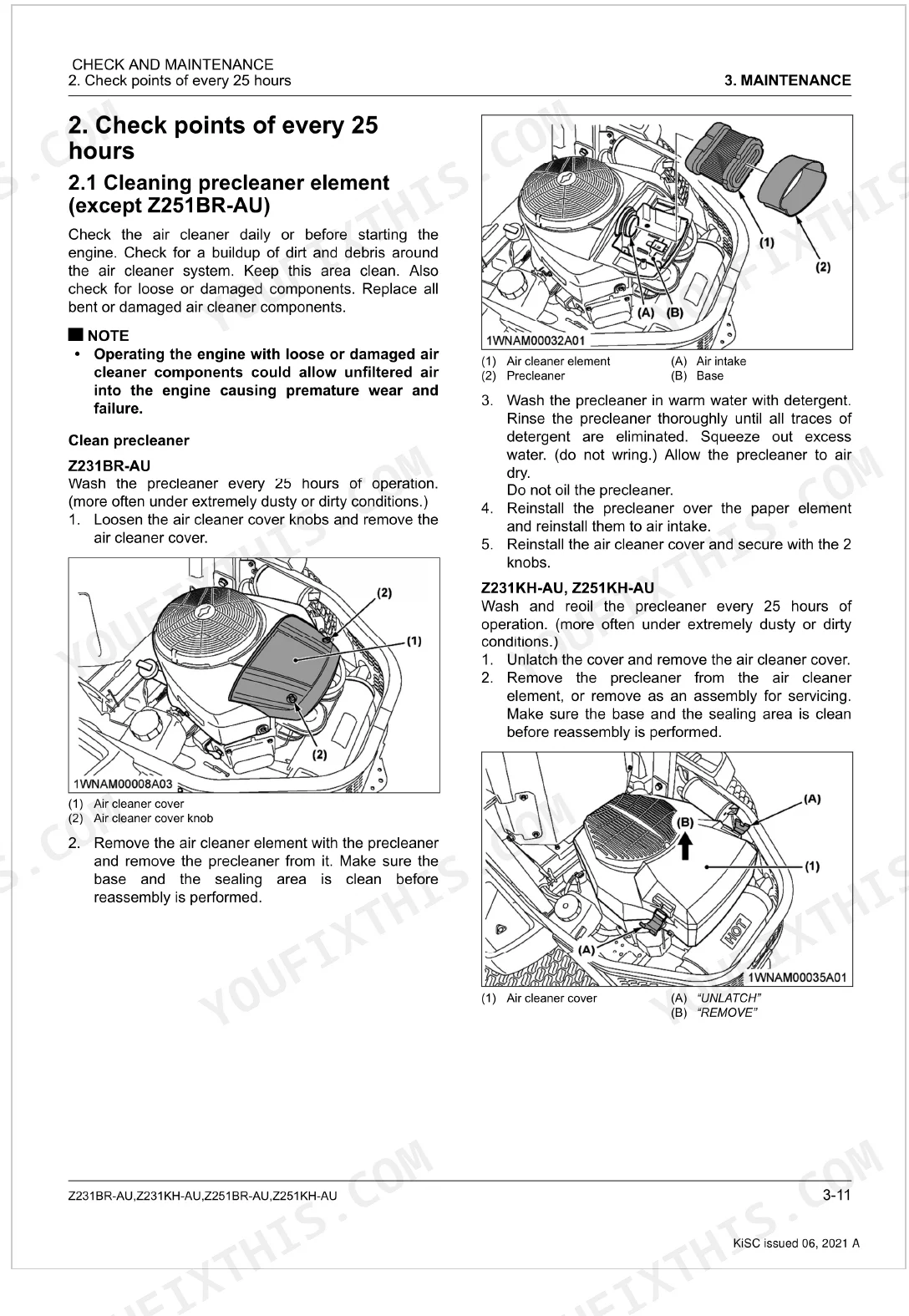
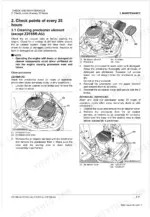
Service intervals are laid out in a dedicated table. Engine oil and its filter both go every 50 hours or once a year (page 3-14, 3-15). The transaxle oil filter and fluid run on a 400-hour cycle (page 3-23, 3-24), and hydraulic hoses get checked every 4 years (page 3-27).
What fluids and capacities does this machine require?
Fuel is unleaded gasoline, 87 octane/87AKI (90 RON) or higher, in a 16.3 L (4.3 U.S. gals.) tank (page 46). The engine crankcase holds 1.8 L (1.9 U.S.qts.) with the filter, using API SG, SH, SJ or higher oil (page 46). The transmission case (filter, hose, and tank) takes 4.8 L (5.1 U.S.qts.) of API SL, SAE20W-50 (page 46).
How to troubleshoot engine won't start?
Start with the safety interlocks: no operator on the seat, the parking brake disengaged, or the PTO switch out of the “DISENGAGE” (OFF) position will all block starting (page 82). Beyond those, check for no fuel, a blown fuse (page 3-27), a clogged air cleaner (page 3-12, 3-17), a weak battery (page 3-20), or a damaged spark plug (page 3-18). Fixes follow the cause: add fuel, replace the fuse, clean the air cleaner, charge the battery, or adjust or replace the plug.
What are the hydraulic system specifications?
The hydrostatic transaxle runs a 24.74:1 overall reduction and delivers up to 461 N·m (340 lbf·ft) of output torque (page 99). Input speed spans 1800 rpm at minimum to a 3600 rpm hi-idle with no load (page 99). On the service side, top speed at maximum engine rpm is 118 to 138 rpm (7.4 to 8.6 mph), and the L.H. to R.H. difference must stay under 2 rpm (0.1 mph) (page 104).
How quickly can I access this Kubota Z231–Z251 Series manual after buying?
A 188-page Service Manual in searchable PDF, ready the moment your checkout clears. Open it on a computer, tablet, or phone with no shipping wait.
Am I able to print pages from this Kubota Z231–Z251 Series manual?
Yes. Print as many copies as you like, with no restrictions. Plenty of mechanics print just the section they need and carry it to the shop floor.
Does this Kubota Z231–Z251 Series Service Manual cover the hydraulic system?
Yes. The manual includes full hydraulic diagrams covering circuits, valve locations, and component specs for the Kubota Z231-Z251 Series.
Document Quality
This is a high-quality native digital PDF document, allowing you to search and copy the full text content. All text, including in tables, is crisp and easy to read without any blurriness or fading. Diagrams and illustrations are a mix of sharp vector graphics and clear photographs, with all labels consistently readable. The pages are clean, free from scan artifacts, stains, marks, or skewing. There are several blank pages throughout the document, primarily serving as section dividers or filler.


Reviews
There are no reviews yet.