
Part of the Kubota Operator Manuals.
This is the Kubota SVL65-2 Operator's Manual, a 138 page PDF for the SVL65-2 compact track loader and its V2607-CR-TE4 diesel engine. It is the book that ships with the machine, covering safe operation, controls, daily use, and owner maintenance.
It walks through every instrument panel light and switch, the auxiliary hydraulic controls, mechanical and hydraulic quick-hitch use, the diesel particulate filter and its regeneration, and cold weather and long term storage steps. Technical data, recommended oils and fuels, fuse layouts, and a maintenance interval chart are all included.
You can use it to learn the machine, keep service on schedule, read warning lights and error codes, check capacities and tensions, and handle the SVL65-2 safely on inclines, ramps, and around attachments.
What's Inside This Kubota SVL65-2 Operator Manual
| System | Pages | Key Topics |
|---|---|---|
| Safe Operation | 11-28 | ROPS and Fops, Parking the Machine, Loading and Transporting the Machine, Maintenance, Emergency Exit, Safety Labels |
| Service of the Machine | 29-30 | Dealer Service (Warranty Policy, Procedure for Scrapping the Machine) |
| Technical Data | 31 | Specification Table |
| Machine Parts | 32-33 | Bucket, Tilt Cylinder, Armrest, Drive Motor, Rubber Track, Lift Arm |
| Instrument Panel and Switch | 34-46 | Instrument Panel (Fuel Gauge Indicator, Low Fuel Warning Light, Coolant Temperature Gauge, Checking the Coolant Temperature Gauge, Glow Plug Indicator, Parking Brake Warning Light, Bucket-Floating Indicator, Master Warning Light, Engine Oil Pressure Indicator, Battery Charge Warning Light, Hydraulic Oil Temperature Indicator, Hour Meter, Diesel-Particulate-Filter Regeneration Indicator, Engine Rev Up Indicator, Air Cleaning Warning Indicator) |
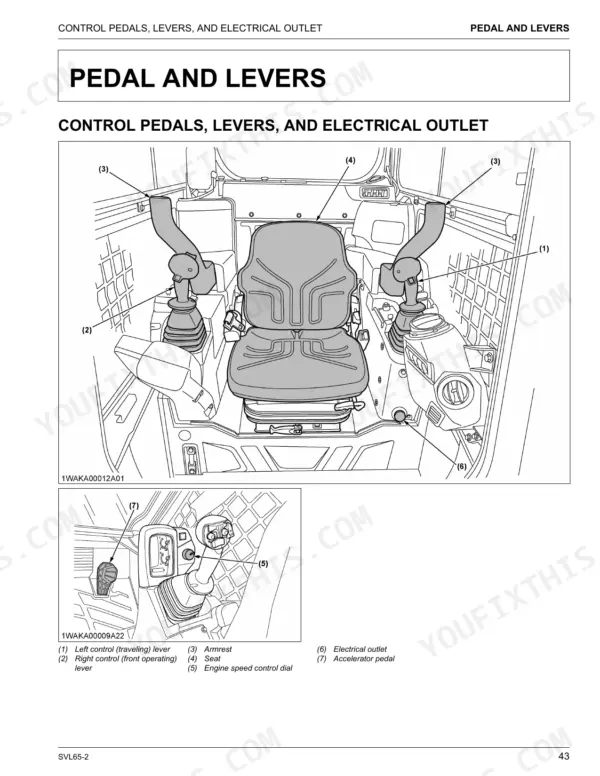
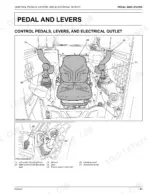
| Pedal and Levers | 47 | Control Pedals, Levers, And Electrical Outlet |
| Safety Features | 48-49 | How to Use the Emergency Exit, Opc Function, How to Use and Check the Function of the Armrest, How to Use and Check the Seat Function, How to Check the Reverse Alarm |
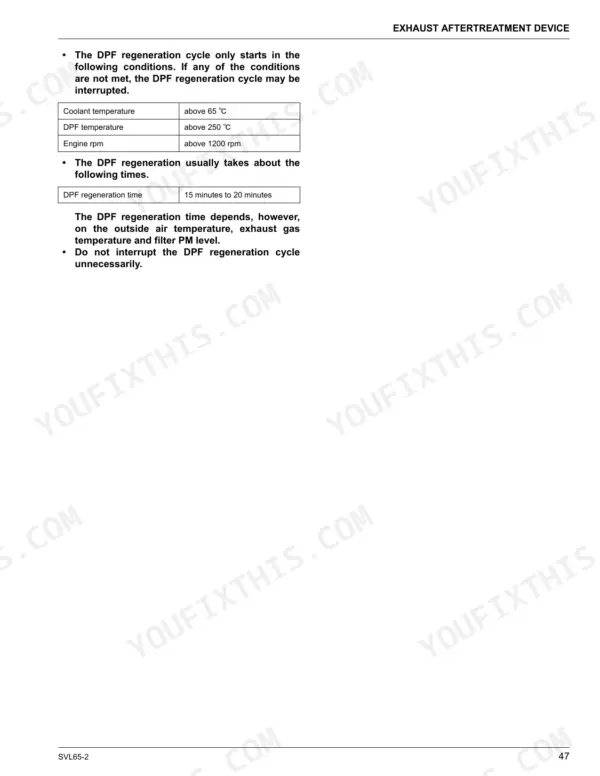
| Exhaust Aftertreatment Device | 50-51 | Catalyst-Containing Diesel-Particulate-Filter Device, Regeneration of Diesel-Particulate-Filter |
| Air Conditioner | 52-54 | Air Flow of the Air Conditioner, Air Control Vent, How to Use the Control Panel, Operating the Control Panel |
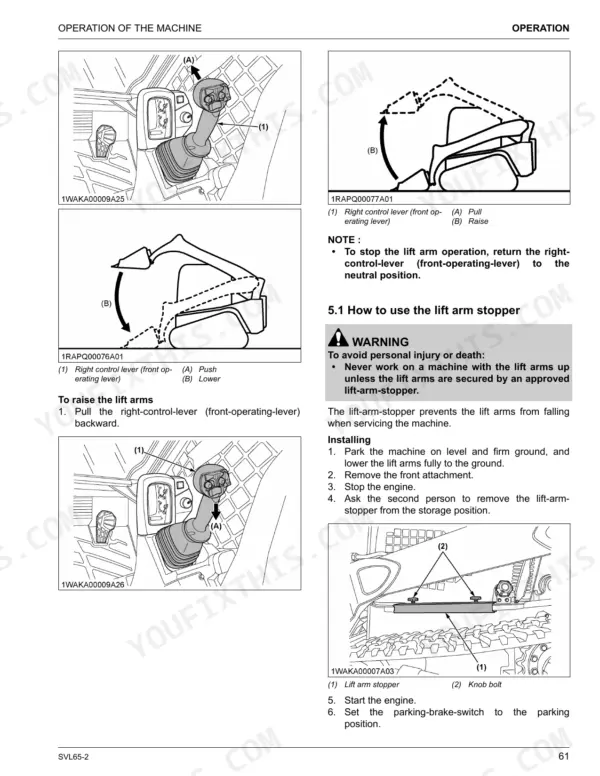
| Operation | 55-67 | Cab Type Machine (Interior Lamp, How to Use the Wiper/Washer Switch [Closed Cab Model], Opening and Closing the Cab Door [Closed Cab Model], Opening and Closing the Side Cab Window [Closed Cab Model]) |
| Auxiliary Hydraulic | 68-70 | How to Use the Auxiliary Hydraulic Control, Operating the Auxiliary Hydraulic Control |
| Quick-Hitch | 71-74 | How to Use the Mechanical Quick-Hitch, How to Use the Hydraulic Quick-Hitch |
| Machine Precaution | 75-77 | Important Information on Machine Operation (Caution While Traveling, Precaution When Traveling in High Speed, Precautions When Traveling on Inclines, Parking on an Incline, Prohibited Actions for the Machine, Prevention of Slippage of Rubber Tracks) |
| Lifting | 78-80 | Lifting the Machine |
| Transporting | 81-83 | Loading the Machine on a Transport Vehicle, Towing an Operable Machine, Towing an Inoperable Machine |
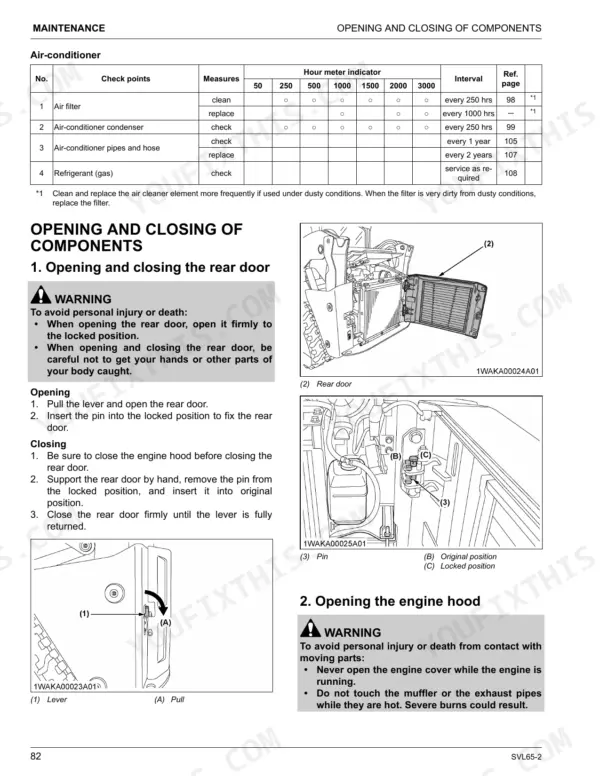
| Maintenance | 84-112 | Maintenance Intervals |
| Track | 113-114 | Tracks |
| Fuse | 115-117 | Fuses (Replacing the Fuse, Fuse Capacities and Circuits, Electrical Outlet, Slow Blow Fuse, Replacing the Bolted Slow Blow Fuse) |
| Troubleshooting | 118-125 | Troubleshooting of the Engine and Other Systems, List of the Error Code Numbers |
| Cold Weather | 126 | Preparation for Operation of the Machine in Cold Weather, Storing the Machine After Completion of Work in Cold Weather |
| Long Storage | 127-128 | Storing the Machine for a Longer Period of Time, Operating the Machine After Storing for a Long Period of Time (Periodic Replacement of Important Component Parts) |
| Recommended Oils | 129-132 | Greases, And Fuels, Biodiesel Fuel |
| Appendices | 133-134 | Main Dimensions of the Machine |
Quick Reference Specifications
| Specification | Value | Page |
|---|---|---|
| Cab lock bolts tightening torque | 77.5 N⋅m to 90.2 N⋅m | p. 89 |
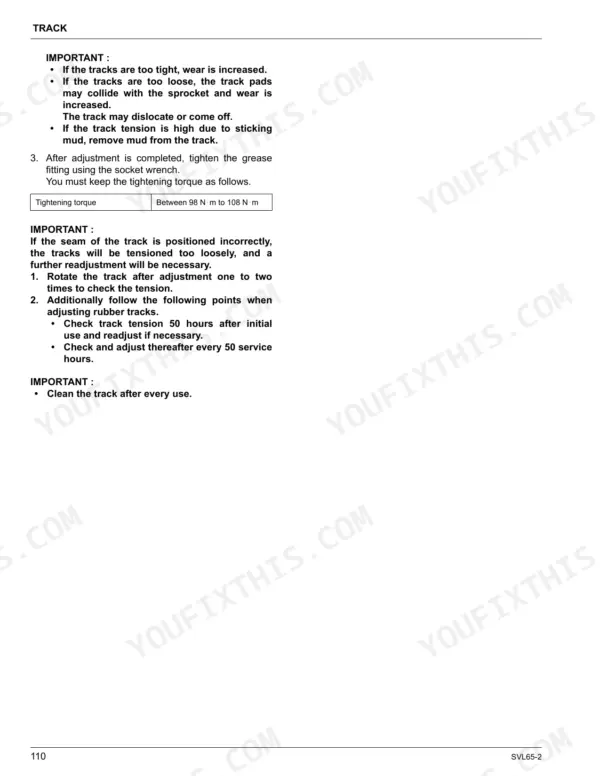
| Track grease fitting tightening torque | Between 98 N⋅m to 108 N⋅m | p. 114 |
| Operating weight (Closed Cab) | 3885 kg | p. 31 |
| Fuel tank capacity | 82 L | p. 31 |
| Engine oil volumes with engine oil filter | 8.5 L | p. 104 |
| Cooling water capacity | 9.5 L | p. 110 |
| Hydraulic oil change interval | every 1000 Hrs. | p. 84 |
| DPF cleaning interval | 3000 hours | p. 84 |
| Track tension clearance | 20 mm to 30 mm | p. 98 |
| V-belt deflection | About 4.0 mm to 5.0 mm | p. 101 |
| Max. pressure (attachments) | 22.5 MPa (230 kgf/cm2) | p. 31 |
| Rated operating capacity | 953 kg | p. 31 |
Kubota SVL65-2 Common Problems This Manual Covers
DPF regeneration warning or trouble
The diesel particulate filter needs periodic regeneration, and ignoring the indicator can force a longer service regen. The exhaust aftertreatment section explains the indicators and the regeneration steps.
Manual Section: Exhaust Aftertreatment Device p. 50Rubber track too loose or slipping
A track that slips or throws needs the tension set within the specified range. The track section covers checking and adjusting rubber track tension.
Manual Section: Track p. 113Warning light or error code on the display
When a warning light or code appears, the troubleshooting section lists the error code numbers and the checks for the engine and other systems.
Manual Section: Troubleshooting p. 118Auxiliary hydraulics not working
Attachments that will not run are often an auxiliary hydraulic control or switch issue. This section shows how to use and check the auxiliary hydraulic controls.
Manual Section: Auxiliary Hydraulic p. 68Quick-hitch will not lock an attachment
A coupler that will not lock is worked through the quick-hitch section, which covers both the mechanical and hydraulic quick-hitch operation and checks.
Manual Section: Quick-Hitch p. 71Hard starting in cold weather
Cold weather starting and warm up are covered in the cold weather section, along with steps to protect the machine after work in low temperatures.
Manual Section: Cold Weather p. 126Dead accessory or blown fuse
When a circuit or outlet stops working, the fuse section gives the fuse capacities and circuits and how to replace standard and slow blow fuses.
Manual Section: Fuse p. 115Frequently Asked Questions
What machine and engine does this manual cover?
It is the operator's manual for the Kubota SVL65-2 compact track loader, including the SVL65-2S, powered by the V2607-CR-TE4 diesel engine. It covers safe operation, controls, and owner maintenance.
Does it list error codes?
Yes. The troubleshooting section includes a list of the error code numbers and troubleshooting for the engine and other systems, so you can match a code on the display to a likely cause. p. 118
Does it show maintenance intervals?
Yes. The maintenance section lays out the maintenance intervals and the daily and hour based service points, including oil, filter, hydraulic, and DPF related items. p. 84
Where are the machine specifications and capacities?
The technical data section has the specification table with operating weight, rated operating capacity, fuel tank capacity, and hydraulic figures for the SVL65-2. p. 31
How quickly can I access this Kubota SVL65-2 manual after buying?
Instant PDF download. The full 138-page searchable Operator Manual lands in your hands right after payment, ready to open on a laptop, tablet, or phone in the shop.
Am I able to print pages from this Kubota SVL65-2 manual?
Yes. Printing works from any reader and any printer, for your own shop use.




Reviews
There are no reviews yet.