
All 112 pages of this Kubota R430 Operator Manual zero in on one machine: your Kubota R430 Wheel Loader. Inside, you get 14 pages of safety procedures covering ROPS and FOPS requirements, travel precautions, and load-transport protocols, plus a full instrument panel walkthrough that decodes every dashboard indicator before you ever turn the key. The operations section walks you through typical job cycles — sand pile loading, V-shift truck loading, ground leveling — while the maintenance chapter lays out service intervals from daily checks all the way to 3,000-hour EGR and turbocharger inspections. Fill the engine with 5.0 L of oil, top the hydraulic system to 58 L, and torque your wheel bolts to 275-314 N-m before you pull out of the yard. Your machine is down and the clock is running. Pull up this bookmarked PDF on your phone, jump straight to the section you need, and get back to work.
What's Inside This Kubota R430 Operator Manual
| System | Pages | Key Topics |
|---|---|---|
| Safe Operation | 11-24 | General precautions, ROPS and FOPS, Precautions for operating the machine, Precautions for traveling, Precautions for safely loading and transporting the machine |
| Servicing of the Wheel Loader | 25-26 | Dealer service, Warranty policy, Procedure for scrapping the wheel loader |
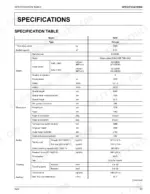
| Specifications | 27-28 | Operating weight, Bucket capacity, Engine specifications, Dimensions, Tipping load, Traveling speed |
| Machine Parts | 29-30 | Description of machine parts, Bucket, Lift arm, Steering wheel, Engine hood, Hydraulic oil tank |
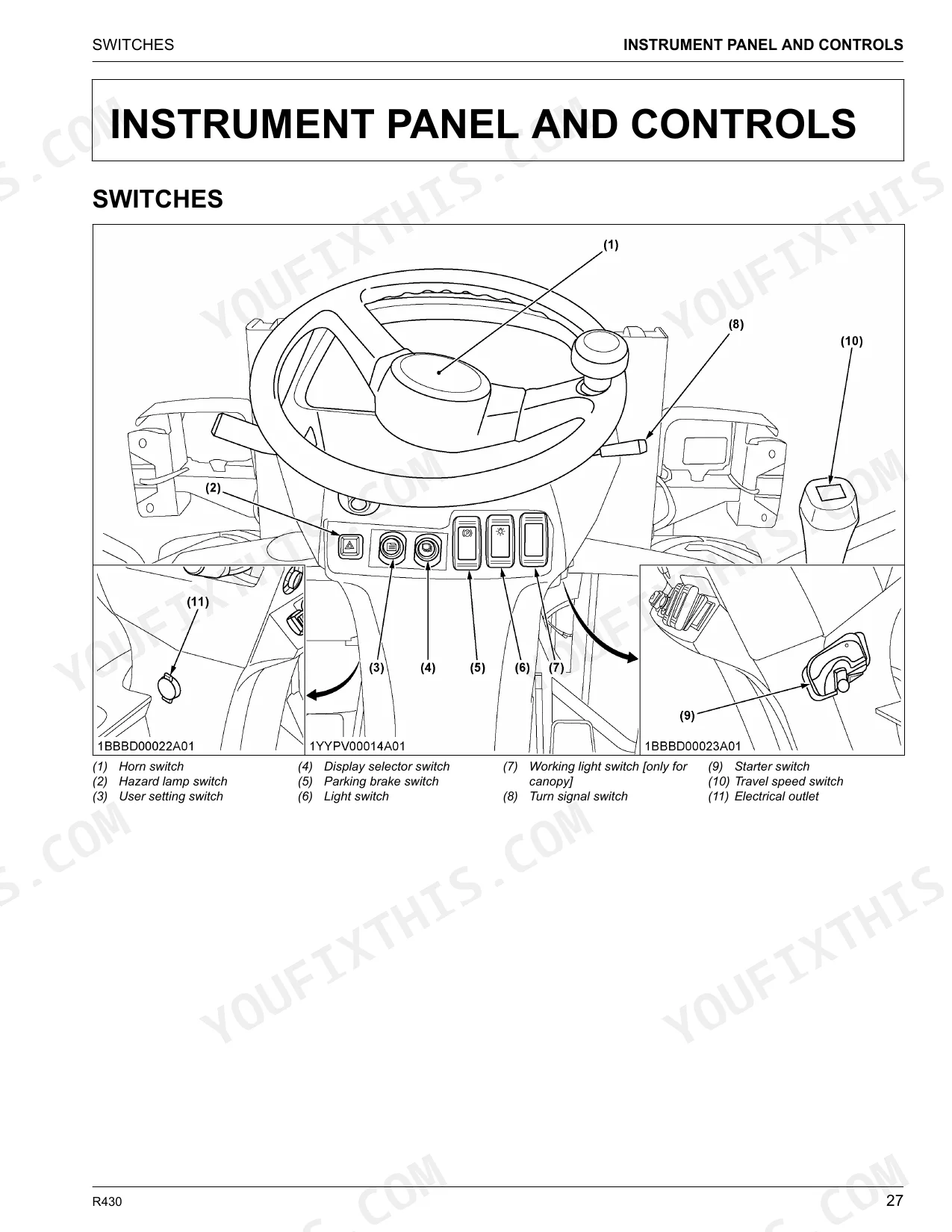
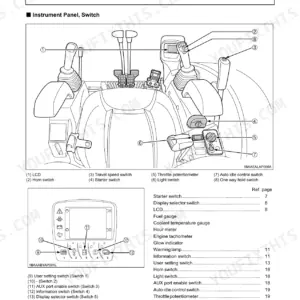
| Instrument Panel and Controls | 31-33 | Switches, Control Pedals And Levers, Instrument Panel |
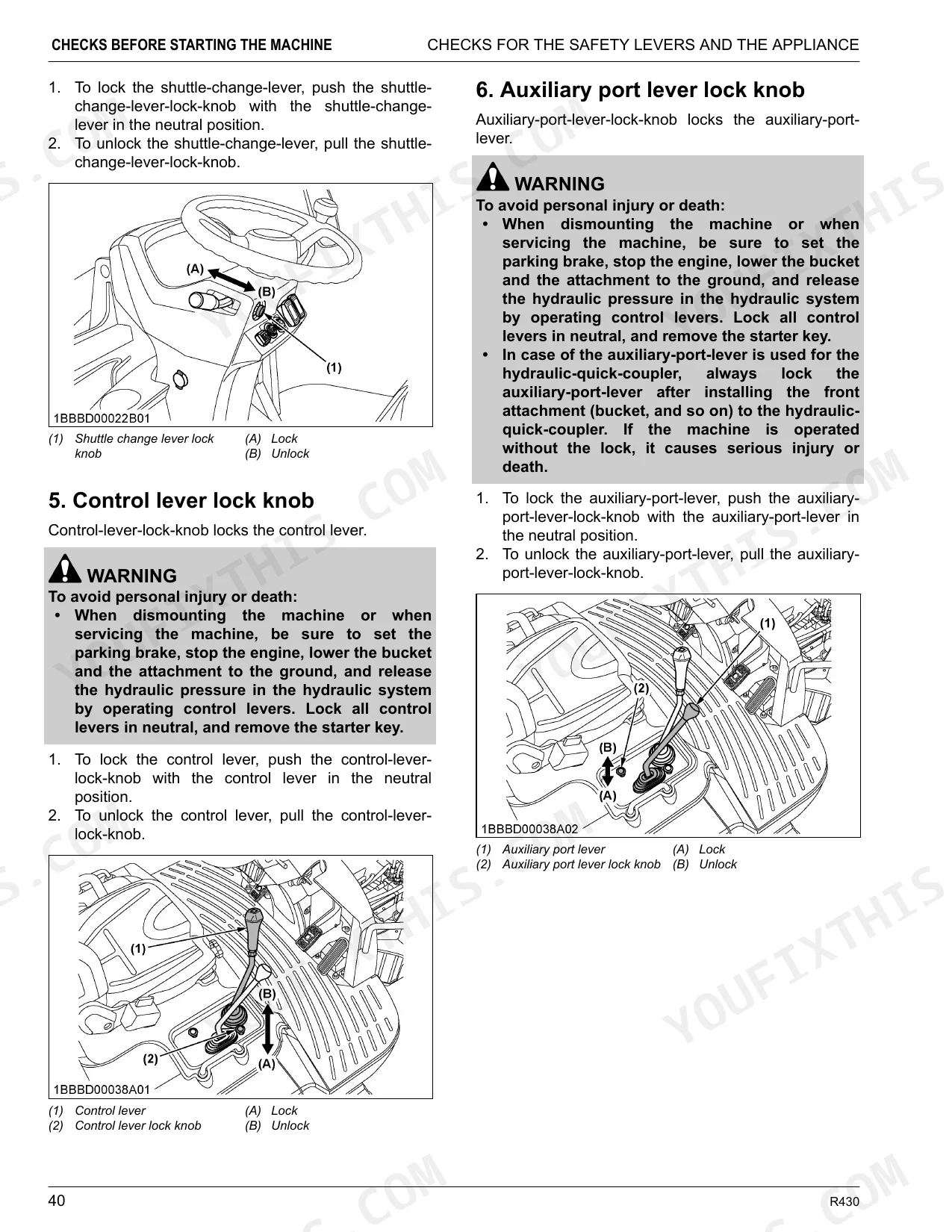
| Checks Before Starting the Machine | 34-44 | Daily Check Items |
| Operation of the Engine | 45-47 | Starting The Engine (Checkpoints After Starting The Engine), Starting The Engine Under Cold Conditions, Stopping The Engine, Starting The Engine With An Auxiliary Battery |
| Operation of the Machine | 48-61 | Guide For The Operator, Working In The Vicinity Of Overhead Power Lines, Running-In Of The Machine, Starting Of The Machine (Operator's Seat, How To Use The Seat Belt) |
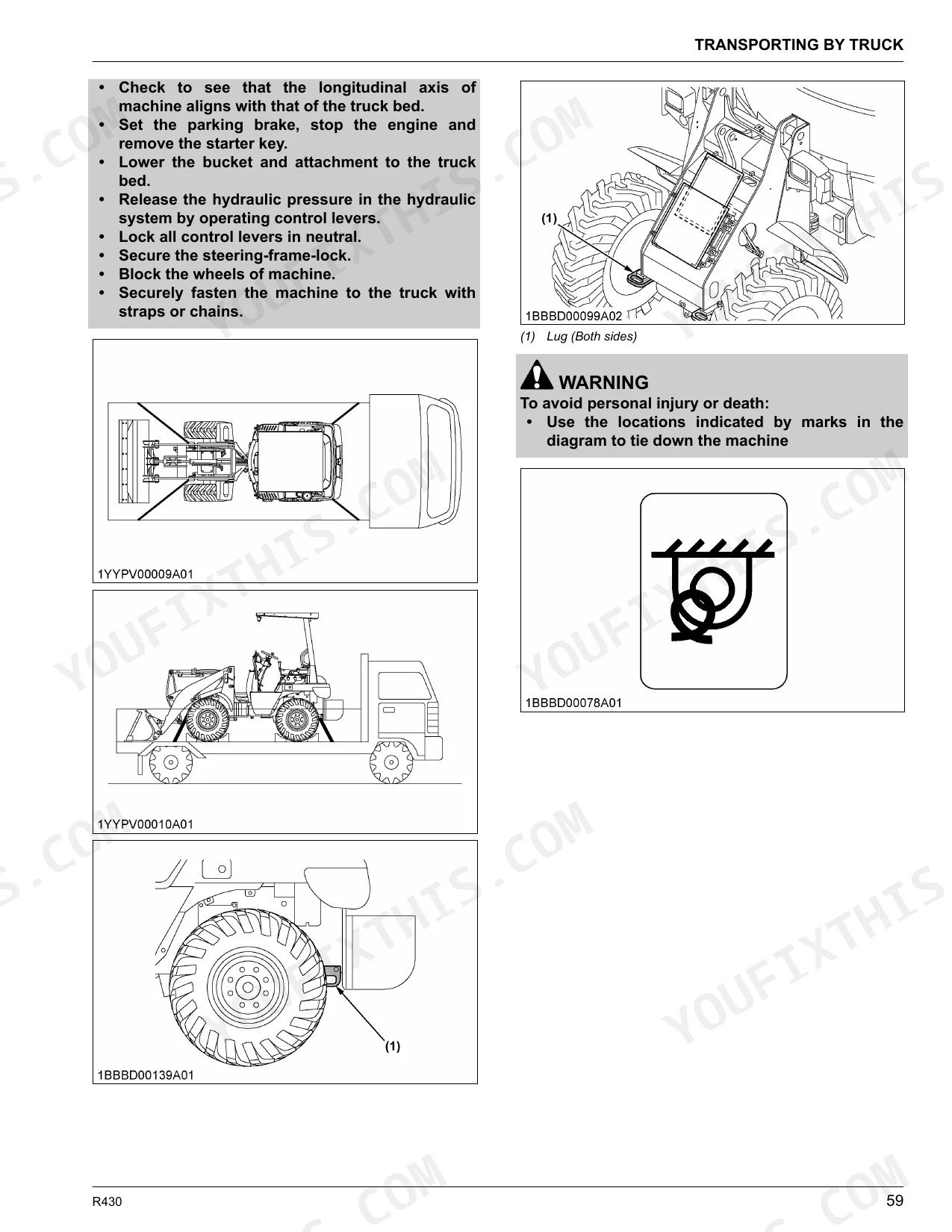
| Transporting by Truck | 62-63 | Loading procedures, Ramps, Securing the machine, Parking brake, Steering frame lock, Control levers |
| Handling the Wheel Loader in Cold Weather | 64 | Engine oil viscosity, Battery charge, Antifreeze mixing ratio, Removing mud and water, Draining fuel system water |
| Maintenance | 65-69 | Precautions for maintenance, Maintenance intervals, Daily check, Service every 250 hours, Service every 1000 hours, Periodic replacement of important component parts |
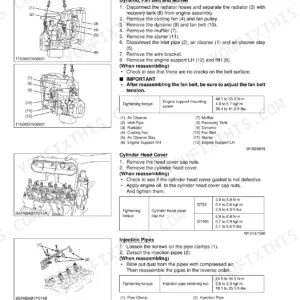
| Periodic Service | 70-97 | Opening And Closing Of Covers (And Closing The Engine Cover, The Document Folder And The Magazine Rack, The Grease Gun Holder To Store The Grease Gun) |
| Taking Out of Operation and Storing | 98 | Storing procedures, Measures prior to taking out of operation, Measures during storing, Restarting after storing, Washing precautions |
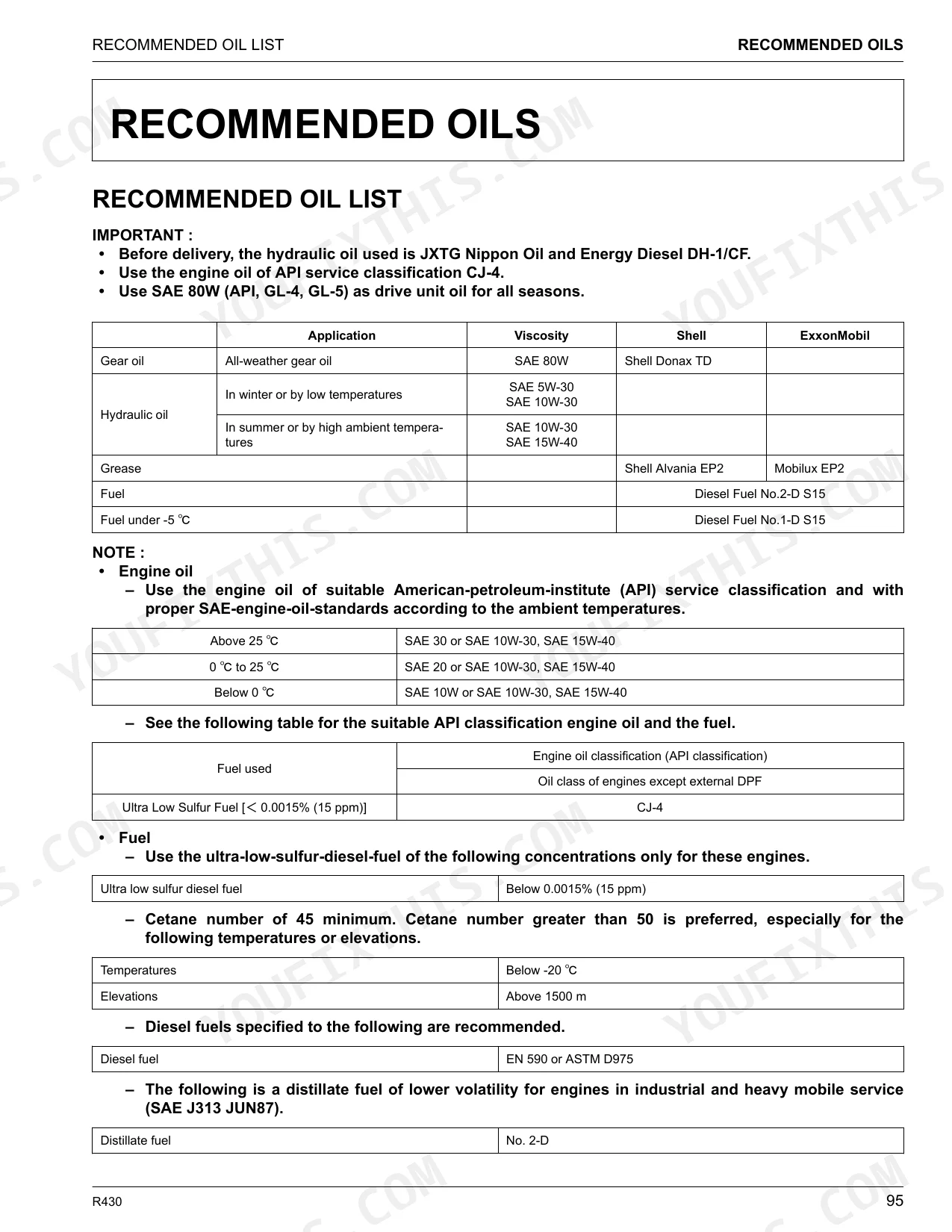
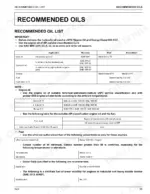
| Recommended Oils | 99-102 | oil, grease, hydraulic oil, engine oil, fuel, biodiesel fuel (BDF) |
| Troubleshooting | 103-107 | Starting difficulties, Insufficient engine power, Engine suddenly stops, Water temperature in red zone (overheating), Hydraulic system, Electric system |
| Appendix | 108 | SERVICE HOUR METER, Check points, Hour meter indicator, Engine oil, Hydraulic oil, Air cleaner element |
Quick Reference Specifications
| Specification | Value | Page |
|---|---|---|
| Wheel bolt tightening torque | 275 N⋅m to 314 N⋅m (28 kgf⋅m to 32 kgf⋅m) | p. 75 |
| LST oil filter Hexagon nut tightening torque | 73.6 N⋅m to 83.4 N⋅m (7.5 kgf⋅m to 8.5 kgf⋅m) | p. 85 |
| Engine oil capacity | 5.0 L | p. 71 |
| Hydraulic oil system whole oil volumes | 58 L | p. 88 |
| Fuel tank capacity | 54 L | p. 72 |
| Brake fluid capacity | 0.3 L | p. 73 |
| Axle case oil capacity | Front 3.0 L, Rear 3.0 L | p. 85 |
| Coolant capacity | Radiator 9.0 L, Recovery tank 1.1 L | p. 64 |
| Engine oil change interval | every 250 hrs | p. 67 |
| Hydraulic oil replace interval | every 1000 hrs | p. 67 |
| Fuel filter cartridge replace interval | every 500 hrs | p. 68 |
| Air cleaner element Outer element clean interval | every 200 hrs | p. 67 |
Kubota R430 Common Problems This Manual Covers
Kubota R430 water separator filled-up indicator is illuminated on the dashboard during morning startup p. 72
Drain the water from the fuel filter immediately. Place a catch pan under the separator and open the drain plug. Fill the 54 L fuel tank with clean diesel to prevent condensation buildup overnight. Check page 72 for proper draining locations.
Manual Section: Periodic ServiceEngine oil pressure warning indicator flashing on the instrument panel during operation p. 71
Shut down the engine immediately and check the dipstick level. Add approved oil if the level is low. The crankcase has an engine oil capacity of 5.0 L as noted on page 71. Inspect the block for external leaks before restarting the machine.
Manual Section: Periodic ServiceBattery charge indicator remains lit and engine turns over slowly in cold weather p. 76
Inspect the V-belt condition and tension as shown on page 76. Push on the belt midway between the pulleys and verify the fan belt tension deflection is exactly 7 mm to 9 mm. Adjust the alternator bracket if the belt is loose. Replace the belt if cracked or frayed.
Manual Section: Periodic ServiceHydraulic system low power and sluggish lift arm operation during heavy lifting p. 103
Check the hydraulic fluid sight glass to confirm the level is correct. The machine requires a total hydraulic oil system capacity of 58 L as specified on page 88. Inspect all visible hoses for leaks. Review the troubleshooting guide on page 103 if the fluid level is full.
Manual Section: TroubleshootingFrequently Asked Questions
What are the recommended service intervals?
The manual provides a comprehensive table of recommended service intervals for various components. For example, engine oil should be checked daily and changed every 250 hours, while hydraulic oil should be checked daily and replaced every 1000 hours. The fan belt tension should be adjusted every 200 hours, and radiator hoses and clamps should be checked every 200 hours.
What fluids and capacities does this machine require?
The machine requires various fluids with specific capacities. The fuel tank capacity is 54 L, the hydraulic oil tank capacity is 42 L, and the total hydraulic oil system capacity is 58 L. The engine oil capacity is 5.0 L, and the brake fluid reservoir holds 0.3 L. For cooling, the radiator holds 9.0 L and the recovery tank 1.1 L. Front and rear axle cases each require 3.0 L of oil. Recommended oils include SAE 80W gear oil, SAE 5W-30/10W-30/15W-40 hydraulic oil, and Diesel Fuel No.2-D S15.
How to troubleshoot engine won't start?
If the engine won't start, common issues include fuel being too viscous, air or water in the fuel system, a blown fuse, high oil viscosity in winter, or a dead battery with insufficient compression. Countermeasures involve checking and draining the fuel tank and filter, purging the fuel system, replacing blown fuses with the same capacity, using an engine-block-heater in winter, or recharging/replacing the battery.
What are the hydraulic system specifications?
The hydraulic system has a maximum pressure of 18.6 MPa (190 kgf/cm²) and a theoretical maximum flow rate of 42.1 L/min. The hydraulic oil tank capacity is 42 L, and the total hydraulic oil system volume is 58 L. It is recommended to use hydraulic oil that meets ISO VG 32 or VG22 standards.
What torque specifications are listed?
The manual lists several torque specifications for critical components. The M10 bolts for auto leveler adjustment should be tightened to 48.1 N⋅m to 55.9 N⋅m (4.9 kgf⋅m to 5.6 kgf⋅m). Wheel bolts require a tightening torque of 275 N⋅m to 314 N⋅m (28 kgf⋅m to 32 kgf⋅m). The hexagon nut for the LST oil filter should be tightened to 73.6 N⋅m to 83.4 N⋅m (7.5 kgf⋅m to 8.5 kgf⋅m).
Is this Kubota R430 Operator Manual a digital download?
A 112-page Operator Manual in searchable PDF format, available the moment you complete checkout. View on computer, tablet, or phone — no shipping wait.
Is this Kubota R430 Operator Manual printable?
Yes. The PDF has no DRM restrictions — print any page or section you need for your shop. Works with any standard printer.
Document Quality
This document is a scanned PDF, not a native digital file. However, it includes an OCR layer, so you can search and copy the full text, which is crisp and easy to read throughout. All diagrams and illustrations are raster images, but they are clear and their labels are consistently readable. The pages are clean with no noticeable scan artifacts, stains, marks, or skewing, though there is one blank page (page 10) present.
Reviews
There are no reviews yet.