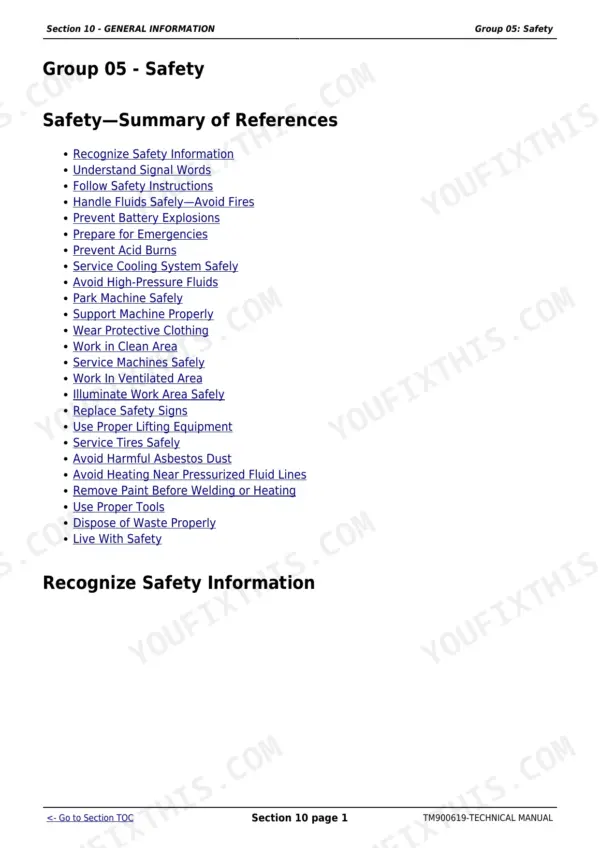

Part of the John Deere Repair Manuals.
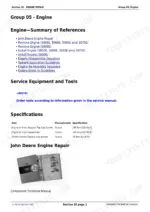
One manual, seven tractors: the older 5310 and 5210 (1999-2008) plus the E-series 5050E, 5055E, 5060E, 5065E and 5075E (2012-2021). It is really two books bound together. Sections 10-90 are the repair half: cylinder head, pistons, crankshaft, clutch, transmission, final drives, hydraulic pump, rockshaft, steering and brakes, torn down step by step with assembly torques. Sections 210-270 are the tests-and-adjustments half: oil pressure, compression, injection timing, idle speeds, charging circuit tests, hydraulic pressure and flow tests, all with real numbers, like minimum cylinder pressure of 2400 kPa (350 psi) and valve clearance of 0.35 mm intake / 0.45 mm exhaust. If you keep one of these 3-cylinder tractors working for a living, this is the book the dealer techs use.
Other editions of this manual
What's Inside This John Deere 5310-5075E Repair Manual
| System | Pages | Key Topics |
|---|---|---|
| General Information | 8-113 | General Specifications, Bolt Torque Values, Fuel & Lubricants, Safety |
| Engine Repair | 114-399 | Cylinder Head, Pistons, Crankshaft, Timing, Assembly Torques |
| Fuel and Air Intake System Repair | 400-462 | Injection Pump, Injectors, Fuel Filters, Air Cleaner |
| Electrical Repair | 463-533 | Alternator, Starter, Wiring Harness Replacement, Batteries |
| Power Train Repair | 534-766 | Clutch, Transmission, Differential, Final Drive, PTO |
| Steering and Brake Repair | 767-821 | Power Steering, Steering Cylinder, Brakes |
| Hydraulic Repair | 822-900 | Hydraulic Pump, SCV, Rockshaft, Hitch, Cylinders |
| Miscellaneous Repair | 901-950 | Cab/canopy, Sheet Metal, Fenders |
| Operator Station Repair | 951-990 | Seat, Controls, Instruments |
| Operational Checkout Procedures | 991-1026 | Pre-Diagnosis Walkaround Checks |
| Engine Operation, Tests and Adjustments | 1027-1094 | Engine Tests, Oil Pressure, Compression, Idle Speeds |
| Fuel/Air Operation, Tests and Adjustments | 1095-1123 | Injection Timing, Fuel Pressure Tests |
| Electrical System Operation, Tests and Adjustments | 1124-1471 | Wiring Schematics, Circuit Tests, Charging Tests, Connector Pin-Outs |
| Power Train Operation, Tests and Adjustments | 1472-1563 | Clutch Tests, Transmission Adjustments |
| Steering and Brake Operation, Tests & Adjustments | 1564-1609 | Steering Pressure Tests, Brake Adjustment |
| Hydraulic System Operation, Tests and Adjustments | 1610-1713 | Hydraulic Pressure Tests, Rockshaft Adjustment, Flow Tests |
Quick Reference Specifications
| Specification | Value | Page |
|---|---|---|
| Declared PTO power | 31.3 kW (42.6 hp) | p. 30 |
| Cylinders | 3 | p. 30 |
| Bore | 106.5 mm | p. 30 |
| Stroke | 110 mm | p. 30 |
| Displacement | 2.9 L | p. 30 |
| Compression Ratio | 18.7:1 | p. 30 |
| Firing Order | 1-2-3 | p. 30 |
| Slow Idle | 850 (+/-50) rpm | p. 30 |
| Fast Idle | 2600 (-25/+50) rpm | p. 30 |
| Radiator Cap Pressure Valve Opening Pressure | 43-53 kPa (0.43-0.53 bar) (6.25-7.75 psi) | p. 30 |
| Engine Oil Temperature at 825 rpm | 93 °C (200 °F) | p. 30 |
| Engine Oil Temperature at 2500 rpm | 105 °C (221 °F) | p. 30 |
| Minimum Oil Pressure at 825 rpm | 100 kPa (1 bar) (15 psi) | p. 30 |
| Minimum Oil Pressure at 2500 rpm | 277-483 kPa (2.77-4.83 bar) (40-70 psi) | p. 30 |
| Cylinder Pressure (Minimum) | 2400 kPa (24 bar) (350 psi) | p. 30 |
| Maximum Difference Between Cylinders Pressure | 350 kPa (3.50 bar) (50 psi) | p. 30 |
| Engine-Slow Idle Speed | 850 (-50/+25) rpm | p. 30 |
| Engine-Fast Idle Speed | 2600 (-25/+50) rpm | p. 30 |
| Fuel Injection Pump Mounting Nuts Torque | 25 N·m (18 lb-ft) | p. 30 |
| Intake Valve Clearance | 0.35 mm (0.014 in.) | p. 30 |
| Exhaust Valve Clearance | 0.45 mm (0.018 in.) | p. 30 |
| New V-Belt-Gauge Method Tension | 578-622 N (130-140 lb) | p. 30 |
| Used V-Belt-Gauge Method Tension | 378-423 N (85-94 lb) | p. 30 |
| V-Belt-Gauge/Straight Edge Method Belt Deflection at 89 N (20 lb) | 19 mm (0.750 in.) | p. 30 |
| Fuel Injection Pump Line Torque | 16 N·m (12 lb-ft) | p. 30 |
| Fuel Injection Nozzle Line Nuts Torque | 27 N·m (20 lb-ft) | p. 30 |
| Rated rpm at full load | 2300 rpm | p. 30 |
John Deere 5310-5075E Common Problems This Manual Covers
Engine knocks under load
Check oil level first, then injection pump timing - a pump out of time is the classic cause on these engines. The Fuel/Air Operation, Tests and Adjustments section gives the timing check and correction procedure, and the pump remounts at 25 N·m on the mounting nuts.
Manual Section: Fuel/Air Operation, Tests and AdjustmentsLow oil pressure warning
Verify against the real numbers before tearing anything down: minimum 100 kPa (15 psi) at 825 rpm and 277-483 kPa (40-70 psi) at 2500 rpm, oil warm. The manual's test procedure then walks leaks, gaskets and a restricted crankcase vent tube before pointing you at bearings.
Manual Section: Engine Operation, Tests and AdjustmentsStarter dead or cranking slowly
The electrical tests section runs you through it in order: gear lever position, battery load test, fuses, cable connections, then starter draw. Wiring schematics and connector pin-outs let you find a voltage drop with a multimeter instead of swapping parts on a guess.
Manual Section: Electrical System Operation, Tests and AdjustmentsHydraulics foaming, weak lift, sluggish hitch
Overfilled hydraulic oil aerates and kills performance - check the level before condemning the pump. The hydraulic tests section then gives pump pressure and flow test procedures plus rockshaft adjustment, so you can prove whether the pump, SCV or relief valve is actually at fault.
Manual Section: Hydraulic System Operation, Tests and AdjustmentsFrequently Asked Questions
How do I read or reset fault codes on a 5055E or 5075E?
You don't, and that is good news. These are mechanical tractors: mechanical injection pump, no CAN-bus, no code reader needed. There are no fault codes to reset. When something acts up, you diagnose it the old way, and this manual is built exactly for that: start with the Operational Checkout walkaround, then go to the tests sections. Low power gets a compression test (2400 kPa minimum per cylinder, no more than 350 kPa spread between cylinders). Electrical gremlins get chased with the wiring schematics and connector pin-outs. A multimeter and a pressure gauge replace the scan tool.
Does it include torque specs?
Yes, both a general bolt torque table in the General Information section and specific values where they matter. Injection pump mounting nuts are 25 N·m (18 lb-ft), pump line fittings 16 N·m (12 lb-ft), nozzle line nuts 27 N·m (20 lb-ft). Head bolts, main bearings, rod bolts and flywheel bolts are all in the Engine Repair assembly sequences for each model.
Are the wiring diagrams actually usable?
The Electrical System Operation, Tests and Adjustments section carries full schematics, connector pin-outs and circuit-by-circuit test procedures. When the starter won't crank, the manual walks you through the usual suspects in order: lever in gear, low battery output, blown fuse. Same for a battery that won't charge - it has you check connections, the alternator belt and charging output before you buy an alternator you didn't need.
Which models and years does it cover, and are the specs per model?
5310 (1999-2007), 5210 (2000-2008), and the E-series 5050E, 5055E, 5060E, 5065E and 5075E (2012-2021). The spec tables list each model separately. As an example of the detail, the 5050E entry shows a 2.9 L 3-cylinder with 106.5 mm bore, 110 mm stroke, 18.7:1 compression, 31.3 kW (42.6 hp) PTO power, slow idle 850 rpm and fast idle 2600 rpm.
Can I set valve clearance and idle speed with this?
Yes. Valve lash is 0.35 mm (0.014 in.) intake and 0.45 mm (0.018 in.) exhaust, with the adjustment procedure in the engine tests section. Idle speeds (850 rpm slow, 2600 rpm fast, 2300 rpm rated at full load) are set per the Engine Operation, Tests and Adjustments section. Fan belt tension is covered too: 578-622 N on a new belt, 378-423 N used, or 19 mm deflection at 89 N by the straight-edge method.