
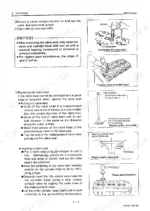

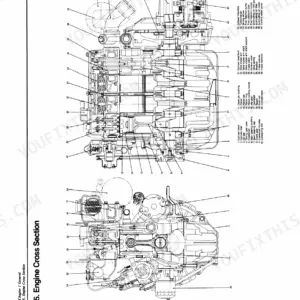
Part of the Yanmar Repair Manuals.
Popping an injector on a bench tester and reading 220±5 kgf/cm² is the moment a 4JH3 fuel system stops being a mystery, and the Overhaul chapter of this Yanmar service manual gives you that figure along with the YDLLA-P nozzle specs and the case nut torque to put it back together correctly. The same chapter strips the rest of the engine: cylinder head and valve guides, pistons and rings, crankshaft and main bearings, camshaft, gear train, the lubrication and cooling water systems, and the IHI RHB52W turbocharger.
It covers the 4JH3-TE, 4JH3-HTE and 4JH3-DTE marine diesels under Yanmar publication HINSHI-H10-009, 100 pages in English, delivered as a bookmarked PDF download.
Beyond teardown, you get a troubleshooting chapter keyed to real symptoms, a periodic checking list, and a service specifications section with the adjusting standards, clearances and tightening torques you need before the engine goes back together.
Complete the set for your 4JH3 Series
What's Inside This Yanmar 4JH3 Series Manual
| System | Pages | Key Topics |
|---|---|---|
| 1. to Perform Service Safely | 6-11 | Warning Symbols, Safety Precautions, Location of Product Safety Labels |
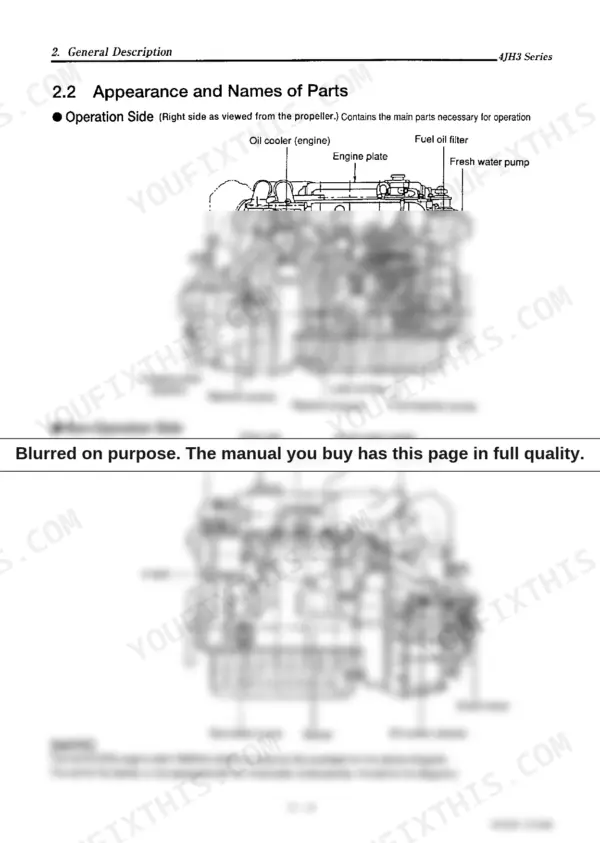
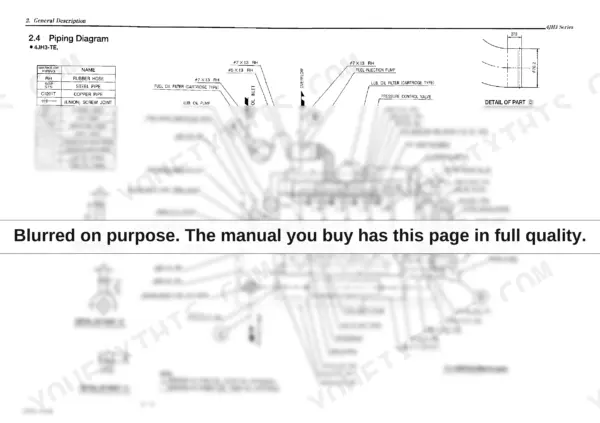
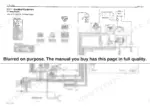
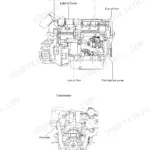
| General Description | 12-25 | Principal Particulars, Appearance and Names of Parts, Cross-Sectional Drawing, Piping Diagram, Performance Curves, Front Power Take-Off, Fuel Oil, Lube Oil |
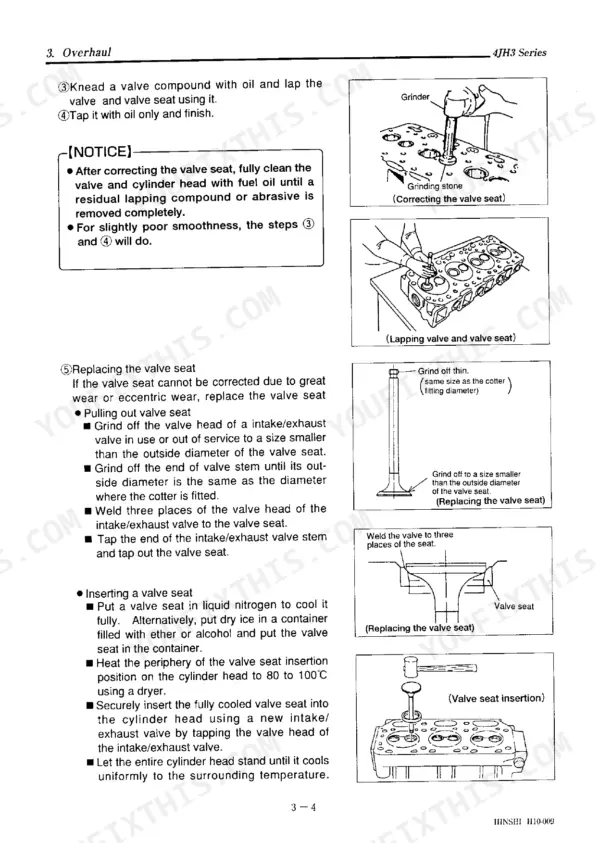
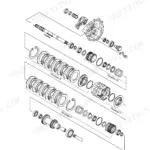
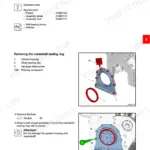
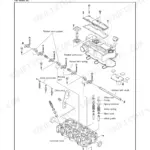
| Overhaul | 26-75 | Cylinder Head, Combustion Surface, Valve Seat, Suction/Exhaust Valve and Valve Guide, Valve Spring, Valve Arm and Push Rod, Installing the Cylinder Head, Piston |
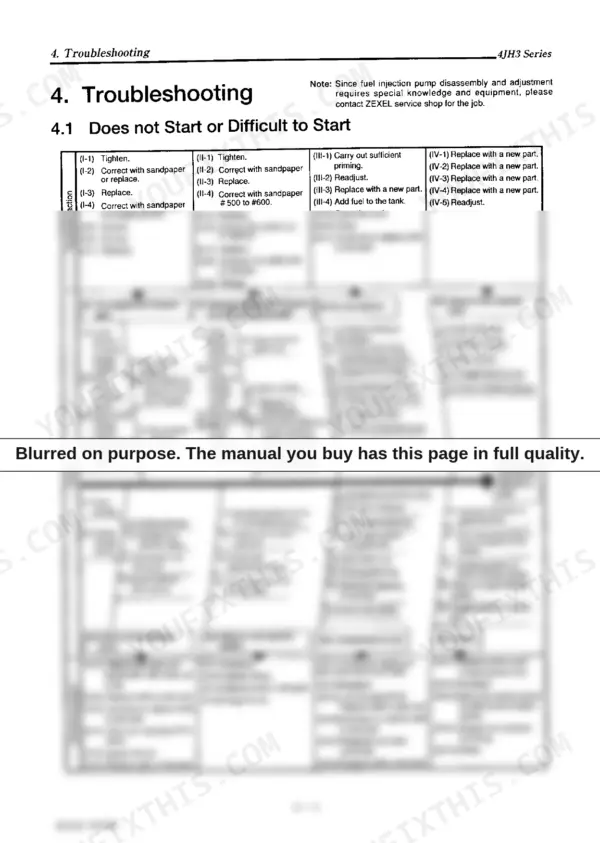
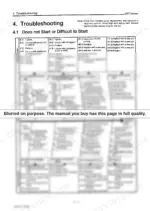
| Troubleshooting | 76-84 | Does Not Start or Difficult to Start, Unsmooth Revolution, Sudden Engine Stop, Poor Exhaust Gas Color, Insufficient Output, Uneven Cylinder Outputs, Knocking |
| Periodic Checking List | 85 | Fuel Oil Check and Supply, Lube Oil Check and Replacement, Marine Gear Oil Check and Replacement, Cooling Water System Check, Electrical Components Check |
| Tool and Measuring Instrument | 86-88 | Tool, Measuring Instrument |
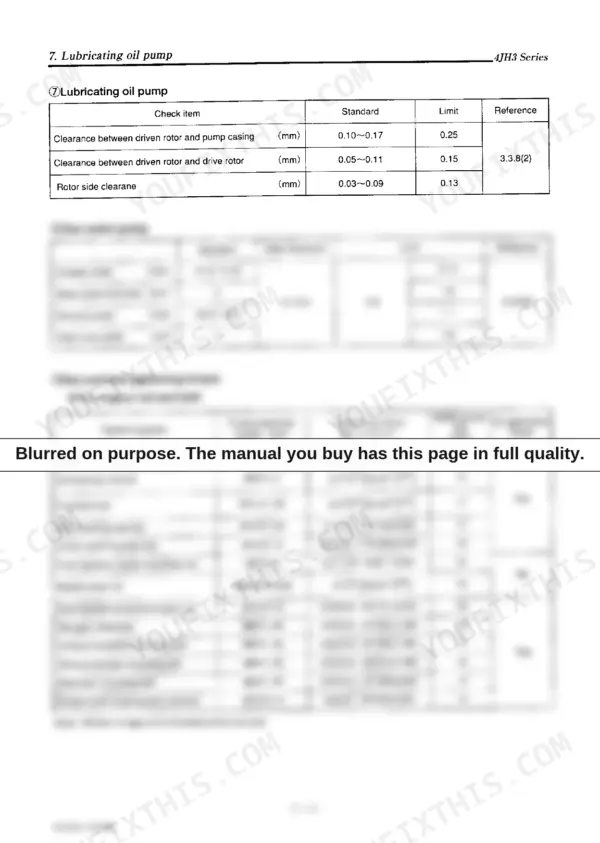
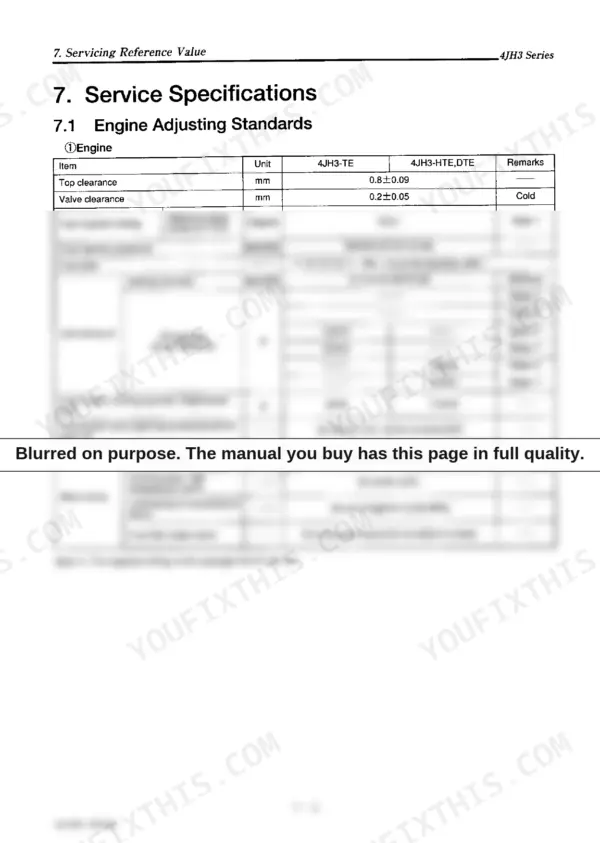
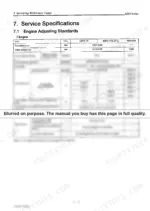
| Service Specifications | 89-96 | Engine Adjusting Standards, Service Standards |
| Instrument Panel(Option) | 97-100 |
Quick Reference Specifications
| Specification | Value | Page |
|---|---|---|
| All Models | ||
| Cylinder head bolt tightening torque (First step) | 5 kgf·m | p. 32 |
| Cylinder head bolt tightening torque (Second step) | 9.3±0.3 kgf·m (91.4±0.94 N·m) | p. 32 |
| Nozzle type | YDLLA-P | p. 63 |
| Hole angle | 150° | p. 63 |
| Fuel filter water alarm activation level | On at the water level of 23 mm (80cm³) or more | p. 89 |
| Turbocharger model | RHB52W (IHI) | p. 72 |
| Turbine shaft end nut tightening torque | 20±2 kgf·cm (196±19 N·cm) | p. 72 |
| Fuel feed pump type | Vane type (built-in) | p. 55 |
| Top clearance | 0.8±0.09 mm | p. 89 |
| Valve clearance | 0.2±0.05 mm | p. 89 |
| 4JH3-TE | ||
| Number of nozzle holes hole diameter, 4JH3-TE | 5-φ0.23 mm | p. 63 |
| 4JH3-HTE,DTE | ||
| Number of nozzle holes hole diameter (4JH3-HTE,DTE) | 5-φ0.25 mm | p. 63 |
Yanmar 4JH3 Series Common Problems This Manual Covers
Will not reach rated RPM under load
A 4JH3 that falls short of full throttle RPM is usually starved of fuel or air, or fighting exhaust backpressure or a boost problem. The Troubleshooting chapter works through insufficient output and uneven cylinder outputs symptom by symptom instead of leaving you to swap parts.
Manual Section: 4. Troubleshooting p. 76Blue smoke on a high-hour engine
Persistent oil smoke points to worn valve guides, ring blow-by, or fouled injectors. The Overhaul chapter gives measuring procedures and wear limits for valves, guides, pistons, and rings so you can decide from numbers whether the engine needs a top end or a full rebuild.
Manual Section: 3. Overhaul p. 26Dies at idle or starts hard
Owners report engines that die at idle, run at partial RPM, or refuse to start until something in the fuel path clears. The Troubleshooting chapter covers does not start or difficult to start, unsmooth revolution, and sudden engine stop with likely causes for each.
Manual Section: 4. Troubleshooting p. 76Overheating from a tired impeller
The sea water pump impeller wears quietly until cooling drops off on a hot day. The Overhaul chapter includes the sea water pump disassembly procedure and servicing standards, including impeller width limits, so you can judge the pump instead of just throwing an impeller at it.
Manual Section: 3. Overhaul p. 26Water in the fuel
Water contamination is a fact of life with tank condensation, and it kills injection components fast. The Periodic Checking List lays out the fuel oil check and supply routine, and the manual documents the fuel filter water alarm, which trips at a 23 mm water level.
Manual Section: 5. Periodic Checking List p. 85Black smoke and boost loss
Black smoke under load means overfueling or poor combustion, often traced to the turbocharger or injectors rather than the pump. The Overhaul chapter covers the IHI RHB52W turbocharger and the fuel injection components, with the specs to test rather than guess.
Manual Section: 3. Overhaul p. 26Frequently Asked Questions
Which engines does this manual cover?
It covers the Yanmar 4JH3-TE, 4JH3-HTE, and 4JH3-DTE marine diesel engines. It is the factory service manual, publication HINSHI-H10-009, 100 pages in English, regardless of what boat or application the engine is installed in.
Does it include cylinder head and bearing torque specs?
Yes. Head bolts tighten in two steps, 5 kgf·m then 9.3±0.3 kgf·m, and main bearing cap bolts go to 11±0.5 kgf·m. The Service Specifications section tabulates tightening torques and engine adjusting standards for reassembly. p. 89
What are the injector specifications?
The Overhaul chapter specifies YDLLA-P nozzles with an opening pressure of 220±5 kgf/cm² (21.57±0.49 MPa). The 4JH3-TE uses five 0.23 mm holes; the HTE and DTE use five 0.25 mm holes. Nozzle case nut and mounting nut torques are given too. p. 26
Will it help me diagnose smoke or starting problems?
Yes. The Troubleshooting section is organized by symptom: does not start or difficult to start, unsmooth revolution, sudden engine stop, poor exhaust gas color, insufficient output, uneven cylinder outputs, and knocking, each pointing you toward likely causes before you open the engine. p. 76
How is this Yanmar 4JH3-TE Service Manual delivered?
Instant PDF download (2 MB). You get the full 100-page searchable Service Manual immediately after payment. Open it on your laptop, tablet, or phone right in the shop.
Can I print a copy of this Yanmar 4JH3-TE Service Manual for the shop?
Yes. Print the pages or sections you need for your own shop use. Any standard printer works.
Is the electrical system covered in this Yanmar 4JH3-TE Service Manual?
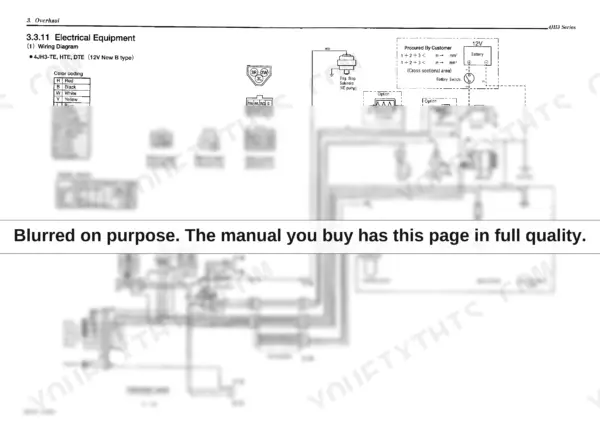
Yes, full electrical schematics are included with wire colors, connector locations, and circuit descriptions.



Reviews
There are no reviews yet.