


This is the Kubota operator manual for the U17-3 compact excavator, powered by the Kubota D902 diesel engine. Its 89 pages cover safe operation, the instrument panel and controls, daily checks, starting, full machine operation, transport, lifting, and the complete maintenance program.
You get the technical data, including a 1680 kg operating weight, 12.7 kW engine power, 19 L fuel tank, and 18.6 MPa maximum attachment pressure, plus the maintenance interval tables from every 50 hours through every 2000 hours, track and fuse work, cold weather and long storage procedures, a troubleshooting message list, and the lifting capacity charts.
Use it to run the excavator safely, follow the correct service intervals, adjust the tracks, work through no-start and hydraulic faults, and confirm the machine data. Delivered as a downloadable, printable PDF with a full text layer.
Complete the set for your U17-3
- Repair Manual: Kubota U17 Kubota Excavator Workshop Manual (incl. Wiring)
What's Inside This Kubota U17-3 Operator Manual
| System | Pages | Key Topics |
|---|---|---|
| Safe Operation | 9-20 | Before Operation, Starting of the Excavator, After Operation, Safe Loading and Transport of the Excavator, Maintenance, Danger, Warning and Caution Labels |
| Dealer Service | 21 | Serial Number of the Excavator, Engine, Spare Parts |
| Technical Data | 22 | Model Name, Operating Weight, Engine, Performance, Dozer, Fuel Tank Capacity |
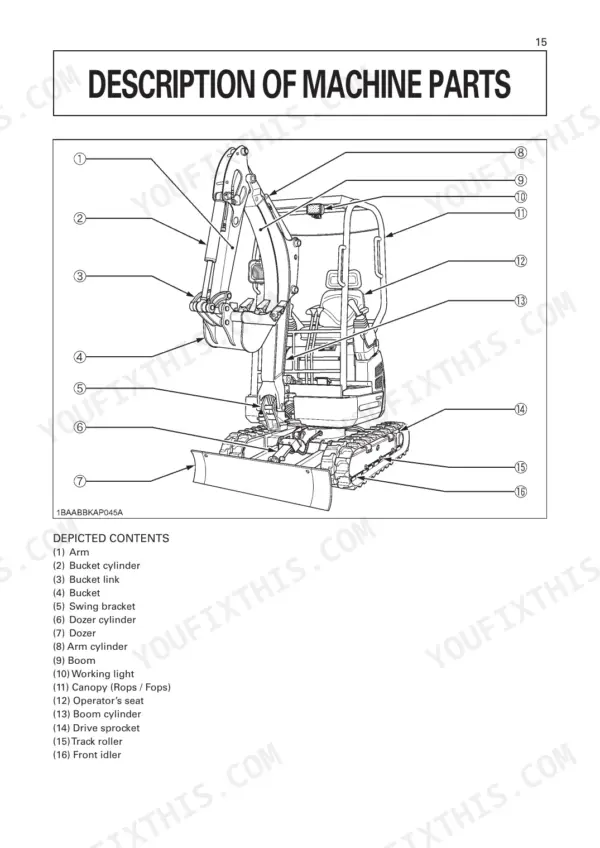
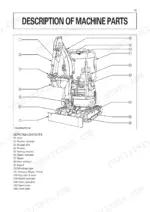
| Description of Machine Parts | 23 | Arm, Bucket, Swing Bracket, Dozer, Boom, Drive Sprocket |
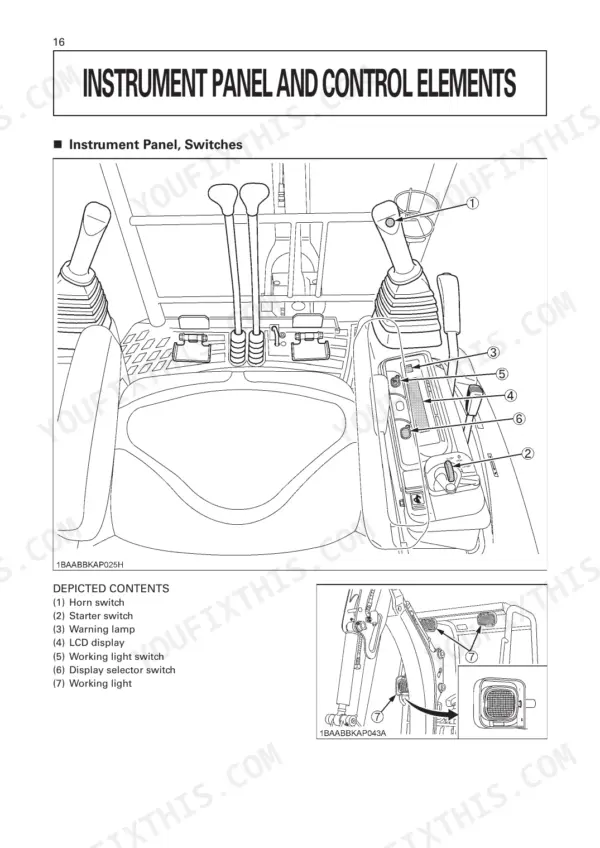
| Instrument Panel and Control Elements | 24-25 | Horn Switch, Starter Switch, Warning Lamp, LCD Display, Drive Lever, Control Lever for Front Attachments |
| Before Start | 26-29 | Daily Checks, Tilting the Seat, Opening and Closing of Parts, Handling the Safety Devices |
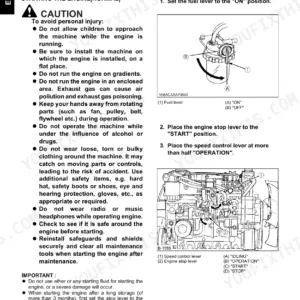
| Operation of the Engine | 30-36 | Horn Switch, Starting the Engine, Starting the Engine Under Cold Conditions, Stopping the Engine, Starting with an Auxiliary Battery |
| Excavator Operation | 37-50 | Control Observations During Operation, Running-In of the New Excavator, Starting, Two Pattern Selection System, Operation of the Boom, Operation of the Arm, Operation of Bucket |
| Transporting the Excavator on a Truck | 51-52 | Transporting on a Truck |
| Lifting of the Excavator | 53-54 | Basics When Lifting with Cables or Straps, Safety Aspects When Lifting with Cables or Straps, Lifting Procedure for the Excavator |
| Maintenance | 55-61 | Maintenance Intervals, Daily Checks |
| Regular Checks and Maintenance Work | 62-73 | Every 50 Service Hours, Every 200 Service Hours, Every 250 Service Hours, Every 500 Service Hours, Every 1000 Service Hours, Every 1000 Service Hours or Once a Year |
| Other Adjustments and Replacements | 74-78 | Purging of the Fuel System, Tracks, Exchange of Bucket Teeth and Side Cutters, Fuses |
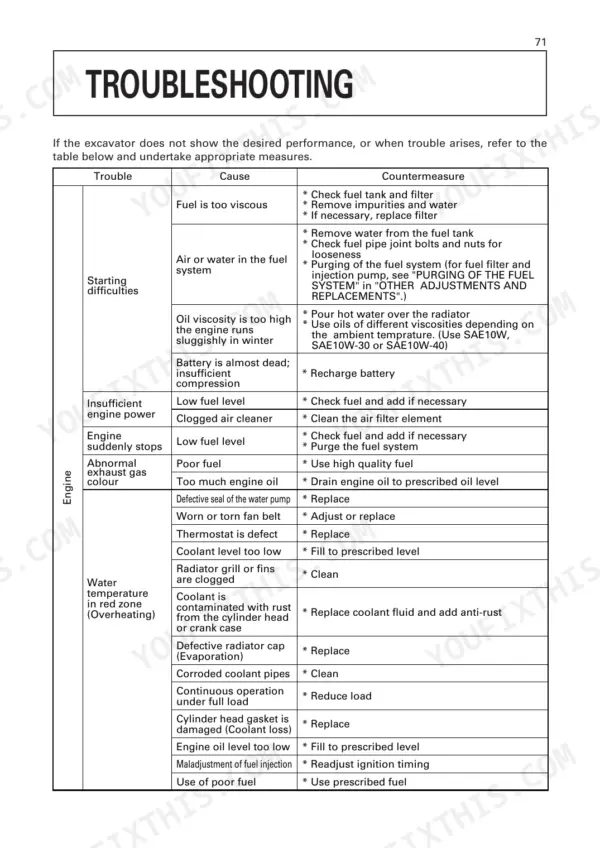
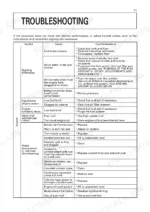
| Troubleshooting | 79-82 | Kubota I.C.S Navigation List of Messages |
| Operation Under Cold Weather Conditions | 83 | Preparation for Operation in Cold Weather, Procedure After Done Work |
| Long Storage | 84-85 | Should the Excavator Be Stored for a Longer Period of Time, Observe Following Procedures, Observe Following Procedures When the Machine Is to Be Operated After Long Storage |
| Recommended Oils | 86 | Engine Oil, Gear Oil, Hydraulic Oil, Grease, Fuel |
| Main Dimensions | 87 | |
| Lifting Capacity | 88-89 | Lifting Capacity Over-Front Blade Down, Lifting Capacity Over-Front Blade Up, Lifting Capacity Over-Side Track Width 1240Mm |
Quick Reference Specifications
| Specification | Value | Page |
|---|---|---|
| Air filter element cleaning compressed air pressure | 30 psi (205 kPa, 2.1 kgf/cm²) | p. 55 |
| Air filter element replacement interval | every 1000 hrs | p. 47 |
| Hydraulic hose replacement interval | Every 2 years or 4000 hours | p. 77 |
| Fuel hose replacement interval | Every 2 years or 4000 hours | p. 77 |
| Coolant change interval | every 2 years | p. 47 |
| Coolant volume (Radiator system) | 0.71 US gal (2.7 L) | p. 65 |
| Engine oil change interval | every 250 hrs | p. 47 |
| Engine oil volume (with replacing engine oil filter) | approx. 3.6 L | p. 57 |
| Cause: Swing lock pin is in lock position | Remove swing lock pin in unlock position | p. 80 |
| Cause: Hydraulic oil level too low | Add oil | p. 80 |
| Operating Weight (including operator's) | 1680 kg | p. 22 |
| Engine Power (SAE gross) | 12.7 kW | p. 22 |
Kubota U17-3 Common Problems This Manual Covers
Engine will not start at the controls
The U17-3 will not start unless the operator interlock sequence, including the seat belt and armrest, is satisfied. The before start section explains handling the safety devices and the correct startup conditions.
Manual Section: Before Start p. 26Hydraulics do not engage after startup
The machine can start yet leave the hydraulic functions disabled. The troubleshooting section covers this, noting causes such as the swing lock pin left in the lock position.
Manual Section: Troubleshooting p. 79Excavator feels weak or slow
Poor hydraulic performance often traces to low fluid or leaks. The troubleshooting section lists low hydraulic oil level among the causes, with the remedy to add oil.
Manual Section: Troubleshooting p. 79Reduced performance from a clogged air filter
A dirty air filter cuts engine performance. The regular checks and maintenance work covers cleaning the element and its replacement interval of every 1000 hours.
Manual Section: Regular Checks and Maintenance Work p. 62Track too loose or too tight
Abnormal travel or wear points to track tension. The other adjustments section covers setting the tracks, with a track clearance of 10 to 15 mm.
Manual Section: Other Adjustments and Replacements p. 74Aging hydraulic hoses and fuel lines
Hoses and fuel lines wear and leak over time. The other adjustments section gives a replacement interval of every 2 years or 4000 hours for hydraulic hoses and fuel hoses.
Manual Section: Other Adjustments and Replacements p. 74Frequently Asked Questions
Which machine and engine does this manual cover?
It is the operator manual for the Kubota U17-3 compact excavator, which is powered by the Kubota D902 diesel engine.
Why will the excavator not start?
The U17-3 uses a start interlock, so it will not start unless the seat belt and armrest sequence is satisfied. The before start section covers handling these safety devices. p. 26
What are the key machine specifications?
The technical data lists a 1680 kg operating weight, 12.7 kW engine power, 19 L fuel tank, and 18.6 MPa maximum pressure for attachments. p. 22
Does it include a troubleshooting guide?
Yes. The troubleshooting section includes the Kubota I.C.S navigation list of messages and covers common faults such as disabled hydraulics and low hydraulic oil. p. 79
How will I receive this Kubota U17-3 Operator Manual?
A 89-page Operator Manual in searchable PDF format, available the moment you complete checkout. View on computer, tablet, or phone, no shipping wait.

Reviews
There are no reviews yet.