
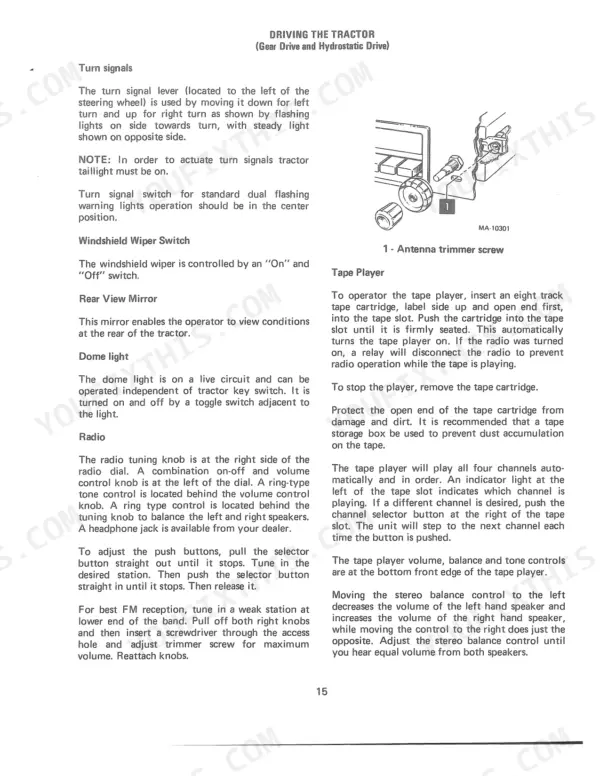
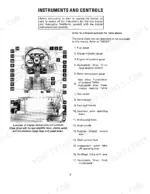
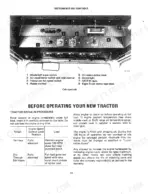
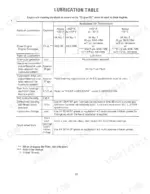
All 120 pages of this International 966 Tractor Operator Manual (OEM #1084205R1) are built around one job: putting your 966 to work correctly and keeping it there. Inside, you get full operating sequences for both the Gear Drive and Hydrostatic Drive variants, a complete instrument walkthrough covering the Charge Indicator Gauge, Engine Oil Pressure Gauge, Water Temperature Gauge, and Transmission Oil Pressure tellite, plus step-by-step procedures for the three-point hitch, two-point hitch, weight-transfer hitch, and auxiliary hydraulic outlets. The break-in section walks you through lubrication, tires, cooling, and fuel system checks before your first hour of field time. Set belt tension to 13/16-inch deflection under a 25-pound load. No more guessing which lever does what. Bookmarked throughout; pull it up on your tablet at the machine and navigate to any section in one tap.
What's Inside This International 966 Operator Manual
| System | Pages | Key Topics |
|---|---|---|
| Serial Numbers | 9 | Diesel Engine Serial Number, Tractor Serial Number, Protective CAN Serial Number, Model |
| Introduction | 12-13 | Hydrostatic Drive Tractor, Hydrostatic Drive Service, Speed Ratio Control Lever, Foot-N-inch Pedal, Hydrostatic Motor, Filters |
| Work Safely – Follow These Rules | 14-15 | Before Starting, During Operation, Tractors with Cabs, Transporting, After Operations |
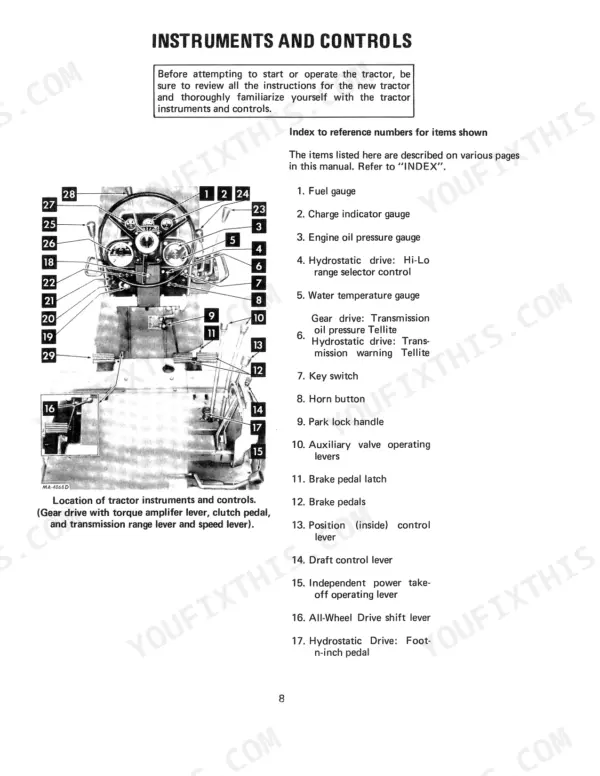
| Instruments and Controls | 16-18 | Fuel Gauge, Charge Indicator Gauge, Engine Oil Pressure Gauge, Hydrostatic Drive Selector Control, Water Temperature Gauge, Transmission Oil Pressure Tellite |
| Before Operating Your New Tractor | 19 | Tractor Break-In Procedure, Lubrication, Tires, Air Cleaning System, Engine Cooling System, Fuel System |
| Driving the Tractor | 20-30 | Preparing the Tractor for Each Day's Work, Fuel Gauge, Filling the Fuel Tank, Seat, Steering the Tractor, Tilt Steering Wheel, Locking the Brakes, Accelerator Pedal |
| Engine and Fuel System | 31-36 | Fuel System, Warranty Notice, Venting the Fuel System, Fuel Storage, Starting the Engine, After the Engine Is Running, Engine Oil Pressure, Stopping the Engine |
| Hydraulic Controls for the Three-Point Hitch | 37-39 | Position Control, Draft Control, Run Range |
| Three-Point Hitch | 40-46 | Lift Links and Leveling Cranks, Rigid Hitch Position, Free to Float Position, Hitch Lower Links, Hitch Upper Link, Lateral Limiter, Lateral Limiter Adjustment Procedure |
| Weight Transfer Hitch | 47-49 | Operation |
| Two-Point Hitch | 50-52 | Lift Links and Leveling Cranks, Hitch Sockets, Rigid Hitch Position, Free to Float Position, Coupling the Equipment, Uncoupling the Equipment, Removing the Two-Point Hitch Linkage |
| Hitching Trailing Equipment to the Tractor | 53-55 | Swinging Drawbar, Cross Drawbar |
| Auxiliary Valves, Remote Cylinders and Hydraulic Outlets | 56-120 | Connecting Hoses to Rear Hydraulic Outlets, Connecting Hoses to Front Hydraulic Outlets, Thermal Expansion Pressures, Operating the Double-Acting Cylinders |
Quick Reference Specifications
| Specification | Value | Page |
|---|---|---|
| Belt Tension Deflection (with 25 pound load) | 13/16 inch | p. 64 |
International 966 Common Problems This Manual Covers
Cooling system overheats or water temperature gauge climbs into red zone
Shut down and let the engine cool before opening the radiator cap. Check coolant level and inspect for leaks at hoses and the radiator core. Refer to for the correct filling and coolant addition procedure. Check fan belt deflection: with a 25-pound load applied midspan, deflection should be 13/16 inch (page 55). Clean debris from the radiator fins with compressed air blown from the engine side outward.
Manual Section: Cooling System MaintenanceBattery won't hold charge or starter cranks slowly and engine won't start
Check battery terminals for corrosion and clean with a wire brush; confirm both cables are tight. Refer to for fuse locations and verify no fuses are blown in the charging circuit. Check the charge indicator gauge on page 16 while the engine runs: if it stays in the discharge zone above idle, the alternator belt or alternator itself needs inspection before the next shift.
Manual Section: Electrical System & Battery MaintenanceFrequently Asked Questions
How do you fix international 966 engine hard to start or won't fire in cold morning conditions?
Check the fuel system vent procedure on page 31 before cranking. Verify the fuel gauge reads above empty and the shutoff valve is fully open. Prime the system by operating the hand primer until resistance is felt. If the engine cranks but won't fire after three attempts, inspect the fuel filter for water or sediment and drain the bowl. p. 31
How do you fix transmission oil pressure tellite light stays on after engine warms up?
Check the instrument panel on page 16 to confirm which tellite is illuminated. Verify transmission oil level with the dipstick at operating temperature. Inspect the oil for milky discoloration, which indicates coolant contamination. Do not operate the tractor under load until the light extinguishes or the cause is identified; continued operation risks transmission damage. p. 16
How do you fix engine oil pressure gauge reads low or drops to zero at idle?
Stop the engine immediately and check oil level on the dipstick. Verify oil is not milky or diluted with fuel. Refer to page 33 for the oil pressure check procedure. If level and condition are correct but pressure stays low at idle with the engine warm, do not restart until inspected by a qualified technician. p. 33
How do you fix three-point hitch won't raise implement or raises slowly under load?
Check hydraulic fluid level first; add fluid at the filler point described, then cycle the hitch several times to bleed trapped air from the system. Verify the position control and draft control levers on page 37 are set correctly for your implement. If the hitch still lifts slowly after bleeding, inspect the hydraulic filter for restriction before continuing fieldwork. p. 37
What do I get after purchasing this International 966 Tractor manual?
This is a 120-page searchable PDF ready for immediate download. Works on any device, so pull it up on your phone while you're under the hood. No shipping, no waiting.
Are there any print restrictions on this manual?
No restrictions at all. Print individual pages, full chapters, or the entire manual. The PDF is completely unlocked.


Reviews
There are no reviews yet.