
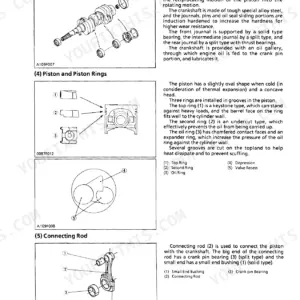
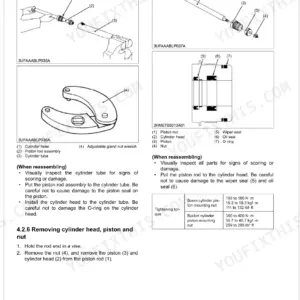
This is the factory operator manual for the Kubota L4600 tractor, supplied as a 100-page PDF you download and keep on hand. It covers the L4600 in manual transmission 2WD and 4WD and HST versions, powered by the V2203-M-E3-LB3 diesel engine, and was produced from 2004 to 2013.
The manual walks through safe operation, the instrument panel and controls, starting and running the engine, working the tractor, the PTO, the three-point hitch, and the hydraulic unit. A full maintenance section lays out service intervals, fluid capacities, tire pressures, torque values, and adjustments, and a troubleshooting section covers common engine faults.
Use it to run the tractor correctly, keep to the right service schedule, set tire pressures and wheel bolt torque, and diagnose starting or power problems before they grow. The file is text-searchable and bookmarked, ready to print in full or page by page.
What's Inside This Kubota L4600 Operator Manual
| System | Pages | Key Topics |
|---|---|---|
| Universal Symbols | 3 | Safety Alert Symbol, Diesel Fuel, Fuel-Level, Engine-Rotational Speed, Hourmeter/Elapsed Operating Hours, Engine Coolant-Temperature, Diesel Preheat/Glow Plugs |
| Safe Operation | 9-18 | Cab, ROPS, Starting, Working, Operating on Slopes, Driving the Tractor on the Road |
| Servicing of Tractor | 19 | Tractor Serial Number, Engine Serial Number, ROPS Identification Plate |
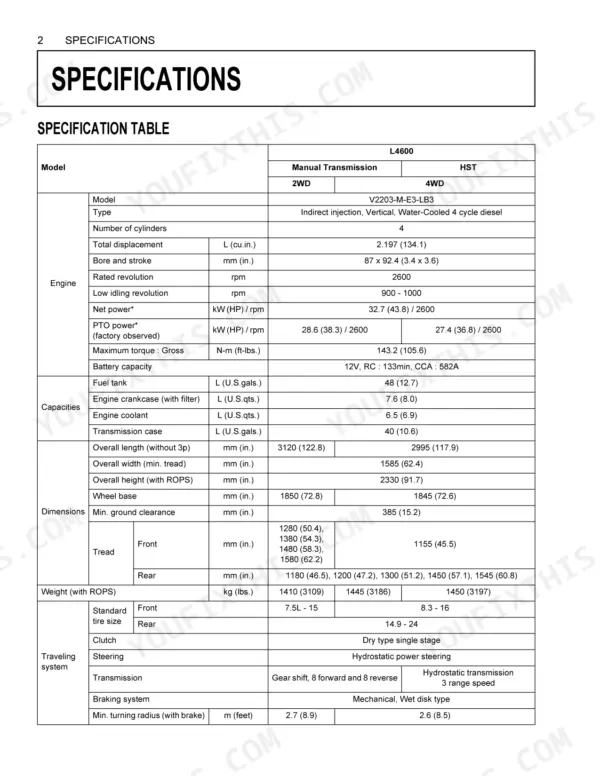
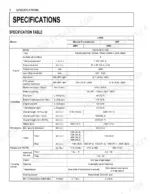
| Specifications | 20-22 | Specification Table (Model L4600 Manual Transmission 2WD, Model L4600 Manual Transmission 4WD, Model L4600 HST, Engine, Capacities, Dimensions, Weight with ROPS, Standard Tire Size, Traveling System) |
| Implement Limitations | 23-24 | Tread Max Width with Farm Tires |
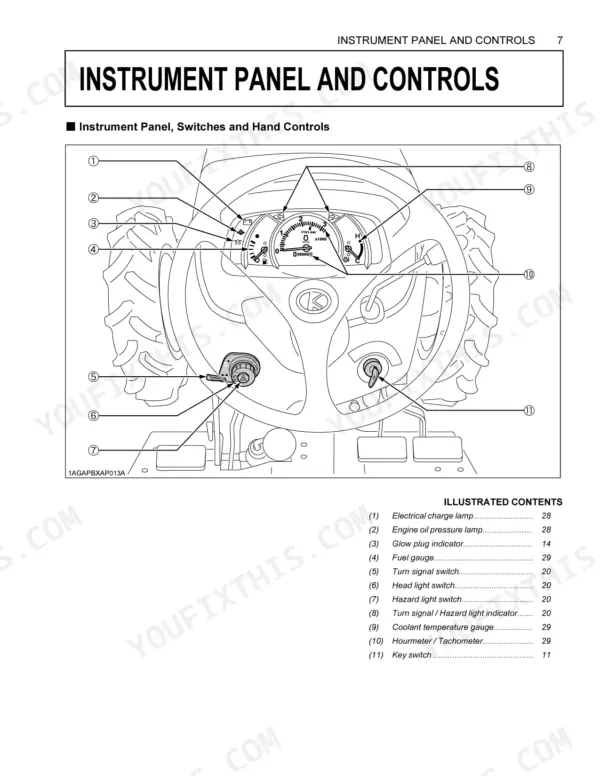
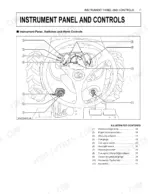
| Instrument Panel and Controls | 25-27 | Instrument Panel, Key Switch, Pedals, Shift Levers, Hydraulic Control Levers, Hand Controls |
| Pre-Operation Check | 28 | Daily Check (Check Item, Walk Around Inspection, Check Engine Oil Level, Check Transmission Oil Level, Check Coolant Level, Clean Grill and Radiator Screen, Clean Oil Cooler HST Model, Check Air Cleaner Evacuator Valve, Check Brake and Clutch Pedal, Check Indicators Gauges and Meter, Check Lights, Check Wire Harness, Check Seat Belt and ROPS, Check Movable Parts, Refuel, Care of Danger Warning and Caution Labels) |
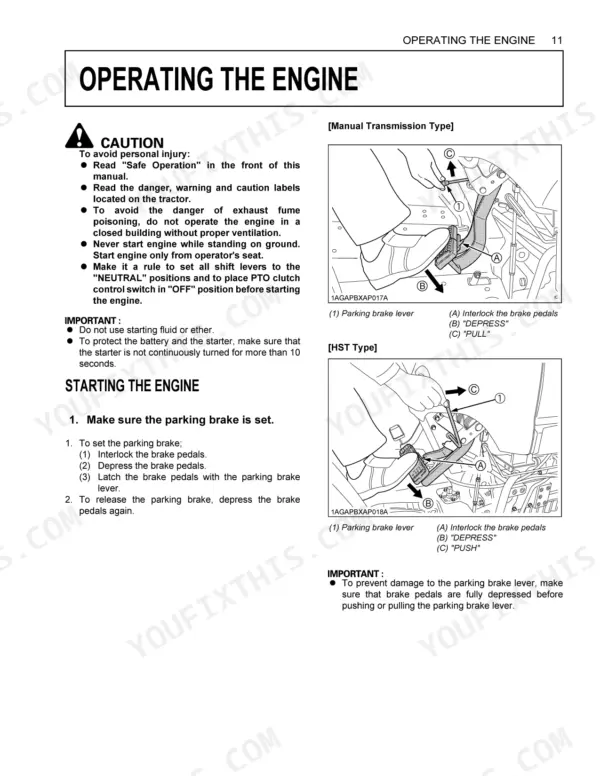
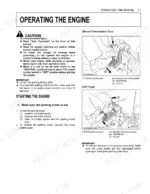
| Operating the Engine | 29-34 | Starting the Engine (Manual Transmission Type, HST Type), Cold Weather Starting, Block Heater, Stopping the Engine |
| Operating the Tractor | 35-50 | Operating New Tractor (Do Not Operate the Tractor at Full Speed for the First 50 Hours, Changing Lubricating Oil for New Tractors) |
| PTO | 51-52 | PTO Operation (PTO Clutch Control Switch), Stationary PTO, PTO Shaft Cover and Shaft Cap |
| Three-Point Hitch & Drawbar | 53-56 | Top Link, Lifting Rod, Telescopic Stabilizers, Lower Link, Drawbar, Swing Drawbar Frame [Option] |
| Hydraulic Unit | 57-61 | 3-Point Hitch Control System (Position Control, Draft Control, Mixed Control, Float Control), 3-Point Hitch Lowering Speed, Auxiliary Hydraulics (Hydraulic Block Type Outlet) |
| Tires, Wheels and Ballast | 62-67 | Tires (Inflation Pressure, Dual Tires), Wheel Adjustment (Front Wheels, Rear Wheels), Ballast (Front Ballast, Rear Ballast, Liquid Ballast in Rear Tires) |
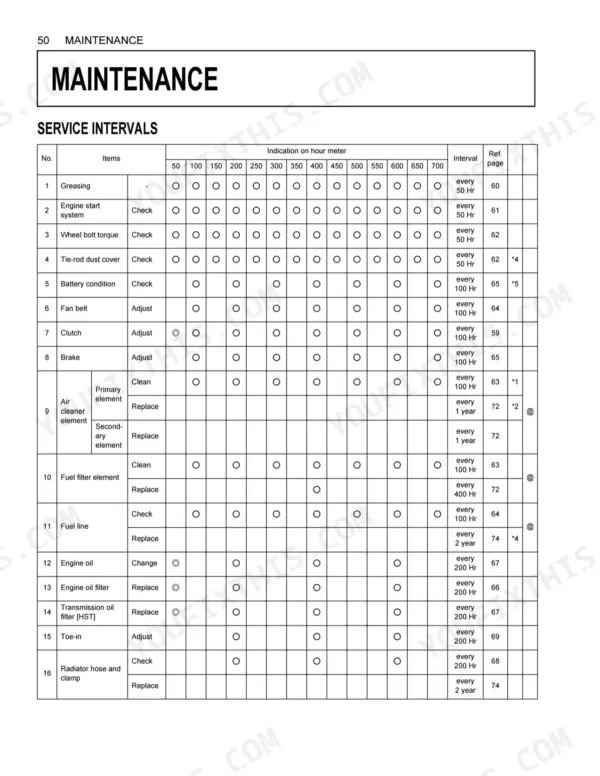
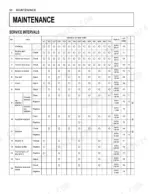
| Maintenance | 68-94 | Service Intervals (Greasing, Engine Start System, Wheel Bolt Torque, Tie-Rod Dust Cover, Battery Condition, Fan Belt, Clutch, Brake, Air Cleaner Element, Fuel Filter Element, Fuel Line, Engine Oil, Engine Oil Filter, Transmission Oil Filter [HST], Toe-In, Radiator Hose and Clamp, Power Steering Oil Line, Intake Air Line, Oil Cooler Line [HST], Hydraulic Oil Filter, Transmission Fluid, Front Axle Case Oil, Front Axle Pivot, Engine Valve Clearance, Fuel Injection Nozzle, Injection Pump, Cooling System, Coolant, Fuel System, Clutch Housing Water, Fuse, Light Bulb) |
| Storage | 95 | Tractor Storage, Removing the Tractor From Storage, Lock Plate |
| Troubleshooting | 96 | Engine Troubleshooting (Trouble, Cause, Countermeasure, Engine Is Difficult to Start or Won't Start, Insufficient Engine Power, Engine Stops Suddenly, Exhaust Fumes Are Colored, Engine Overheats) |
| Options | 97-100 | Engine Block Heater, Front End Weights, Front Bumper, Rear Wheel Weights, Sunshade, Front Grill Guard, Double Acting Remote Hydraulic Control Valve with Float Position |
Quick Reference Specifications
| Specification | Value | Page |
|---|---|---|
| Front axle mounting bolt torque | 124 to 147 N-m (12.6 to 15 kgf-m) [91.5 to 108.9 ft-lbs.] | p. 62 |
| Tie-rod mounting bolt torque | 61 to 71 N-m (6.2 to 7.2 kgf-m) [44.8 to 52.1 ft-lbs.] | p. 62 |
| Fuel filter element cleaning interval | every 100 Hr | p. 68 |
| Fuel filter element replacement interval | every 400 Hr | p. 68 |
| Engine oil filter replacement interval | every 200 Hr | p. 68 |
| Air cleaner primary element cleaning interval | every 100 Hr | p. 68 |
| Air cleaner primary element replacement interval | every 1 year | p. 68 |
| Transmission oil filter [HST Type] replacement interval | every 200 Hr | p. 68 |
| Battery type | 80D-26R | p. 84 |
| Battery voltage | 12 V | p. 84 |
| Clutch pedal free travel | 20 to 30 mm (0.8 to 1.2 in.) | p. 82 |
| Engine Oil Capacity (with filter) | 7.6 L | p. 20 |
Kubota L4600 Common Problems This Manual Covers
Engine cranks but will not start
Hard starting, especially after sitting or in cold weather, often comes from fuel delivery, air in the fuel system, a weak battery, or a glow plug and preheat issue. The Troubleshooting section lists the causes and countermeasures for an engine that is difficult to start.
Manual Section: Troubleshooting p. 96Low power, smoke, or stalling under load
Insufficient power, colored exhaust, or a sudden stall usually trace to fuel restriction, dirty filters, or an air intake problem. The Troubleshooting section pairs each symptom with its likely cause and fix.
Manual Section: Troubleshooting p. 96Weak or slow hydraulic lift
A three-point hitch that lifts slowly or weakly points to low hydraulic fluid, a dirty filter, or air in the system. The Hydraulic Unit section explains the three-point control system and lowering speed adjustment.
Manual Section: Hydraulic Unit p. 57PTO will not engage or disengage
A PTO that will not engage or release cleanly often involves the clutch control switch or a safety interlock. The PTO section covers PTO operation, the clutch control switch, and the shaft cover and cap.
Manual Section: PTO p. 51Clutch or brake pedal out of adjustment
A dragging clutch or long brake pedal usually means free travel has drifted out of range. The Maintenance section gives the clutch pedal free travel of 20 to 30 mm and the brake pedal free travel of 15 to 20 mm.
Manual Section: Maintenance p. 68Low tire pressure or loose wheel bolts
Uneven handling or wheel wobble often comes from incorrect tire pressure or under-torqued wheel hardware. The Tires, Wheels and Ballast section lists inflation pressures and the rear wheel bolt torque of 196.0 to 225.0 N-m.
Manual Section: Tires, Wheels and Ballast p. 62Frequently Asked Questions
Which L4600 versions does this manual cover?
It covers the Kubota L4600 in manual transmission 2WD and 4WD and HST forms, all powered by the V2203-M-E3-LB3 diesel engine.
What maintenance intervals does it include?
The Maintenance section lists service intervals for the whole tractor, including engine oil changes every 200 hours and fuel filter element cleaning every 100 hours. p. 68
Does it give torque specifications?
Yes. The Tires, Wheels and Ballast section covers wheel and axle torque, including the front axle mounting bolt at 124 to 147 N-m and the rear wheel bolt at 196.0 to 225.0 N-m. p. 62
How do I get the manual after buying?
It is an instant download. The PDF is available right after purchase to save on your computer, tablet, or phone, with nothing shipped.
How will I receive this Kubota L4600 Operator Manual?
Instant PDF download. The full 100-page searchable Operator Manual lands in your hands right after payment, ready to open on a laptop, tablet, or phone out in the shop.
Am I able to print pages from this Kubota L4600 manual?
You can. Print the sections you want for your own use and keep the file as your backup.
Reviews
There are no reviews yet.