
This is the Kubota M108S Low Profile workshop manual, a 464-page PDF covering the low-profile M108S tractor and its V3800-CR-TI common rail diesel engine. It follows Kubota's factory service documentation (publication 9Y111-16183) and is organized system by system.
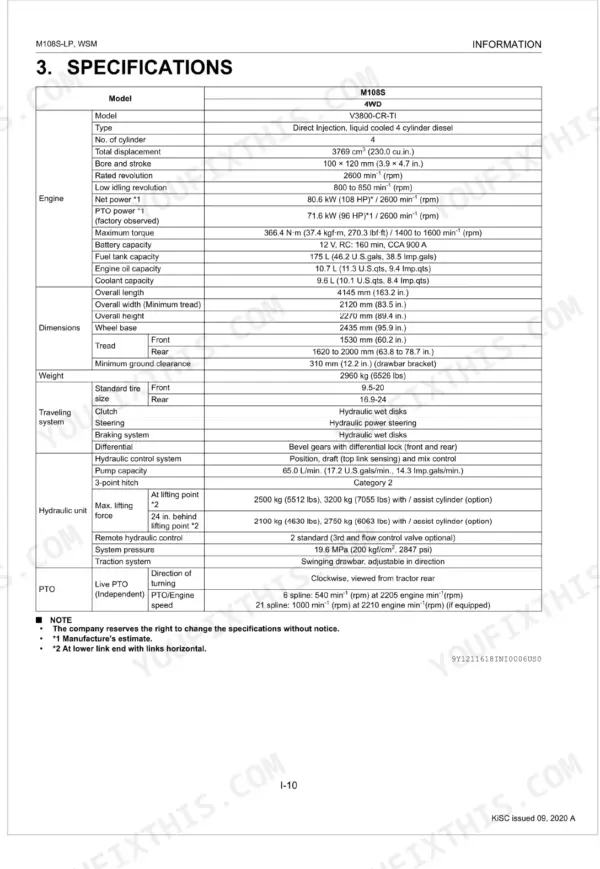
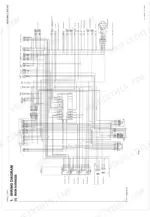
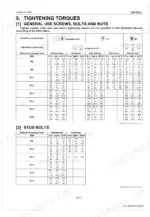
Inside you get full engine work, the traveling clutch, the shuttle shift transmission, front and rear axles, brakes, steering, and the three point hitch hydraulic system, plus complete wiring diagrams for the main, engine, and bonnet harnesses. The General section carries tractor identification, lubricants, and tightening torques, and verified capacities include a 175 L fuel tank, 10.7 L engine oil, and a 60 L transmission case.
Owners and independent mechanics get the specifications, torque values, and procedures needed to service, troubleshoot, and rebuild the M108S Low Profile to Kubota standards.
What's Inside This Kubota M108S Low Profile Manual
| System | Pages | Key Topics |
|---|---|---|
| Information | 4-18 | |
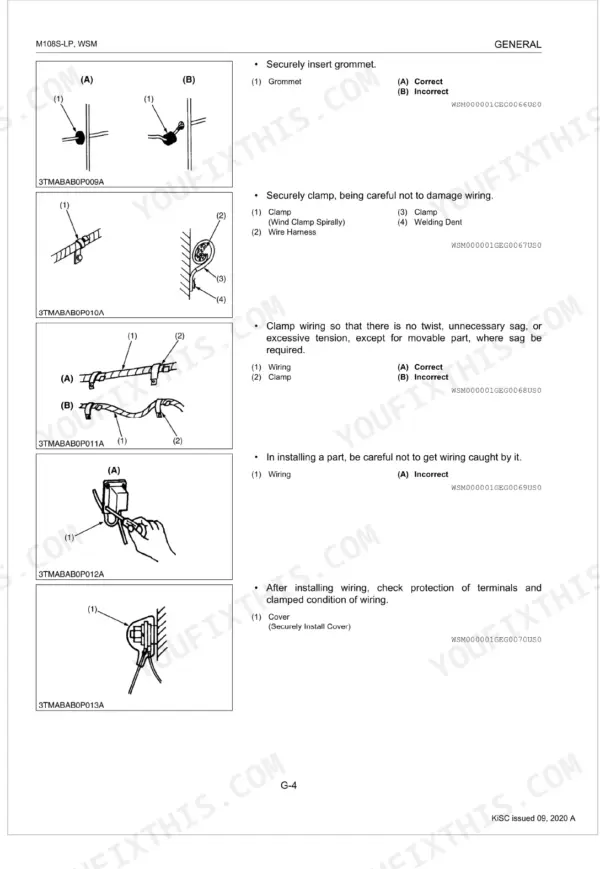
| General | 19-98 | Tractor Identification, Handling Precautions for Electrical Parts and Wiring (Battery, Fuse, Connector, Handling of Circuit Tester, Color of Wiring), Lubricants, Fuel and Coolant |
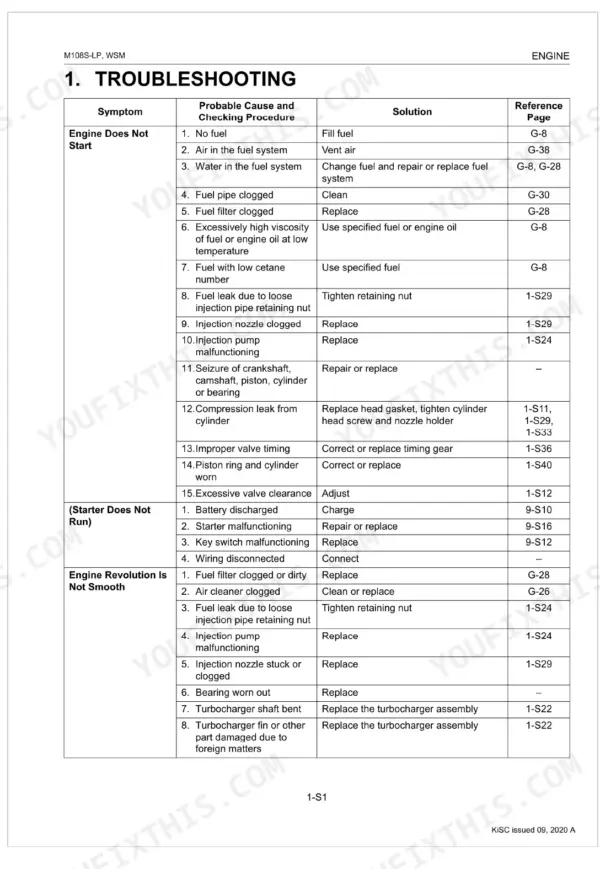
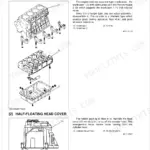
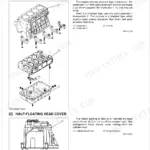
| Engine | 99-189 | Feature, Engine Body (Cylinder Block, Half-Floating Head Cover, Cylinder Head, Center Direct Injection System, Piston, Built-In Dynamic Balancer), Lubricating System (Oil Cooler) |
| Clutch | 190-203 | Traveling Clutch, Damper Disc, Propeller Shaft, Differential Lock Spring, Brake Oil Tank, Engine, Clutch Housing |
| Transmission | 204-298 | Structure, Shuttle Shift Mechanism (Shuttle Shift Section, Regulator Valve, Hydraulic Shuttle Valve) |
| Rear Axle | 299-310 | Planetary Gear Support, Planetary Gear, Rear Axle Nut, Rear Axle Cover |
| Brakes | 311-332 | Brake Pedal, Master Cylinder, Equalizer, Parking Brake Lever, Brake Pad, Brake Plate, Friction Plate, Rear Axle Case |
| Front Axle | 333-359 | Propeller Shaft, Front Wheel, Power Steering Hoses, Tie-Rod, Front Differential Case, Bevel Gear Case, Front Wheel Case |
| Steering | 360-376 | Steering Mechanism, Hydraulic Pump, Regulator Valve, Steering Controller, Steering Cylinder, Relief Valve, Gerotor Assembly, Sleeve and Spool |
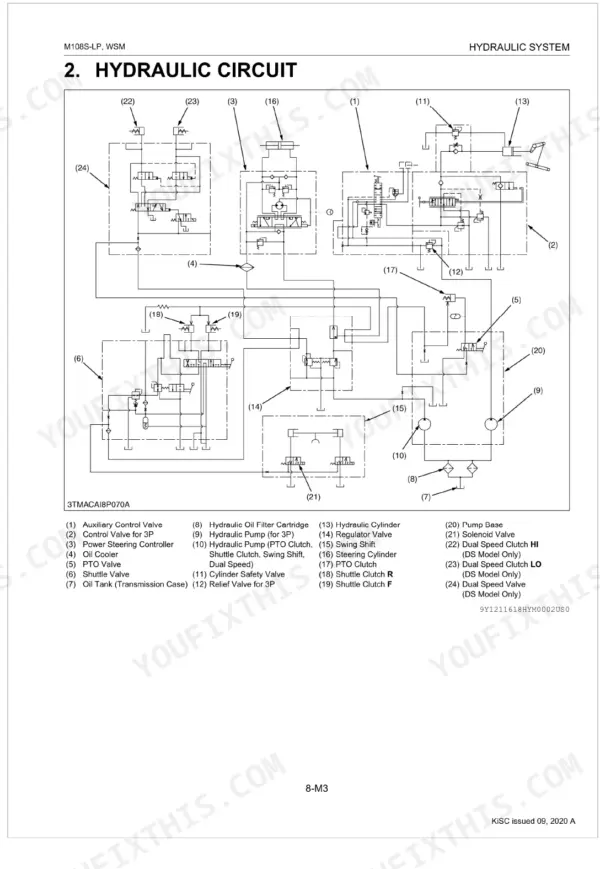
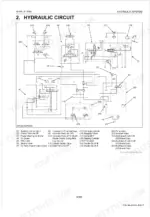
| Hydraulic System | 377-409 | Mechanism, Structure, Hydraulic Circuit, Point Hydraulic System, Control Valve, Position Control, Servicing, Troubleshooting |
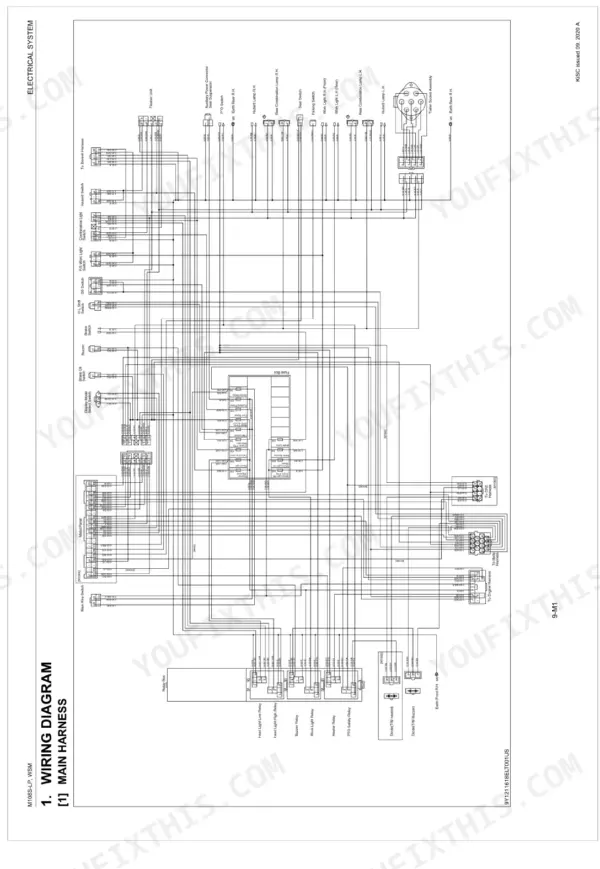
| Electrical System | 410-464 | Wiring Diagram (Main Harness, Engine Harness, Bonnet Harness) |
Quick Reference Specifications
| Specification | Value | Page |
|---|---|---|
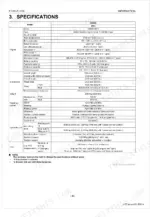
| Fuel Tank Capacity | 175 L | p. 29 |
| Engine Crankcase Oil Capacity | 10.7 L | p. 29 |
| Engine Oil Capacity | 10.7 L | p. 15 |
| Transmission Case Capacity | 60 L | p. 15 |
| Engine Oil Pressure (At Rated Speed) | 200 to 390 kPa | p. 136 |
| Thermostat Valve Opening Temperature | 74.5 to 78.5 °C | p. 136 |
| Cylinder Head Surface Flatness | 0.05 mm | p. 132 |
| Clutch Pedal Free Travel | Below 15 mm | p. 196 |
| Brake Pedal Free Travel | 7 to 14 mm | p. 316 |
| Front Wheel Alignment Toe-in | 2.0 to 8.0 mm | p. 338 |
| Hydraulic Pump Delivery (3-Point Hitch) | 66.6 L/min. | p. 389 |
| Tire Pressure (Front 9.5-20, 6PR) | 200 kPa | p. 92 |
Kubota M108S Low Profile Common Problems This Manual Covers
Hard starting or rough running
The V3800-CR-TI common rail diesel can start hard or run rough when injectors, the center direct injection system, or valve clearance drift. The Engine section covers the fuel and lubricating systems and servicing specifications.
Manual Section: Engine p. 99Clutch slip or hard pedal
A slipping traveling clutch or heavy pedal makes the tractor hard to drive. The Clutch section covers the mechanism, oil flow, servicing, and pedal free travel.
Manual Section: Clutch p. 190Shuttle shift or transmission trouble
Harsh or lost shuttle shifts and range shifting problems trace to the transmission. The Transmission section covers the shuttle shift mechanism, regulator valve, and hydraulic shuttle valve.
Manual Section: Transmission p. 204Weak or slow three point hitch
A slow, weak, or drifting hitch usually points to the hydraulic system. The Hydraulic System section covers the hydraulic circuit, control valve, and position control.
Manual Section: Hydraulic System p. 377Poor or uneven braking
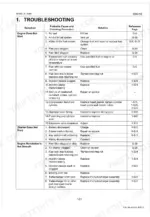
Weak or uneven braking can come from worn friction surfaces or a low brake fluid level. The Brakes section covers servicing, troubleshooting, and the correct pedal free travel.
Manual Section: Brakes p. 311Steering play or wander
Excess play or wander comes from a worn steering linkage or gear. The Steering section covers structure, servicing, troubleshooting, and tightening torques.
Manual Section: Steering p. 360Charging or wiring faults
Charging faults or dead circuits are traced through the harnesses. The Electrical System section provides wiring diagrams for the main, engine, and bonnet harnesses.
Manual Section: Electrical System p. 410Frequently Asked Questions
What does this manual cover?
It covers the Kubota M108S Low Profile tractor and its V3800-CR-TI common rail diesel engine, across every system from the engine to the electrical harnesses. It is a 464-page workshop manual with publication number 9Y111-16183.
How much fuel and oil does it hold?
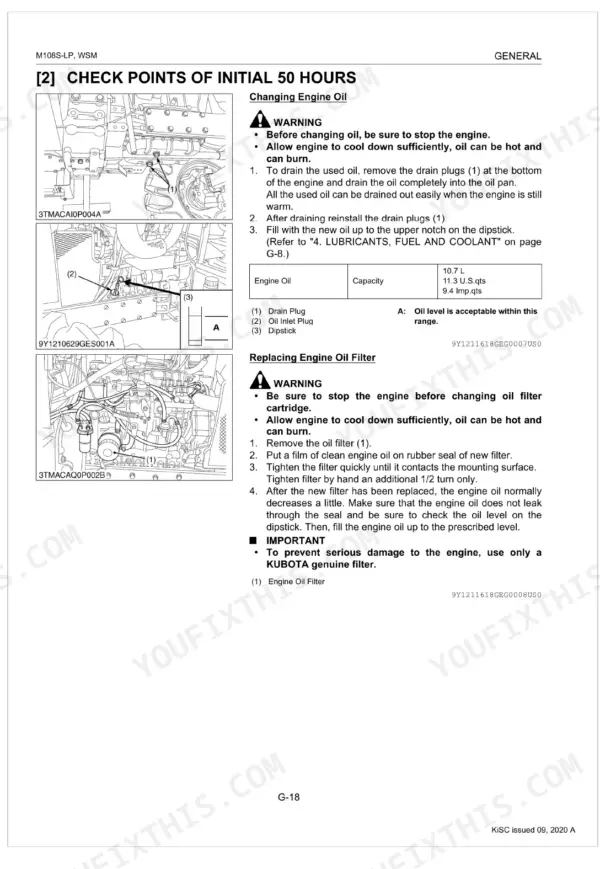
The M108S Low Profile holds 175 L of fuel, 10.7 L of engine oil, and 60 L in the transmission case. Full capacities are in the General section. p. 19
Are wiring diagrams included?
Yes. The Electrical System section provides wiring diagrams for the main harness, engine harness, and bonnet harness. p. 410
Does it include tightening torques?
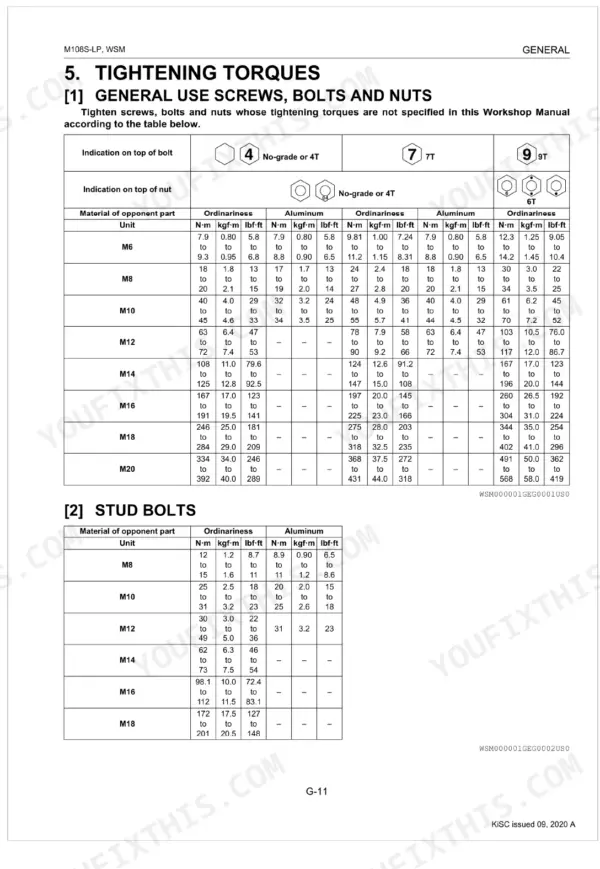
Yes. The General section lists fastener torques, for example 40 to 45 N·m for an M10 no-grade bolt and 108 to 125 N·m for M14. p. 19
Is this Kubota M108S Low Profile Workshop Manual a digital download?
A 464-page Workshop Manual in searchable PDF, ready the moment you finish checkout. Open it on a computer, tablet, or phone. No shipping wait.
Can I print specific sections of this Kubota M108S Low Profile Workshop Manual?
Yes. Printing works from any reader and any printer, for your own shop use.
Does this Kubota M108S Low Profile Workshop Manual cover the hydraulic system?
Yes. It includes hydraulic system diagrams, circuit schematics, and component specifications for the M108S Low Profile.

Reviews
There are no reviews yet.