This is the Kubota M4900 and M5700 Workshop Manual, the factory service book (publication number 97897-12460) covering both tractors across 2WD, 4WD, ROPS, and cabin configurations. Both machines run the Kubota F2803 diesel engine, and the manual documents them in full across 472 pages.
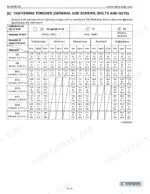
Inside you get the complete mechanism and servicing split for every major system: engine, clutch, transmission, front and rear axles, wet disc brakes, power steering, the three-point hydraulic system, the electrical system with full wiring diagrams, and the cabin air conditioning. Each servicing section carries its own troubleshooting charts, servicing specifications, and tightening torques.
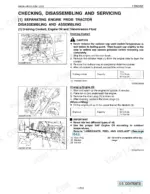
With this PDF you can trace a fault, pull the correct clearance or torque value, and follow step-by-step disassembly and reassembly instead of guessing. It is the same reference a Kubota dealer technician reaches for on these tractors.
Complete the set for your M4900, M5700
- Operator Manual: Kubota M5700–M9000 Series Operator Manual
- Operator Manual: Kubota M4900–M9000 Series Tractor Operator Manual
Other edition of this manual
- Kubota M4900, M5700, M6800HD Service Manual (incl. Wiring) Original price was: $60.99.$39.99Current price is: $39.99.
What's Inside This Kubota M4900, M5700 Manual
| System | Pages | Key Topics |
|---|---|---|
| Safety Instructions | 3-9 | |
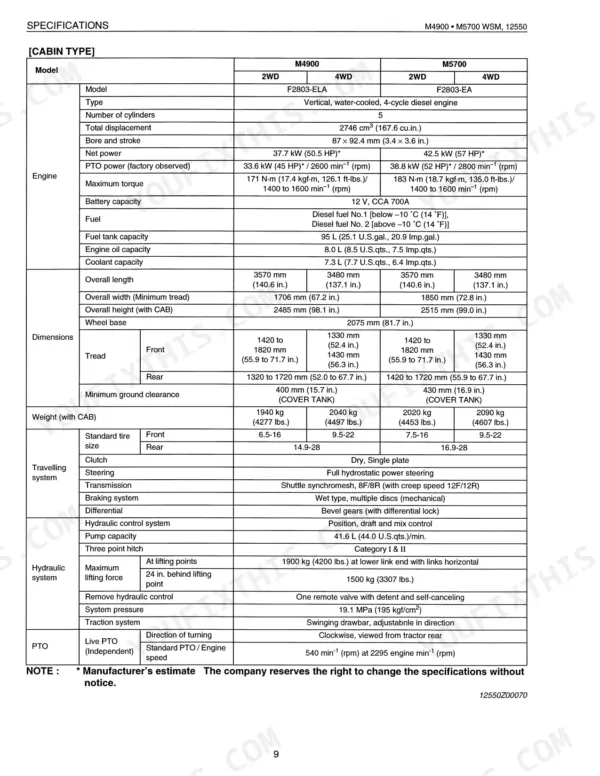
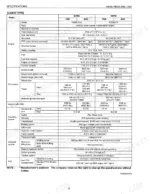
| Specifications | 10-15 | ROPS Type, M4900 - M5700 [2WD Type], M4900 - M5700 [4WD Type], M4900 - M5700 [Cabin Type], Cabin Type |
| General | 16-70 | Features, Tractor Identification, Handling Precautions for Electrical Parts and Wiring (Battery, Fuse, Connector, Handling of Circuit Tester), Lubricants, Fuel and Coolant |
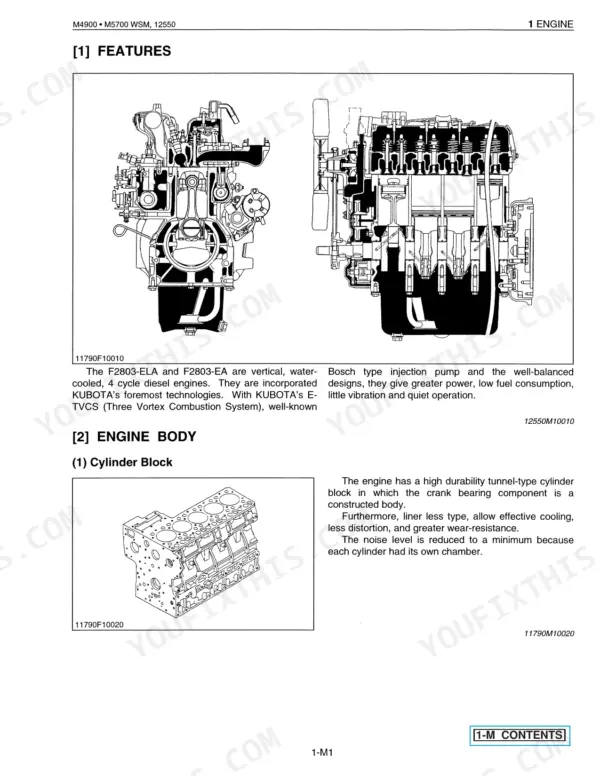
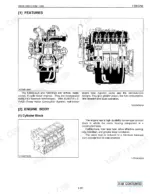
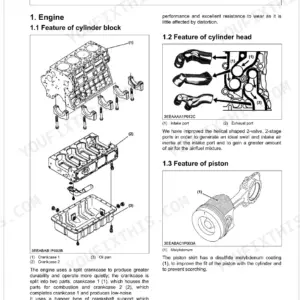
| Engine Mechanism | 71-88 | Features, Engine Body (Cylinder Block, Cylinder Head, Crankshaft, Piston and Piston Rings, Connecting Rod, Camshaft, Fuel Camshaft, Rocker Arm, Intake and Exhaust Valve, Flywheel) |
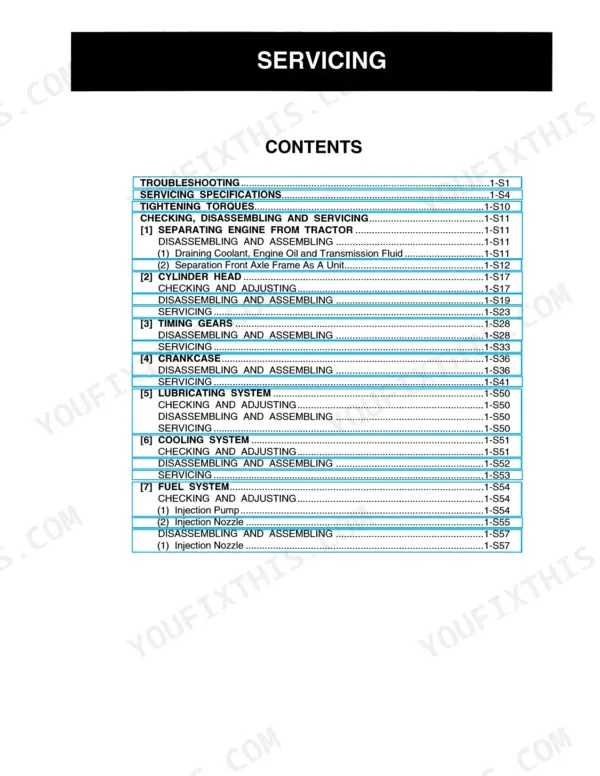
| Engine Servicing | 89-146 | Separating Engine From Tractor, Cylinder Head, Timing Gears, Crankcase, Lubricating System, Cooling System, Fuel System |
| Clutch Mechanism | 147-154 | Travelling Clutch, PTO Clutch (Features, Travelling Clutch Linkage, Operation, Structure, Oil Flow, Valve, Shift Linkage) |
| Clutch Servicing | 155-178 | Troubleshooting, Servicing Specifications, Tightening Torques, Checking, Disassembling and Servicing (Travelling Clutch, Hydraulic PTO Clutch, PTO Clutch) |
| Transmission Mechanism | 179-190 | Structure (Shuttle Shift Section, Main Gear Shift Section, Hi-Lo, Creep Shift Section, Four Wheel Drive Section), PTO System, Differential Gear (Structure, Operation) |
| Transmission Servicing | 191-224 | Clutch Housing, Transmission Case |
| Rear Axle Mechanism | 225-227 | Features, Final Reduction System |
| Rear Axle Servicing | 228-234 | Disassembling Planetary Gear, Disassembling Rear Axle |
| Brakes Mechanism | 235-237 | Features (Wet Disc Brakes, Reduced Disc Wear, Stable Braking, Pedal Stroke Does Not Change Under Influence of Heat), Operation (During Braking) |
| Brakes Servicing | 238-247 | Brake Pedal, Brake Case |
| Front Axle Mechanism | 248-251 | Structure (Wheel Drive Type), Front Wheel Alignment (Camber), Kingpin Angle, Caster, Toe-In |
| Front Axle Servicing | 252-271 | Troubleshooting, Servicing Specifications, Tightening Torques, Checking, Disassembling and Servicing (and Assembling, Front Axle), Servicing (2WD Type, 4WD Type) |
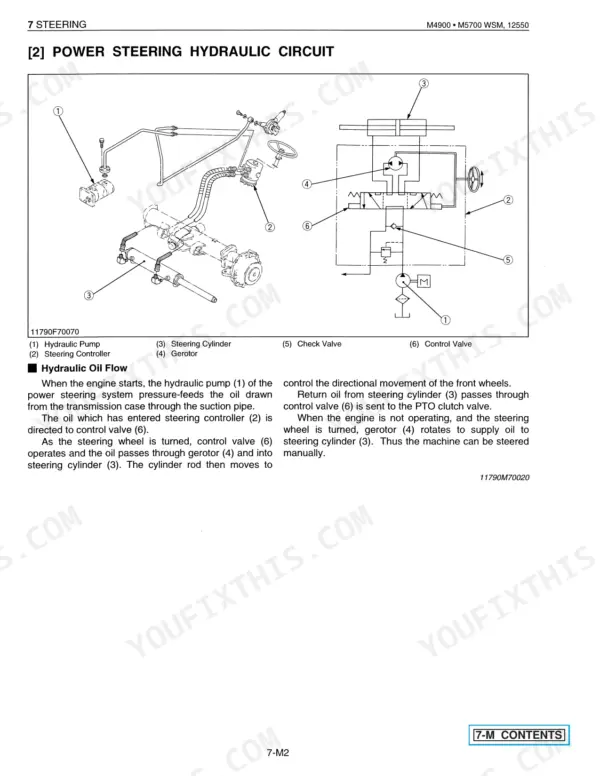
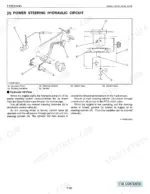
| Steering Mechanism | 272-281 | Steering Linkage, Power Steering Hydraulic Circuit, Hydraulic Pump, Steering Controller (Control Valve, Metering Device, Oil Flow), Steering Cylinder |
| Steering Servicing | 282-296 | Power Steering Hydraulic Pump, Relief Valve, Steering Cntroller, Steering Cylinder |
| Hydraulic System Mechanism | 297-314 | Three Point Hydraulic System, Hydraulic Circuit for Three Point Hydraulic System, Hydraulic Pump, Oil Filter, Position Control Valve, Relief Valve, Hydraulic Cylinder |
| Hydraulic System Servicing | 315-334 | Hydraulic Pump, Position Control and Draft Control Linkage, Relief Valve, Hydraulic Cylinder and Position Control Valve |
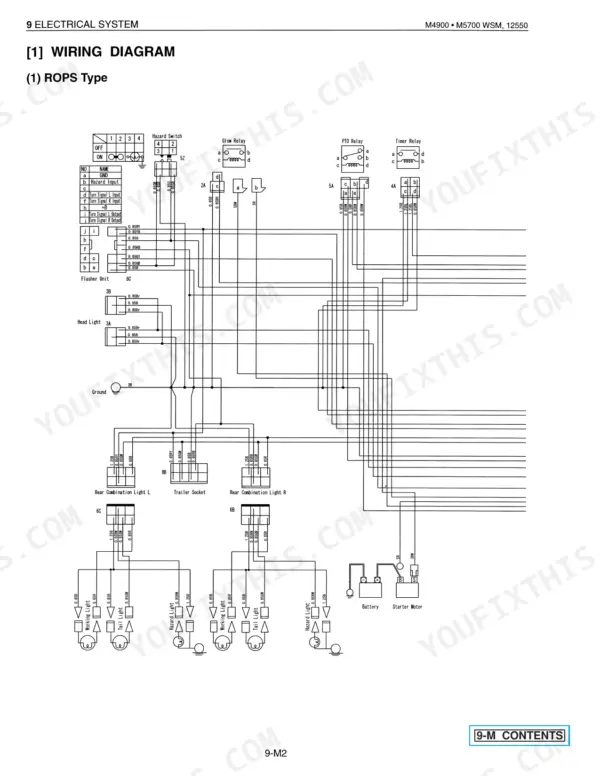
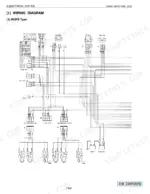
| Electrical System Mechanism | 335-378 | Wiring Diagram (ROPS Type, Cabin Type), Electrical Circuit (ROPS Type, Starting System (Starter Motor, Glow Control System) |
| Electrical System Servicing | 379-405 | Battery, Starting System, Engine Key Switch Shut Off System, Charging System, Lighting System, Warning Lamps, Gauges |
| Cabin Mechanism | 406-428 | Air Conditioner System (Principles of Air Conditioner, Expansion and Evaporation, How to Condense Gaseous Refrigerant Into Liquid, Condensing Gaseous, Refrigeration Cycle, Outline of Air Conditioning System, Refrigeration System, Compressor, Condenser, Receiver, Air Conditioner Unit, System Control, Electrical System, Thermostat) |
| Cabin Servicing | 429-472 | Troubleshooting-1, Troubleshooting-2, Servicing Specifications, Tightening Torques, Precautions at Repairing Refrigerant Cycle (Handling of Service Tools) |
Quick Reference Specifications
| Specification | Value | Page |
|---|---|---|
| M4900 | ||
| Fuel, M4900 | 65 L (17.2 U.S.gals., 14.3 Imp.gals.) | p. 24 |
| Transmission case, M4900 | 40.0 L (42.3 U.S.qts., 35.2 Imp.qts.) | p. 24 |
| M5700 | ||
| Fuel, M5700 | 95 L (25.1 U.S.gals., 20.9 Imp.gals.) | p. 24 |
| Transmission case, M5700 | 43.0 L (45.4 U.S.qts., 37.8 Imp.qts.) | p. 24 |
| All Models | ||
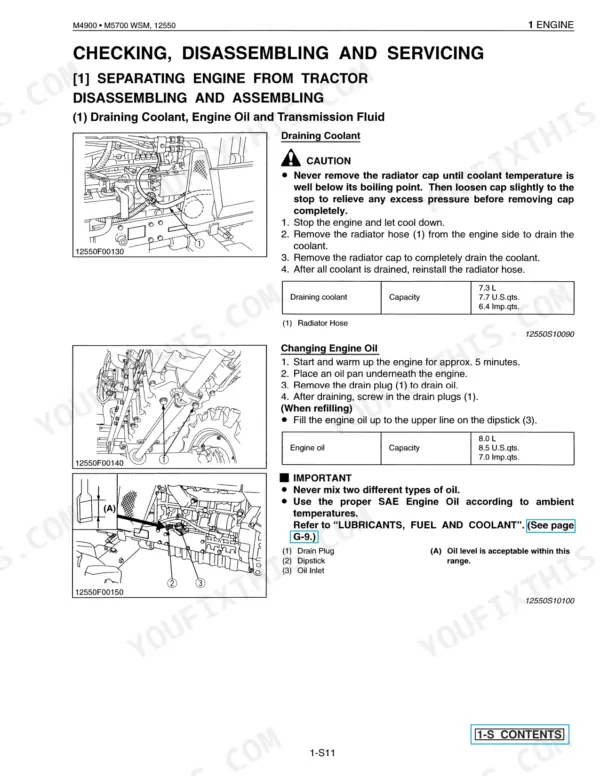
| Engine crankcase | 8.0 L (8.5 U.S.qts., 7.0 Imp.qts.) | p. 24 |
| Front axle case [4WD] | 8.0 L (8.5 U.S.qts., 7.0 Imp.qts.) | p. 24 |
| Engine oil | Change (Every 50 Hours) | p. 26 |
| Engine oil filter | Replace (Every 50 Hours) | p. 26 |
| Transmission fluid | Change (Every 600 Hours) | p. 26 |
| Cooling system | Flush (Every 2 Years) | p. 26 |
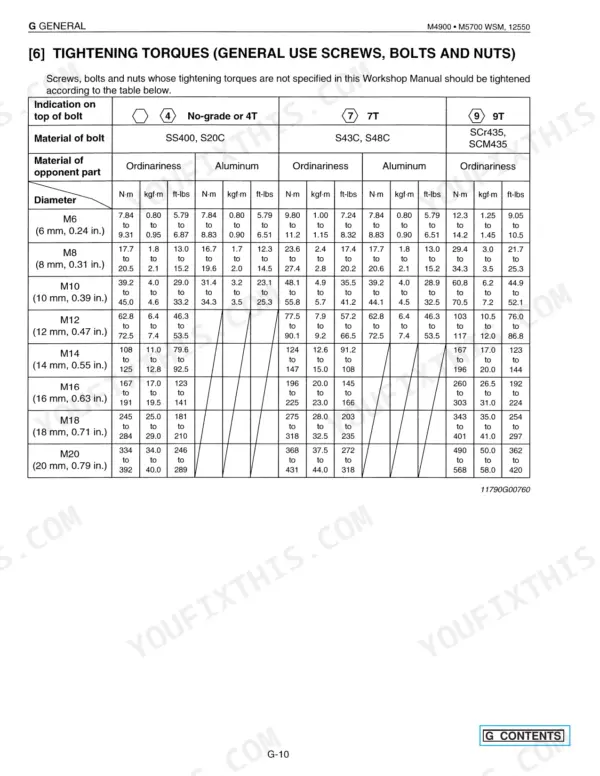
| M10 (10 mm, 0.39 in.) Ordinary | 39.2 N·m (4.0 kgf·m, 28.9 ft-lbs) | p. 25 |
Kubota M4900, M5700 Common Problems This Manual Covers
Hard cold starting on the diesel
The F2803 engine can crank steadily yet fail to fire in cold weather when the glow plugs or glow control system weaken. The manual walks the starting and glow control system so you can test and restore reliable cold starts.
Manual Section: Electrical System Mechanism p. 335Wet disc brakes dragging or weak
As the internal wet disc brakes wear or their hydraulic actuation loses pressure, braking gets soft or the discs drag and overheat. This section covers checking, servicing specifications, and disassembly of the brake pedal and case.
Manual Section: Brakes Servicing p. 238Heavy or wandering power steering
Steering that turns stiff or wanders often traces to a worn steering controller, control valve, or low hydraulic pump pressure. The servicing section gives troubleshooting, checking steps, and the specs to isolate the cause.
Manual Section: Steering Servicing p. 282Three-point hitch lifts slowly
A three-point hitch that drops under load or raises slowly usually points to a tired hydraulic pump, relief valve, or position control valve. This section covers troubleshooting the three-point hydraulic system and its pressure specifications.
Manual Section: Hydraulic System Servicing p. 315Clutch slipping or not releasing
The travelling or PTO clutch can slip under load or fail to fully disengage as friction plates wear and pedal free play drifts out of spec. The manual covers disassembling and servicing both the travelling and hydraulic PTO clutch.
Manual Section: Clutch Servicing p. 155Cabin air conditioner not cooling
On cabin models the air conditioner can blow warm from refrigerant loss or a compressor fault. This section covers the refrigeration cycle troubleshooting, servicing specifications, and safe handling of the refrigerant circuit.
Manual Section: Cabin Servicing p. 429Frequently Asked Questions
Which tractors does this manual cover?
It covers the Kubota M4900 and M5700 tractors in 2WD, 4WD, ROPS, and cabin configurations, both powered by the Kubota F2803 diesel engine. The specifications section lists each variant separately.
Does it give engine servicing specifications like valve clearance?
Yes. The Engine Servicing section provides troubleshooting, full servicing specifications, tightening torques, and checking procedures, including cold valve clearance and compression pressure values for the F2803 engine. p. 89
Are wiring diagrams included?
Yes. The Electrical System Mechanism section contains the full wiring diagrams and electrical circuits for both ROPS and cabin types, plus the starting and glow control systems. p. 335
Does it cover the hydraulic and three-point hitch system?
Yes. The Hydraulic System Servicing section covers troubleshooting, servicing specifications, tightening torques, and checking for the three-point hydraulic system, hydraulic pump, and relief valve. p. 315
What exactly do I receive with this Kubota M4900 Workshop Manual?
A 472-page Workshop Manual in searchable PDF, ready the moment checkout completes. Open it on a computer, tablet, or phone with no shipping wait.
Can I print a copy of this Kubota M4900 Workshop Manual for the shop?
Yes. Print individual pages or full chapters for your own shop use, on letter or A4 paper.
Is the hydraulic system diagrammed in this Kubota M4900 manual?
Yes. Full hydraulic diagrams are included, covering circuits, valve locations, and component specs for the Kubota M4900, M5700.