
Keep a Liebherr A 900 - A 942 wheeled hydraulic excavator digging with the factory service manual written for it. The pages were printed in 1982 and apply from serial number 101. These machines are purely hydraulic and electromechanical, so every fix comes down to pressures, flows, clearances and torques.
The book covers the hydraulic double pump data and regulation, the oil cooling circuit, rotary connection resealing and the air brake system. It also covers swing gear, axles, the two speed gearbox, hydrostatic steering and cylinder repair. A guessed torque on a swing ring bolt or a guessed pump regulation pressure can cost you a swing bearing or a pump.
Check the pump and swing ring data for your model before you order, so the right part arrives the first time.
What's Inside This Liebherr A 900–A 942 Manual
| System | Pages | Key Topics |
|---|---|---|
| General | 1-6 | Title, Contents |
| Tables, Data and Torque | 7-50 | Conversion Factors, Metric Bolt Sizes, Tightening Torques, Ermeto Couplings, ISO Tolerances, Graphic Symbols |
| Special Tools and Welding | 51-108 | Special Tools, Welding Instructions, Mini Test System, Flow Meter, Spool Travel Measuring Tool |
| Lubrication and Inspection | 109-178 | Lubrication, Technical Data, Inspection Schedule |
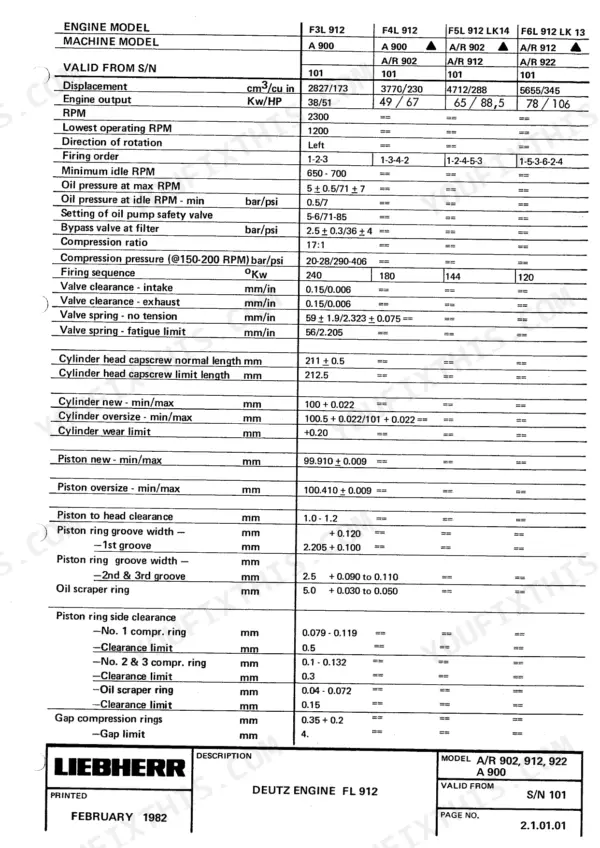
| Engine | 179-220 | Deutz Engine FL 912, Liebherr Engine D 904, Sensor Controlled Low Idle Automatic, Valve Clearance |
| Swing Gear and Swing Brake | 221-268 | Swing Gear, Swing Brake, Torque Values, Swing Brake Maintenance, Pressure Settings |
| Hydraulic System | 269-564 | Hydraulic Diagrams, Hydraulic Double Pump Data and Regulation, Oil Cooling Circuit and Thermostat Valve, Pump Troubleshooting by Comparative Cycle Times |
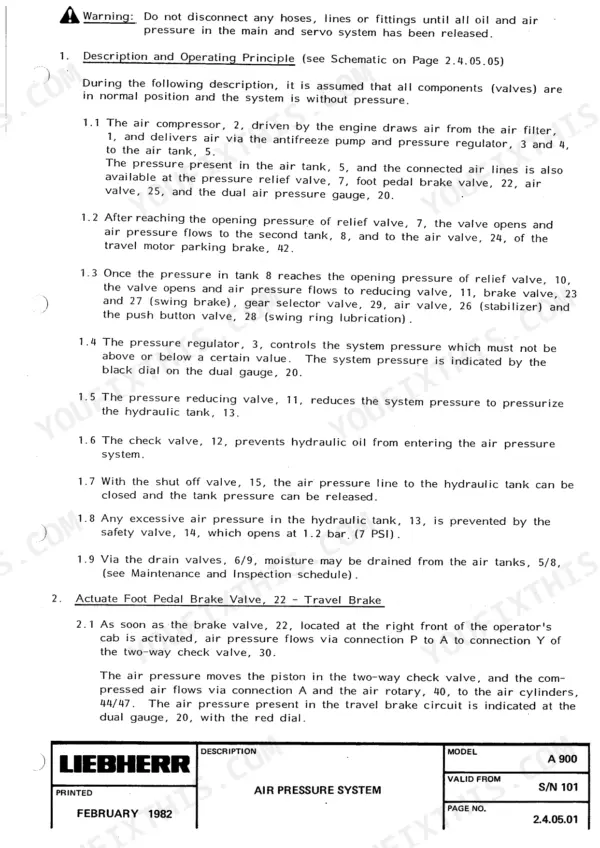
| Air Pressure System | 565-614 | Brake Valve, Air Cylinders |
| Rotary Connection | 615-632 | Hydraulic Rotary Connection Construction, Function and Resealing |
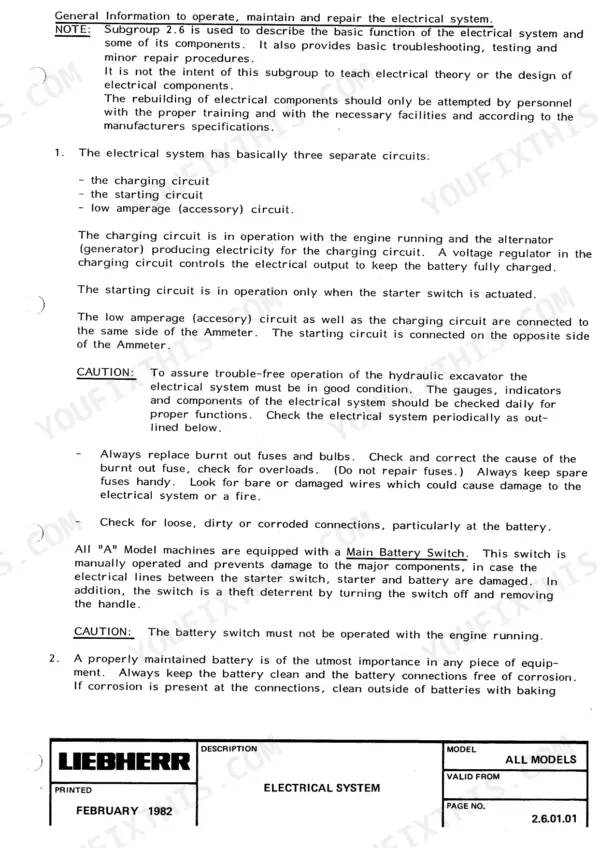
| Electrical System | 633-688 | Wiring Diagrams, Electrical Box, Charging, Starting and Accessory Circuits |
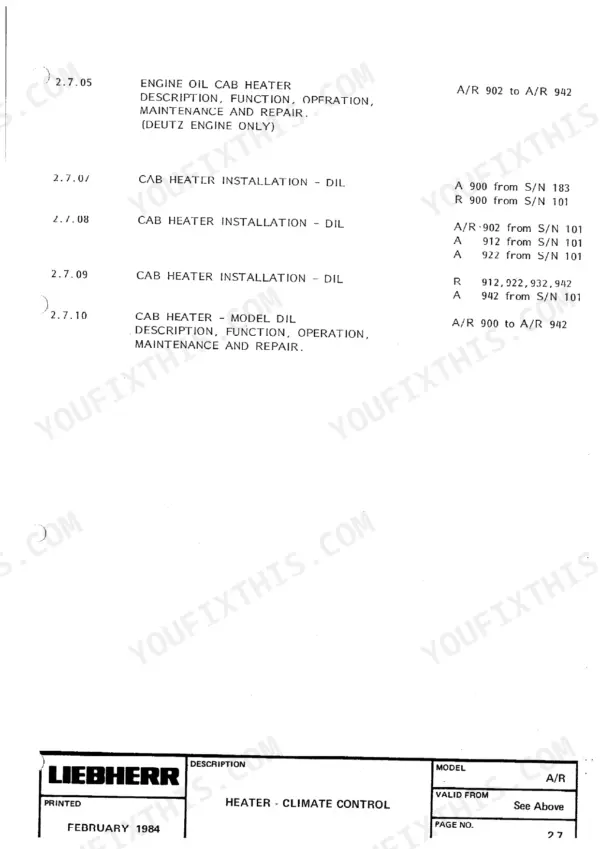
| Heater and Air Conditioner | 689-726 | Heater, Air Conditioner, Engine Oil Cab Heater, Cab Heater Installation |
| Two Speed Gearbox | 727-740 | Two-Speed Gearbox, Install Gearbox to Undercarriage |
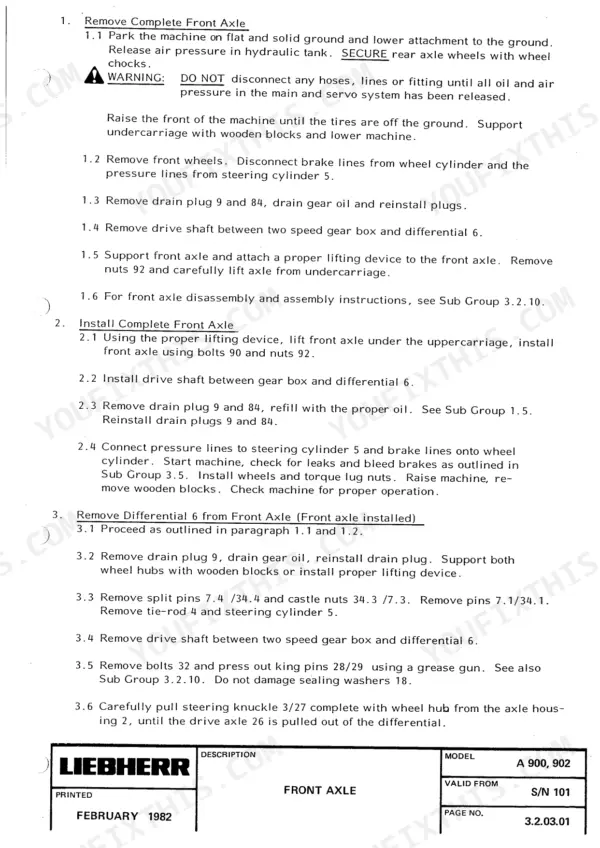
| Axles and Differential | 741-824 | Front and Rear Axle, Differential, Contact Patterns, Removing and Installation of Rear Axle |
| Hydrostatic Steering | 825-856 | Hydraulic Circuit, Servostat, Flow Indicator |
| Oscillating Axle Support | 857-904 | Axle Stabilizers, Checking and Bleeding of System, Valve Blocks |
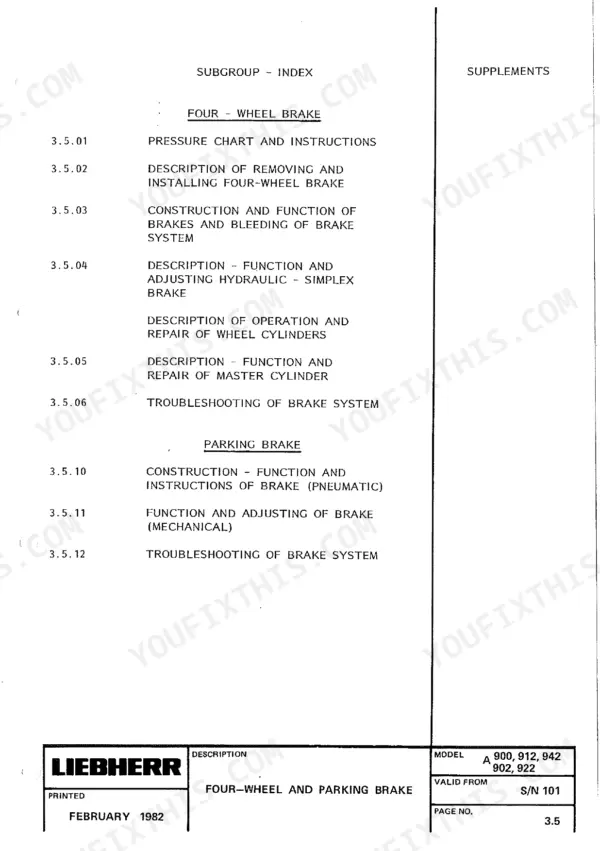
| Brakes | 905-926 | Pressure Chart, Wheel Cylinders, Master Cylinder, Troubleshooting of Brake System, Parking Brake |
| Swing Ring | 927-936 | Axial Play, Backlash, Swing Ring Bolt Torques, Upper Carriage Weights |
| Special Equipment and Accessory Kits | 937-1258 | Special Equipment, Accessory Kits, Overload Warning Device, Hoist Limit, Load Check Valve, Hydraulic Hammer |
| Hydraulic Cylinders | 1259-1299 | Hydraulic Cylinder Repair |
Quick Reference Specifications
| Specification | Value | Page |
|---|---|---|
| All Models | ||
| Swing ring axial play, new | 0.8 mm (0.031 in) | p. 897 |
| Swing ring axial play, maximum | 2.2 mm (0.086 in) | p. 897 |
| Swing ring backlash | 1.4 mm (0.055 in) | p. 897 |
| Swing ring bolt torque M20 10.9 (lubricated) | 480 Nm (355 ft-lbs) | p. 897 |
| Upper carriage weight | 6250 kg (14,000 lbs) (A 900) / 7500 kg (16,535 lbs) (A 902) / 9400 kg (20,730 lbs) (A 912) / 11,000 kg (24,250 lbs) (A 922) / 12,100 kg (27,000 lbs) (A 942) | p. 897 |
| Hydraulic double pump output | 55.2 kW / 75 HP at 2300 RPM (A 912) / 69 kW / 94 HP at 2300 RPM (A 922) | p. 475 |
| Hydraulic double pump max flow | 2x126 L/min (2x33.2 GPM) (A 912) / 2x156 L/min (2x41 GPM) (A 922) | p. 475 |
| Pump regulation begin | 217 bar (3146 PSI) (A 912) / 228 bar (3300 PSI) (A 922) | p. 475 |
| A 900, A 902, A 912 | ||
| Swing ring bolt torque M16 10.9 (lubricated) | 240 Nm (180 ft-lbs) | p. 897 |
| A 922, A 942 | ||
| Swing ring bolt torque M20 12.9 (lubricated) | 570 Nm (420 ft-lbs) | p. 897 |
| A 912, A 922 | ||
| Pump Allen bolt torque | 43 Nm (32 ft-lbs) | p. 475 |
| Cooler motor constant flow | 18 L/min (4.75 GPM) | p. 331 |
| Oil cooler check valve setting | 3 bar (43 PSI) | p. 331 |
| Hydraulic oil thermostat valve | starts to close above 40 C (105 F), fully closed at approx. 55 C (130 F) | p. 331 |
Liebherr A 900–A 942 Common Problems This Manual Covers
Hydraulic oil running hot
Check thermostat valve 21 on the expansion pipe. It should start to close above 40 C (105 F) and be fully closed at about 55 C (130 F), sending oil to the cooler fan motor 22. If the valve hangs up, the cooler never gets the flow. The Hydraulic System section covers this circuit for the A 912 and A 922.
Manual Section: Hydraulic System / Oil Cooling Circuit and Thermostat Valve p. 331Cloudy hydraulic oil and repeat component failures
Cloudy oil means air or water is getting into the system. The Hydraulic System section names water, air and dirt as the causes of component failures. Find where they are getting in before you drain and refill, or the fresh oil will cloud up as well. Use the hydraulic diagrams to trace every line back to the tank.
Manual Section: Hydraulic System / Hydraulic Diagrams p. 272Oscillating axle support piston moves into the cylinder under load
Unlock the stabilizer and lift one side of the machine off the ground with the attachment, then lock it. The piston with the load should not move into the cylinder. If it does, check the check valve in valve block 8 for proper function. The Oscillating Axle Support section covers this check and the bleeding procedure.
Manual Section: Oscillating Axle Support p. 866Air cylinders 44/47 move too little or not at all
If brake valve 22 or 3-way valve 25 is being actuated and cylinders 44/47 barely move or do not move, the fault is in the air cylinders themselves. The Air Pressure System section covers the brake valve and the air cylinders. Go through those cylinders before you replace valves that are doing their job.
Manual Section: Air Pressure System / Brakes p. 888Frequently Asked Questions
How do I tell which hydraulic pump is weak when the functions go slow?
First work out whether one circuit is slow or all of them are. Then bring the oil up to operating temperature, set the correct engine RPM and time boom-up cycles on each pump in turn. The Hydraulic System section walks through that comparison. On the A 912, the double pump is rated 2x126 L/min (2x33.2 GPM) at 2300 RPM, with regulation beginning at 217 bar (3146 PSI). On the A 922 it is 2x156 L/min (2x41 GPM), with regulation beginning at 228 bar (3300 PSI). p. 493
What torque do the swing ring bolts take on the Liebherr A 900, 902, 912, 922, 942?
All of these figures are for lubricated threads. On the A 900, A 902 and A 912, M16 10.9 bolts take 240 Nm (180 ft-lbs) and M20 10.9 bolts take 480 Nm (355 ft-lbs). On the A 922 and A 942, M20 10.9 bolts take 480 Nm (355 ft-lbs) and M20 12.9 bolts take 570 Nm (420 ft-lbs). Read the grade stamped on the bolt head before you pick up the wrench. p. 897
When is the swing ring worn out?
On every model from the A 900 to the A 942, a new ring has 0.8 mm (0.031 in) of axial play. The maximum allowed is 2.2 mm (0.086 in), and backlash is listed at 1.4 mm (0.055 in). Change a ring that binds or is hard to turn, whatever the play reads. The Swing Ring section also lists upper carriage weights, which you need before you rig the lift. p. 897
Does it cover the wheeled undercarriage, or only the upper carriage?
It covers both. Besides the engine, hydraulics and swing gear, there are sections on the two speed gearbox (p. 727), the front and rear axles with differential (p. 741), hydrostatic steering (p. 825), the oscillating axle support (p. 857) and the brakes (p. 905). The air pressure system is covered as well (p. 565), including the brake valve and the air cylinders (p. 569). p. 727
Where do I start on an electrical fault?
Start at the battery. Most trouble on these machines comes from loose, dirty or corroded connections, and the book says to check gauges and indicators daily. After that, use the wiring diagrams for the electrical box and the charging, starting and accessory circuits. This generation has no controller and no fault display, so you trace faults with a meter and the diagram. p. 635

Reviews
There are no reviews yet.