

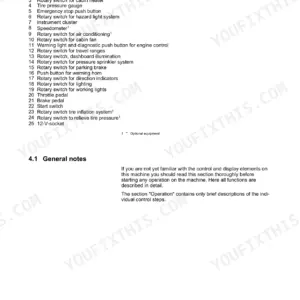
When the BVC display throws a fault mid-lift and your roller stops adapting amplitude, this 182-page Bomag BW 177 service manual PDF (OEM 008 099 94) has the answer, and it covers the 213 and 226 DH-4 BVC single drum rollers under the same cover. Circuit diagrams with component listings and connector overviews close out the book, backed by hydraulic schematics and an error code section that turns each fault reaction into a concrete check.
The BVC exciter system gets its own chapters: gear pump, valve block, swashing motor, acceleration transducers, and the potentiometer adjustment your compaction readings depend on. Set steering pressure to 200 bar plus or minus 10, verify the proportional solenoids between 0.4 and 1.2 A, and confirm the CAN bus terminator at 120 ohms.
Every hour a roller sits with a dead exciter, the fill schedule slips. Bookmarked and text-searchable, this download helps you trace a circuit to the failed component on the first try.
Complete the set for your BW 177, 213, 226 DH-4 BVC
- Repair Manual: Bomag BW 177, BW 179, PDH-4 Service Manual — Wiring Diagrams
- Repair Manual: Bomag BW 213, 213 D Repair Manual
What's Inside This Bomag BW 177, 213, 226 DH-4 BVC Manual
| System | Pages | Key Topics |
|---|---|---|
| Documentation | 5 | Index of Related Bomag Publications (Each Sold Separately) |
| General | 6-7 | Efficient Operation, Compaction Measuring System, Automatic Adaptation, Reproducible Results, Jump Operation, Vibration Loads |
| Peculiarities | 8 | Electric Steering System, Hydraulic Steering |
| Electric Steering | 9-26 | Steering Circuit, Steering Pump, Steering Wheel, Steering Valve, Steering Angle Sensor, Trouble Shooting |
| Compaction Measuring System | 27-30 | Bem, BTM Plus, BTM Prof, Bvc |
| BVC System | 31-44 | Exciter System, Gear Pump, Valve Block, Swashing Motor, Acceleration Transducer, MESX-Control, Bop |
| Working Principle of the System | 45-46 | Compaction Power, Effective Amplitude, Acceleration Transducers, MESX-control, Exciter System, Stiffness Changes |
| Repair and Adjustments | 47-53 | Swashing Motor, Potentiometer, Potentiometer Adjustment |
| MESX Control System Overview | 55-71 | Document Updates, Software Updates, Known Faults, Component Replacement Procedures, Machine Type Settings |
| BOP and Diagnostics | 72-79 | Extended Diagnostics, Printer Language Settings, Machine Serial Number, Teaching Distance Impulses |
| Block Diagrams and Signal Descriptions | 80-87 | BEM Block Diagram, BTMplus/Variocontrol Block Diagram, ESX-control Signal Descriptions |
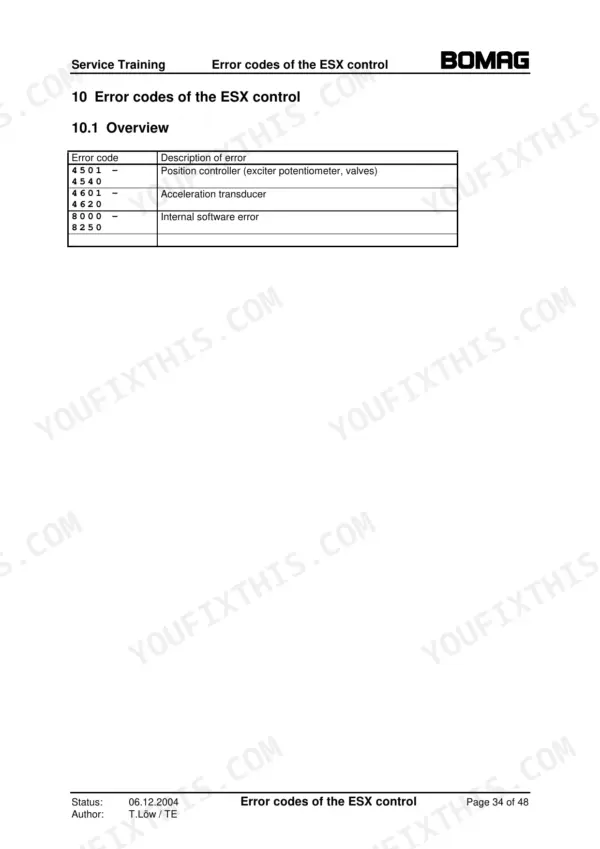
| Error Codes and Fault Reactions | 88-93 | Error Code Overview, Fault Reaction Descriptions, Detailed Fault Code Analysis |
| Input Codes and General Terminology | 94-102 | Travel System Input Codes, Vibration Input Codes, Light Input Codes, Diesel Engine Input Codes, General Electrical Terminology |
| Wz-4 Electrical Training | 103-148 | Fault Reactions, LC Display Fault Display, Steering Unit Changes, Surge Current Detection, Electrical Signal Descriptions |
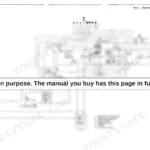
| Wiring Diagrams and Component Lists | 149-182 | Circuit Diagrams, Component Listings, Connector Overviews, Hydraulic Schematics |
Quick Reference Specifications
| Specification | Value | Page |
|---|---|---|
| All Models | ||
| Steering valve, prop. solenoid (Y 93) | 0,4 - 1,2 A | p. 15 |
| Steering valve, prop. solenoid (Y 92) | 0,4 - 1,2 A | p. 15 |
| CAN bus termination resistor | 120 OHM | p. 156 |
| Steering pressure | 200 +/- 10 bar | p. 12 |
| Steering valve shock valves pressure | 230 bar | p. 16 |
| Steering valve pressure relief valve | 175 + 25 bar | p. 16 |
| Steering valve accumulator pressure | 50 bar | p. 16 |
| Potentiometer voltage (Vertical forward) | approx. 2 V | p. 40 |
| Potentiometer voltage (Horizontal) | approx. 4.25 V | p. 40 |
| BW 177 BVC | ||
| Additional gear pump capacity, BW 177 BVC | 5.5 cm³ | p. 12 |
| BW 213 and 226 BVC | ||
| Additional gear pump capacity, BW 213 and 226 BVC | 8 cm³ | p. 12 |
| Pressure retaining valve pressure | 110 / 99 bar | p. 20 |
| Accumulator pressure | 85 bar | p. 20 |
| BW 177 DH-4 | ||
| Valve block pressure relief valve, BW 177 DH-4 | 80 bar | p. 32 |
| BW 213 / 226 DH-4 | ||
| Valve block pressure relief valve, BW 213 / 226 DH-4 | 120 bar | p. 33 |
Bomag BW 177, 213, 226 DH-4 BVC Common Problems This Manual Covers
Bomag BW 213 DH-4 BVC no vibration, acceleration transducer fault code on display
Read the stored code through the BOP, then check the acceleration transducer wiring and plugs at the drum for breaks and corrosion; the overview on page 88 puts the acceleration transducer codes in the 4601 to 4620 range. While the covers are off, test the vibration pump valve coils: 0.4 to 1.2 A is the working range. Replace the transducer only after the harness checks clean.
Manual Section: Error Codes and Fault Reactions p. 88Vibration stuck on one amplitude, position controller code for the pump valve on the display
Test both amplitude solenoids on the vibration pump valve; each coil should draw 0.4 to 1.2 A per the values on page 37. The overview on page 88 groups the exciter potentiometer and valve faults in the 4501 to 4540 range. Swap the low and high amplitude plugs to see whether the fault follows the coil or stays with the circuit. Replace any solenoid outside that current range, clear the code, and confirm both amplitudes on a test pass.
Manual Section: Bvc System p. 37Machine will not travel, brake valve fault on the display
Check the brake solenoid valve first: coil Y04 should draw 1.8 A per the component list on page 169. Inspect the harness between the ESX control and the brake valve for chafed wires and loose connector pins, since a wiring interruption sets the same fault. If coil and wiring test good, replace the brake valve and verify the brake releases before rolling.
Manual Section: Wiring Diagrams and Component Lists p. 169Steering heavy or drum will not reach full lock with the electric steering system
Check steering circuit pressure first; the pump must hold 200 bar, plus or minus 10 bar, per the spec on page 12. Measure current at steering valve solenoids Y92 and Y93: 0.4 to 1.2 A is the range listed on page 15. If pressure and current are good but the drum stops short, re-teach the electronic end stops for the steering angle sensor.
Manual Section: Electric Steering p. 12Automatic amplitude adaptation not working, compaction values drift
Measure the potentiometer voltage on the swashing motor: approximately 2 V in vertical forward and approximately 4.25 V in horizontal position, per the values on page 40. If either reading is off, readjust the potentiometer using the procedure in the repair section starting on page 47. The exciter potentiometer and valve codes sit in the 4501 to 4540 range on page 88, so inspect the valve block and exciter drive before condemning the pump.
Manual Section: Repair and Adjustments p. 47Frequently Asked Questions
How do I reset the error code on a Bomag BW 213 DH-4 BVC?
Stored faults can be deleted by entering code 0710 while the engine is not running, then switching the ignition off and on again. This function is valid from software version 1.10. p. 117
How do I reset the display on a Bomag BW 226 DH-4 BVC?
The display can be reset or terminated by entering code 0000 or by switching the ignition off. p. 62
What is the procedure for replacing the swashing motor?
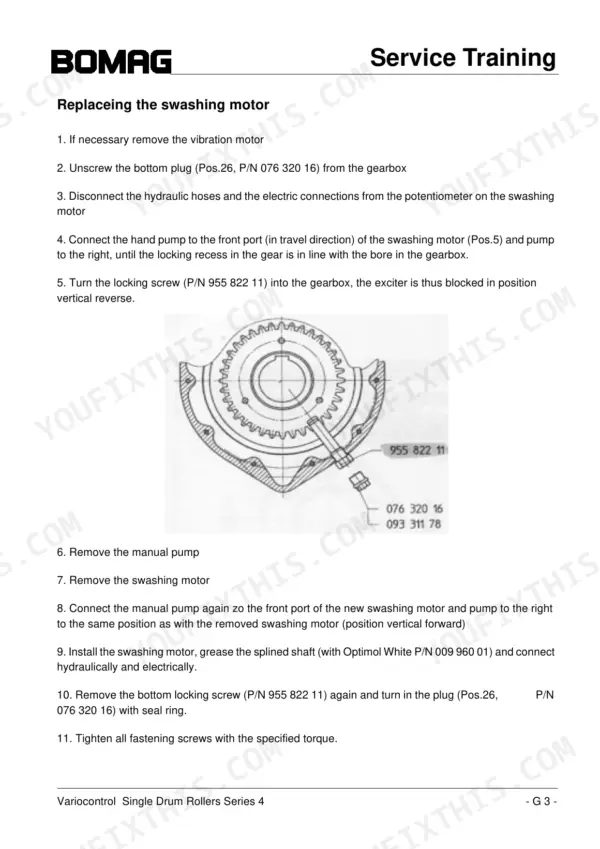
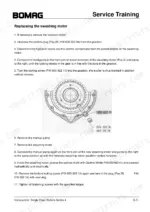
To replace the swashing motor, you must first block the exciter in the vertical reverse position using locking screw P/N 955 822 11. After installing the new motor, grease the splined shaft with Optimol White P/N 009 960 01 and tighten all fastening screws to the specified torque. p. 49
What is the nominal voltage for the sensor supply output on the ESX control on the Bomag BW 177, 213, 226 DH-4 BVC?
The nominal voltage supply for sensors is 8.5 V, with a permissible range of approximately 7.65 V to 9.35 V. p. 84
What is the steering valve pressure relief valve setting on the Bomag BW 177, 213, 226 DH-4 BVC?
The steering valve pressure relief valve is set to 175 + 25 bar. p. 16
How quickly can I access this Bomag BW 177 DH-4 BVC manual after buying?
One searchable PDF covering 182 pages, delivered instantly. No disc, no shipping, no waiting on the post.
Is printing allowed for this Bomag BW 177 DH-4 BVC Service Training?
Yes. Many mechanics print the section they need for their own shop and bring it to the bench.
Reviews
There are no reviews yet.