
What that warning lamp means, and which checks fall due at 500 hours: only the factory book settles it. This Bomag BW 27 RH operator manual PDF (OEM 008 048 41) packs the rubber tire roller's operating, safety, and maintenance instructions into 148 pages. Service intervals run from ten-hour daily checks to the 6000-hour injection valve replacement, a schedule filling nearly half the book. Troubleshooting pages show you how to read out fault codes from the electronic engine control and start with jump wires, while a tire compaction table pairs wheel load and inflation pressure with effective contact area. Before rolling out, confirm at least 5.7 bar (83 psi) in the brake system's air accumulator; when adjusting valve clearance, torque the counter nut to 20 Nm (15 ft lbs). One unread lamp can park the whole crew. Bookmarks and a genuine text layer drop you onto the right interval table in seconds.
Complete the set for your BW 27 RH
- Repair Manual: Bomag BW 27 RH Service Manual — Wiring Diagrams
Other edition of this manual
- Bomag BW 24 RH, 27 RH, 24/27 RH Operator Manual Original price was: $29.99.$19.99Current price is: $19.99.
What's Inside This Bomag BW 27 RH Operator Manual
| System | Pages | Key Topics |
|---|---|---|
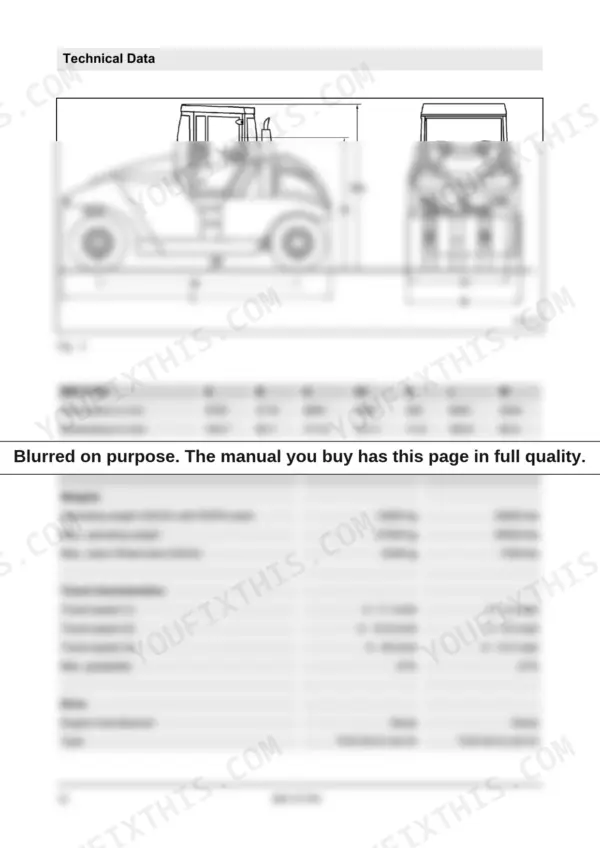
| Technical Data | 11-14 | Weights, Travel Characteristics, Drive, Brakes, Steering, Tires |
| Safety Regulations | 15-28 | General Safety Regulations, Operating Safety, Maintenance Safety |
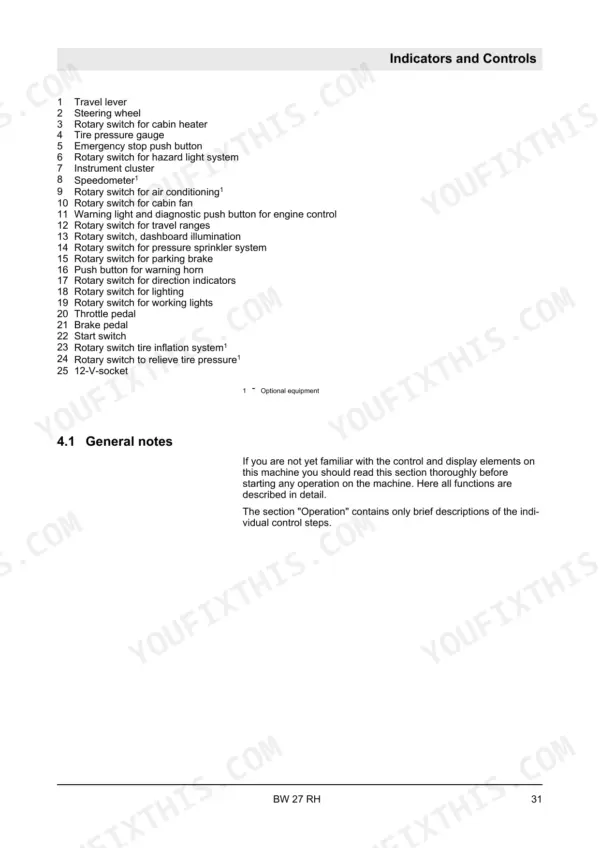
| Indicators and Controls | 29-44 | Description of Indicators and Controls |
| Operation | 45-70 | General, Tests Before Taking Into Operation, Operating the Driver's Seat, Electronic Immobilizer, Starting the Engine, Driving the Machine / Braking the Machine |
| General Notes on Maintenance | 72-73 | Fuel System, Engine Performance, Cooling System, Hydraulic System |
| Fuels and Lubricants | 74-79 | Engine Oil, Oil Viscosity, Fuel Quality, Winter Fuel, Coolant, Lubrication Grease |
| Table of Fuels and Lubricants | 80 | Engine Oil, Fuel, Coolant, Hydraulic System, Travel Gear, Sprinkler System |
| Running-In Instructions | 81 | Engine Leaks, Bolted Connections, Wheel Studs, Engine Oil, Oil Filter Cartridge |
| Maintenance Table | 82-83 | Operating Hours, Maintenance Works |
| Every 10 Operating Hours | 84-90 | Check the Engine Oil Level, Checking the Fuel Level, Checking the Coolant Level, Check the Hydraulic Oil Level |
| Every 250 Operating Hours | 91-92 | Clean the Cooling Fins on Engine and Hydraulic Oil Cooler, Check the Oil Level in the Drive Gear/Wheel Hub |
| Every 500 Operating Hours | 93-105 | Changing Engine Oil and Oil Filter Cartridge, Check, Clean the Water Separator, Check the Anti-Freeze Concentration and the Condition of the Coolant, Drain the Fuel Tank Sludge |
| Every 1000 Operating Hours | 106-111 | Replacing the Fuel Filter Cartridge, Change the Fuel Filter, Bleed the Fuel System, Checking Condition and Tension of Ribbed V-Belt, Check the Engine Mounts |
| Every 2000 Operating Hours | 112-122 | Adjust the Valve Clearance, Changing the Oil in Travel Gears/Wheel Hubs, Changing Hydraulic Oil and Breather Filter, Replacing the Hydraulic Oil Filter |
| Every 3000 Operating Hours | 123 | Replacing Ribbed V-Belt and Idler Pulley |
| Every 6000 Operating Hours | 124 | Replace the Injection Valves, Replace Crankcase Ventilation Valve |
| As Required | 125-134 | Air Filter Maintenance, Service the Water Sprinkling System, Maintenance in Case of Frost, Filling the Windscreen Washer System |
| Trouble Shooting | 135-142 | Reading Out Fault Codes of the Electronic Engine Control, Starting with Jump Wires, Engine Problems |
| Tire Compaction Values | 143-144 | Area Pressure, Wheel Load, Tire Pressure, Effective Area |
| Disposal | 145-148 | Final Shut-Down of Machine |
Quick Reference Specifications
| Specification | Value | Page |
|---|---|---|
| Main fuse for battery | 125A | p. 44 |
| Minimum pressure in the compressed air accumulator for the brake system | 5.7 bar (83 psi) | p. 52 |
| High pressure relief valves on the travel pump | 100 Nm (74 ft.lbs) | p. 67 |
| Tightening torque for counter nut (valve clearance adjustment) | 20 Nm (15 ft·lbs) | p. 113 |
| Compressed air for cleaning | 5 bar (70 psi) | p. 126 |
| Operating weight (Cece) with ROPS-cabin | 13600 kg | p. 12 |
| Max. operating weight | 27000 kg | p. 12 |
| Rated power ISO 14396 | 100 KW | p. 13 |
| Water filling capacity | 400 l | p. 13 |
| Fuel filling capacity | 250 l | p. 13 |
| Engine oil change interval | 500 operating hours | p. 75 |
| Wheel stud tightening torque | 500 Nm | p. 131 |
Bomag BW 27 RH Common Problems This Manual Covers
Bomag BW 27 RH engine won't start, cranks slowly or stop solenoid clicks with no fire
Test battery open-circuit voltage first: 12.6 V is fully charged, and anything below 12.25 V needs recharging, per page 98. Check the 125 A main battery fuse shown on page 44. If both check out, work through the engine troubleshooting steps starting on page 136 before condemning the starter or stop solenoid.
Manual Section: Trouble Shooting p. 136Engine temperature climbs during long passes, coolant gauge in the red before the shift ends
Clean the cooling fins on the engine and hydraulic oil cooler, a job due every 250 operating hours per page 91; mat dust plugs them faster on dry sites. Check the coolant level with the daily 10-hour checks on page 84, topping up only when the engine is cool, then watch the gauge on the next pass.
Manual Section: Every 250 Operating Hours p. 91Parking brake won't release and machine refuses to move at the start of the shift
Check the compressed air accumulator before blaming the hydraulics: the brake system needs a minimum of 5.7 bar (83 psi), listed on page 52. Let the engine run at idle until pressure builds past that mark, then confirm brake release. If pressure holds but the machine still won't move, run the brake function test from the maintenance schedule.
Manual Section: Operation p. 52Engine down on power with black exhaust smoke when climbing the ramp loaded
Inspect the air filter under the as-required maintenance on page 125 and clean the element with dry compressed air at no more than 5 bar (70 psi), blowing from the inside out per page 126. Check the water separator and fuel filters as well; they come due at the 500 and 1000 hour services on pages 93 and 106.
Manual Section: As Required p. 126Uneven mat finish, one wheel path compacting less than the others on the same lift
Check every tire pressure against the tire compaction values table on page 143; matched pressures set the area load, and one soft tire leaves a light strip in the mat. While you are at the wheels, confirm the studs are torqued to 500 Nm (369 ft. lb.) per page 131, then re-roll the lift.
Manual Section: Tire Compaction Values p. 143Hydraulic oil film under the machine after parking overnight, level dropping on the sight glass
Verify the hydraulic oil level during the daily 10-hour checks on page 84 and top up before moving the machine. Wipe fittings and hoses clean, then run the machine briefly to find the fresh leak. If the oil is dark or past the 2000 operating hour change interval, plan the oil and filter change from page 112.
Manual Section: Every 10 Operating Hours p. 84Frequently Asked Questions
How do I read out fault codes for the electronic engine control?
To read out fault codes, press the diagnostic button for 1 to 3 seconds. The system will then output the code via flashing lights: 2 short flashes for the first digit, 1 long flash for the second, and 1 short flash for the third. Refer to page 137 for the full procedure. p. 137
What is the procedure for adjusting tire pressure on a Bomag BW 27 RH rubber tire roller?
The Operation chapter documents this on page 61, under Operating the Tire Inflation System. A safety device makes sure that the tire pressure does not fall below 2 bar (29 PSI), so the system will not let the tires drop past that floor. For the pressure to set, read the tire compaction values table on pages 143 to 144, which pairs wheel load and tire pressure with effective contact area. p. 61
What is the wheel stud torque specification for the Bomag BW 27 RH?
The wheel studs must be tightened cross-wise to a torque of 500 Nm (369 ft. lb.). p. 132
What are the replacement specifications for the fuel filter on the Bomag BW 27 RH?
The fuel filter cartridge should be replaced every 1000 operating hours. When installing, slightly oil the rubber seal and tighten the filter element by hand until the seal contacts, then tighten for another half turn. p. 106
What is the valve clearance adjustment angle on the Bomag BW 27 RH engine?
The valve clearance adjustment angle is 75° ±15° for the intake valve and 120° ±15° for the exhaust valve. p. 112
Do I get instant access to this Bomag BW 27 RH Operator Manual?
All 148 pages arrive as one searchable PDF at checkout. Read it at the desk, then take the phone out to the machine.
Can I print pages of this Bomag BW 27 RH manual for my own shop?
You can. Print the sections you want for your own use and keep the file as your backup.
Reviews
There are no reviews yet.