
This is the Dingo 950 maintenance reference guide, the dealer reference manual for the 950P and 950D compact utility loaders. These mini loaders date from the early 1990s and can run several engines, including Kohler 22 Hp, Robin 20.5 and 22 Hp, and Kubota units.
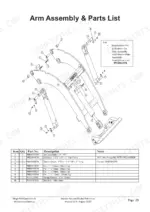
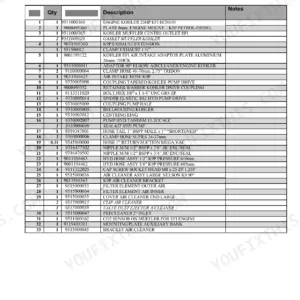
The 39 page manual gathers machine specifications, safety, pre start checks, and operating instructions, plus attachment connecting procedures, transporting, troubleshooting, and detailed parts lists with assembly drawings for the arms, mount plate, axles, wheels, dash, and hydraulics.
Use it to look up dimensions, hydraulic and battery specs, connect attachments correctly, work through starting faults, and identify the right replacement parts. A fast moving parts list at the back lists the common filters so you can order service items with confidence.
What's Inside This Dingo 950P, 950D Operator Manual
| System | Pages | Key Topics |
|---|---|---|
| Dingo 950 Maintenance Reference Guide | 1 | Maintenance Reference Guide, Dealer Reference Manual, Important |
| Introduction | 2 | This Manual Is a Resource for Dealers, Models Manufactured in the Early 1990s, Maintenance Reference Guide Purpose, Original Owners / Operations Manual, Disclaimer |
| Specifications | 3-5 | All Dingo 950 Models Have the Same Outside Dimensions/Chassis, Approximate Only, Overall Width, Overall Length, Overall Height, Maximum Operating Height, Operating Weight |
| Safety | 6-8 | Operating on Slopes, Children, Service, Safety and Instruction Decals |
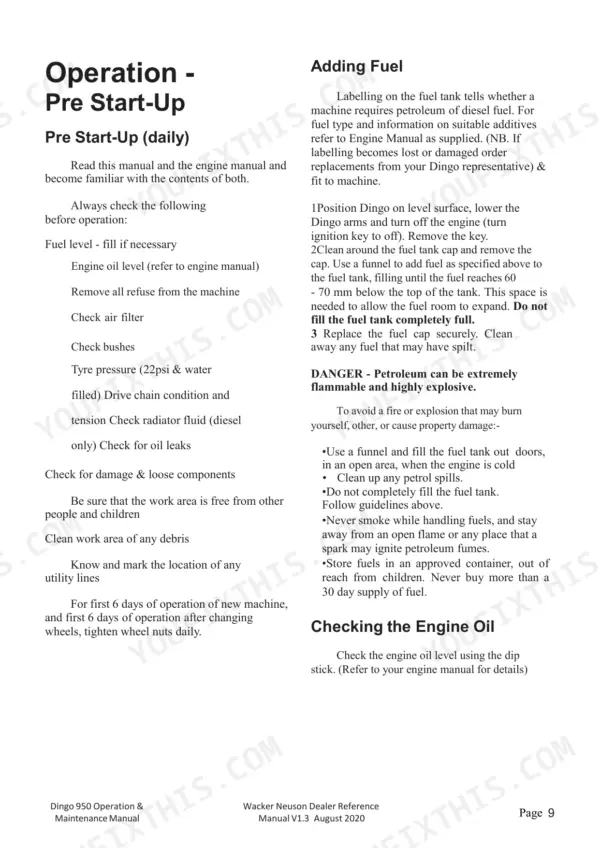
| Operation - Pre Start-Up | 9-10 | Pre Start-Up, Adding Fuel, Checking the Engine Oil, Remove Debris From the Machine, Tyres and Traction |
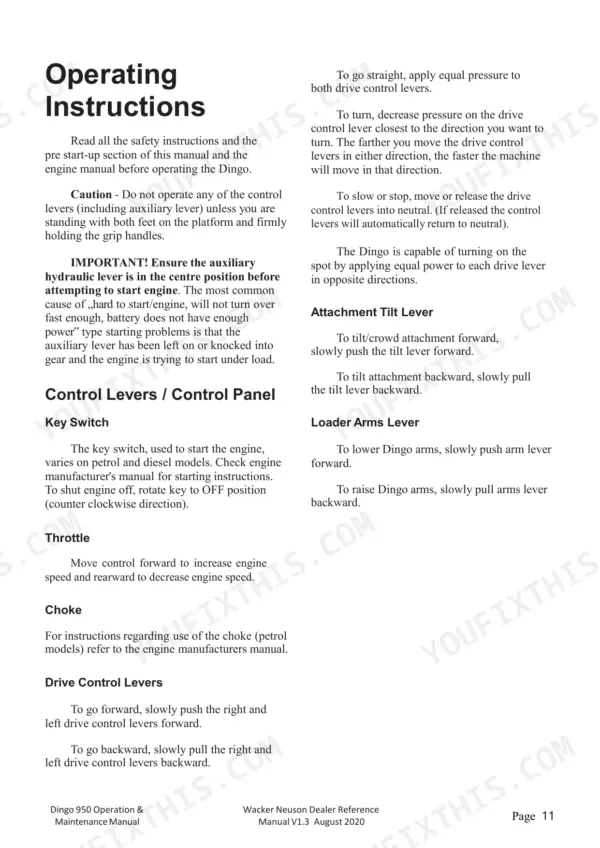
| Operating Instructions | 11-12 | Control Levers / Control Panel (Key Switch, Throttle, Choke, Drive Control Levers, Attachment Tilt Lever, Loader Arms Lever, Control Panel Diagram, Auxiliary Hydraulic Lever, Pump Selector Lever, Flow Divider Control) |
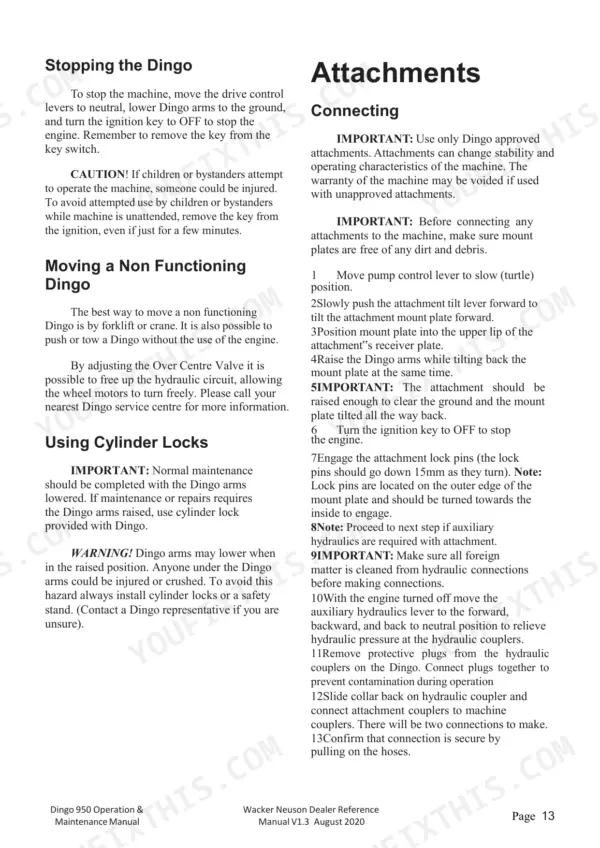
| Attachments | 13 | Connecting (Move Pump Control Lever to Slow Position, Slowly Push the Attachment Tilt Lever Forward, Position Mount Plate Into the Upper Lip, Raise the Dingo Arms While Tilting Back, Turn the Ignition Key to Off, Engage the Attachment Lock Pins, Make Sure All Foreign Matter Is Cleaned, Move the Auxiliary Hydraulics Lever, Remove Protective Plugs, Slide Collar Back on Hydraulic Coupler, Confirm That Connection Is Secure) |
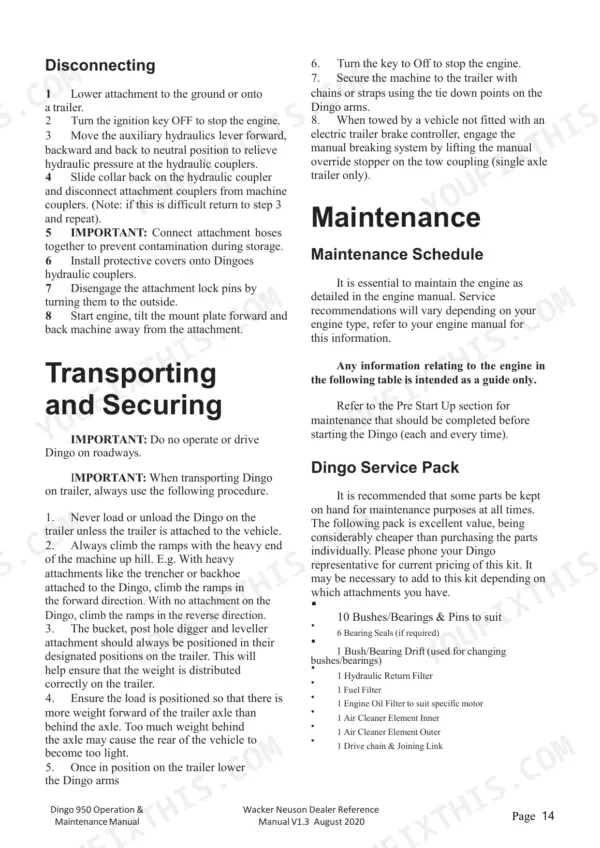
| Transporting and Securing | 14-18 | Do Not Operate or Drive Dingo on Roadways |
| Troubleshooting | 19 | Starter Does Not Crank (Battery Is Dead, Electrical Connections Are Corroded or Loose, Relay Switch Is Defective, Charge Battery, Check Electrical Connections for Good Contact, Contact Authorised Service Dealer) |
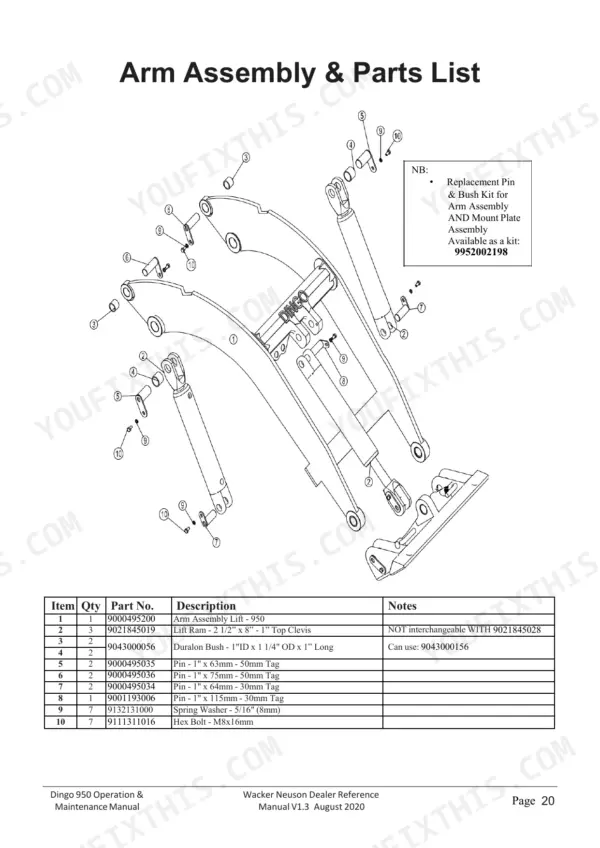
| Parts List | 20-33 | Arm Assembly & Parts List, Mount Plate Assembly & Parts List, Front Axle Assembly & Parts List, Rear Wheel Assembly & Parts List, Dash Assembly & Parts List |
| Risk Hazard Assessment | 34-35 | Summary of Product Application, Product Name: 950 |
| Warranty Statement | 36-37 | Dingo Mini Diggers Pty Ltd Policy (Warranty Period, Replacement or Repair Authorisation), Warranty Period Repairs |
| Fast Moving Parts List | 38-39 | Oil Filter, Element - Air Filter - Inner Small, Element - Air Filter - Outer Small, Element - Air Filter - Inner Large, Element - Air Filter - Outer Large, Inline - Fuel Filter |
Quick Reference Specifications
| Specification | Value | Page |
|---|---|---|
| Fuel filter replacement interval | 100 hours or yearly | p. 16 |
| Air filter replacement interval (recommended) | 50 hour intervals | p. 15 |
| Air filter replacement interval (dusty conditions) | 8 hours | p. 15 |
| Battery Voltage | 12v | p. 18 |
| Battery Cold Cranking Amps | 380 Cold Cranking Amps | p. 18 |
| Hydraulic Reservoir capacity | 60 litres | p. 3 |
| Hydraulic Output | 43 litres per minute | p. 3 |
| Wheel motor sizes | 29 cu in | p. 3 |
| Number of bushes/bearings | 9 bushes/bearings | p. 15 |
| Number of pins | 10 pins | p. 15 |
| System relief pressure (hydraulic) | 3000psi (206 Bar) | p. 3 |
| Overall length (without attachment) | 1565mm | p. 3 |
Dingo 950P, 950D Common Problems This Manual Covers
Starter will not crank
A Dingo that will not crank often has a flat battery or corroded and loose connections. The troubleshooting section walks through checking the battery, cleaning the electrical connections, and the relay switch.
Manual Section: Troubleshooting p. 19Worn loader arm pins and bushings
Older 950 machines wear at the loader arm pins and bushes, giving play and sloppy movement, and replacement arms can be hard to find. The parts list details the arm assembly and its pins and bushes.
Manual Section: Parts List p. 20Hard starting after storage
Stale fuel or a dirty fuel supply causes hard starting after the machine has sat. The pre start section covers adding clean fuel and the daily checks that keep the engine running.
Manual Section: Operation - Pre Start-Up p. 9Weak or slow hydraulics
Degraded hydraulic oil or pump wear makes the loader functions weak and slow. The specifications list the hydraulic output and a system relief pressure of 3000 psi (206 Bar) so you can compare against measured performance.
Manual Section: Specifications p. 3Attachment will not connect
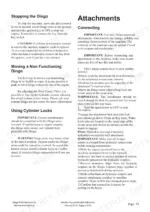
Trouble hooking up an attachment usually comes from the pin lock position or hydraulic couplers that are not fully seated. The attachments section gives the full connecting sequence.
Manual Section: Attachments p. 13Tipping risk on slopes and overloading
These loaders have real load limits and can lose stability on slopes or with an overweight load. The safety section covers operating on slopes and safe load handling.
Manual Section: Safety p. 6Frequently Asked Questions
Which machines and engines does this cover?
It covers the Dingo 950P and 950D compact utility loaders from the early 1990s. Depending on build, these ran Kohler 22 Hp, Robin 20.5 or 22 Hp, or Kubota engines. This is the dealer maintenance reference guide, since no complete factory service manual survived.
Does it include troubleshooting?
Yes. The troubleshooting section covers a starter that will not crank, pointing you through the battery, electrical connections, and relay switch checks before calling a dealer. p. 19
What are the hydraulic specs?
The specifications give a hydraulic output of 43 litres per minute and a system relief pressure of 3000 psi (206 Bar), with a 60 litre reservoir. Full machine specs are listed on the specifications pages. p. 3
How quickly can I access this Dingo 950P manual after buying?
This is a 39-page searchable PDF ready for immediate download. Works on any device — pull it up on your phone while you're under the hood. No shipping, no waiting.
Can I print this manual?
Yes. Print individual pages or full chapters for your own shop use, on letter or A4 paper.


Reviews
There are no reviews yet.