
Part of the Kubota Repair Manuals.
This is the factory Kubota Workshop Manual for the T1570, T1670, T1770, and T1870 riding mowers, a 293-page service document (publication 97897-15140). All four models are covered in one book, along with their GH430V and GH500V gasoline engines.
Because the range uses two engines, the manual has separate Engine 1 and Engine 2 chapters, then covers the Hydrostatic Transaxle, Brakes, Front Axle, Steering, Fender and Lift System, PTO System, two Electrical System chapters, and the Mower deck. Each section carries troubleshooting, servicing specifications, tightening torques, and disassembly and assembly steps.
With it an owner or independent mechanic can diagnose a no start, set spark plug gap and valve clearance on either engine, rebuild the hydrostatic transaxle, service the PTO and mower deck, and work through the KRA reverse awareness system from the wiring diagram. It downloads as a searchable PDF with a text layer for the shop.
What's Inside This Kubota T1570–T1870 Series Manual
| System | Pages | Key Topics |
|---|---|---|
| G General | 12-48 | Features, Identification, Handling Precautions for Electrical Parts and Wiring, Fuel and Lubricants, Special Tools |
| Engine 1 | 49-102 | Separating Engine, Engine Body, Fuel System, Troubleshooting, Servicing Specifications |
| Engine 2 | 103-152 | Separating Engine, Engine Body, Fuel System, Troubleshooting, Servicing Specifications |
| Hydrostatic Transaxle | 153-175 | Disassembleing and Servicing (T1670, T1770 and T1870) |
| Brakes | 176-183 | Parking Brake System, Brake Pedal Assembly, Brake Assembly |
| Front Axle | 184-190 | Front Axle Assembly, Front Wheel, Tie-Rod, Bonnet, Muffler Cover, Front Bumper, Muffler |
| Steering | 191-198 | Steering Wheel, Battery, PTO Clutch Lever, Parking Lock Pedal, Throttle Cable, Fender, Steering Support, Steering Shaft |
| Fender and Lift System | 199-209 | Fender, Lift System, Gas Spring, Suspension, Lift Link, Lift Lever, Seat, Cutting Height Adjusting Dial |
| PTO System | 210-217 | PTO Belt, PTO Clutch Lever, Mower Brake, Tension Bracket, Tension Pulley |
| Electrical System 1 | 218-247 | Wiring Diagram, Kra (Kubota Reverse Awareness) System, Battery, Starting System, Charging System, Ignition System |
| Electrical System 2 | 248-278 | Wiring Diagram, Kra (Kubota Reverse Awareness) System, Battery, Starting System, Charging System, Ignition System |
| Mower | 279-293 | Mower Blade, PTO Belt, PTO Belt Support, Mower Belts, Mower Link, Blade Pulley, Blade Shaft, Tension Arm Bushing |
Every system also includes tightening torques.
Quick Reference Specifications
| Specification | Value | Page |
|---|---|---|
| All Models | ||
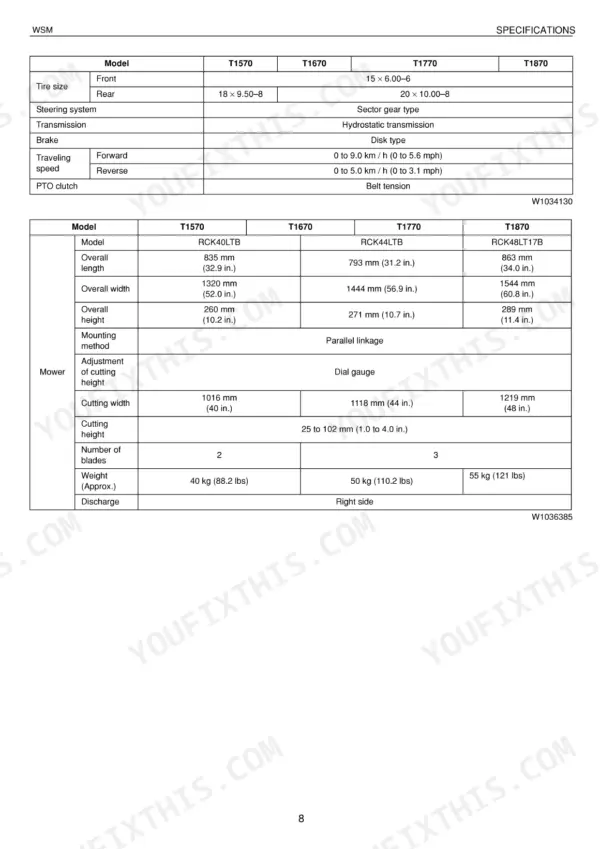
| Muffler cover mounting screw torque | 23.5 to 27.5 N·m (2.4 to 2.8 kgf·m, 17.4 to 20.3 ft-lbs) | p. 59 |
| Front bumper mounting screw torque | 23.5 to 27.5 N·m (2.4 to 2.8 kgf·m, 17.4 to 20.3 ft-lbs) | p. 59 |
| Brake Disk to Brake Pad Clearance | 0.76 mm | p. 178 |
| Front Wheel Alignment Toe-in | 0 to 10 mm | p. 186 |
| T1570, T1670 | ||
| Engine 1 Spark Plug Gap | 1.02 mm | p. 58 |
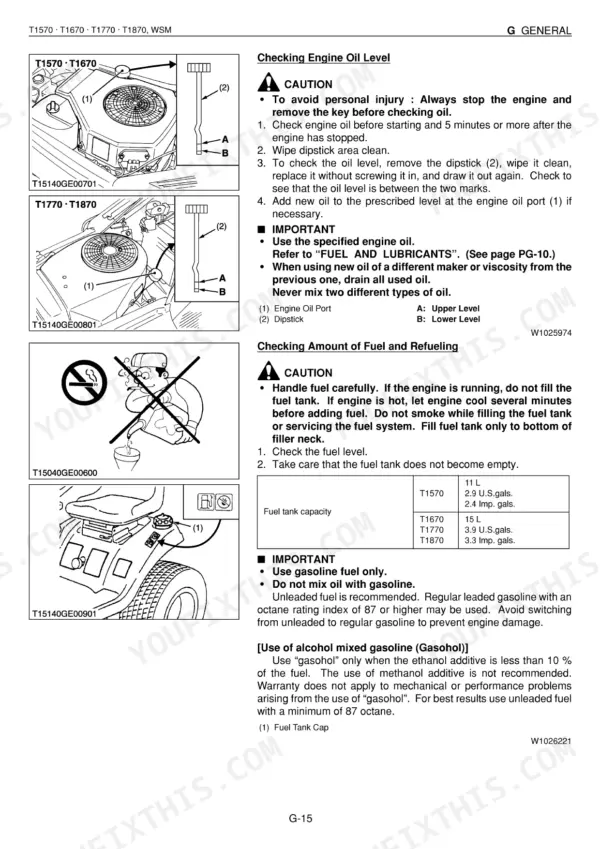
| Engine Oil Capacity (Crankcase) (T1570, T1670) | 1.9 L | p. 29 |
| Fuel Tank Capacity (T1570, T1670) | 11.0 L | p. 9 |
| Cylinder Head Surface Flatness (Engine 1) | 0.076 mm | p. 55 |
| T1770, T1870 | ||
| Engine 2 Spark Plug Gap | 0.75 mm | p. 109 |
| Engine Oil Capacity (Crankcase) (T1770, T1870) | 1.7 L | p. 29 |
| Fuel Tank Capacity (T1770, T1870) | 15.0 L | p. 9 |
| Cylinder Head Surface Flatness (Engine 2) | 0 to 0.08 mm | p. 109 |
Kubota T1570–T1870 Series Common Problems This Manual Covers
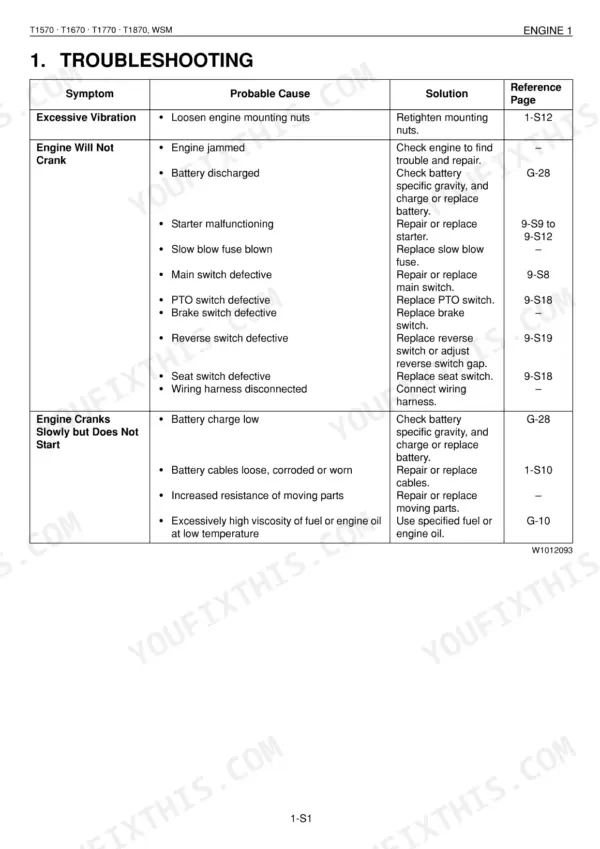
Engine will not start (T1570, T1670)
A T1570 or T1670 that cranks but will not fire often has a fouled plug, weak spark, or fuel fault on the GH430V. The Engine 1 section covers the engine body, fuel system, troubleshooting, and servicing specifications including the spark plug gap.
Manual Section: 1 Engine 1 p. 49Rough running (T1770, T1870)
Rough running or lost power on a T1770 or T1870 points to the GH500V fuel system, valves, or ignition. The Engine 2 section covers the engine body, fuel system, troubleshooting, and servicing specifications for these models.
Manual Section: 2 Engine 2 p. 103Weak or uneven hydrostatic drive
A mower that pulls to one side, creeps, or loses drive usually has a worn or out of adjustment transaxle. The Hydrostatic Transaxle section covers checking and adjusting, disassembly and assembly, troubleshooting, and servicing specifications.
Manual Section: 3 Hydrostatic Transaxle p. 153PTO or blades will not engage
A PTO that slips or fails to engage the blades points to the clutch, tension spring, or linkage. The PTO System section covers checking and adjusting, disassembly and assembly, troubleshooting, and the tension spring length spec.
Manual Section: 8 PTO System p. 210Reverse warning or electrical fault
A machine that cuts out in reverse or has a charging fault involves the KRA reverse awareness system and the charging circuit. The Electrical System 1 section covers the wiring diagram, KRA system, battery, starting, charging, and ignition.
Manual Section: 9 Electrical System 1 p. 218Mower deck cuts unevenly
Scalping, an uneven cut, or deck vibration points to blade, spindle, or level problems. The Mower section covers checking and adjusting, disassembly and assembly, troubleshooting, and servicing specifications for the deck.
Manual Section: 11 Mower p. 279Frequently Asked Questions
Which models does this manual cover?
It covers the Kubota T1570, T1670, T1770, and T1870 riding mowers in one book, publication 97897-15140, along with their GH430V and GH500V gasoline engines.
Does it cover both engines?
Yes. The GH430V on the T1570 and T1670 is covered in the Engine 1 section, and the GH500V on the T1770 and T1870 is covered in a separate Engine 2 section, each with its own specs. p. 49
Are wiring diagrams included?
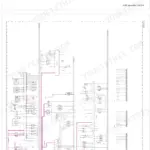
Yes. The Electrical System section carries the wiring diagram plus the KRA reverse awareness system, battery, starting, charging, and ignition, so you can trace and test circuits. p. 218
Does it cover the mower deck?
Yes. The Mower section covers checking and adjusting, disassembly and assembly, troubleshooting, and servicing specifications for the deck, blades, and related parts. p. 279
What format is this Kubota T1570–T1870 Series manual in?
This is a 293-page searchable PDF ready for immediate download. It works on any device, so pull it up on your phone while you're under the hood. No shipping, no waiting.
Can I print pages of this Kubota T1570–T1870 Series manual for my own shop?
Yes. Print the sections you need to take out to the shop for your own use. Standard letter or A4 paper works.
Does this Kubota T1570–T1870 Series manual include hydraulic schematics?
Full hydraulic system diagrams are included, covering circuits, valve locations, and hydraulic component specs for the Kubota T1570–T1870 Series.




Reviews
There are no reviews yet.