

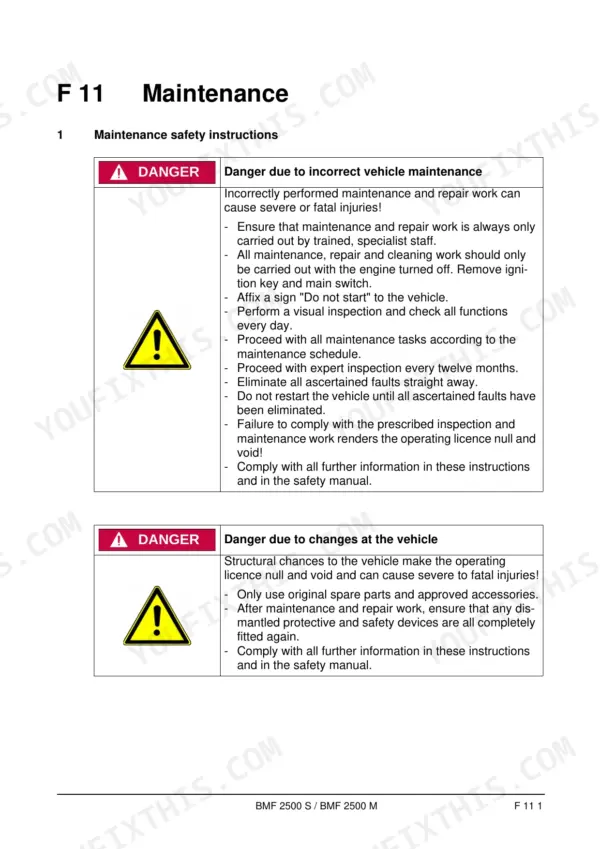
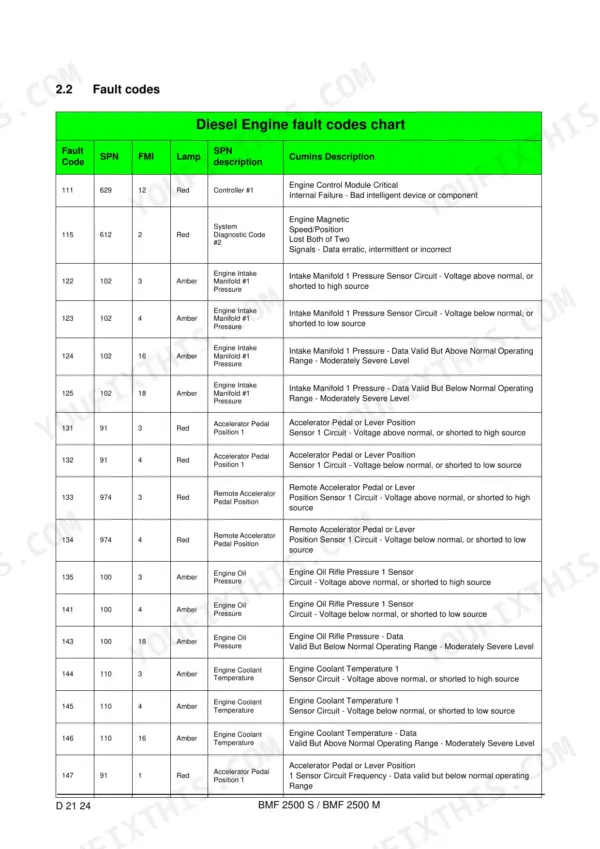



Diagnosing diesel engine fault codes on the display terminal is the hardest part of running a paving train, which is why this 588-page Bomag BMF 2500 S and BMF 2500 M feeder operator manual (OEM 00890004EN) covers terminal error messages before widening into daily operations. A massive section of the document breaks down the input menus and dashboard indicators so you know exactly what the plant is doing. The factory instructions detail material transfer procedures, night work safety, and the daily servicing intervals required to keep the conveyor moving material to the screed. You will find exact adjustment tolerances, like setting the hopper scraper gap to 6 mm and dialing in the conveyor belt sag to 0 mm +/- 5 mm. When you are stuck on a night shift with a stalled machine and no one to ask, this searchable, bookmarked PDF lets you jump straight to the safety and maintenance sections you need.
Complete the set for your BMF 2500 S, BMF 2500 M
- Repair Manual: Bomag BMF 2500 M Service Manual — Wiring Diagrams
- Repair Manual: Bomag BMF 2500 S Service Manual — Wiring Diagrams
What's Inside This Bomag BMF 2500 S, BMF 2500 M Operator Manual
| System | Pages | Key Topics |
|---|---|---|
| Preface | 9 | Operating Instructions |
| General Safety Instructions | 10-17 | Laws, Guidelines, Accident Prevention Regulations, Safety Signs, Signal Words (Danger, Warning, Caution, Note), Other Supplementary Information, Warning Symbols |
| Ce Identification and Declaration of Conformity | 18 | Declaration of Conformity |
| Residual Risks | 19 | Safety Devices |
| Sensibly Predictable Incorrect Usage | 20 | Danger Zone |
| Introduction (Scope, Purpose) | 21-22 | Operating Instructions, Residual Risks, Spare Parts, Protective Devices, Safety Devices |
| Definitions | 23-24 | Proper Use, Correct Use, Operator, Specialist |
| Proper Use and Application Areas | 25-28 | Proper Use of the Feeder (Damage, Defects, Danger Zone, Rules for Driving Lanes and the Operating Area, Danger Points, Inclinations), Liability |
| Information on the Feeder | 29-30 | Feeder, Its Assemblies and the Enclosed Equipment, Safety Facilities and Warning Signs, Airborne Sound and Vibration, Dimensions |
| Driver Permission | 31-40 | Driver's Seat and Operator's Control Station, Rights, Duties and Rules of Conduct for the Driver, Ban on Use by Unauthorised Parties, Persons in the Danger Zone |
| Installation, Maintenance and Charging of Batteries | 41-44 | Maintenance Personnel, Fire Prevention Measures, Secured Parking, Battery Fastening, Damage to Cables, Battery Maintenance, Charging the Battery |
| Refuelling Feeders | 45-46 | Permissible Fuels, Refuelling |
| Transportation, Initial Commissioning and Storage | 47-52 | Weights and Dimensions, Transportation and Loading (Transportation on Low-Loaders, Personal Safety, Transport Vehicle, Loading and Unloading with the Help of a Ramp) |
| Operation | 53-72 | Conduct in an Emergency (Fundamentals, Accident, Escape of Fluids, Fire, Short-Circuit, Technical Malfunctions), Notes on Operation, Cleaning (Bear the Following Point in Mind!) |
| Handling the Hydraulic System | 73-74 | Connecting or Releasing Hydraulic Hoses, Working on the Hydraulic System, Extension, Conversion and Spare Parts |
| Servicing and Maintenance | 75-96 | Personnel Training, Maintenance Intervals, Recurring Inspections, Disposal of Operating Substances, Special Maintenance Measures |
| Table of Contents (Extended) | 97-106 | Detailed Index, Vehicle Description, Transportation, Operation, Maintenance, Lubricants |
| Safety and General Information | 107-120 | Preface, Safety Instructions, Residual Risks, Incorrect Usage, CE Identification |
| Vehicle Description and Operation | 121-262 | Feeder Application, Assembly Descriptions, Danger Zones, Safety Devices, Technical Data, Operation Controls |
| Operation and Error Codes | 263-326 | Input and Display Terminal, Menu Operation, Engine Error Messages, Fault Codes, Diesel Engine Fault Codes |
| Maintenance Schedule and Vehicle Controls | 327-423 | Vehicle Control Elements, Maintenance Intervals |
| Conveyor and Engine Maintenance | 424-531 | Conveyor Belt Sag and Chain Adjustment, Engine Fuel Filter Service |
| Hydraulic System and Torque Specifications | 532-588 | Hydraulic Hose Service Life, Chain Tension and Torque Specs, Fluid Capacities |
Quick Reference Specifications
| Specification | Value | Page |
|---|---|---|
| Hopper scraper gap | 6 mm | p. 351 |
| Conveyor belt sag | 0 mm +/- 5 mm | p. 424 |
| Engine fuel system - Fuel filter (drain the water separator) | 10 hours | p. 457 |
| Engine fuel system - Replace fuel pre-filter | 500 hours | p. 491 |
| Hydraulic hose period of use | 6 years | p. 532 |
| Chain slack | 30-40 mm | p. 542 |
| Bottom plate bolts | 155 ± 8 Nm | p. 545 |
| Small rollers (A) tightening torque | 210 Nm | p. 546 |
| Hopper Capacity | 12.0 t | p. 138 |
| Fuel Tank Capacity | 300 litres | p. 581 |
| Engine Oil Capacity | 13 litres | p. 581 |
Bomag BMF 2500 S, BMF 2500 M Common Problems This Manual Covers
Bomag BMF 2500 S conveyor belt slipping under heavy load or tracking off center during material transfer
Inspect the conveyor belt tension and look for material carryback. Measure the belt sag at the center point; adjust tensioners until sag measures exactly 0 mm +/- 5 mm as shown on page 424. Clean the scraper bars to prevent further buildup.
Manual Section: Maintenance and Lubrication p. 424Hopper scraper dragging on the belt or leaving excessive material behind in the hopper bed
Check the hopper scraper adjustment bolts for tightness. Measure the clearance between the scraper blade and the belt. Adjust the gap to exactly 6 mm as directed on page 351 to ensure clean material flow without damaging the belt surface.
Manual Section: Maintenance and Lubrication p. 351Track chassis making loud clanking noises and vibrating heavily while tramming across the paving mat
Verify the drive chain tension immediately to prevent derailing. Measure the chain slack midway between the sprockets. Adjust the grease cylinder until you achieve a chain slack of 30-40 mm as specified on page 542. Tighten the lock valves before resuming travel.
Manual Section: Maintenance and Lubrication p. 542Engine sputtering, losing power under load, or displaying a fuel system warning code on the terminal
Drain the fuel water separator immediately. Open the bottom valve and drain until clear diesel flows. Perform this check every 10 hours of operation as noted on page 457. Replace the fuel pre-filter if the machine has reached the 500 hours interval.
Manual Section: Maintenance and Lubrication p. 457Track bottom plates feeling loose or rattling excessively when crossing uneven ground or curbs
Inspect all bottom plates for missing hardware before the start of the shift. Torque any loose bottom plate bolts to exactly 155 Nm as specified on page 545. Replace any sheared bolts immediately to avoid complete track failure on the mat.
Manual Section: Maintenance and Lubrication p. 545Frequently Asked Questions
What are the torque specifications for standard metric bolts on the BMF 2500?
The torque specifications for standard metric threads depend on the strength class and treatment. For example, an M10 bolt with a strength class of 8.8 (dry/lightly oiled) requires 41 Nm of torque, while an M10 bolt with a strength class of 12.9 requires 70 Nm. Detailed tables for both standard and fine metric threads are provided in the manual. p. 577
What is the procedure for replacing the conveyor belt chain on the Bomag BMF 2500 S, BMF 2500 M?
The chain must be replaced if it has lengthened to such an extent that it is no longer possible to adjust the prescribed conveyor belt sag. Detailed maintenance instructions for the conveyor belt are found in section F 30. p. 426
What are the replacement specifications for hydraulic hoses on the Bomag BMF 2500 S, BMF 2500 M?
Hydraulic hoses must be replaced if the period of use has exceeded 6 years. The date of manufacture stated on the fitting counts, plus 6 years. Additionally, hoses must be replaced if they show signs of damage such as chafing, cuts, cracks, brittleness, or leakage. p. 532
What is the required torque for tightening the bottom plate bolts on the Bomag BMF 2500 S, BMF 2500 M?
When installing new bottom plates, the bolts must be tightened diagonally to a required torque of 155 ± 8 Nm. p. 545
What is the correct drive-unit chain slack on the Bomag BMF 2500 S, BMF 2500 M?
The chain tension is correct if the chain slack (C) between the centre roller and the chain is 30-40 mm. p. 542
How is this Bomag BMF 2500 S Operator Manual delivered?
You download the Operator Manual yourself: 588 pages, searchable PDF, available immediately. Keep a copy on every device you use.
Is this Bomag BMF 2500 S manual print-friendly?
Yes. It prints from any PDF reader, so run off the pages you need for your own repair work.

Reviews
There are no reviews yet.