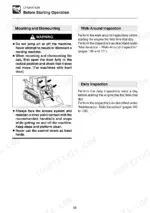
Maintenance takes up roughly a quarter of this 170-page Gehl CTL60, CTL70, CTL80 operator manual PDF (OEM ID 908305), with service data and a maintenance chart for all three compact track loaders, and the book widens from there into safety, controls, operation, transport and options. Every switch, door and cover on the machine gets named in the controls chapter, while the operation section takes you through pre-start checks, engine starting, loading for transport and the care of rubber crawlers. Troubleshooting runs from engine overheating, battery and fuel faults to fuses, warning lamps and lift arm problems; specifications close with mass, performance, dimensions and operating range. Change your engine oil and filter at the first 50 hours, then every 250; torque M10 coarse thread fasteners to 47.1 ± 2.4 N·m (34.7 ft-lb). A service stalls fast over one missing number. Bookmarks drop you onto the maintenance chart in one click, and the text layer finds any spec by keyword.
What's Inside This Gehl CTL60, CTL70, CTL80 Operator Manual
| System | Pages | Key Topics |
|---|---|---|
| Introduction | 4 | Manual Storage, Serial Numbers |
| Machine Description | 5-8 | Designated Operations, Features, Break-In Period |
| Safety | 9-36 | Preparing Precautions, Starting Precautions, Operating Precautions, Stopping Precautions, Transporting Precautions, Maintenance Precautions, Safety Signs |
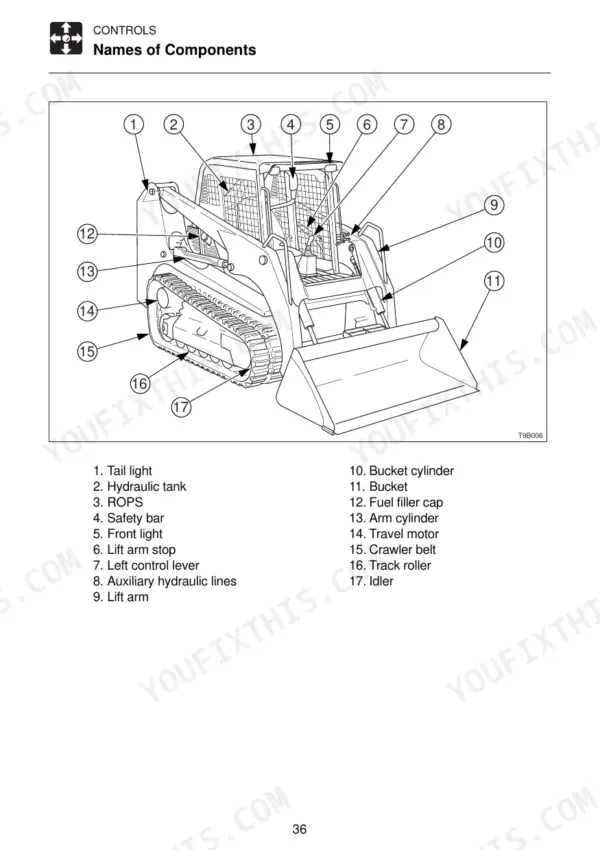
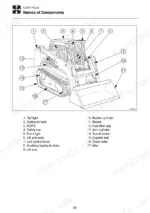
| Controls | 37-58 | Names of Components, Doors and Covers, Switches |
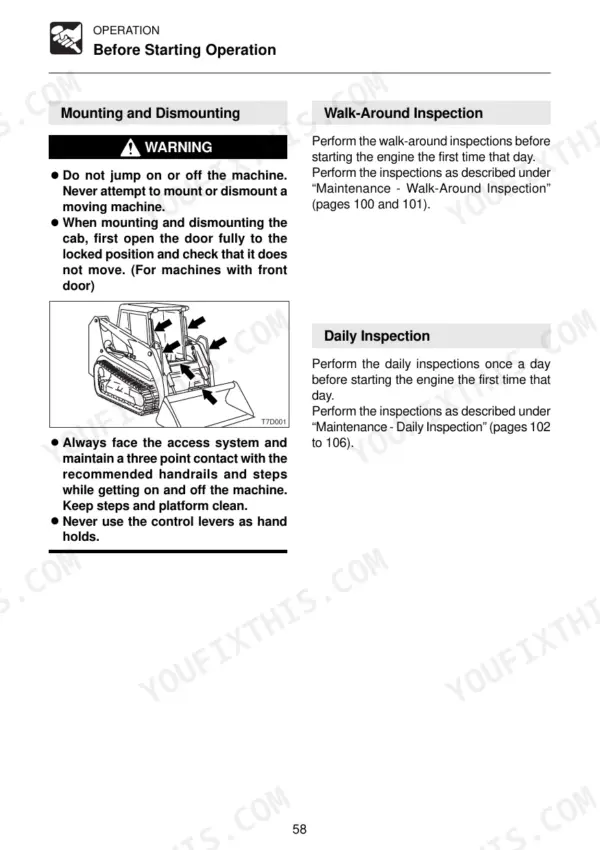
| Operation | 59-84 | Before Starting Operation, Starting and Stopping the Engine, Machine Operation, Operating Procedures, Handling Rubber Crawlers |
| Transport | 85-88 | Loading and Unloading, Securing the Machine, Transporting Posture |
| Maintenance | 89-134 | General, Service Data, Maintenance Chart |
| Troubleshooting | 135-148 | Engine Overheating, Battery, Fuel System, Fuse, Warning Lamps, Lift Arms |
| Specifications | 149-158 | Mass, Performance, Engine, Machine Dimensions, Operating Range |
| Options | 159-162 | Safety Precautions, Installing Attachments, Operating Attachments |
Quick Reference Specifications
| Specification | Value | Page |
|---|---|---|
| Rated Pressure | 20.6 Mpa (2987 psi) | p. 55 |
| Tightening Torques for Coarse Thread M6 X 1.0 | 9.8 ± 0.5 N·m (7.2 ± 0.4 ft-lb) | p. 95 |
| Tightening Torques for Coarse Thread M8 X 1.25 | 22.6 ± 1.1 N·m (16.6 ± 0.8 ft-lb) | p. 95 |
| Engine oil pan oil replacement interval | After first 50 hrs, Every 250 hrs | p. 92 |
| Engine oil filter replacement interval | After first 50 hrs, Every 250 hrs | p. 93 |
| Return filter replacement interval | After first 50 hrs, Every 500 hrs | p. 93 |
| Line filter replacement interval | Every 500 hrs | p. 93 |
| Fuel filter replacement interval | Every 500 hrs | p. 93 |
| Air cleaner outer element replacement interval | Every 1000 hrs | p. 93 |
| Air cleaner inner element replacement interval | Every 1000 hrs | p. 93 |
| Crawler tension gap | 15 to 25 mm (0.6 to 1.0 in.) | p. 113 |
| Grease discharge valve tightening torque | 59 N·m (43.4 ft.lb.) | p. 113 |
Gehl CTL60, CTL70, CTL80 Common Problems This Manual Covers
Gehl CTL60, CTL70 or CTL80 engine running hot with engine emergency lamp lit on the dash panel
Check the Engine Overheating steps in the Troubleshooting section before restarting. Inspect the fan belt and measure slack against 10mm following page 111. Use the warning lamp diagnostics to confirm whether the engine emergency lamp points to oil pressure or coolant, and do not run the loader until that cause is cleared.
Manual Section: Engine OverheatingHydraulic line filter warning lamp comes on while running the lift arms under load
Check what the line filter lamp means in the Warning Lamp Diagnostics, then shut the loader down. Replace the line filter element, part 180324, which page 93 lists as due every 500 hrs. Check the return filter, part 181607, too: it is due after the first 50 hrs and every 500 hrs after that.
Manual Section: Warning Lamp DiagnosticsLoader battery dead with no response from the engine when the key is turned
Check the battery condition using the Battery Troubleshooting steps in the Troubleshooting section. Follow the jump starting procedure exactly as written, and connect the cables in the order the manual gives. Recharge the battery afterward as that section directs, and verify the battery warning lamp goes out once the engine is running.
Manual Section: Battery Troubleshooting p. 138Blown fuse or fusible link leaving the loader with no electrical power at the panel
Inspect the fuses and fusible links following the Electrical System Troubleshooting steps in the Troubleshooting section. Replace any blown fuse or fusible link as that section directs. If one blows again right after you replace it, stop and trace the cause on that circuit before fitting another, and never bypass a fusible link with wire.
Manual Section: Electrical System Troubleshooting p. 140Air trapped in the fuel system after a fuel filter change and engine will not start
Verify the fuel filter cartridge is seated and that its part number matches your model in the table on page 93. Bleed air from the fuel system following the Fuel System Troubleshooting procedure before you crank again. Replace the fuel filter cartridge every 500 hrs to keep the service schedule on track.
Manual Section: Fuel System TroubleshootingLift arms stuck in the raised position and will not come down after the engine stops
Clear everyone from under the raised lift arms first, then follow the Emergency Lowering of Lift Arms procedure on page 146. Once the arms are down, retighten the port relief valve to 31.4 ± 2.9 N·m as page 146 specifies. Find out why the engine stopped before you put the loader back to work.
Manual Section: Emergency Lowering of Lift Arms p. 146Frequently Asked Questions
What do the warning lamps and alarms on the instrument panel mean?
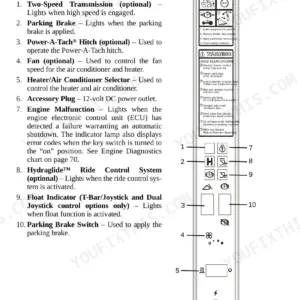
If a warning lamp flashes and an alarm sounds, stop all operations immediately. The Engine Emergency Lamp indicates a problem with engine oil pressure, coolant level, or coolant temperature, and the engine will stop automatically after 5 seconds. Other lamps indicate specific issues like battery charging, air cleaner clogging, or hydraulic line filter clogging. p. 46
What are the engine oil and oil filter replacement specs for the Gehl CTL60, CTL70, CTL80?
The engine oil and oil filter should be replaced after the first 50 hours of operation, and then every 250 hours thereafter. For the CTL60, the engine oil filter part number is 182131; for the CTL70, it is 182136; and for the CTL80, it is 425-34635. p. 93
What is the correct tightening torque for M10 x 1.5 coarse thread bolts on the Gehl CTL60, CTL70, CTL80?
For general connection points, the tightening torque for M10 x 1.5 coarse thread bolts is 47.1 ± 2.4 N·m (34.7 ± 1.7 ft-lb). p. 95
What is the required crawler tension for the machine?
The crawler tension should be checked by measuring the clearance between the center track roller and the surface of the crawler belt. The gap (A) should be within the range of 15 to 25 mm (0.6 to 1.0 in.). p. 113
What is the procedure for bleeding air from the hydraulic system after replacing hydraulic oil?
After replacing hydraulic oil, bleed the air from the hydraulic pump by tilting the ROPS and removing the plug (1) until oil overflows. For the cylinders, run the engine at low idle for 10 minutes, then extend and contract all cylinders 4 or 5 times without hitting the stroke end, and finally 4 or 5 times to the stroke ends. p. 125
How quickly can I access this Gehl CTL60 manual after buying?
You get a 170-page searchable PDF that downloads instantly after checkout. Open it on your laptop, tablet, or phone, and bring it right to the shop floor.
Am I able to print pages from this Gehl CTL60 manual?
You can. Print the sections you want for your own use and keep the file as your backup.