
Part of the Kubota Repair Manuals.
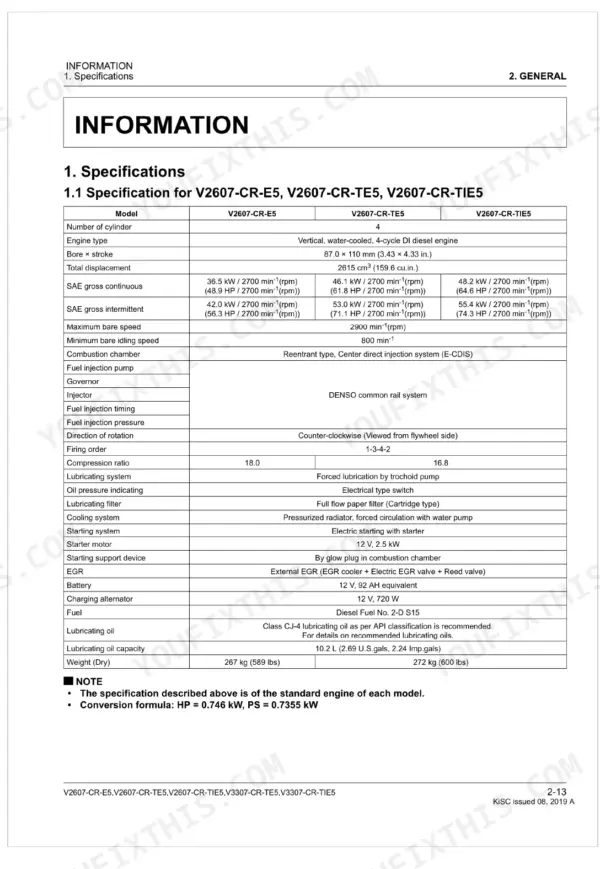
This is the factory Kubota workshop manual for the V2607 and V3307 common rail diesel engines, supplied as a 362 page downloadable PDF. It covers the V2607-CR-E5, V2607-CR-TE5, V2607-CR-TIE5, V3307-CR-TE5, and V3307-CR-TIE5 Tier 4 engines.
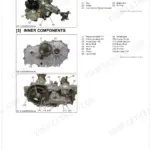
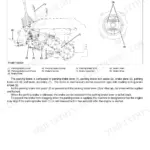
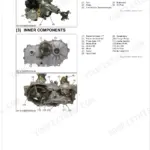
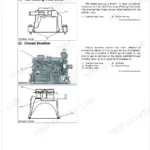
Inside you get safety guidance, engine identification and general service practice, a full maintenance program covering the DPF, turbocharger, EGR system, injectors, and valve clearances, plus detailed engine mechanism and servicing chapters with checking, disassembly, and reassembly steps. Torque values, fluid capacities, and service intervals are listed throughout.
Owners and diesel technicians can use it to run scheduled maintenance, diagnose emissions and performance faults, and rebuild the engine to factory specification. Read it on a phone, tablet, or laptop in the field, or print the exact pages you need for the workbench.
Complete the set for your V2607–V3307 Series
- Operator Manual: Kubota CR-Series Diesel Engine Operator Manual
What's Inside This Kubota V2607–V3307 Series Manual
| System | Pages | Key Topics |
|---|---|---|
| Safety | 19-25 | Safety First, Working Precautions, Preparing for Emergencies, Working Cautions, Starting Machine Safely, Preventing Fires, Preventing Acid Burns, Avoiding High Pressure Fluid |
| General | 26-82 | Engine Identification (Engine Model Name and Engine Serial Number, Cylinder Number), Muffler Full Assembly Identification (Part Number and Serial Number) |
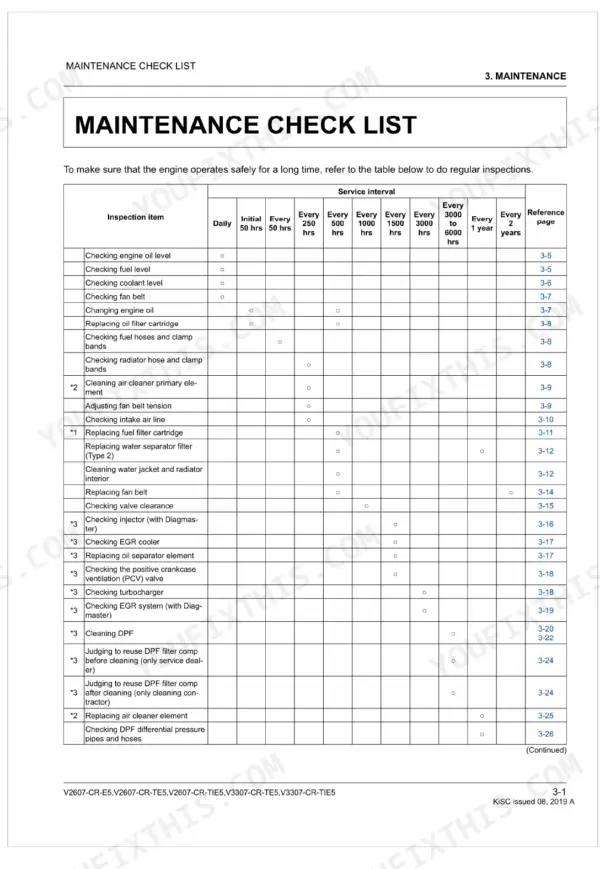
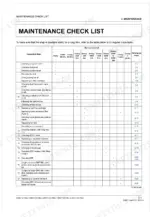
| Maintenance | 83-115 | Maintenance Check List (Daily Check Points, Checking Engine Oil Level, Checking Fuel Level, Checking Coolant Level, Checking Fan Belt, Check Points of Initial 50 Hours, Changing Engine Oil, Replacing Oil Filter Cartridge, Check Point of Every 50 Hours, Checking Fuel Hoses and Clamp Bands, Check Points of Every 250 Hours, Checking Radiator Hose and Clamp Bands, Cleaning Air Cleaner Primary Element, Fan Belt Tension, Checking Intake Air Line, Replacing Fuel Filter Cartridge, Replacing Water Separator Filter, Cleaning Water Jacket and Radiator Interior, Replacing Fan Belt, Checking Valve Clearance, Check Points of Every 1500 Hours, Checking Injector, Checking EGR Cooler, Replacing Oil Separator Element, Checking the Positive Crankcase Ventilation Valve, Checking Turbocharger, Checking EGR System, Check Points of Every 3000 to 6000 Hours, Cleaning DPF, Judging Reuse of DPF Filter Comp Before Cleaning, Judging Reuse of DPF Filter Comp After Cleaning, Check Points of Every 1 Year, Replacing Air Cleaner Element, Checking DPF Differential Pressure Pipes and Hoses) |
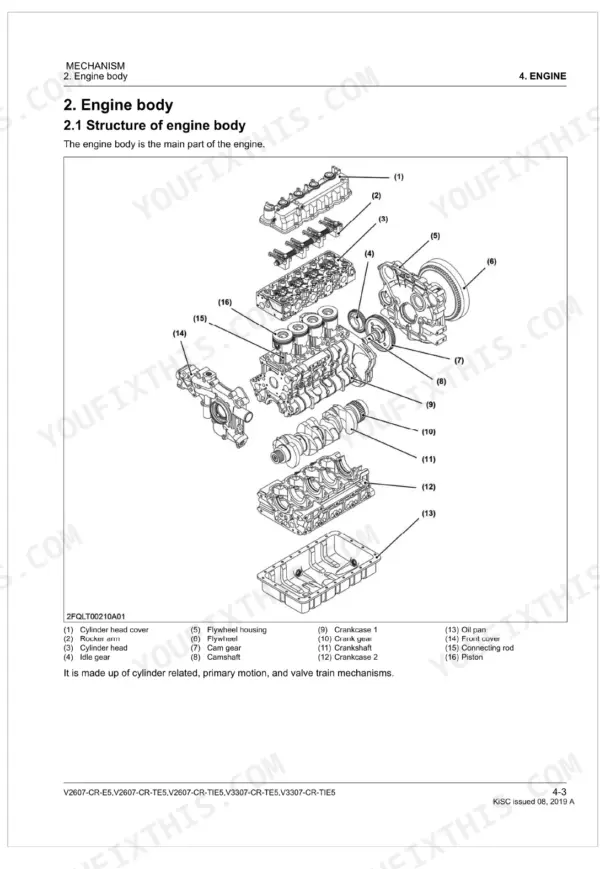
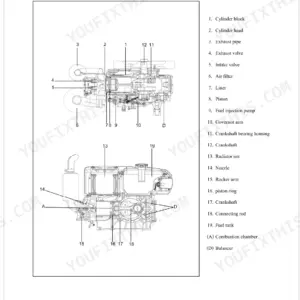
| Engine | 116-196 | Control of Combustion, Engine Body (Structure of Engine Body), Feature of Engine Body |
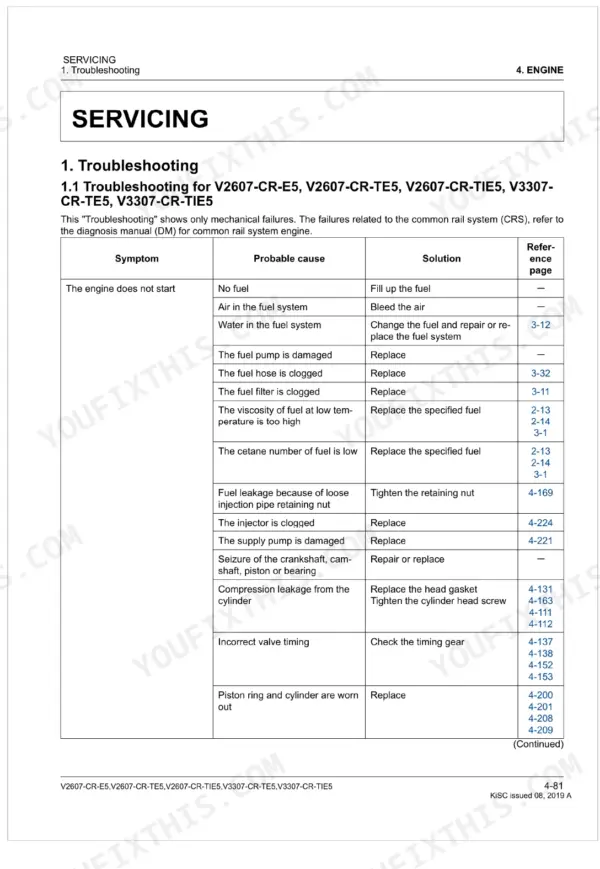
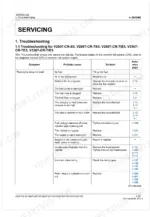
| Troubleshooting | 197-200 | Troubleshooting for V2607-CR-E5, V2607-CR-TE5, V2607-CR-TIE5, V3307-CR-TE5, V3307-CR-TIE5 |
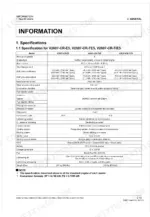
| Servicing Specifications | 201-208 | Servicing Specification for Engine |
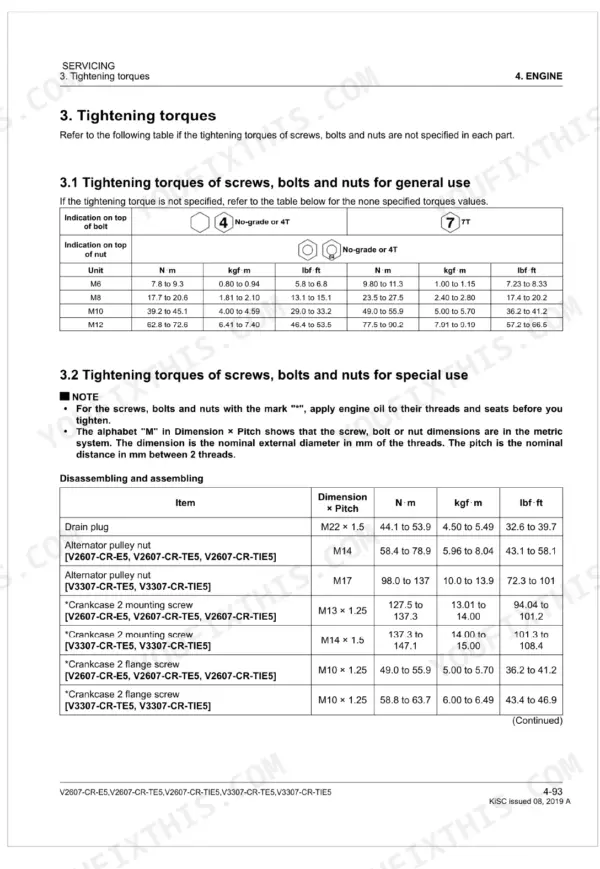
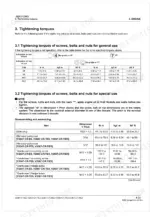
| Tightening Torques | 209-211 | Tightening Torques of Screws, Bolts and Nuts for General Use, Bolts and Nuts for Special Use |
| Checking and Adjusting | 212-232 | Checking Compression Pressure of Cylinder, Adjusting Valve Clearance, Checking Engine Oil Pressure, Checking Fan Belt Tension, Checking Fan Belt Damage and Wear, Checking Radiator Cap Air Leakage, Checking Radiator Water Leakage, Checking Battery Voltage |
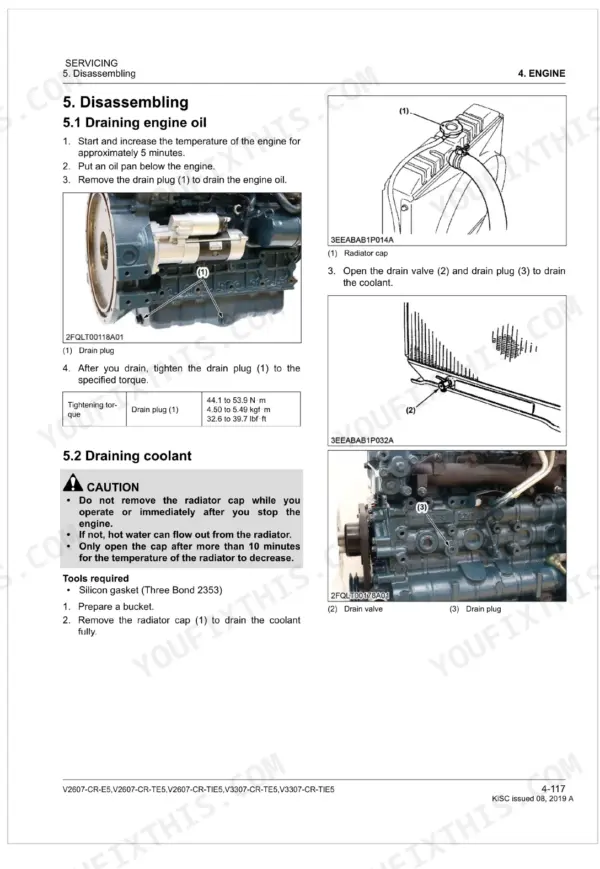
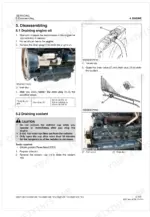
| Disassembling | 233-258 | Draining Engine Oil, Draining Coolant, Removing Crs Intermediate Harness, Removing External Components, V3307-CR-TE5, V2607-CR-TIE5, V3307-CR-TIE5), Removing Turbocharger Assembly |
| Assembling | 259-297 | Assembling Alternator, Assembling Starter, Installing Crankshaft, Installing Crankcase 2, Assembling Piston Assembly, Installing Piston Ring, Installing Piston, Installing Tappet |
| Servicing | 298-362 | Checking Cylinder Head Top Clearance, Checking Cylinder Head Surface Flatness, Checking Cylinder Head Flaw, Checking Valve Recessing, Adjusting Valve Lapping |
Quick Reference Specifications
| Specification | Value | Page |
|---|---|---|
| All Models | ||
| General Tightening Torque (No-grade or 4T) M6 | 7.8 to 9.3 N·m | p. 209 |
| General Tightening Torque (7T) M6 | 9.80 to 11.3 N·m | p. 209 |
| Radiator Capacity | 4.0 L | p. 176 |
| Radiator Cap Test Pressure | 137 kPa | p. 176 |
| Valve Clearance (Cold) | 0.13 to 0.17 mm | p. 201 |
| Fan Belt Deflection | 7.0 to 9.0 mm | p. 90 |
| Engine Oil Pressure (at idle speed) | 50 kPa | p. 207 |
| Glow Plug Resistance | Approx. 0.95 Ω | p. 208 |
| V2607-CR-E5, V2607-CR-TE5, V2607-CR-TIE5 | ||
| Engine Oil Capacity (V2607-CR-E5, V2607-CR-TE5, V2607-CR-TIE5) | 10.2 L | p. 39 |
| V3307-CR-TE5, V3307-CR-TIE5 | ||
| Engine Oil Capacity (V3307-CR-TE5, V3307-CR-TIE5) | 11.2 L | p. 39 |
| V2607-CR-E5 | ||
| Compression Pressure (Service Specification), V2607-CR-E5 | 3.20 MPa / 250 min⁻¹ (rpm) | p. 201 |
| V2607-CR-TE5, V2607-CR-TIE5, V3307-CR-TE5, V3307-CR-TIE5 | ||
| Compression Pressure (Service Specification) (V2607-CR-TE5, V2607-CR-TIE5, V3307-CR-TE5, V3307-CR-TIE5) | 3.10 MPa / 250 min⁻¹ (rpm) | p. 201 |
Kubota V2607–V3307 Series Common Problems This Manual Covers
DPF clogging and forced regeneration
Soot buildup in the diesel particulate filter triggers warnings and lost power if regeneration is neglected. The maintenance section covers DPF cleaning and how to judge whether the filter can be reused.
Manual Section: Maintenance p. 83Turbocharger wear or boost loss
Worn turbo bearings or fouling reduce boost and increase smoke. The maintenance section includes the turbocharger check as part of the higher hour service points.
Manual Section: Maintenance p. 83Hard starting from glow plugs or injectors
Slow cranking starts often trace to weak glow plugs or worn injectors. The servicing section covers glow plug resistance and injector checks with factory figures.
Manual Section: Servicing p. 197Low compression and lost power
Falling compression through worn valves or cylinder wear robs power. The servicing section gives the compression pressure service specification and how to check the cylinder head.
Manual Section: Servicing p. 197EGR system and cooler faults
A fouled EGR cooler or valve raises emissions and can set faults. The maintenance section lists the EGR checks in the scheduled service points.
Manual Section: Maintenance p. 83Valve clearance drift and top end noise
Clearances that fall out of spec cause tapping and poor running. The servicing section covers checking and setting valve clearance to the cold specification.
Manual Section: Servicing p. 197Frequently Asked Questions
Which engines does this manual cover?
It covers the Kubota V2607 and V3307 common rail Tier 4 diesels: the V2607-CR-E5, V2607-CR-TE5, V2607-CR-TIE5, V3307-CR-TE5, and V3307-CR-TIE5.
Does it cover the maintenance schedule including DPF and EGR?
Yes. The Maintenance section starting on page 83 lays out the full check list, including engine oil, fan belt, valve clearance, turbocharger, EGR, and DPF cleaning intervals. p. 83
Are torque values and service specifications included?
Yes. The Servicing section beginning on page 197 covers checking, disassembly, and reassembly with tightening torques and servicing specifications. p. 197
How do I get the manual after purchase?
You download the PDF right after buying and keep your own copy, so nothing is shipped and there is no wait.
What do I get after purchasing this Kubota V2607–V3307 Series manual?
You get a 362-page searchable PDF that downloads instantly after checkout. Open it on your laptop, tablet, or phone, bring it right to the shop floor.
Is this Kubota V2607–V3307 Series Workshop Manual printable?
Yes. Print a chapter or just the pages for the job at hand, for use in your own shop. Any home or office printer works.
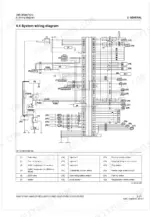
Can I find wiring schematics in this Kubota V2607–V3307 Series manual?
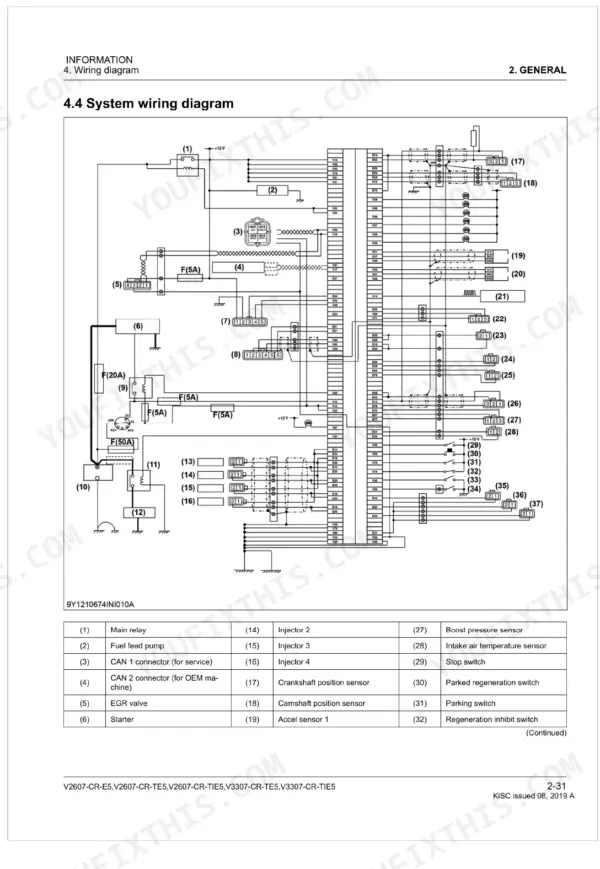
Complete wiring diagrams are included, covering all electrical circuits, harness routing, and connector pinouts for the Kubota V2607–V3307 Series.





Reviews
There are no reviews yet.