
A pre-start walkaround at shift change goes quicker with the Mitsubishi FGC15N operator manual PDF open beside you: 209 pages under part number 99720-7C121, covering seven variants of the FGC series, from the FGC15N up to the FGC33N. The meter panel chapter explains each LCD warning icon and what to do when an error code appears, while a solid share of the book walks through the mast interlock, driving interlock and parking brake alarm on both MC lever and FC control box trucks. Your maintenance schedule runs from the 10-hour daily check out to 2000 hours, naming lift chains, tilt cylinder socket bolts and the inching pedal. Fit a 20A fuse to the VCM circuit, and torque wheel nuts on the 1.5 to 2 ton compacts to 141.2 to 172.6 N·m. A tire swap stalls on one forgotten number. Bookmarks jump you to the right chapter, and printed pages can sit on the bench and take the grease.
What's Inside This Mitsubishi FGC15N-FGC33N Operator Manual
| System | Pages | Key Topics |
|---|---|---|
| Safety Rules for Forklift Truck Operators | 9-43 | General, Location of Warning Decals, Warning Decals, Decals for LPG Only, Danger, Warning, Safety Rules, Operating Precautions, Working Precautions, Tipover Prevention, Operator Training, LPG Safety, Lockout/Tagout |
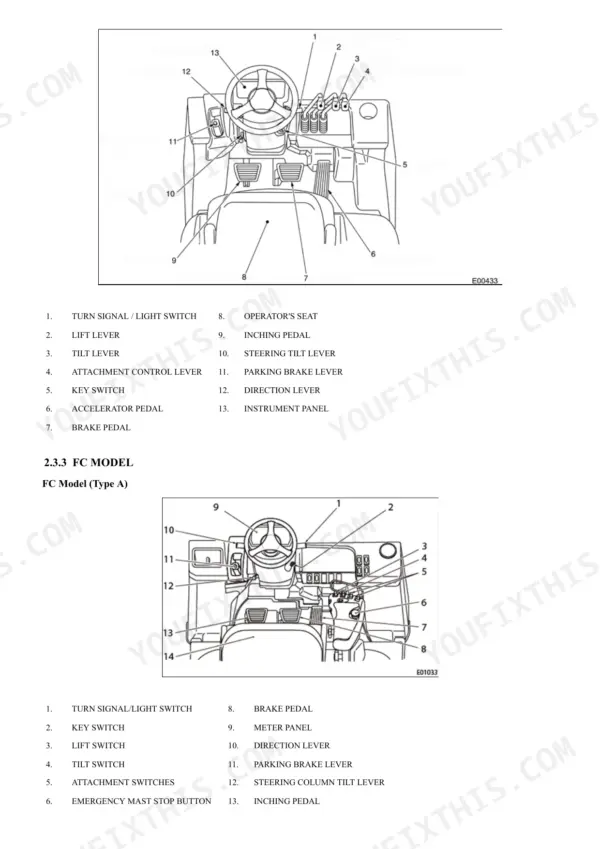
| Know Your Forklift Truck | 44-96 | Serial Number and Capacity Plate, Serial Number, Electrical Components, Model View (- Overview), Driving Switches and Controls, Controls, Meter Panel, Integrated Presence System, Operator Seat, Seat Belt, Fork Locking Pins, Replacing Forks, Drawbar Pin, Assist Grip and Foot Step |
| How to Avoid a Tipover; How to Survive One | 97-106 | Know What Forklift Truck Stability Is, Center of Gravity, Stability and Center of Gravity, Forklift Truck Stability Base, Capacity, Capacity Plate (- Overview, Sample), How to Survive in a Tipover |
| Refueling | 107-108 | LPG Engine Equipped |
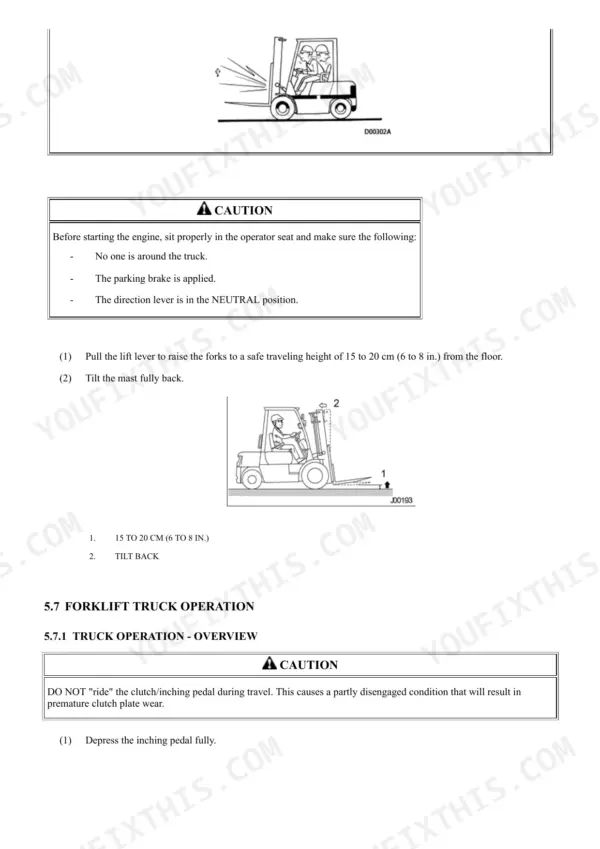
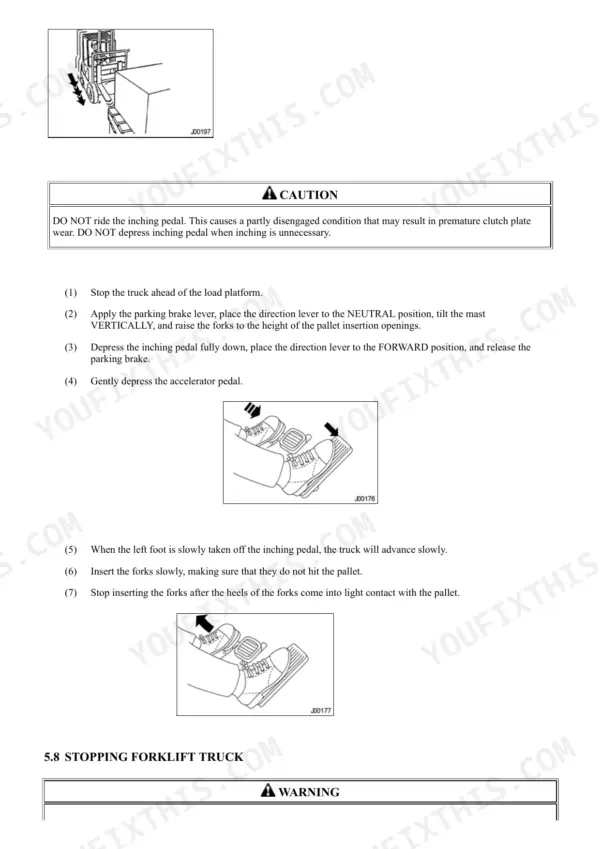
| Operation | 109-121 | New Forklift Truck Break-In, Before Starting Engine (Seat Adjustment), Starting LPG Engine, Starting Procedures, Engine Won't Start, Stopping Forklift Truck, Parking Forklift Truck |
| Operating Techniques | 122-134 | Stacking Methods (- Overview, Stacking Different Size Loads, Stacking Small Identical Loads, Stacking Large Identical Loads), Stacking Methods, Handling Loads Safely (- Overview), Handling Loads, Lifting the Load, Traveling with the Load, Unloading, Working on Grades, Traveling on Grades |
| Storing the Forklift Truck | 135-136 | End of Each Shift Storage, Long Term Storage (- Overview, Fuel System, Hydraulic System), Long Term Storage |
| Transportation Hints | 137 | Forklift Truck Loading and Shipping, Shipping, Forklift Truck Lifting and Tie Down Information |
| Special Situations | 138-139 | Care in Cold Weather (Lubrication Oils, Battery, Engine Coolant), Cold Weather Care, Care in Hot Weather (Fuel Oils and Lubrication Oils, Hot Weather Care, Severe Dust or Lint Conditions, Dust Conditions |
| Troubleshooting | 140-157 | Stalled Engine, Starting with Jumper Cables, Jumper Cables, If Lights Won't Glow (How to Check Fuses and Lights), Fuse Checks, If the Water Temperature Gauge Shows Red Zone, Replacing Tires, Tire Replacement, Diagnostic Codes and Explanations |
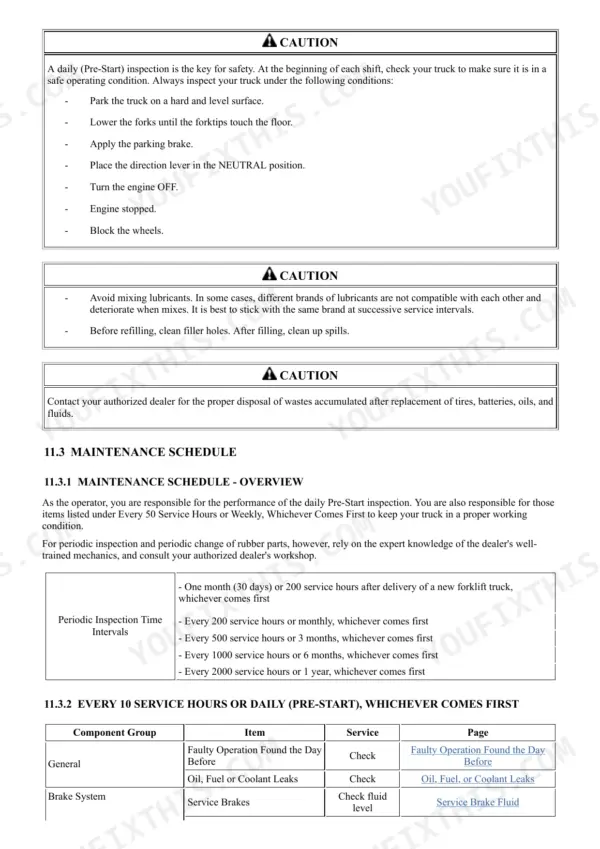
| Maintenance | 158-197 | General, Inspection Precautions, Maintenance Schedule, Parts to Be Changed Periodically |
| Service Data | 198-203 | Fuel Information (- Overview, Liquefied Petroleum Gas), Fuel Information, Coolant Information (- Overview, Coolant Water, Antifreeze Solution), Coolant Specifications, Recommended Fuels and Oils, Recommended Oils, Specifications, Refill Capacities, Instructions for Ordering Parts, Service Registration, Transfer of Ownership |
| Index | 204-209 | Alphabetical Subject Index, Chapter-Page References |
Quick Reference Specifications
| Specification | Value | Page |
|---|---|---|
| All Models | ||
| VCM Fuse Capacity | 20A | p. 142 |
| QGS / others Fuse Capacity | 10A | p. 142 |
| Tilt cylinder socket bolt tightening torque | 157 to 182 N·m (16 to 18.6 kgf·m) [116 to 134 lbf·ft] | p. 165 |
| FGC15N, FGC18N, FGC20CN | ||
| Wheel nut tightening torque | 141.2 N·m to 172.6 N·m (104 lbf·ft to 127 lbf·ft) | p. 153 |
| 1.5 to 2 ton compact models | ||
| Wheel Nut Tightening Torque | 141.2 to 172.6 N·m (14.4 to 17.6 kgf·m) [104 to 127 lbf·ft] | p. 179 |
| Brake pedal free play | 7 mm (0.3 in.) | p. 166 |
| 2 to 3.3 ton models | ||
| Wheel Nut Tightening Torque | 339.8 to 415.4 N·m (34.6 to 42.4 kgf·m) [251 to 306 lbf·ft] | p. 179 |
| 1.5 to 3.3 ton models | ||
| Inching pedal free play | 2.5 to 7.5 mm (0.1 to 0.3 in.) | p. 167 |
| 1.5 to 1.8 ton models | ||
| Lift chain elongation limit (/20 links) | 327 mm (12.9 in.) | p. 170 |
| FGC15N, FGC18N, FGC20CN (Excluding CC4000) | ||
| Lift chain elongation limit | 327 mm (12.9 in.) / 20 links | p. 201 |
| 2 ton compact to 2.5 ton models | ||
| Lift Chain Elongation Limit (/20 links) | 392 mm (15.4 in.) | p. 170 |
| 3 to 3.3 ton models | ||
| Lift Chain Elongation Limit (/20 links) | 523 mm (20.6 in.) | p. 170 |
Mitsubishi FGC15N-FGC33N Common Problems This Manual Covers
Mitsubishi FGC15N through FGC33N forklift headlights, stop lights, or meter panel lights won't glow
Check the fuses following page 142 before you swap any bulbs. Match each fuse to its circuit: 15A for head lights, 10A for stop lights and the meter panel. Replace a blown fuse with one of the same rating, then check the bulb against the 12V-55W head lamp spec on page 143.
Manual Section: If Lights Won't Glow p. 142Partway through a working shift, the water temperature gauge needle climbs into the red zone
Let the engine cool before you open the radiator, as the procedure on page 143 warns. Inspect the fan belt for looseness or damage, then clean dirt out of the radiator air passages. Top up with the coolant water and antifreeze solution covered under Coolant Information in the Service Data section.
Manual Section: If Water Temperature Gauge Shows Red Zone p. 143Engine running and parking brake warning displayed, but the truck won't move forward or reverse
Check whether the driving interlock system has cut drive. Confirm the operator is seated and the parking brake is fully released before selecting a direction. Recheck parking brake lever operating effort against 245 to 295 N on page 167; a lever outside that range needs adjustment before the truck goes back to work.
Manual Section: If the Forklift Truck Won't MoveWith the engine still running, the mast and attachment controls suddenly stop responding
Sit properly in the operator seat and return the lift or tilt lever to the NEUTRAL position, as the procedure on page 147 directs, then operate the lever again. On MC models the mast interlock locks only the lift and tilt levers; on FC models it also covers attachments, and a pressed emergency mast stop button (if equipped) locks lift, tilt and attachment actions. If the mast stays locked, contact your dealer.
Manual Section: If the Mast and Attachments Stop Moving p. 147During operation, the truck throws an E-series, F-series, P-series, or S-series diagnostic code
Check the exact code letter and number against the Diagnostic Codes and Explanations table on pages 156 to 158 and note the listed explanation. The manual says to contact your authorized Mitsubishi forklift truck dealer when the error code is displayed.
Manual Section: Diagnostic Codes and Explanations p. 156At the scheduled maintenance check, the lift chains on the mast look stretched
Measure across 20 links on each lift chain following page 170. On FGC15N and FGC18N trucks, a reading of 327 mm (12.9 in.) means the chain has hit its elongation limit. Larger trucks have their own limits on that page. Check lift chain anchor torque at the same time against 98 N·m (72.3 lbf·ft) on page 171.
Manual Section: Troubleshooting and Maintenance p. 170Frequently Asked Questions
What does error code E-26 mean on the Mitsubishi FGC15N-FGC33N?
Error code E-26 indicates an O2 sensor heater warning signal. You should contact your authorized Mitsubishi forklift truck dealer when this error code is displayed. p. 157
What are the engine oil and filter replacement specifications for the Mitsubishi FGC15N-FGC33N?
Change the engine oil and oil filter every 500 service hours or 3 months, whichever comes first; the first change is due at 200 hours or one month after delivery of a new truck. Refill capacities are 3.5 liters (0.9 U.S. gal) for the crankcase and 0.3 liters (0.1 U.S. gal) for the oil filter. p. 201
What is the intake and exhaust valve clearance on the Mitsubishi FGC15N-FGC33N?
The intake and exhaust valve clearance should be adjusted to 0.25 mm (0.0098 in.). After adjusting the clearance, tighten the lock nut firmly and inspect the clearance again. p. 195
What is the wheel nut tightening torque on the 2 to 3.3 ton Mitsubishi FGC15N-FGC33N models?
The tightening torque for the wheel nuts on 2 to 3.3 ton models is 339.8 N·m to 415.4 N·m (34.6 kgf·m to 42.4 kgf·m) [251 lbf·ft to 306 lbf·ft]. p. 153
What is the correct alternator drive belt deflection on the Mitsubishi FGC15N-FGC33N?
The alternator drive belt deflection should be 11 to 13 mm (0.4 to 0.5 in.) when pushed with 98 N (10 kgf) [22 lbf] of pressure midway between the pulleys. p. 186
Will this Mitsubishi FGC15N-FGC33N Operator Manual download right away?
One searchable PDF covering 209 pages, delivered instantly. No disc, no shipping, no waiting on the post.
Does this Mitsubishi FGC15N-FGC33N manual allow printing?
Yes. Many mechanics print the section they need for their own shop and bring it to the bench.


Reviews
There are no reviews yet.