
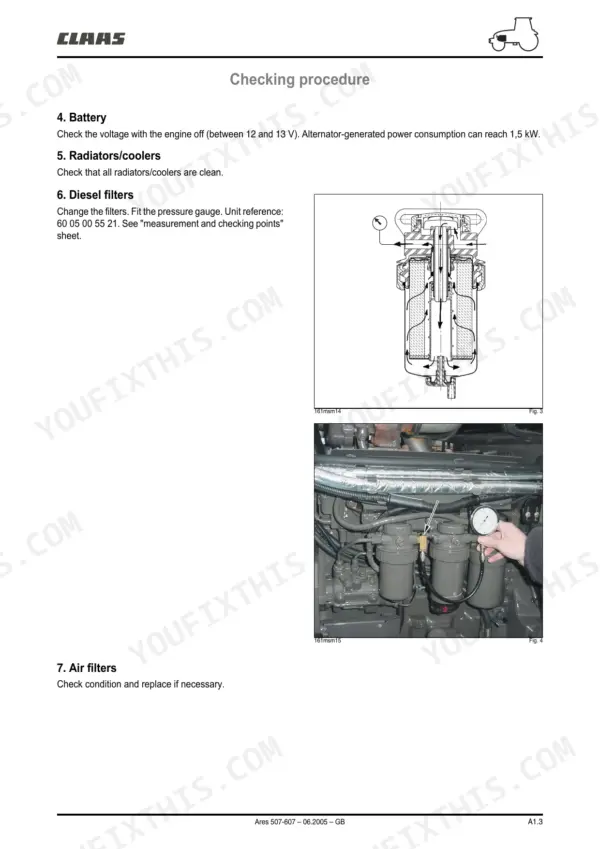
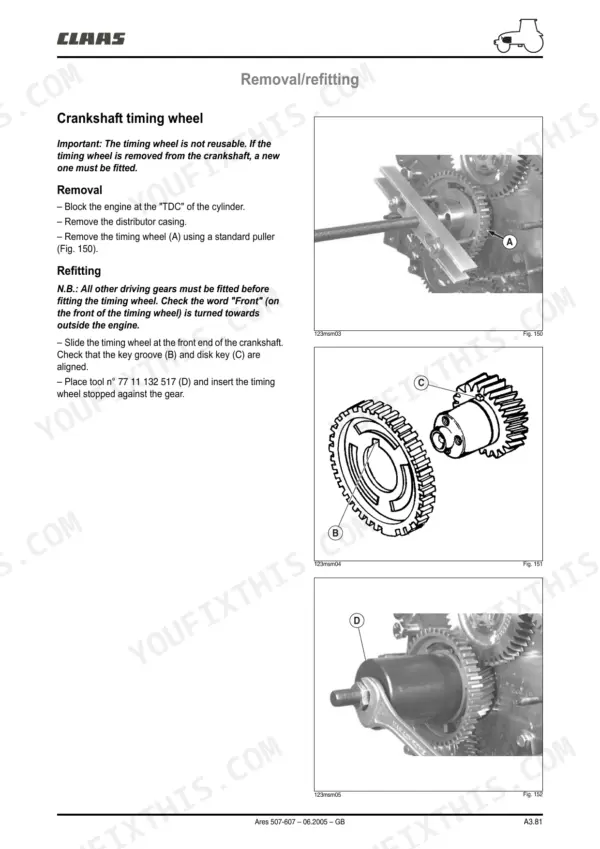
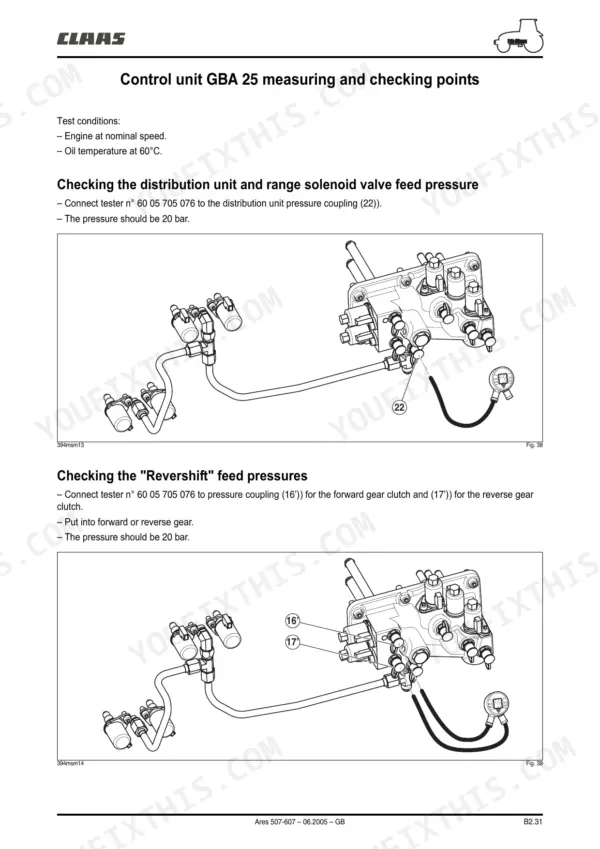
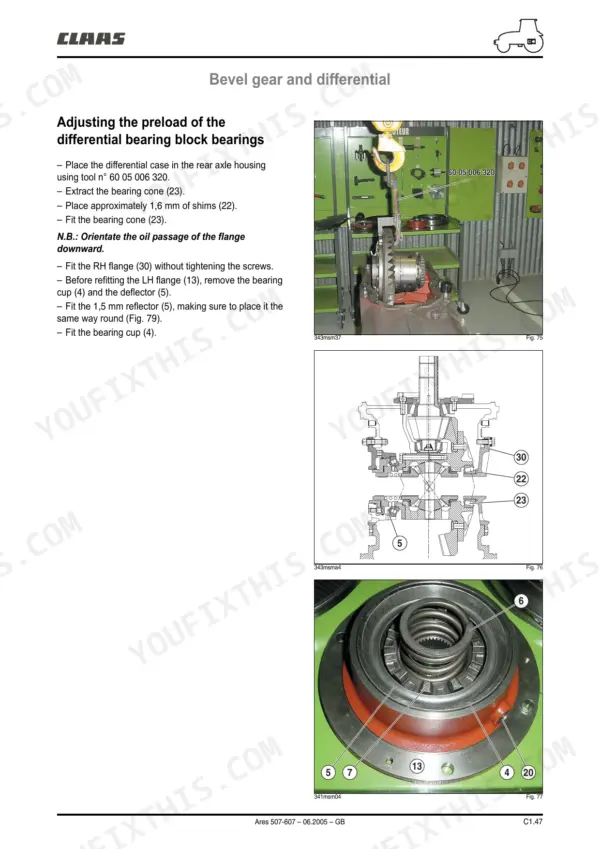

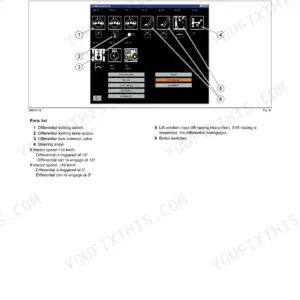
This is the factory workshop manual for the CLAAS/Renault Ares 547, 557, 567, 577, 617, 657 and 697, and it also covers the 507 and 607, built 2002-2008. It splits the tractor the way CLAAS split it at the factory: engine and injection on the Tier II John Deere PowerTech units, the Group B and Group C powershift transmissions broken into mechanical, hydraulic and electronic parts, rear axle with PTO and linkage, the 60 l/min open-centre and 100/110 l/min load-sensing hydraulic circuits, full wiring with harness and connector paths, the TCE 15 electronic lift, Electropilot and ISO socket, cab work including glass bonding, plus front linkage, front PTO and pneumatic brake. Checking procedures come with real reference values, not guesswork.
What's Inside This CLAAS 547-697 Manual
| System | Pages | Key Topics |
|---|---|---|
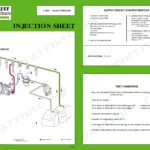
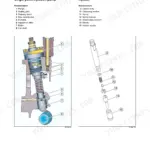
| Engine & Injection System | 2-185 | Injection sheet checking procedure, Tier II diesel engine, Fuel injection pump and timing |
| Transmission & Powershift (Groups B and C) | 186-601 | Powershift transmission overhaul, Transmission hydraulic control circuits, Transmission control electronics |
| Rear Axle, PTO & Linkage | 602-753 | Rear axle and differential, PTO and three-point linkage hydraulics, Draft and lift control electronics |
| Main Hydraulic Circuits | 754-907 | Open-centre 60 l/min circuit, Load-sensing 100 and 110 l/min circuits, Common hydraulic elements |
| Electrical Wiring, Harnesses & Connectors | 908-1031 | Wiring item lists and general lists, Harness and connector paths |
| Electronic Systems | 1032-1240 | Instrument panel, TCE 15 and TCE 15/25 electronic lift, InfoTrac, ISO socket and Electropilot |
| Cab, Heating & Air Conditioning | 1241-1306 | Cab lifting and glass bonding, Manual heating and air conditioning, Regulated climate control |
| Front Linkage, Front PTO, Brake & Tools | 1307-1376 | Front lift linkage and attachment points, Front power take-off, Pneumatic brake and special tools |
Quick Reference Specifications
| Specification | Value | Page |
|---|---|---|
| All models | ||
| Maximum off-load speed | 2325 ± 10 rpm | p. 8 |
| Engine temperature (checking procedure) | 90°C | p. 8 |
| Transmission temperature (checking procedure) | 60-65°C | p. 8 |
| Transmission temperature (reference value) | 60°C - 65°C | p. 9 |
| Engine temperature (reference value) | > 87°C | p. 9 |
| Ares 547 | ||
| Boost pressure range, Ares 547 | 0.19 - 0.71 bar | p. 10 |
| Ares 557 | ||
| Boost pressure range, Ares 557 | 0.22 - 0.64 bar | p. 10 |
| Ares 567 | ||
| Boost pressure range, Ares 567 | 0.24 - 0.77 bar | p. 10 |
| Ares 577 | ||
| Boost pressure range, Ares 577 | 0.23 - 1.04 bar | p. 10 |
| Ares 617 | ||
| Boost pressure range, Ares 617 | 0.17 - 0.63 bar | p. 10 |
| Ares 657 | ||
| Boost pressure range, Ares 657 | 0.20 - 0.80 bar | p. 10 |
CLAAS 547-697 Common Problems This Manual Covers
Engine overheating during harvest, usually from straw and chaff packed around the cooling pack and exhaust, sometimes masking a genuine boost or injection fault.
Use the Engine and Injection System section's injection sheet checking procedure at operating temperature above 87 degrees C. Compare boost pressure against the published range for your model to separate debris blockage from a real turbo or injection problem.
Manual Section: Engine & Injection System - Injection Sheet Checking ProcedurePowershift shifting rough, dropping drive under load, or throwing warnings, with no obvious way to tell a worn clutch pack from a hydraulic or electronic fault.
Follow the transmission section for your gearbox group with oil at 60-65 degrees C. The mechanical, hydraulic and electronic parts each carry their own test procedures, so you isolate the failing layer before splitting the tractor.
Manual Section: Transmission & Powershift - Group B / Group C, Hydraulic and Electronic PartsHeavy or unresponsive hydrostatic steering, or weak hydraulics on the loader and linkage, pointing at the pump, priority circuit or a leaking steering line.
The Main Hydraulic Circuits section covers common elements plus the open-centre 60 l/min and load-sensing 100 and 110 l/min systems with pressure test procedures, so you confirm pump output and circuit priority before replacing hoses or the steering unit.
Manual Section: Main Hydraulic Circuits - Common Elements, Open Center 60 L/Min, Load Sensing 100/110 L/MinElectronic lift misbehaving: linkage hunting, not responding to draft control, or the TCE unit flagging faults that are really a sensor or harness issue.
Work through the Electronic Systems section for the TCE 15 T or TCE 15/25 lift, then use the harness and connector paths in the electrical section to check wiring runs and connector pins before condemning the control unit.
Manual Section: Electronic Systems - TCE 15 T / TCE 15/25 Electronic LiftFrequently Asked Questions
Does this manual cover the electronic side of the powershift, or just the gears?
Both, properly. The Group B and Group C transmission sections are each split into mechanical, hydraulic and electronic parts, so you can chase a shift problem from the clutch packs through the solenoid hydraulics to the control electronics without switching books. Checking procedures specify transmission at 60-65 degrees C before you take readings, which matters because cold oil will lie to you.
My Ares runs hot in dusty harvest work. Does the manual help with overheating diagnosis?
Yes. The Engine and Injection section covers the Tier II engine checking procedure with the reference values you need: engine at operating temperature above 87 degrees C, max off-load speed 2325 rpm plus or minus 10, and boost pressure ranges per model so you can tell a lazy turbo from a plugged cooling pack. Chaff packed around the engine is the usual culprit on these, and having real numbers tells you when the engine itself is fine.
Steering has gone heavy or vague. Is the hydrostatic steering circuit in here?
The Main Hydraulic Circuits section covers the common elements plus the 60 l/min open-centre and the 100 and 110 l/min load-sensing versions, with test procedures to prove whether the pump, priority valve or steering unit is at fault before you buy parts. Steering hose and actuator problems on these tractors usually show up in the pressure tests first.
Can I trace a wiring fault, say a dead work light or an intermittent panel warning?
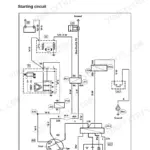
The electrical section gives you the item lists, wiring diagrams and, importantly, the harness and connector paths, so you know where each loom physically runs and which connector to open. The Electronic Systems section then covers the instrument panel, TCE 15 and TCE 15/25 lift electronics, Infotrac, the ISO socket and Electropilot with their own diagnostic procedures.
Does it cover cab and air conditioning work, including replacing bonded glass?
Yes. There is a dedicated section on cab lifting and glass bonding, which is the part most people get wrong, plus separate procedures for the manual heating and A/C and the regulated climate system. If you are pulling the cab to get at the transmission, the lifting procedure alone is worth having.
Reviews
There are no reviews yet.