
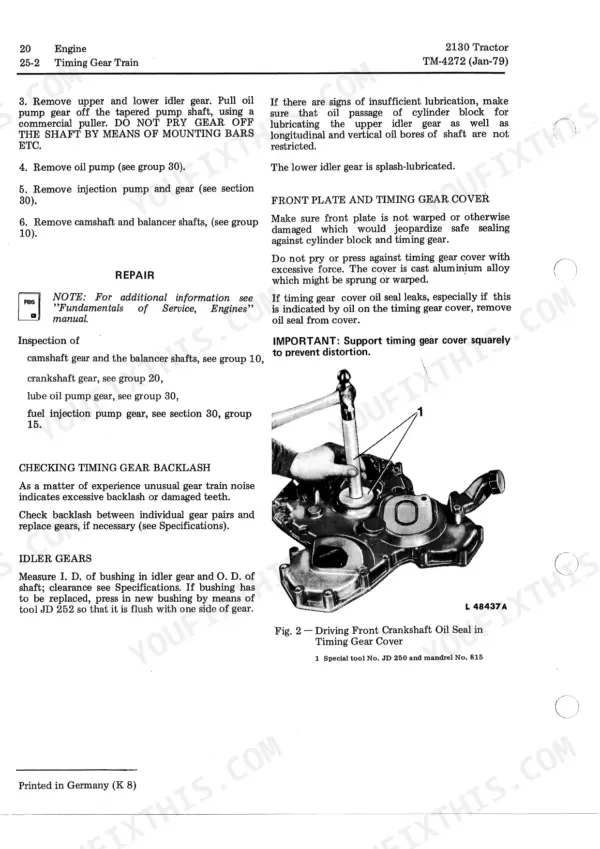
Part of the John Deere Repair Manuals.
This is the John Deere 2130 Tractor Technical Manual, TM-4272, the 454-page factory service publication for the 2130 built at John Deere's Mannheim works. It is the dealer-level guide written for technicians doing actual repairs, not a quick operator booklet.
The manual walks through every major system on the tractor: engine, fuel and injection, the electrical and lighting systems, the power train with its High-Low shift and collar-shift transmission, front axle, steering and brakes, and the full hydraulic system including the rockshaft and selective control valves. You get diagnosing malfunctions procedures, torque values, clearances, and test pressures for each group.
With this PDF you can trace a hydraulic fault, set clutch free travel, retorque a cylinder head, or rebuild an injection pump using the same specifications the factory published. Delivered as a downloadable, printable PDF you can keep on the shop bench.
What's Inside This John Deere 2130 Manual
| System | Pages | Key Topics |
|---|---|---|
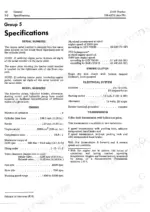
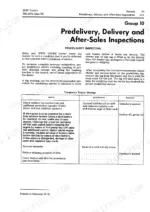
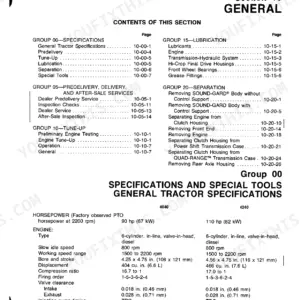
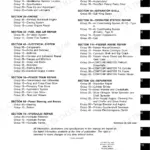
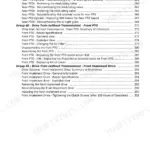
| General | 3-38 | Specifications, Pre-Delivery, Delivery and After-Sales Inspections, Lubrication and Periodic Service, Engine and Tractor Tune-Up, Tractor Separation |
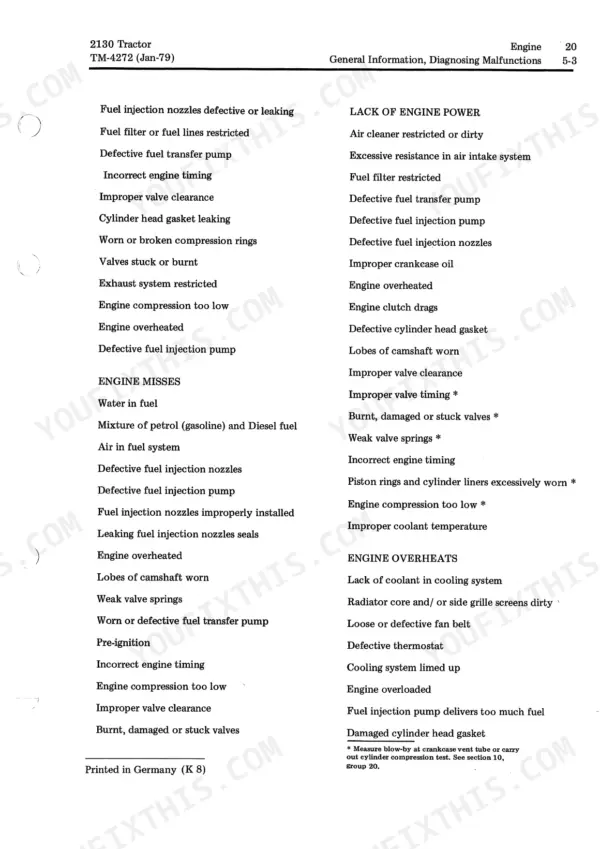
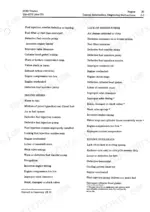
| Engine | 39-100 | General Information, Diagnosing Malfunctions, Cylinder Head, Camshaft and Balancer Shafts, Cylinder Block, Liners, Pistons and Connecting Rods, Crankshaft |
| Fuel System | 101-132 | Diagnosing Malfunctions, Fuel Tank, Water Trap, Fuel Transfer Pump, Fuel Filter and Air Cleaner, Roto-Diesel Fuel Injection Pump, Fuel Injection Nozzles, Cold Weather Starting Aids |
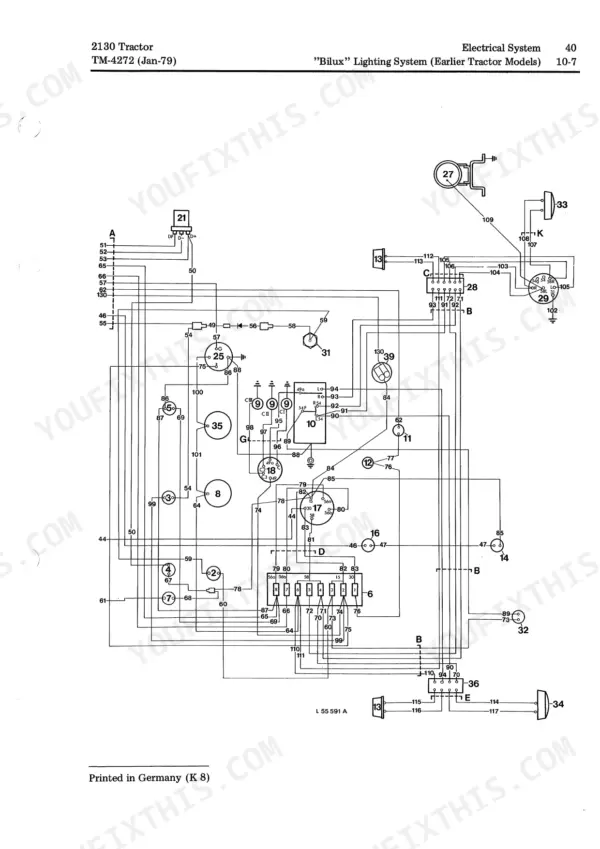
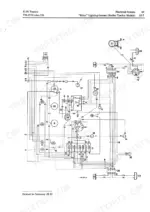
| Electrical System | 133-206 | Diagnosing Malfunctions, Bilux Lighting System (Earlier Tractor Models), Bilux Lighting System (Later Tractor Models), Bilux Lighting System (Tractor with Operator’s Cab) |
| Power Train | 207-286 | Engine Clutch and Clutch Linkage, High-Low Shift Unit, Creeper Transmission, Collar-Shift Transmission, Differential, Final Drives, Independent PTO |
| Front Axle, Steering System and Brakes | 287-328 | Front Axle, Steering System, Hydraulic Brakes, Hand Brake, Parts for Hydraulic Trailer Brake |
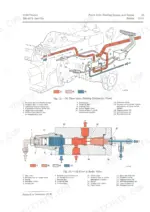
| Hydraulic System | 329-424 | General Information, Diagnosing Malfunctions and Tests, Oil Reservoir, Filter, Valves and Oil Cooler, Hydraulic Pumps and Transmission Oil Pump, Rockshaft |
| Miscellaneous | 425-454 | Belt Pulley, Operator’s Seats, Front and Rear Wheels, Roll Guard, Operator’s Cab - Ventilation and Heating, Operator’s Cab |
Quick Reference Specifications
| Specification | Value | Page |
|---|---|---|
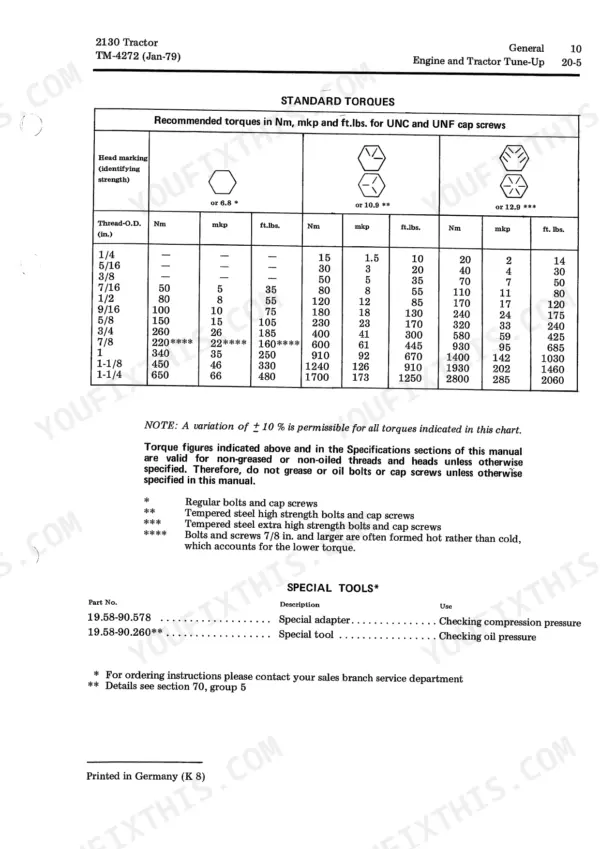
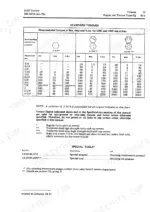
| Cylinder head to cylinder block, cap screws (dipped in oil) | 130 Nm 13 mkp 95 ft-lb | p. 55 |
| Valve opens on tractors without High-Low shift unit at a pressure differential of | 2.0 to 3.5 bar 28 to 50 psi | p. 347 |
| Intake screen | No numerical specifications found | p. 345 |
| Hydraulic hose | No numerical specifications found | p. 338 |
| Transmission-hydraulic system Dry system | 36.0 Liters 9.5 U.S.gals. | p. 7 |
| Fan belt flex with pull | 19 mm (0.75 in.) flex with 90 N (20 lb) pull | p. 93 |
| Distance between control lever and front end of quadrant slot | 15 ± 5 mm 0.6 ± 0.2 in. | p. 398 |
| Air cleaner system vacuum (not restricted) | approx. 35 mbar (14 in.) water head | p. 107 |
| Capacity of cooling system | 11.4 liters 3.0 U.S. gals. | p. 93 |
| Leakage from function return line should not exceed | 150 cm3 per minute | p. 335 |
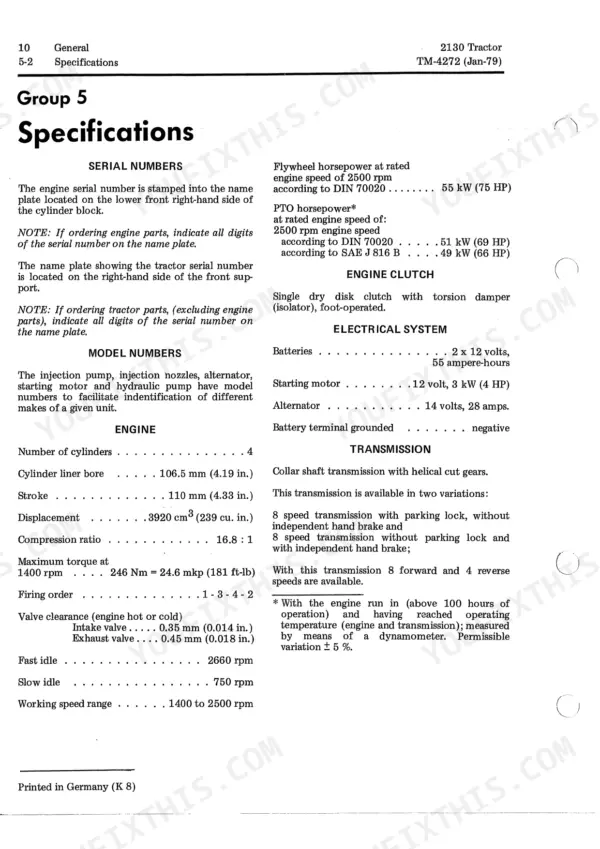
| Engine Displacement | 3920 cm^3 | p. 6 |
| Maximum Engine Torque at 1400 rpm | 246 Nm | p. 6 |
John Deere 2130 Common Problems This Manual Covers
Hydraulics fail after warm-up
A common 2130 complaint is hydraulics that work when cold, then lose function once the tractor warms up, sometimes taking the steering with them. Likely causes are contaminated or degraded transmission-hydraulic oil, a clogged sump screen, or a restricted filter, all covered in the Hydraulic System section.
Manual Section: Hydraulic System p. 3293-point hitch will not stay down
Owners report the rockshaft dropping or behaving unpredictably so the hitch will not hold position. This usually traces to a worn rockshaft control lever shaft or mis-seated draft and depth linkage, and the Rockshaft group gives the teardown and adjustment procedure.
Manual Section: Rockshaft p. 377Leaks and wet hydraulic hoses
Puddles under the tractor, sluggish response, and weeping hoses point to failing seals, hoses, or low fluid that can eventually starve the pump. The Oil Reservoir, Filter, Valves and Oil Cooler group covers reservoir, filter, and valve service to stop the leak.
Manual Section: Oil Reservoir, Filter, Valves and Oil Cooler p. 345Engine overheating under load
Overheating on the 2130 is often dirty radiator fins, low coolant, or restricted airflow rather than a failed part. The Cooling System group covers radiator, thermostat, and coolant service along with the relief-valve and thermostat test values.
Manual Section: Cooling System p. 89Hard starting and fuel air lock
After filter changes or running low on fuel the Roto-Diesel system can trap air and refuse to start. The Fuel System section walks through the tank, transfer pump, filters, and injection pump so you can bleed the system correctly.
Manual Section: Fuel System p. 101Clutch drag or slipping
Difficult shifting or a slipping clutch on the 2130 is frequently just free-travel out of spec or worn linkage. The Engine Clutch and Clutch Linkage group covers pedal free travel adjustment and clutch overhaul.
Manual Section: Engine Clutch and Clutch Linkage p. 208Frequently Asked Questions
Which tractor does this manual cover?
It covers the John Deere 2130 Tractor. This is the factory Technical Manual TM-4272, 454 pages, in English, covering engine, fuel, electrical, power train, front axle and steering, and the hydraulic system for the 2130 built at the Mannheim works.
Where are the cylinder head torque specs?
The Cylinder Head, Camshaft and Balancer Shafts group gives the head cap screw torque, listed at 130 Nm, along with camshaft and valve specifications for the 3920 cm^3 engine. Torques for hardware appear at the end of each group.
Does it help diagnose hydraulics that quit when warm?
Yes. The Hydraulic System section includes General Information, Diagnosing Malfunctions and Tests with the pressure and leakage checks needed to trace a fault that only appears once the tractor warms up, plus the reservoir, filter, and valve service.
Can I use it to service the fuel injection system?
Yes. The Fuel System section covers the fuel tank, water trap, transfer pump, filters, air cleaner, the Roto-Diesel injection pump, and the injection nozzles, with diagnosing malfunctions and cold weather starting aids for the 2130.
What do I get after purchasing this John Deere 2130 Tractor manual?
You get a 454-page searchable PDF that downloads instantly after checkout. Open it on your laptop, tablet, or phone, bring it right to the shop floor.
Is this John Deere 2130 Tractor Technical Manual printable?
Yes. Print individual pages or full chapters for your own shop use, on letter or A4 paper.
Are there hydraulic schematics in this John Deere 2130 Tractor manual?
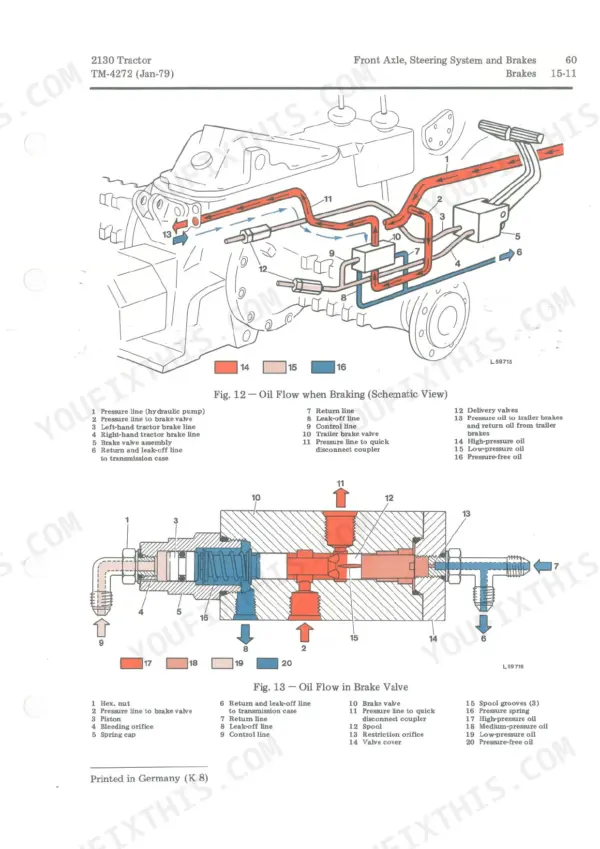
Full hydraulic system diagrams are included, covering circuits, valve locations, and hydraulic component specs for the John Deere 2130 Tractor.







Reviews
There are no reviews yet.