
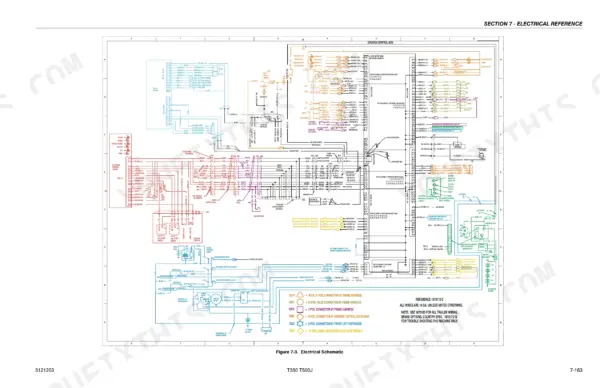
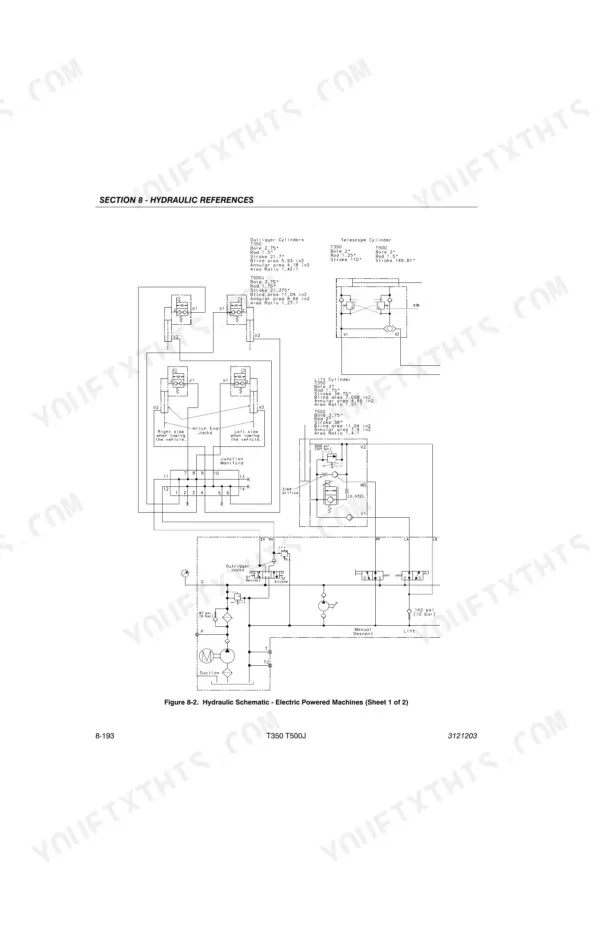
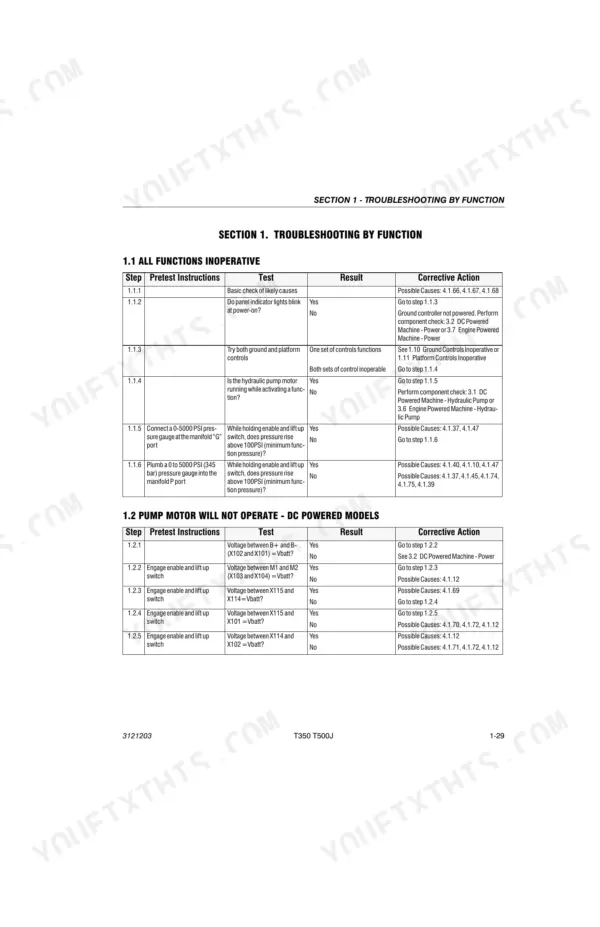
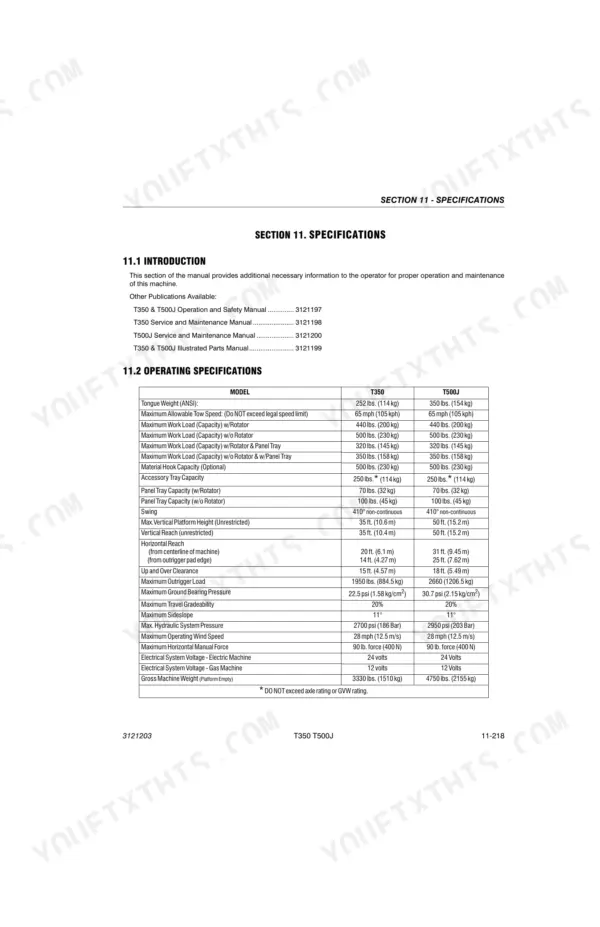
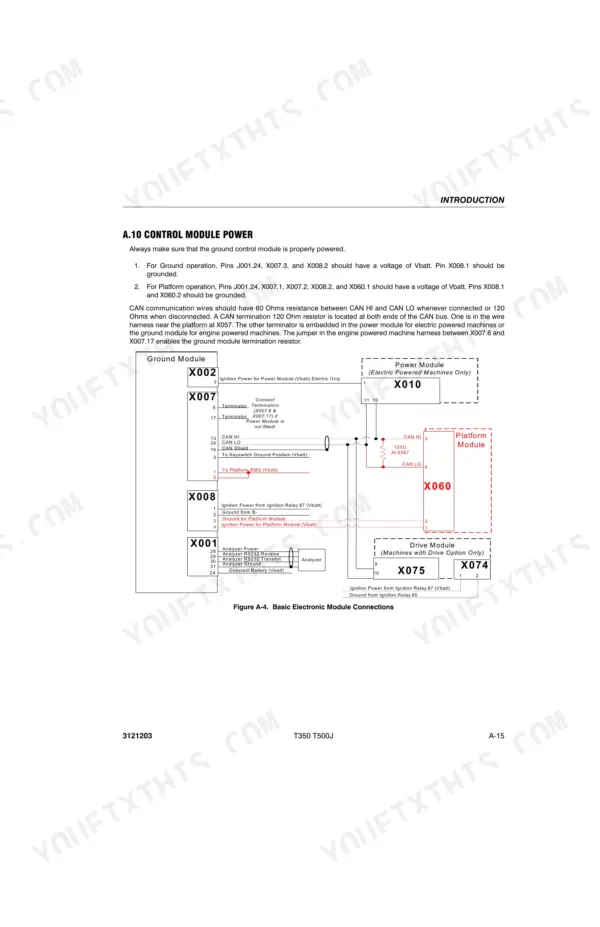
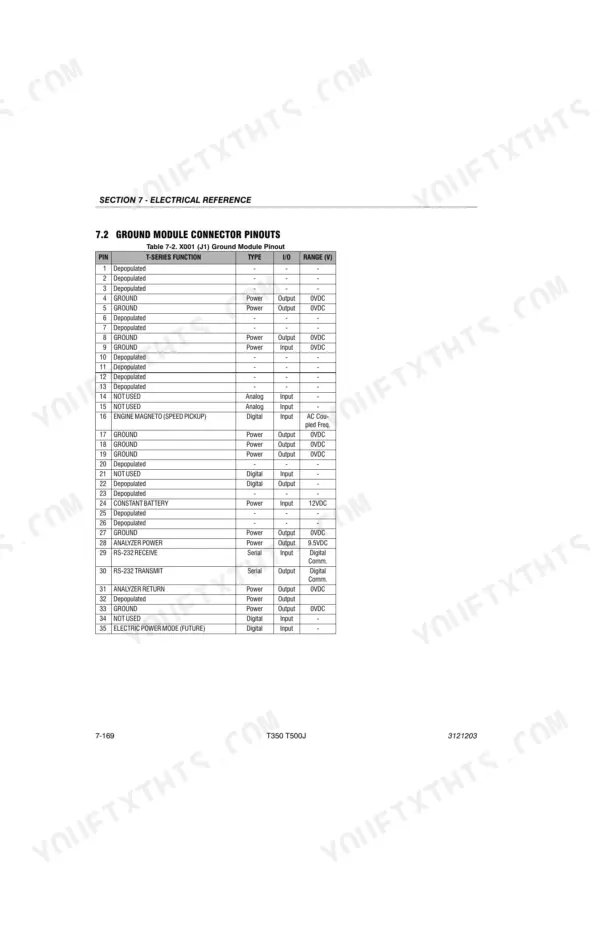
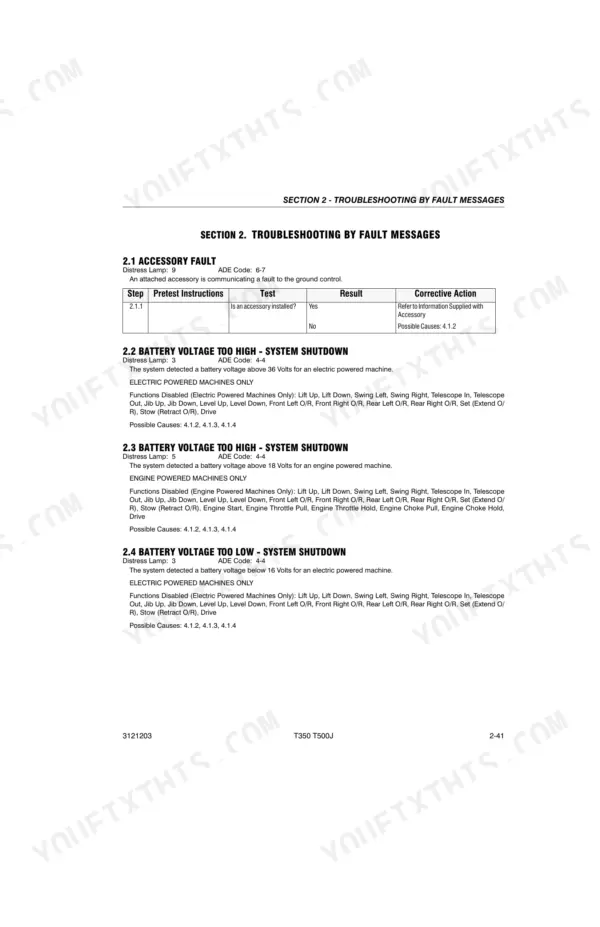
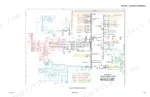
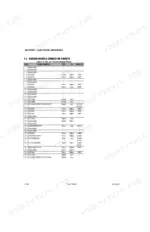
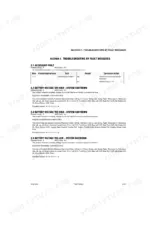
Factory fault-mapping for the JLG T350 or T500J aerial platform starts here. This 225-page troubleshooting manual (OEM #3121203) traces every fault code, failed function, and wiring fault from symptom to root cause. Inside: wiring schematics with full connector pinouts for the ground, platform, and drive modules, plus hydraulic schematics for both electric- and engine-powered configurations. The fault diagnostics chapter covers CANBUS failures, solenoid open/short circuits, joystick faults, and tilt sensor errors, with step-by-step component checks for the hydraulic pump, power module, and outrigger switches. Max hydraulic system pressure on the T350 is 2700 psi (186 Bar); fill the engine-powered unit's fuel tank to exactly 1.6 gallons (6.0 L) before running engine diagnostics. Your boom is down and the display is throwing codes. Bookmarked and searchable. Open it on a tablet at the machine and trace the fault.
What's Inside This JLG T350, T500J Manual
| System | Pages | Key Topics |
|---|---|---|
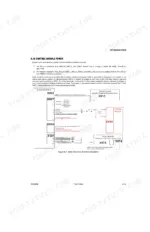
| Introduction | 5-16 | How to Use This Manual, Visual Inspection, Connector References, Reading Fault Codes, User Fault Codes, Control Module Power, Tilt, Critical Vehicle Interlock Scenarios |
| Troubleshooting Safety Precautions | 17-18 | General Safety, Hydraulic System Safety, Troubleshooting Safety |
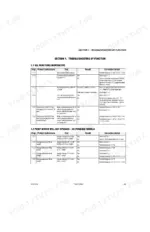
| Troubleshooting by Function | 29-40 | All Functions Inoperative, Pump Motor Will Not Operate, Engine Will Not Crank, Ground/Platform Controls Inoperative, Lift Down/Up Function Inoperative |
| Troubleshooting by Fault Messages | 41-116 | Battery Voltage Too High/Low, Canbus Failure, Chassis Tilt Sensor, Solenoid Open/Short Circuits, Function Locked Out/Problem, Joystick Faulty |
| Component Checks | 117-128 | DC Powered Machine (Hydraulic Pump, Power Module), Engine Powered Machine (Hydraulic Pump, Power), Joystick Diagnostics, Outrigger Switches, Tilt Sensor, Transport Limit Switch |
| Possible Causes | 129-132 | Bad Contacts, Incorrect System Setup, Improper Battery Level, Defective Modules, Wiring Issues, Stuck/Defective Switches, Hydraulic Fluid Issues, Engine Problems |
| System Test Messages | 133-158 | Battery Lamp Indicators, Battery Voltage, Check Choke Switch, Check Jib Down/Up Switch, Check Power & CAN Wiring, Solenoid Open/Short Circuits, Joystick to Max |
| Calibration Messages | 159-160 | Reserved for Calibration Process Messages |
| Electrical Reference | 161-189 | Connector Index, Ground Module Pinouts, Platform Module Pinout, Drive Module Pinout, Connector Loading Diagrams, Working with AMP/Deutsch Connectors, Trailer Wiring |
| Hydraulic References | 190-201 | Solenoids, Minimum Operating Pressure, Hydraulic Test Ports, Hydraulic Schematic (Electric Powered Machines), Hydraulic Schematic (Engine Powered Machines) |
| Jlg Analyzer | 202-213 | Connecting Analyzer, Using Analyzer, Changing Access Level, Adjusting Parameters, Machine Setup, System Test, User Fault Codes |
| Multimeter Basics | 214-217 | Voltage Measurement (DC), Resistance Measurement, Continuity Measurement, Current Measurement (DC) |
| Specifications | 218-223 | Operating Specifications, Dimensional Data, Fluid Capacities, Electric Power Unit Specifications, Tire Specifications, Engine Specifications, Battery Specifications |
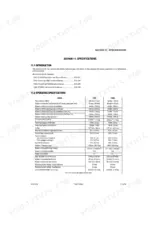
Quick Reference Specifications
| Specification | Value | Page |
|---|---|---|
| Maximum Allowable Tow Speed | 65 mph (105 kph) | p. 218 |
| Maximum Work Load (Capacity) w/o Rotator | 500 lbs. (230 kg) | p. 218 |
| Max. Vertical Platform Height (Unrestricted) | 35 ft. (10.6 m) | p. 218 |
| Max. Hydraulic System Pressure | 2700 psi (186 Bar) | p. 218 |
| Fuel Tank Capacity | 1.6 Gal. (6.0 L) | p. 219 |
| Hydraulic Tank Filling Volume | 4.4 Gallon (16.65 Liters) | p. 219 |
| Engine Displacement | 16.5 cu.in. (270 cm3) | p. 221 |
| Engine Max. Output | 9 bhp (6.6 kW) at 3,600 rpm | p. 221 |
| Engine Battery Cranking Performance (0°F) | 450 amps | p. 221 |
| Battery Voltage | 6-Volt | p. 221 |
| Wheel Nut Torque (ANSI) | 90-120 ft. lbs. (122-164 Nm) | p. 220 |
| Hydraulic Oil Viscosity Index (Mobilfluid 424) | 152 | p. 223 |
JLG T350, T500J Common Problems This Manual Covers
JLG T350 two-flash code illuminated, machine in reduced speed mode with boom raised
Lower the platform to the stowed position immediately before doing anything else. Check all four outrigger pads are fully extended and seated on firm ground. Verify each setup interlock switch activates with a click at full extension. Connect the JLG Analyzer to confirm no additional faults; platform work-load limit is 500 lbs. (230 kg).
Manual Section: Troubleshooting By Fault MessagesBoom or platform function continues running after releasing the control lever or joystick
Hit the emergency stop immediately; do not attempt to operate controls again until the fault is isolated. Inspect the joystick and control lever for mechanical binding or debris preventing return to neutral. Verify battery supply is 6V at the platform module connector. Replace any joystick or switch that holds continuity when released.
Manual Section: Troubleshooting By FunctionSystem distress lamp stays on after startup and machine will not operate normally
Connect the JLG Analyzer before cycling the keyswitch; active fault codes display immediately on connection. Cross-reference each code against the error list. Verify battery voltage is 6V at the ground module terminals; a low or high voltage condition triggers distress codes independently. Inspect outrigger switch and tilt sensor wiring for loose or corroded pins.
Manual Section: Troubleshooting By Fault MessagesLift and telescope stop responding after boom is raised past the interlock angle
Inspect the transport limit switch at the boom pivot for physical damage, corrosion, or misalignment. Verify the switch circuit sees 6V supply at the platform module connector. Trace the interlock harness toward the top control; wiggle each connector while the boom is near the cutoff angle and watch for intermittent function drop-out.
Manual Section: Component ChecksEngine cranks but will not start or fires and dies in cold weather
Check fuel level first: capacity is 1.6 gal. (6.0 L) and cold-weather hard starts often trace to stale or low fuel. Test battery cranking output; spec is 450 amps at 0°F (page 221), so a weak battery won't spin the engine fast enough below freezing. Inspect the choke switch wiring and ignition relay terminals for corrosion.
Manual Section: Troubleshooting By Function p. 221Frequently Asked Questions
Why is my JLG T500J not leveling or self-leveling?
The JLG T500J may not be leveling or self-leveling properly if the ground module's tilt sensor or outrigger switches are not functioning correctly. The machine attempts to level by extending or retracting outriggers, but if the ground is too uneven or the slope too great, it may be unable to achieve level. Refer to Section 1.12 on page 1-34 for troubleshooting steps, including checking outrigger switch indicators with the Analyzer. p. 34
What do the JLG T350/T500J fault or blink codes mean?
The JLG T350/T500J uses various fault and blink codes to indicate problems. User Fault Codes (Flash Code 1-9) are described in Section A.5 on page A-7, covering issues like "Procedure," "Vehicle Setup," or "Battery / Charge System." Power Module Flash Codes, found in Section A.8 on page A-14, indicate errors such as "Internal Failure, Controller Damaged" (Off flash code) or "Communication Loss" (10 flash code). p. 7
How do I clear a JLG T350/T500J error code?
To clear a JLG T350/T500J error code, you often need to "re-cycle power to clear difficulty" as indicated for various power module failures (e.g., Sections 2.79, 2.125, 2.126). For a "Personality Range Error," a specific procedure involves resetting control system Personalities to default settings using the JLG Analyzer, re-selecting the Model, and cycling EMS after 5 seconds (Section 2.127, page 2-99). p. 78
What causes the JLG T500J outriggers to not deploy or cut out functions?
JLG T500J outriggers may not deploy or functions may cut out due to several interlock conditions. These include the boom transport limit switch being open when outriggers are in the set or stow position (Section 2.123, page 2-97), or the boom telescope limit switch being open when attempting to stow outriggers (Section 2.122, page 2-97). Additionally, if the machine is elevated and tilted with one or two outriggers unset, a "RETRIEVAL-B" scenario will prevent boom operation (Section A.12, page A-16). p. 97
What format is this Jlg T350 manual in?
You get a 225-page searchable PDF that downloads instantly after checkout. Open it on your laptop, tablet, or phone — bring it right to the shop floor.
Can I print this manual?
Yes. Print a chapter or just the pages for the job at hand, for use in your own shop. Any home or office printer works.
Is the hydraulic system diagrammed in this Jlg T350 manual?
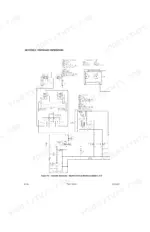
Included. Hydraulic system schematics cover all circuits, control valves, and component specifications for the JLG T350, T500J.


Reviews
There are no reviews yet.