
Part of the John Deere Repair Manuals.
This is the John Deere factory Operation and Tests manual (TM4741) for the 6020, 6120, 6220, 6320, 6420, 6420S, 6520, 6620, 6820, 6920 and 6920S SE tractors. Unlike the companion repair manual, it focuses on theory of operation, test procedures, diagnostic routines and system adjustments rather than disassembly and rebuild. Across 3,476 pages it covers five transmission variants, the load-sensing hydraulic system, electronic control unit diagnostics, electrical sub-system checks and grounded test pressures for cooling, fuel and air intake. It is what a John Deere dealer technician reaches for to confirm system performance to factory spec before deciding whether a component needs repair.
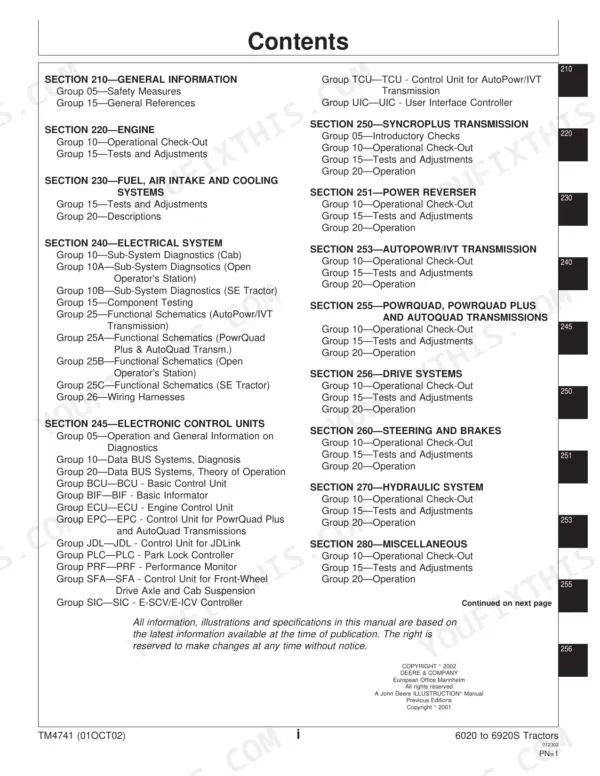
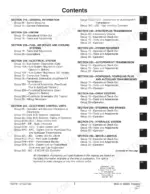
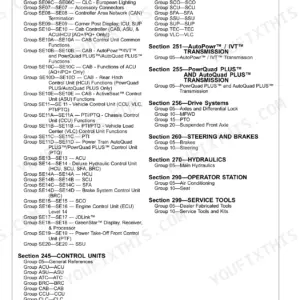
What's Inside This John Deere 6020-6920S Manual
| System | Pages | Key Topics |
|---|---|---|
| General Information | Safety Information, Specifications, Torque Values, Fuel and Lubricant Recommendations | |
| Engine | Theory of Operation, Engine Performance Diagnosis, Tests and Adjustments | |
| Fuel, Air Intake and Cooling Systems | Cooling System Pressure Tests, Air Intake Restriction Tests, Fuel System Pressure Tests, Thermostat Testing, Viscous Fan Drive Tests, Fuel Transfer Pump Flow Rate | |
| Electrical System | Battery and Charging Tests, Wiring Harness and Connector Checks, Gauges and Instrument Diagnostics, Alternator and Starting Motor Tests | |
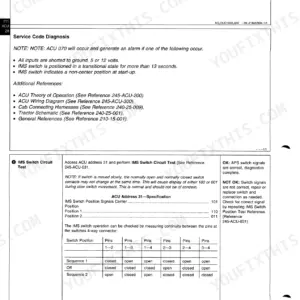
| Electronic Control Units | ECU Diagnostics, Error Code Reading and Clearing, CAN Bus Tests, Bosch VP44 Injection Pump Control | |
| SyncroPlus Transmission | Theory of Operation, Tests and Adjustments, Shift Quality Diagnosis | |
| Power Reverser | Theory of Operation, Tests and Adjustments | |
| AutoPowr/IVT Transmission | Theory of Operation, CVT Diagnostics, Tests and Adjustments | |
| PowrQuad, PowrQuad Plus and AutoQuad Transmissions | Theory of Operation, Shift Quality Diagnosis, Tests and Adjustments | |
| Drive Systems | Differential Lock Tests, MFWD Tests and Adjustments | |
| Steering and Brakes | Power Steering Pressure Tests, Brake Adjustment and Tests | |
| Hydraulic System | Hydraulic Pressure Tests, Load-Sensing System Checks, Selective Control Valve Tests, Pump Flow Tests | |
| Miscellaneous | PTO Tests, General Diagnostic Procedures | |
| Operator's Cab | Air Conditioning Diagnostics, Cab Electrical Sub-System Checks | |
| Special Tools | Tool Identification and Application |
Quick Reference Specifications
| Specification | Value | Page |
|---|---|---|
| All models | ||
| Cooling System Test Pressure | 50-60 kPa (0.5-0.6 bar / 7-8.7 psi) | |
| Expansion Tank Cap High-Pressure Valve Opening | 70-90 kPa (0.7-0.9 bar / 10-13 psi) | |
| Expansion Tank Cap Low-Pressure Valve Opening | 10 kPa (0.1 bar / 1.5 psi) | |
| Air Intake System Test Pressure (restriction limit) | 1.5 kPa (15 mbar / 0.22 psi) | |
| Air Intake Low-Pressure Switch Range | 5.6-6.4 kPa (56-64 mbar / 0.81-0.93 psi) | |
| Fuel System Feed Pressure | 15 kPa (0.15 bar / 2.18 psi) | |
| Thermostat Initial Opening (82 degrees C rated) | 80-84 degrees C (175-182 degrees F) | |
| Level II emission engines | ||
| Fuel Transfer Pump Flow Rate (Level II engine) | 100 L/hr (26.4 US gal/hr) | |
| 82 degrees C rated thermostat | ||
| Thermostat Fully Open | 94 degrees C (202 degrees F) | |
| Models with viscous fan drive | ||
| Viscous Fan Drive - Minimum Speed at Slow Idle (850-900 rpm) | 800 rpm (may drop to 600 rpm for ~30 s) | |
| Level II/12 engines with VP44 pump | ||
| ECU Engine Speed Reduction Threshold (Bosch VP44 fuel cooler) | Above 70 degrees C (158 degrees F) fuel temperature | |
| Optional coolant heater | ||
| Coolant Heater Output | 650 W at 230 V | |
John Deere 6020-6920S Common Problems This Manual Covers
Tractor enters limp mode with EGR-related fault code
Connect the service tool and read the active fault code from the ECU section to confirm it is an EGR circuit fault. The Electronic Control Units section covers testing the EGR valve actuator circuit and checking EGR cooler flow. Replace only the failed component - valve, cooler or wiring - rather than both parts at once. Clearing the code without fixing the root cause will reset the fault within a few hours of operation.
Manual Section: Electronic Control UnitsEngine overheating with coolant loss on 6820/6920 under heavy load
Run the cooling system pressure test first (50-60 kPa) to find any external leak before suspecting the head gasket. If the system holds pressure, pressure-test the expansion tank cap and check that the thermostat opens within its rated range (80-84 degrees C initial opening). The Fuel, Air Intake and Cooling Systems section covers each step so you confirm the failure point before disassembly.
Manual Section: Fuel, Air Intake and Cooling SystemsHydraulic system loses pressure or implements drop under load
Use the test ports described in the Hydraulic System section to measure pump output pressure and load-sensing differential. If pump output is low, check the suction screen and hydraulic oil level first - contaminated or low oil is the most common cause. If pressure is within spec at the pump but drops at the selective control valve, the section covers valve testing to isolate the leaking circuit without a full teardown.
Manual Section: Hydraulic SystemEngine stalls or loses power with injection pump fault on Level II models
The Engine and Electronic Control Units sections cover diagnosing the Bosch VP44 injection pump. The ECU monitors fuel temperature and reduces engine speed above 70 degrees C (158 degrees F) to protect the pump. Check the fuel cooler flow and fuel return temperature before condemning the pump. The fuel transfer pump flow rate should reach 100 L/hr on Level II engines - a low-flow pump starves the VP44 and causes stalling under load.
Manual Section: EngineFrequently Asked Questions
How do I read and clear error codes on a John Deere 6920 or 6920S?
The Electronic Control Units section covers the full ECU diagnostic procedure - connecting the service tool, reading active and stored fault codes, and clearing codes after the root cause is fixed. It also documents the CAN bus network so you can trace which controller is logging the fault before chasing wiring.
What are the hydraulic test pressures for the 6020 to 6920S tractors?
The Hydraulic System section lists the test port locations, required gauges and factory pressure values for the load-sensing system, the selective control valves and the pump output. Running a pressure test first tells you whether you have a pump, valve or internal leak problem before removing anything.
Why does the EGR system cause limp mode on the 6820 or 6920?
A clogged or failed EGR valve or cooler triggers an emissions fault that puts the ECU into power-reduction mode. The Electronic Control Units and Engine sections cover the diagnostic steps - reading the fault code, testing the EGR circuit and confirming exhaust back-pressure - so you can replace only what is actually failed.
How do I test the cooling system pressure on these tractors?
Attach a pressure tester to the expansion tank and pressurize to 50-60 kPa (7-8.7 psi). The Fuel, Air Intake and Cooling Systems section gives the full procedure including checking the expansion tank cap high-pressure valve (70-90 kPa) and the thermostat opening range (80-84 degrees C for the 82 degrees C rated unit).
Does this manual cover all five transmission types on the 6020 series?
Yes. Separate sections cover the SyncroPlus, Power Reverser, AutoPowr/IVT, PowrQuad Plus and AutoQuad transmissions. Each section includes theory of operation and tests so you can verify shift quality and hydraulic pressures to factory spec before pulling a gearbox.
How is this John Deere 6020 Operation and Test delivered?
This is a 3476-page searchable PDF (54 MB) ready for immediate download. Works on any device, so pull it up on your phone while you're under the hood. No shipping, no waiting.
Is this John Deere 6020 Operation and Test printable?
Yes. The PDF has no DRM restrictions, so print any page or section you need for your shop. Works with any standard printer.






Reviews
There are no reviews yet.