
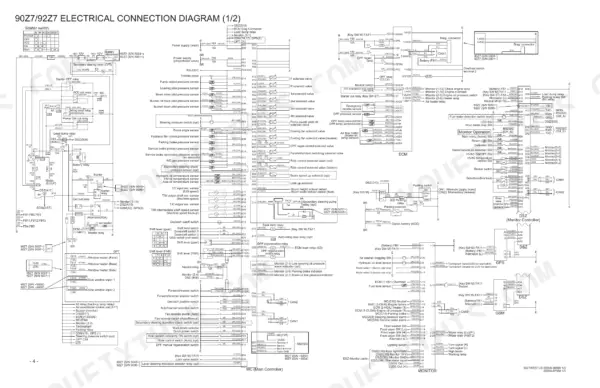
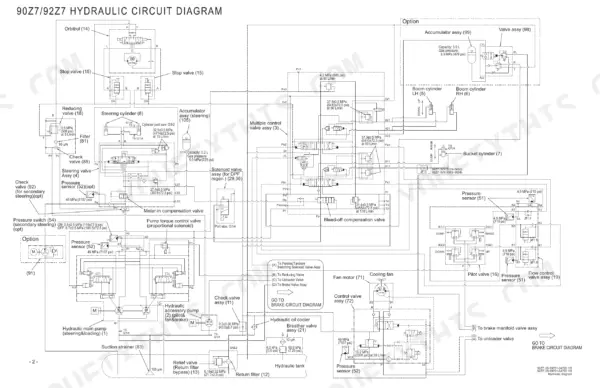
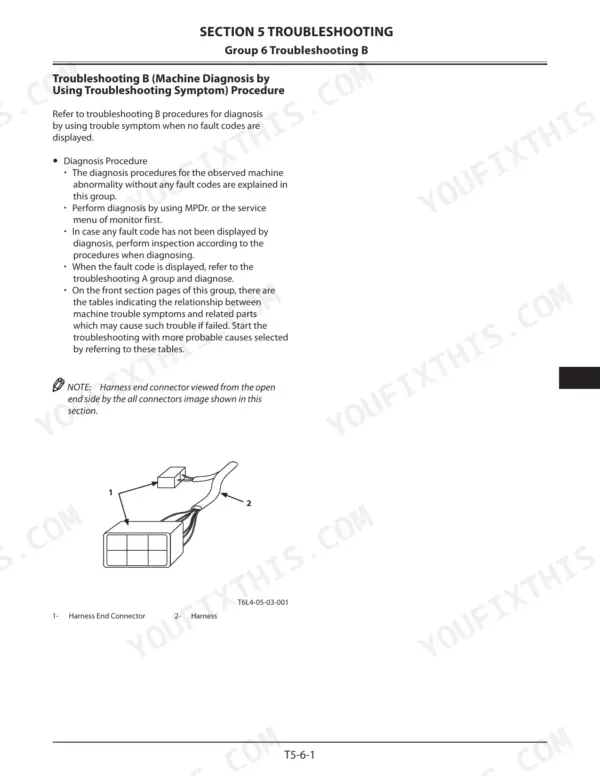
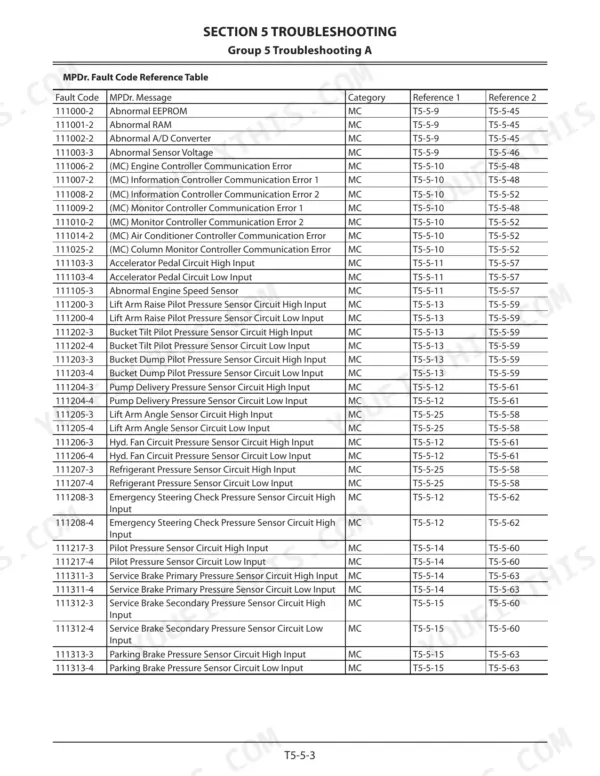
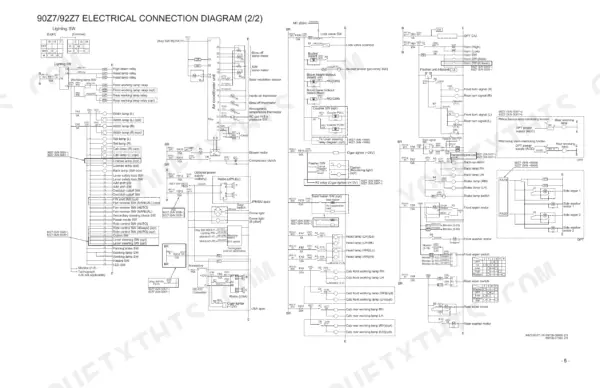
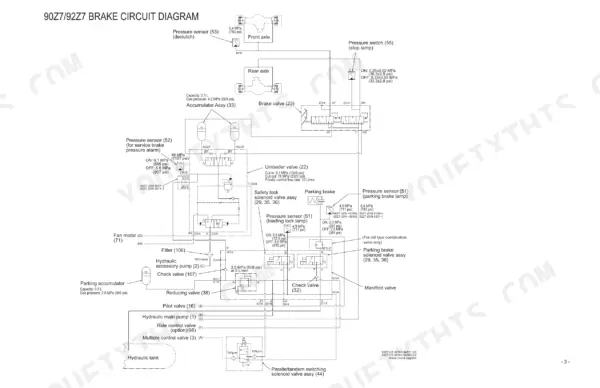
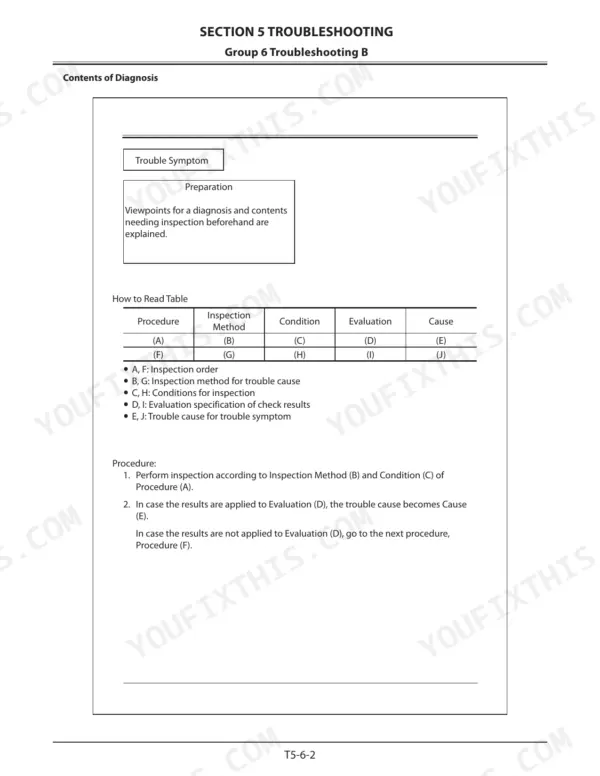
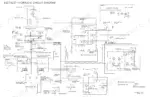
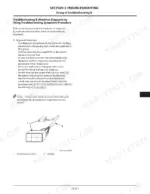
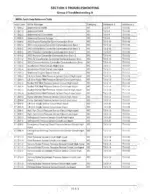
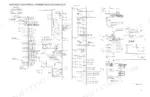
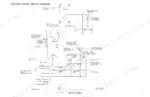
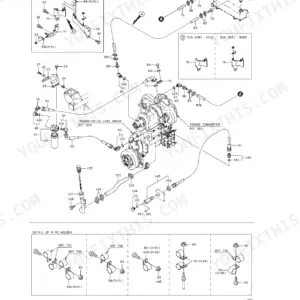
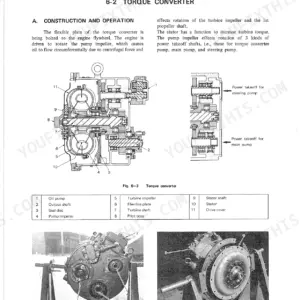
Document number 93213-00593 marks this as Kawasaki's own factory book for the 90Z7 and 92Z7 wheel loaders, reproduced in full as an 898-page Kawasaki 90Z7, 92Z7 shop manual PDF. Hydraulic schematics trace oil from the pump device through the control and steering valves to the bucket and lift arm cylinders; wiring diagrams map the ECM, controller and electrical system. Troubleshooting fills more than a third of the book, with monitor fault codes, diagnosing procedures and performance tests that tell you whether the engine, drive unit, axles and brake valve still meet standard. Set declutch control pressure to 1.5 MPa (218 psi) in first gear with the brake pedal fully applied, and torque 8 mm pipe nuts to 11.8 to 14.7 N·m (8.7 to 10.8 lbf·ft). An intermittent harness fault can eat a whole shift. Your bookmarked copy rides along on a laptop or tablet, in the cab or out at the pit, wherever the loader is parked.
What's Inside This Kawasaki 90Z7, 92Z7 Manual
| System | Pages | Key Topics |
|---|---|---|
| General Information | 1-49 | Introduction, Specifications, Component Layout, Component Specifications |
| System | 50-269 | Controller, Control System, ECM System, Hydraulic System, Electrical System |
| Component Operation | 270-489 | Pump Device, Control Valve, Cooling Fan System, Steering Pilot Valve, Steering Valve, Pilot Valve, Charging Circuit, Drive Unit |
| Operational Performance Test | 490-560 | Engine Test, Machine Performance Test, Component Test, Adjustment, Standard |
| Troubleshooting | 561-898 | Diagnosing Procedure, Monitor, e-Service, Component Layout, Troubleshooting a, Troubleshooting B, Air Conditioner |
Quick Reference Specifications
| Specification | Value | Page |
|---|---|---|
| All Models | ||
| Maximum Output Torque (Net) | 1370 N·m (140 kgf·m, 1010 lbf·ft) at 1300 min-1 | p. 40 |
| Declutch Control Pressure (Speed Range: First, Brake pedal (42) fully applied (b)) | 1.5 MPa (218 psi) | p. 91 |
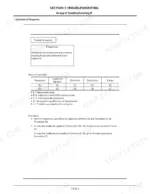
| Nut type (Fig. A) Pipe with dia. 8 | 11.8 to 14.7 N·m (1.2 to 1.5 kgf·m) (8.7 to 10.8 lbf·ft) | p. 894 |
| Engine Rated Output (Net) | 213 kW/1800 min-1 | p. 38 |
| Main Relief Set-Pressure | 31.4 MPa | p. 43 |
| Steering Main Relief Set-Pressure | 27.4 MPa | p. 44 |
| Brake Pressure | 4.8 MPa | p. 44 |
| Battery Voltage | 12 V | p. 42 |
| Transmission Clutch Pressure | 2.1 to 2.3 MPa | p. 554 |
| Torque Converter Inlet Pressure | 0.9 to 1.2 MPa | p. 556 |
| 90Z7 | ||
| Operating Weight (90Z7) | 24550 kg | p. 10 |
| 92Z7 | ||
| Operating Weight (92Z7) | 26840 kg | p. 11 |
Kawasaki 90Z7, 92Z7 Common Problems This Manual Covers
Kawasaki 90Z7 92Z7 wheel loader front attachment hydraulics have weak actuator power and slow cylinder speed
Measure the main relief set-pressure with a gauge and compare it to 31.4 MPa listed on page 43. If the reading is low, sort out the relief before chasing anything else. If it holds spec, follow the Front Attachment System Troubleshooting flow for weak actuator power and slow cylinder speed, one step at a time.
Manual Section: Front Attachment System Troubleshooting p. 43Front attachment drifts down while held and gives a shock during bucket dump
Inspect the front attachment circuit on the hydraulic schematic so you know which control valve and cylinder lines are involved before you pull anything. Then work through the Front Attachment System Troubleshooting checks for drift and shock during bucket dump in order. Retest the attachment after each correction rather than swapping parts on a hunch.
Manual Section: Front Attachment System TroubleshootingSteering system turns weak and slow, with noticeable shock in steering during turns
Measure the steering main relief set-pressure and compare it to 27.4 MPa on page 44. A low reading puts the relief at the top of your list. If pressure is in spec, follow the Steering System Troubleshooting steps for weak steering, slow steering and shock, then review steering pilot valve and steering valve operation in Component Operation.
Manual Section: Steering System Troubleshooting p. 44Parking brake does not release when commanded, or does not apply when set
Check the parking brake accumulator gas charging pressure against 2.8 MPa listed on page 383. A flat accumulator is quick to rule out before you open the wiring diagrams. Then follow the Brake System Troubleshooting flow for parking brake not released or not applied, and verify brake pressure against 4.8 MPa on page 44.
Manual Section: Brake System Troubleshooting p. 383Transmission speed shift fails or is delayed, and travel mode change does not engage
Measure transmission clutch pressure and compare it to 2.1 to 2.3 MPa on page 554, then check torque converter inlet pressure against 0.9 to 1.2 MPa on page 556. If both read in spec, follow the Travel System Troubleshooting steps for speed shift failure, speed shift delay and travel mode change failure.
Manual Section: Travel System Troubleshooting p. 554Declutch does not cut drive when the brake pedal is fully applied in first speed
Test declutch control pressure with the speed range in first and the brake pedal fully applied. The reading should be 1.5 MPa (218 psi) per page 91. If pressure is off, follow the Travel System Troubleshooting flow for declutch failure, and pull up the wiring diagrams when the flow sends you into the electrical side.
Manual Section: Travel System Troubleshooting p. 91Frequently Asked Questions
How do I reset the fault code on a Kawasaki 90Z7 wheel loader?
To clear fault codes, open the Troubleshooting screen on the monitor panel. Select the controller with the fault, then select the 'CLEAR' option and push the select/confirm knob to delete past fault codes. p. 596
What is the procedure to clear an error code on a Kawasaki 92Z7?
The procedure for clearing fault codes is the same for both models. Open the Troubleshooting screen on the monitor, select the controller, and use the 'CLEAR' function to delete past fault codes. p. 596
What are the valve clearance specifications for the HINO E13C-VV engine in Kawasaki wheel loaders?
The valve clearance for the HINO E13C-VV engine, when the engine is cold, is 0.28 mm (0.0110 in) for intake valves and 0.49 mm (0.0193 in) for exhaust valves. p. 40
What is the procedure for bleeding air from the brake system on the 90Z7/92Z7?
Bleed air from the brake system at all four wheels by using the air bleed plug (1) located around the center of the front and rear axles. Continue bleeding until approximately 0.5 L (0.13 gal) of hydraulic oil is drawn from each wheel and no bubbles remain. p. 849
What is the standard torque for the steering relief valve lock nut on Kawasaki wheel loaders?
The standard torque for the steering relief valve lock nut is 17 to 19 N·m (1.7 to 1.9 kgf·m) (12.5 to 14 lbf·ft). p. 541
How will I receive this Kawasaki 90Z7 Shop Manual?
A 898-page Shop Manual in searchable PDF format, available the moment you complete checkout. View on computer, tablet, or phone, with no shipping wait.
Can I print specific sections of this Kawasaki 90Z7 Shop Manual?
Yes. Many mechanics print the section they need for their own shop and bring it to the bench.



Reviews
There are no reviews yet.