
An hour from now you could be out at the tractor with this Ford 1920 operator manual PDF open beside you, all 76 factory pages of OEM document 42192010, checking the same predelivery items Ford dealers ran before handing over the keys. Lubrication and maintenance take up close to a third of the book: service charts split for two-wheel and four-wheel drive, fuel and lubricant procedures, general maintenance, and tractor storage. Operation chapters walk you from break-in and starting through the PTO, differential lock, hydraulic lift, wheel tread settings, ballast, and tire pressures. Change engine oil every 100 hours, transmission and rear axle oil at 300, and check clutch pedal free travel every 50 hours to hold it between 19 and 30 mm. Guess at that free travel and you're buying a clutch. It's a bookmarked, text-searchable PDF: print what you need, let those pages get greasy, and be planting before the weather turns.
Complete the set for your 1920
- Repair Manual: Ford 1120-2120 Compact Tractor Shop Manual (incl. Wiring)
What's Inside This Ford 1920 Operator Manual
| System | Pages | Key Topics |
|---|---|---|
| International Symbols | 5 | Engine Speed, Engine Water Temperature, Air Filter, Differential Lock, Power Take-Off, Parking Brake |
| Safety Precautions | 6-7 | The Tractor |
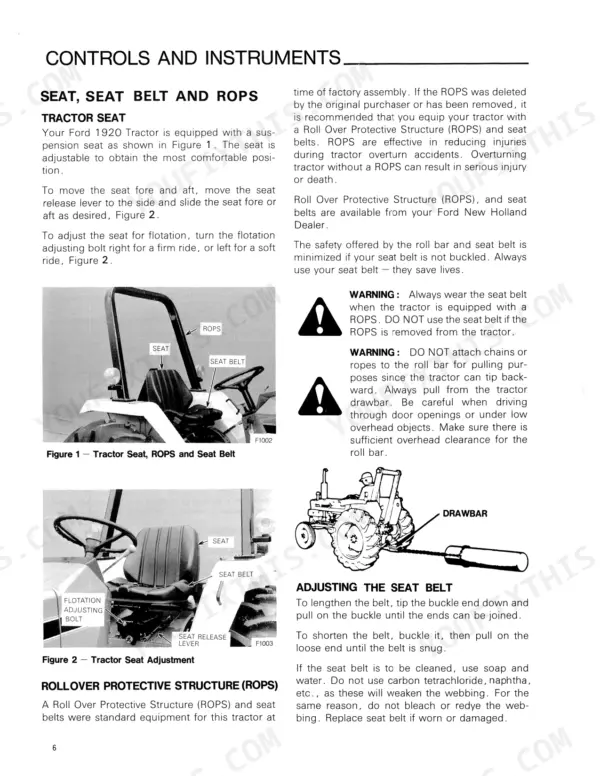
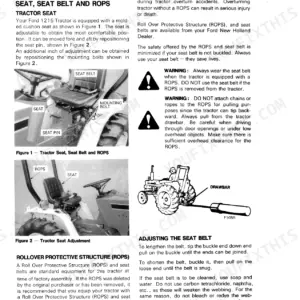
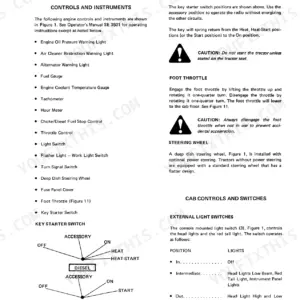
| Controls and Instruments | 8-15 | Seat, Seat Belt and ROPS, Lighting, Instrument Panel, Throttle Controls, Brake Controls, Differential Control, Transmission and PTO Controls |
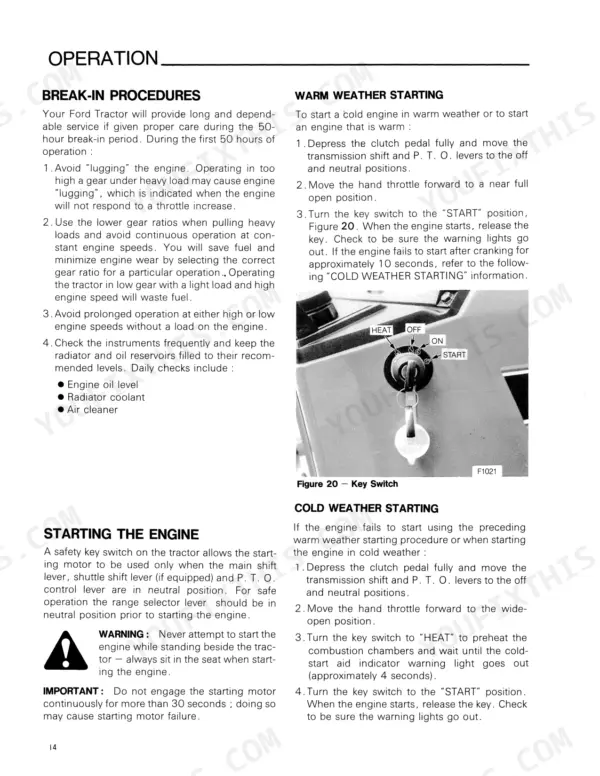
| Operation | 16-33 | Break-In Procedures, Starting the Engine, Stopping the Engine, Operating the Transmission, Four-Wheel Drive and PTO, Towing the Tractor, Operating the Differential Lock |
| Lubrication and Maintenance | 34-58 | Lubrication and Maintenance Chart (Two-Wheel Drive, Four-Wheel Drive), Fuel and Lubricants, Fuel and Lubricant Service Procedures, Tractor Storage |
| Specifications | 59-62 | Engine, General Dimensions |
| Safety and Instruction Decals | 63-70 | Safety Decals, Instruction Decals |
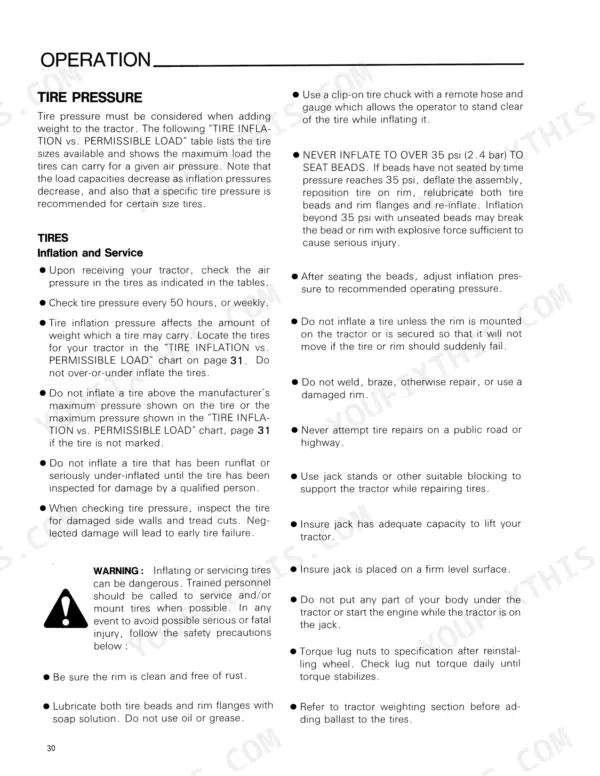
| Predelivery and 50-Hour Service | 71-76 | Tire Pressure, Air Cleaner Element, Radiator Coolant Level, Fan Belt Tension, Battery, Brake Adjustment |
Quick Reference Specifications
| Specification | Value | Page |
|---|---|---|
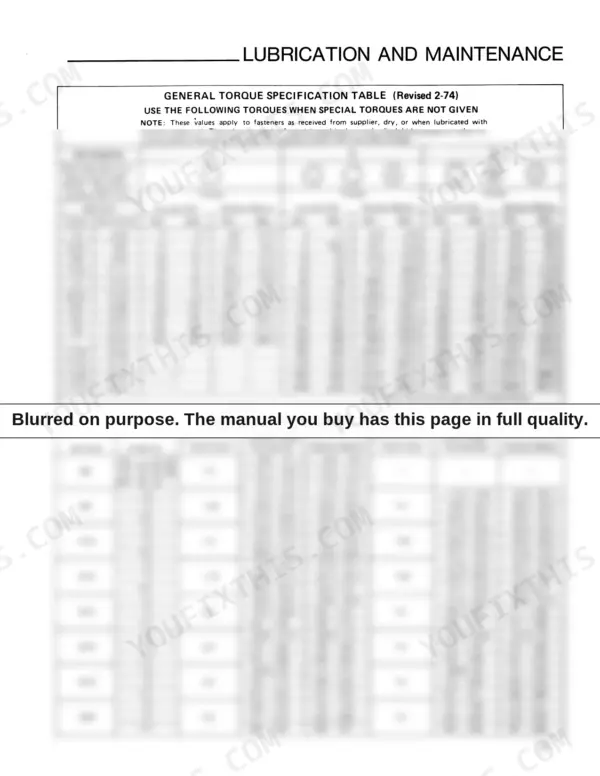
| wheel disc to hub bolts torque | 48-61 lbs.ft. (66-83 N.m) | p. 26 |
| side axle adjusting bolts torque | 170-206 lbs.ft. (233-279 N.m) | p. 26 |
| Engine Oil Change Interval | 100 hours | p. 39 |
| Transmission/Rear Axle Oil Change Interval | 300 hours | p. 42 |
| Valve Clearance (Intake) | 0.008 in. | p. 48 |
| Valve Clearance (Exhaust) | 0.008 in. | p. 48 |
| Radiator Cap Pressure | 12.8 psi | p. 59 |
| Clutch Pedal Free Travel | 3/4-1-3/16 in. | p. 59 |
| Front Wheel Disc-to-Hub Torque (Two-Wheel Drive) | 48-61 lbs. ft. | p. 60 |
Ford 1920 Common Problems This Manual Covers
Engine runs but tractor will not move in any gear or range
Verify the range and main shift levers are fully seated in gear, not caught between positions. Measure clutch pedal free travel and adjust it to 3/4 to 1-3/16 inches (19-30 mm), page 51; a pedal out of spec lets the clutch slip instead of engaging. Check transmission oil level and change it every 300 hours, page 42.
Manual Section: Lubrication and Maintenance p. 51PTO shaft will not turn when lever is engaged and engine running
Check the PTO lever against the controls layout on page 8 and push it fully into engagement. Shut the engine off, then confirm the implement shaft is locked on the PTO splines and turns freely by hand. Check the rear housing oil level; the PTO gears run in this oil, so change it every 300 hours, page 42.
Manual Section: Transmission and PTO OperationThree-point hitch or loader bucket slowly drops with control lever centered and engine running
Check the rear axle oil level first; the lift and loader draw from this sump. Fill to the dipstick mark and change the oil every 300 hours, page 42. Slow the flow control knob for loader work. If the bucket still settles with clean oil at the right level, have your dealer test the valve and cylinders.
Manual Section: Hydraulic Lift SystemTemperature gauge climbs into red zone during heavy fieldwork on hot days
Check the coolant level once the engine cools; never open a hot radiator. Clean chaff and dust from the radiator screen and fins, then check fan belt tension. Replace a cap that will not hold its rated 12.8 psi, listed in the specifications on page 59. Inspect the water pump gasket and bypass hose for seepage before restarting.
Manual Section: Cooling System MaintenanceEngine cranks slowly, fires unevenly, and smokes white on cold winter mornings
Check the battery first; charge or replace one that cranks slowly. Follow the cold weather starting procedure on page 16 and give the glow plugs their full preheat cycle. Run the oil viscosity recommended for the season and change engine oil every 100 hours, page 39. Test glow plugs and the timer relay instead of jumping wires.
Manual Section: Engine Starting (Warm/Cold) p. 16Frequently Asked Questions
What is the torque specification for the front wheel disc-to-hub bolts on a two-wheel drive Ford 1920?
For a two-wheel drive Ford 1920, the front wheel disc-to-hub bolts should be torqued to 48-61 lb. ft. (66-83 N.m). p. 60
What is the correct valve clearance for the intake and exhaust valves on a Ford 1920 tractor?
The intake and exhaust valve clearance for the Ford 1920 engine should be 0.008 inches (0.2 mm) when the engine is cold. p. 48
How do you fix ford 1920 will not start with key but cranks when solenoid is jumped directly?
Check the starting procedure on page 16: depress the clutch pedal fully and shift the PTO lever to disengaged, since the safety start switch blocks the key circuit. Clean and tighten both battery cable ends. Adjust clutch pedal free travel to 3/4 to 1-3/16 inches (19-30 mm), page 51, before condemning the key switch or solenoid. p. 16
How will I receive this Ford 1920 Owner's Manual?
Instant PDF download. You get the full 76-page searchable Owner's Manual immediately after payment. Open it on your laptop, tablet, or phone right in the shop.
Can I print specific sections of this Ford 1920 Owner's Manual?
Yes. Print the pages or sections you need for your own shop use. Any standard printer works.


Reviews
There are no reviews yet.