

Part of the JCB Operator Manuals.
Lifting near the limits of the load charts, with the overload warning system as your backstop, is the hardest job in the 220-page JCB 55Z-1, 57C-1 operator manual PDF (9831/1250), and the book widens from there to every control, attachment and service point on both compact excavators. Instrument panel warnings, the control pattern selector and quickhitch operation each get their own section, and the maintenance schedules take a solid share of the book, setting intervals for slew ring bearings, pivot pins, steel and rubber tracks, and the fuel water separator. Technical data adds weights, digging performance, fuse and relay listings and capacities tables. Fill the engine with 9.1 L of oil and the cooling system with 12 L; the quickhitch runs 265 bar on its high-pressure side. Guess the oil grade and you could buy a pump. Keep the bookmarked, text-searchable PDF in your pocket, on whichever site the machine is working.
What's Inside This JCB 55Z-1, 57C-1 Operator Manual
| System | Pages | Key Topics |
|---|---|---|
| Acronyms Glossary | 11-12 | Controller Area Network, Construction Equipment Security and Registration, Display Electronic Control Unit, Diesel Exhaust Fluid, Engine Control Module, Electronic Control Unit |
| Introduction | 13-18 | General, Owner/Operator Support, Service/Maintenance Agreements, Obtaining Spare Parts |
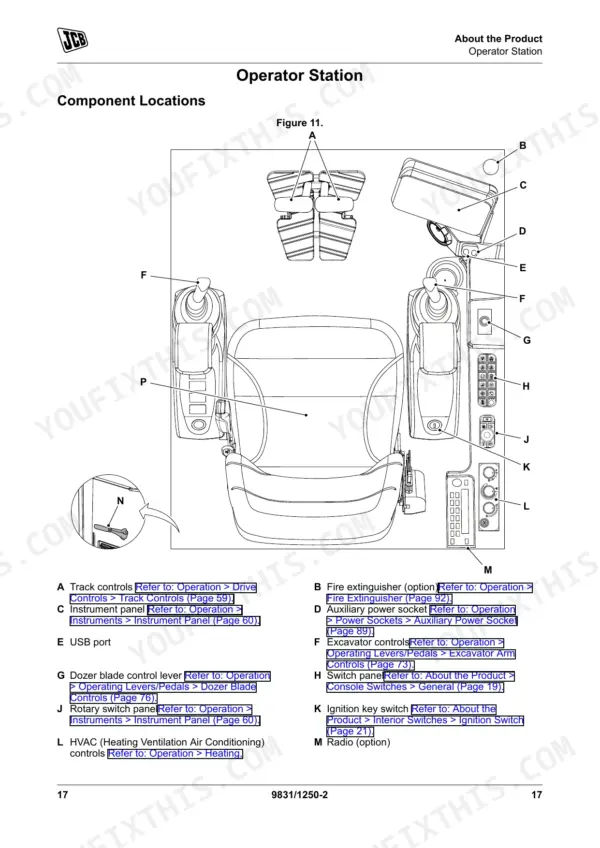
| About the Product | 19-34 | Description (General, Intended Use, Log Moving/Object Handling, Optional Equipment and Attachments, Danger Zone, Main Component Locations) |
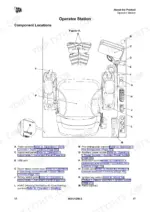
| Operation | 35-118 | Operating Safety (General, Worksite Safety, Risk Assessment), Walk-Around Inspection (General), Entering and Leaving the Operator Station (General, Emergency Exit) |
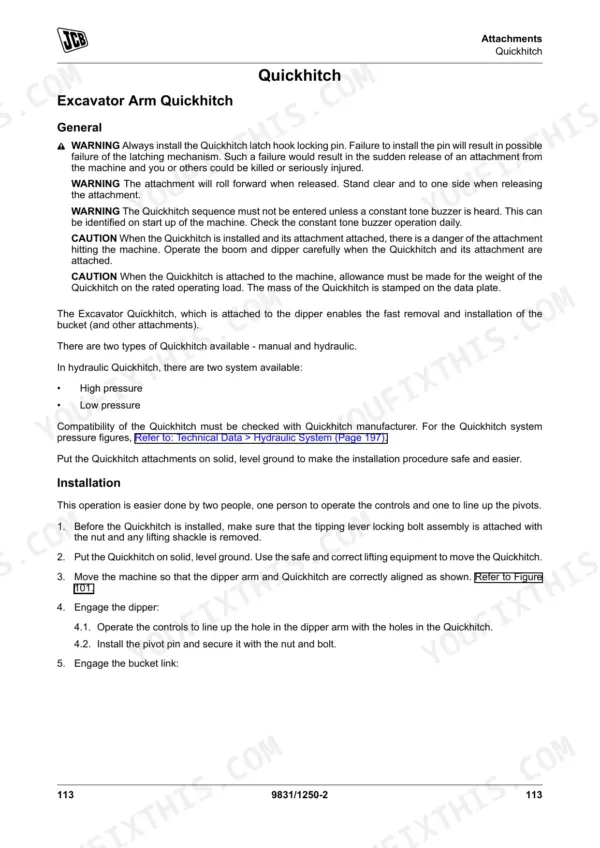
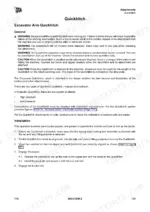
| Attachments | 119-138 | Working with Attachments, Quickhitch, Rockbreaker |
| Preservation and Storage | 139-144 | Cleaning (General, Preparation), Checking for Damage (General), Storage (General, Put Into Storage, During Storage, Take Out of Storage) |
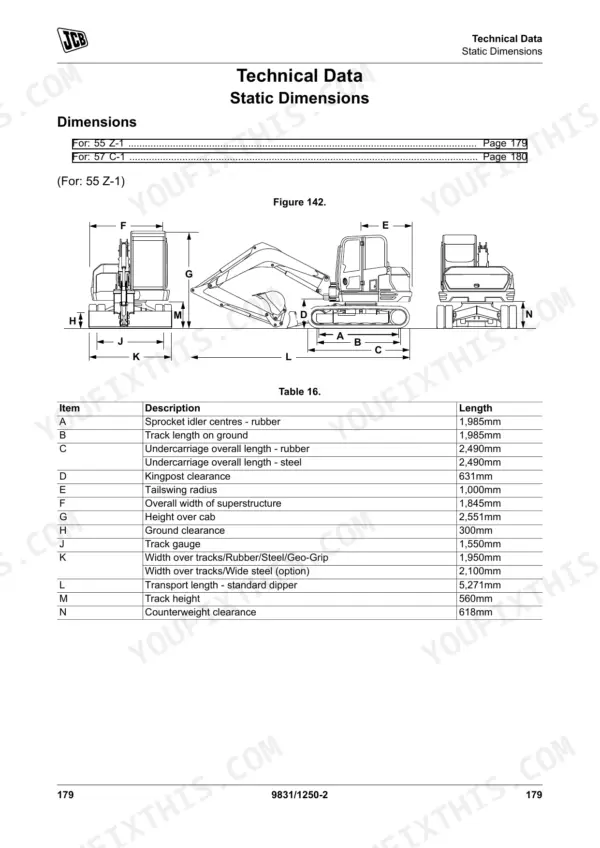
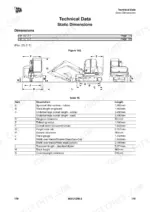
| Technical Data | 191-213 | Static Dimensions (Weights), Performance Dimensions (Excavator Arm Dimensions and Performance), Noise Emissions (General, Noise Data), Vibration Emissions (General, Vibration Data) |
| Warranty Information | 214-220 | Service Record Sheet |
Quick Reference Specifications
| Specification | Value | Page |
|---|---|---|
| All Models | ||
| Auxiliary Pressure - Low flow | 190 bar (2,753.6 psi) | p. 209 |
| Auxiliary Pressure - High flow | 190 bar (2,753.6 psi) | p. 209 |
| System voltage | 12V | p. 206 |
| Engine oil capacity | 9.1L | p. 201 |
| Engine coolant capacity | 12L | p. 201 |
| Hydraulic system capacity | 100L | p. 201 |
| Quickhitch high pressure | 265 bar (3,840.6 psi) | p. 209 |
| Quickhitch low pressure | 32 bar (463.8 psi) | p. 209 |
| 55 Z-1 | ||
| Machine operating weight (400mm rubber track) | 5,366kg | p. 192 |
| 57 C-1 | ||
| Machine operating weight (400mm rubber track) | 5,483kg | p. 193 |
JCB 55Z-1, 57C-1 Common Problems This Manual Covers
JCB 55 Z-1 or 57 C-1 engine fails to start, immobiliser locked out after PIN code errors
Verify the PIN code against the one issued for this machine and enter it slowly. PIN code errors and immobiliser lockout are both covered in the engine starting troubleshooting steps, so work through them in order. Check that the battery is charged and the terminals are clean on the 12V system listed on page 206 before you chase the immobiliser further.
Manual Section: Engine Starting TroubleshootingQuickhitch will not engage or disengage, latch hook not locking onto the attachment
Inspect the latch hook and carry out the latch hook maintenance in the quickhitch section starting on page 125. Run the engagement and disengagement sequence exactly as written, then check by eye that the hook has fully latched before you lift or dig. Never trust an attachment you have not physically checked as locked.
Manual Section: Quickhitch Troubleshooting p. 125Auxiliary circuit hoses hard to disconnect with pressure still locked in the couplings
Check that trapped pressure is fully discharged before you break any auxiliary connection. Follow the hydraulic service venting and auxiliary venting steps in the hydraulic troubleshooting procedures, in order, without skipping any. Afterwards, check the hydraulic oil level. The system holds 100L as listed on page 201, so top up only as needed.
Manual Section: Hydraulic System TroubleshootingWater showing in the fuel water separator and air trapped in the fuel system
Drain and clean the water separator following the fuel system troubleshooting steps, then bleed the fuel system to purge the trapped air before cranking. Inspect every fuel connection you disturbed for leaks with the engine running. If water keeps showing up, check the fuel supply you are filling from instead of cleaning the separator every shift.
Manual Section: Fuel System TroubleshootingCoolant level dropping between checks with cooling system leaks and a clogged cooling pack
Check the coolant level with the engine cold and top up. Engine coolant capacity is 12L, as listed on page 201. Inspect the cooling system for leaks before you keep adding coolant. Clean the cooling pack following the cooling system troubleshooting steps, and do it more often on a machine working in dust.
Manual Section: Cooling System TroubleshootingTrack tension out of adjustment with the rubber track running slack on the undercarriage
Check track tension on level ground and adjust it following the track tension troubleshooting steps, then travel the machine a short distance and check it again. Inspect the track and undercarriage during the routine track maintenance the manual lists. Do not keep working with a slack track, because a thrown track stands the whole crew down.
Manual Section: Track Tension TroubleshootingFrequently Asked Questions
What are the hydraulic pressure settings for a JCB 55Z-1 or 57C-1?
The auxiliary circuit pressure for both low flow and high flow is 190 bar (2,753.6 psi). The Quickhitch system pressure is 265 bar (3,840.6 psi) for high pressure and 32 bar (463.8 psi) for low pressure. p. 209
What are the engine oil and filter replacement specs for the JCB 55Z-1, 57C-1 excavator?
The engine oil capacity is 9.1 liters. For temperatures above -10°C (14°F), use JCB Ultra performance 10W30 (part number 4001/3005). For other conditions, use JCB Ultra performance 5W30 (part number 4001/3105). p. 201
What is the torque specification for the ROPS cab mount bolts on the JCB 55Z-1, 57C-1 excavator?
The torque specification for the ROPS (Roll-Over Protective Structure) cab mount bolts is 184 N·m. p. 205
How often should the engine oil and filter be replaced?
The engine oil and filter should be replaced every 500 hours of operation. p. 153
What is the correct track tension for a machine with rubber tracks?
For a machine with rubber tracks and a 400mm track width, the minimum track tension is 15mm and the maximum is 25mm. p. 210
How will I receive this JCB 55 Z-1 Operator Manual?
All 220 pages arrive as one searchable PDF at checkout. Read it at the desk, then take the phone out to the machine.
Am I able to print pages from this JCB 55 Z-1 manual?
Yes. Many mechanics print the section they need for their own shop and bring it to the bench.
Reviews
There are no reviews yet.