
Part of the JCB Operator Manuals.
This is the JCB operator's manual for the Teletruk variable reach trucks TLT 30D High Lift, TLT 35D, and TLT 35D 4x4, publication 9821/7200-6, running 202 pages in English. It is the factory operator and maintenance guide meant to stay with the machine, written for the owners and operators who run these teletruks.
Inside you get the operating instructions, cab and console switches, attachment fitting through the quickhitch, plus a Maintenance section covering fluids, greasing, and daily checks, and a Technical Data section with weights, capacities, and torque figures. Wheel nuts are listed at 250 N·m and the hydraulic system working pressure at 245 bar.
Use it to operate the truck safely, follow the correct make-safe steps before service, keep to the greasing schedule, and fit buckets, forks, and work platforms. It is delivered as an instant PDF download you can read on any device or print.
What's Inside This JCB TLT 30D High Lift, TLT 35D, TLT 35D 4x4 Operator Manual
| System | Pages | Key Topics |
|---|---|---|
| Acronyms Glossary | 11-12 | Cesar Construction Equipment Security and Registration, DEF Diesel Exhaust Fluid, ECU Electronic Control Unit, Fops Falling Object Protective Structure |
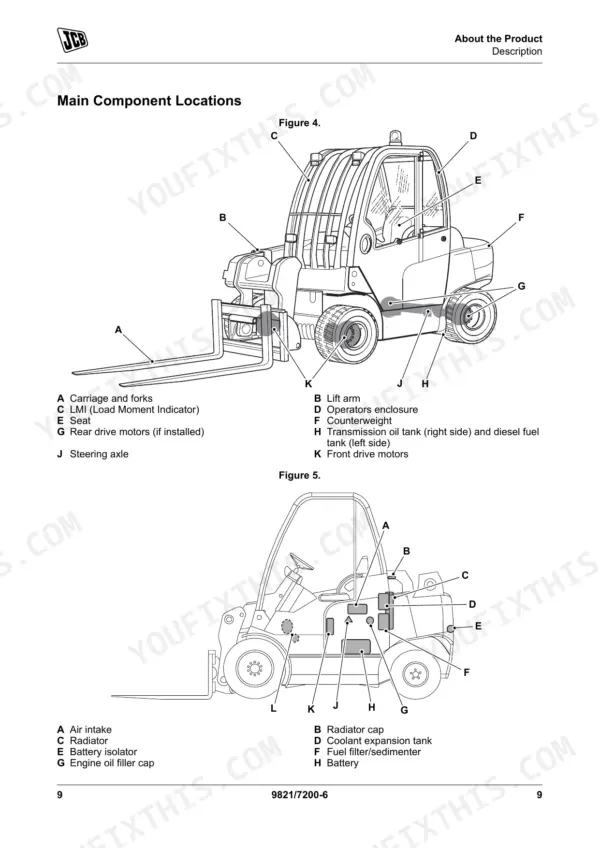
| About the Product | 19-32 | Introduction (General, Name and Address of the Manufacturer, Product Compliance) |
| Operation | 33-104 | Introduction (General) |
| Attachments | 105-118 | Working with Attachments, Quickhitch, Buckets, Forks, Work Platforms |
| Preservation and Storage | 119-124 | Cleaning (General, Detergents, Pressure Washing and Steam Cleaning, Preparation), Checking for Damage (General) |
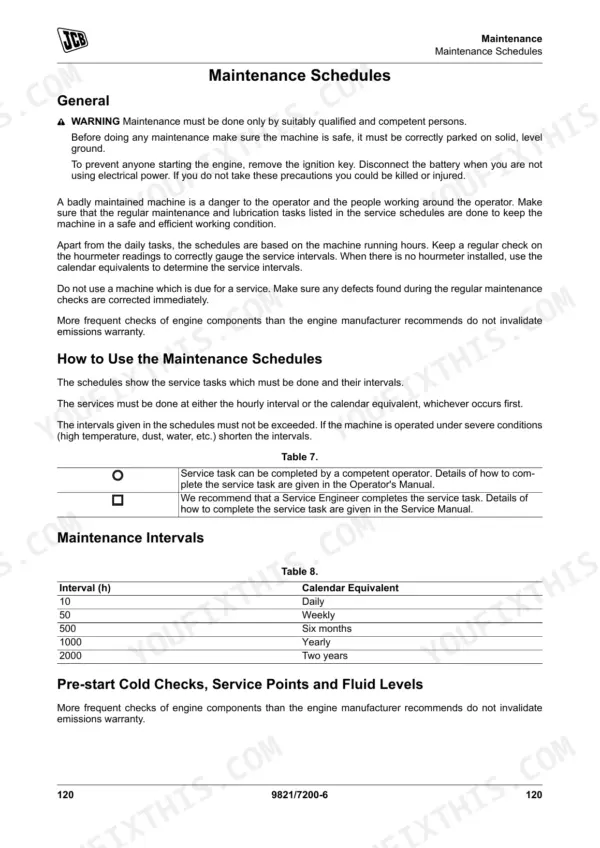
| Maintenance | 125-172 | Introduction (General, Owner/Operator Support, Service/Maintenance Agreements, Obtaining Spare Parts) |
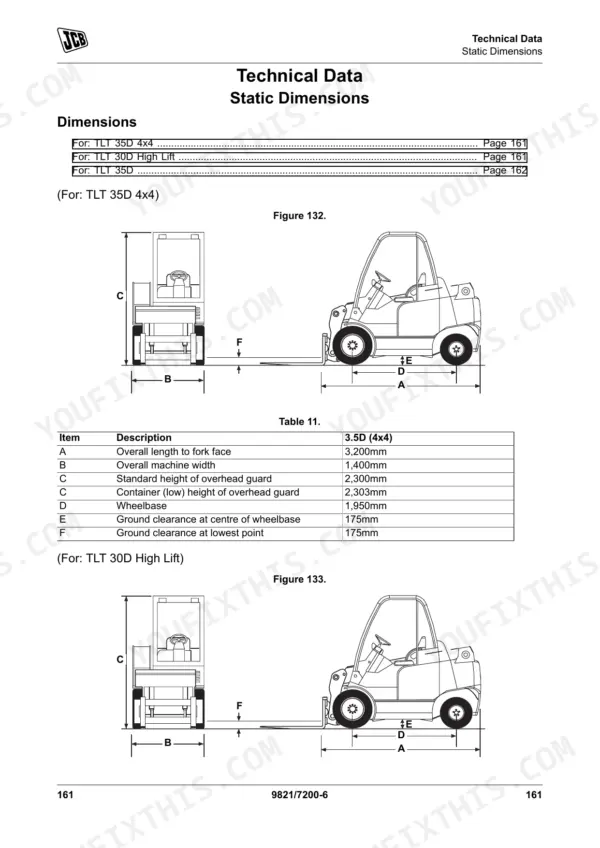
| Technical Data | 173-202 | Static Dimensions (Weights), Performance Dimensions (Lift Arm Dimensions and Performance, Lift Capacities, Driving Performance), Noise Emissions (General, Noise Data) |
Quick Reference Specifications
| Specification | Value | Page |
|---|---|---|
| Front Wheel Nut Torque | 250N·m | p. 186 |
| Rear Wheel Nut Torque | 250N·m | p. 186 |
| Multi-function valves torque (brake release) | 41N·m | p. 95 |
| Battery voltage/system voltage | 12V | p. 187 |
| Fuel Tank Capacity | 55L | p. 183 |
| Engine Oil Capacity | 11.2L | p. 183 |
| Cooling System Capacity | 11L | p. 183 |
| Hydraulics System Capacity | 62.5L | p. 183 |
| Multi-function Valves Torque | 41N·m | p. 186 |
| Wheel Nut Torque (Front/Rear) | 250N·m | p. 186 |
| Hydraulic System Working Pressure | 245bar (3,550.7psi) | p. 192 |
| Max Travel Speed (2 WD) | 20km/h (12.4mph) | p. 176 |
JCB TLT 30D High Lift, TLT 35D, TLT 35D 4x4 Common Problems This Manual Covers
Front wheel locks up on 4x4
Operators of the TLT 35D 4x4 report the front wheel locking up or the drivetrain binding while driving. A hydraulic drive or wheel-end brake and drive binding issue in the front axle circuit is the likely area, covered in the Maintenance section.
Manual Section: Maintenance p. 125Hydraulic drips around cylinders
Fluid visible around cylinders, hoses, and couplings shows up on daily inspection and needs attention before it worsens. The Maintenance section covers the fluid checks and greasing that keep the hydraulics healthy.
Manual Section: Maintenance p. 125Machine not made safe before service
It is unsafe to service the truck if it is not fully made safe first, meaning park brake applied, neutral selected, engine stopped, key removed, load lowered, and machine isolated. The Maintenance section sets out this make-safe procedure.
Manual Section: Maintenance p. 125Unexpected movement during maintenance
Injury risk rises when couplings are disconnected or welding is carried out without the correct lockout steps. The Maintenance section warns to lower the payload, stop the engine, and disconnect the battery and alternator before welding.
Manual Section: Maintenance p. 125Quickhitch or attachment coupling issues
Fitting buckets, forks, or work platforms means using the quickhitch and connecting attachments correctly. The Attachments section covers working with attachments and the quickhitch procedure.
Manual Section: Attachments p. 105Preparing for extended storage
A teletruk left standing needs correct cleaning, damage checks, and preparation before it returns to work. The Preservation and Storage section covers detergents, pressure washing, and checking for damage.
Manual Section: Preservation and Storage p. 119Frequently Asked Questions
Which Teletruk models does this manual cover?
It covers the JCB Teletruk TLT 30D High Lift, TLT 35D, and TLT 35D 4x4 variable reach trucks, publication 9821/7200-6, in 202 pages of English text.
What is the wheel nut torque?
The Technical Data section gives the front and rear wheel nuts at 250 N·m and the multi-function valves at 41 N·m, with the hydraulic system working pressure at 245 bar and a 12 V system. p. 173
What are the fluid capacities?
The Technical Data section lists a 55 litre fuel tank, 11.2 litres of engine oil, an 11 litre cooling system, and 62.5 litres of hydraulic capacity for these trucks. p. 173
What is the lift capacity and travel speed?
The Technical Data section gives a 3,500 kg maximum lift capacity for the TLT 35D and 4x4 models, with a top travel speed of 20 km/h in 2 wheel drive and 18 km/h in 4 wheel drive. p. 173
What format is this Jcb TLT 30D High Lift manual in?
A 202-page Operator Manual in searchable PDF format, available the moment you complete checkout. View on computer, tablet, or phone — no shipping wait.
Is this Jcb TLT 30D High Lift manual print-friendly?
Yes. Print the sections you need to take out to the shop for your own use. Standard letter or A4 paper works.
Reviews
There are no reviews yet.