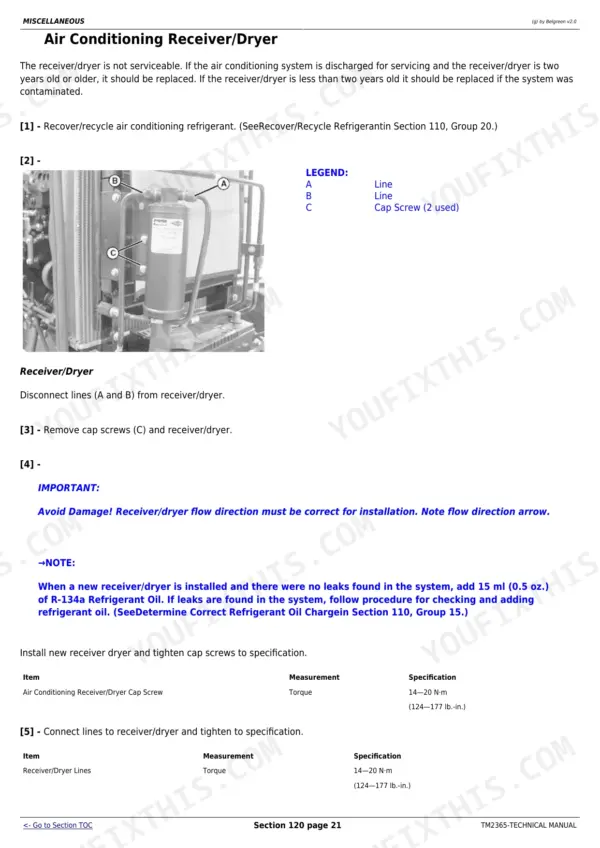
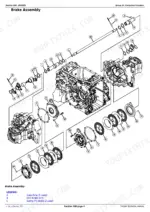
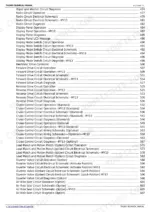
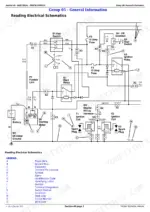
Part of the John Deere Repair Manuals.
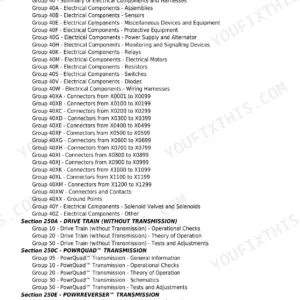
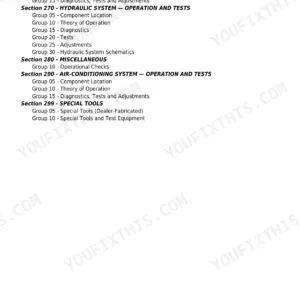
TM2365 is the factory technical manual for the John Deere 3320, 3520 and 3720 cab tractors, all 2101 pages of it. This is the book the dealer techs used: engine repair and testing for all three diesels, the eHydro hydrostatic transmission with pump, motor, charge and loop pressure tests, final drives and axles, hydraulics with Group 15 schematics, steering, brakes and cab HVAC. Electrical gets two full sections, one for North American machines and one for EEC European spec, each with its own component location drawings, harness legends and Main Wiring Schematic sheets you trace with a meter. Every spec is here, from the 2600 rpm rated speed to the 5580 psi hydrostatic loop pressure.
What's Inside This John Deere 3320, 3520, 3720 Manual
| System | Pages |
|---|---|
Quick Reference Specifications
| Specification | Value | Page |
|---|---|---|
| At rated engine speed 2600 rpm | ||
| Hydraulic system pressure | 17 240 kPa (172.4 bar) (2500 psi) | p. 1908 |
| Steering system at rated speed | ||
| Steering relief pressure | 10 340 kPa (103.4 bar) (1500 psi) | p. 1908 |
| Steering 20 L/min plus implement 32.5 L/min at rated speed | ||
| Total pump flow | 46.5 L/min (13.9 gpm) | p. 1908 |
| Hydraulic system | ||
| Hydraulic oil type and capacity | John Deere J20D, 25.7 L (6.8 gal.) | p. 1908 |
| eHydro transmission | ||
| Hydrostatic loop pressure | 38 470 kPa (384.7 bar) (5580 psi) | p. 1908 |
| eHydro transmission, varies with oil temperature | ||
| Hydrostatic charge pressure | 1515 kPa (220 psi) cold / 2000 kPa (290 psi) hot | p. 1908 |
| Rockshaft and lift arms | ||
| Rockshaft lift and drop cycle time | 2.5 to 3 seconds | p. 1908 |
| Rate of drop and stop valve closed | ||
| Lift arm drop in 5 minutes, maximum | 51 mm (2 in.) | p. 1908 |
| Maximum 2000 kPa (290 psi) | ||
| PTO clutch hydraulic pressure at full throttle | 860 to 1380 kPa (8.6 to 13.8 bar) (125 to 200 psi) | p. 1909 |
| All Models | ||
| Engine torque at rated speed | 83.5 N·m (61.6 lb.-ft.) (Model 3320) / 96.4 N·m (71.1 lb.-ft.) (Model 3520) / 114.3 N·m (84.3 lb.-ft.) (Model 3720) | p. 45 |
| All three models | ||
| Engine rated speed | 2600 ± 10 rpm | p. 46 |
| Engine high idle, no load | 2775 ± 25 rpm | p. 46 |
| Engine slow idle | 1000 ± 50 rpm | p. 46 |
John Deere 3320, 3520, 3720 Common Problems This Manual Covers
Tractor cranks slowly or will not crank at all, or the battery keeps going flat between uses.
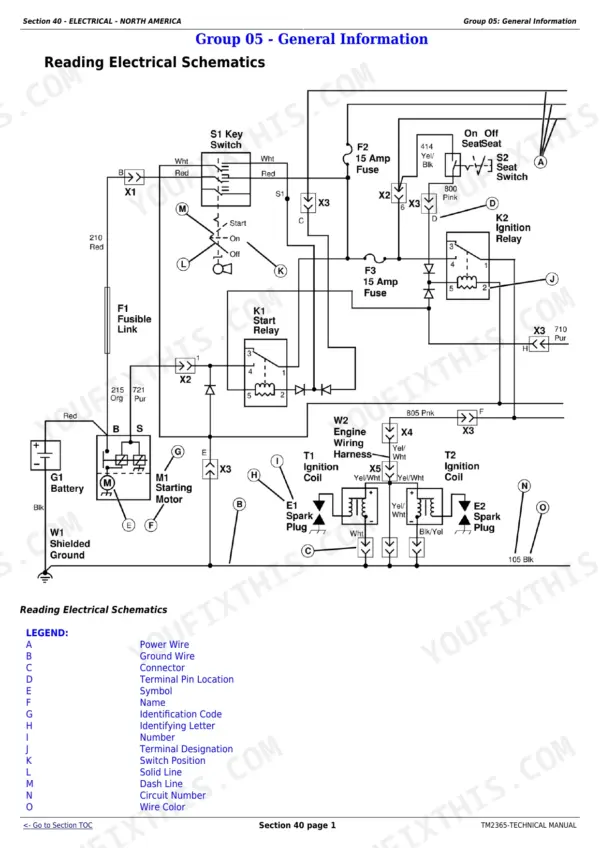
Use the circuit diagnostics for the starting and charging circuits in the North American electrical section, pages 241 to 1093. The Main Wiring Schematic sheets and harness legends let you trace the fault with a meter from the key switch through the relays to the starter.
Manual Section: Electrical - North America p. 1908Loss of power to the wheels, tractor slows on hills or will not move when the hydro oil gets hot.
Run the charge and loop pressure tests in the Power Train Hydrostatic section, pages 1703 to 1747. Compare readings against 220 psi cold / 290 psi hot charge and 5580 psi loop, then follow the pump and motor repair procedures if the numbers are down.
Manual Section: Power Train - Hydrostatic p. 1908Loader or rear implement hydraulics are slow, and the selective control valves leak down or bind.
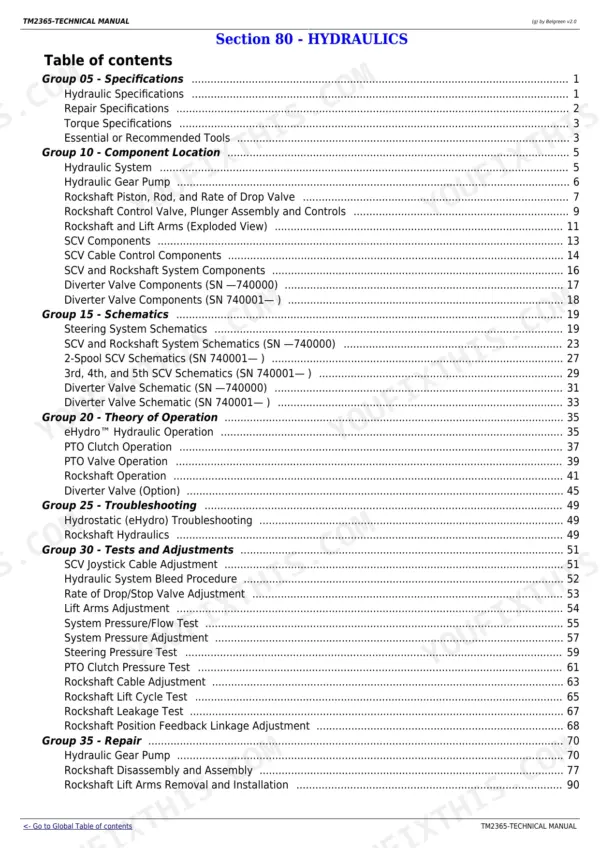
The Hydraulics section, pages 1908 to 2004, covers the steering and implement pumps, SCVs and rockshaft, with total pump flow at 46.5 L/min at rated speed and 2500 psi system pressure to test against. The Group 15 schematics and theory of operation show how the diverter valve routes the oil.
Manual Section: Hydraulics p. 272Steering has gone heavy or wanders, worse at low idle when pump flow is at its lowest.
Check steering relief pressure against the 10 340 kPa (1500 psi) spec from the hydraulic specifications, then follow the Steering section, pages 2005 to 2025, for power steering system diagnosis and the steering cylinder and valve service procedures.
Manual Section: Steering p. 1909Frequently Asked Questions
My eHydro feels weak, especially when the oil warms up. Does this manual cover testing it?
Yes, and this is the section that earns the money. The Power Train Hydrostatic section covers the axial piston pump and motor with actual test procedures and numbers to test against: charge pressure spec is 1515 kPa (220 psi) cold and 2000 kPa (290 psi) hot, and loop pressure is 38 470 kPa (5580 psi). You hook up a gauge, run the test, and know whether you are chasing the charge circuit or the closed loop before you pull anything apart. p. 1908
The three point hitch is slow to lift and the arms drift down with an implement on. Is that in here?
The Hydraulics section covers the rockshaft and lift arms with pass or fail numbers: a healthy system cycles the rockshaft up and down in 2.5 to 3 seconds, and with the rate of drop valve closed the lift arms should not drop more than 51 mm (2 in.) in 5 minutes. System pressure at rated speed should be 17 240 kPa (2500 psi). Test against those figures and the manual walks you to the cylinder, valve or pump repair from there. p. 1908
I have a European spec machine. Are the wiring diagrams the same as the American ones?
No, and this manual handles it properly. There are two separate electrical sections: one for North America and one for EEC specification machines, each with its own component location drawings, wiring harness legends and its own set of Main Wiring Schematic sheets. Between them the electrical coverage runs from page 241 to page 1702, which tells you how much of the diagnosis on these tractors is electrical. Whichever market your tractor was built for, the correct schematic is in the book. p. 272
The PTO clutch slips under load on my 3720. Can I test it without splitting anything?
Yes. The PTO clutch is hydraulically applied, and the Hydraulics section gives the pressure spec: 860 to 1380 kPa (125 to 200 psi) at full throttle, with 2000 kPa (290 psi) as the maximum. Put a gauge on the clutch circuit and if pressure is under spec you are looking at a supply or valve problem, not a burned clutch pack. That one test can save you tearing into the tractor for nothing. p. 45
This is not a fully mechanical tractor, the eHydro has a controller. Do I need dealer software to work on it?
The electrical diagnosis in this book is done the printed way: component location drawings, harness legends and Main Wiring Schematic sheets that you work through with a multimeter. The manual gives circuit diagnostics for the starting, charging, lighting and instrument circuits, so no-start and no-charge complaints get traced wire by wire. If you can read a schematic and use a meter, you can run the diagnostics as written. p. 1909