
Part of the John Deere Repair Manuals.
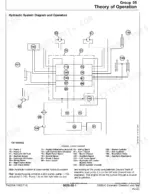
This 958-page John Deere 350DLC Technical Manual (OEM #TM2359) puts the complete factory diagnostics, electrical, and hydraulic documentation for your Excavator in your hands. Inside you get full wiring diagrams with fuse and relay specs, hydraulic system diagrams covering the pilot circuit, pump and drive gearbox, and swing motor, plus a dedicated diagnostic trouble code section for the Main Controller, ECU, and Information Controller. You also open to a full troubleshooting section and exploded views for tearing into the undercarriage and control valve without guesswork. Check swing bearing play at 0.2 to 1.25 mm normal clearance and confirm your hydraulic oil temperature sensor reads correctly at position B40 before you chase a phantom fault. No more pulling panels blind because a forum thread guessed wrong. Bookmarked by section, PDF works on laptop, tablet, or phone, so you can pull it up right at the machine and start fixing.
What's Inside This John Deere 350DLC Manual
| System | Pages | Key Topics |
|---|---|---|
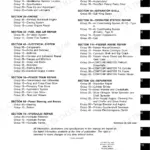
| General Information & Safety | 7-21 | Recognize Safety Information, Wear Protective Equipment, Avoid Unauthorized Machine Modifications, Inspect Machine, Prevent Unintended Machine Movement |
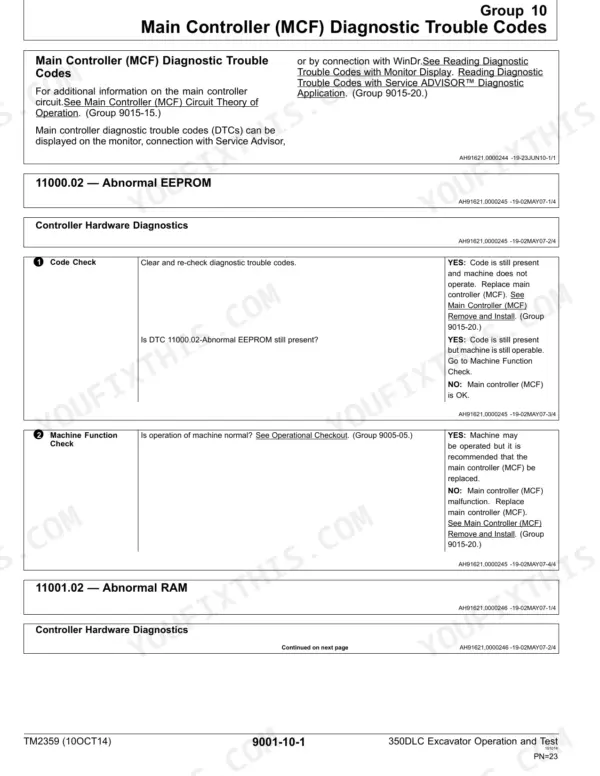
| Diagnostics (Trouble Codes) | 22-200 | Main Controller (Mcf) Diagnostic Trouble Codes, Engine Control Unit (ECU) Diagnostic Trouble Codes, Information Controller (Icf) Diagnostic Trouble Codes |
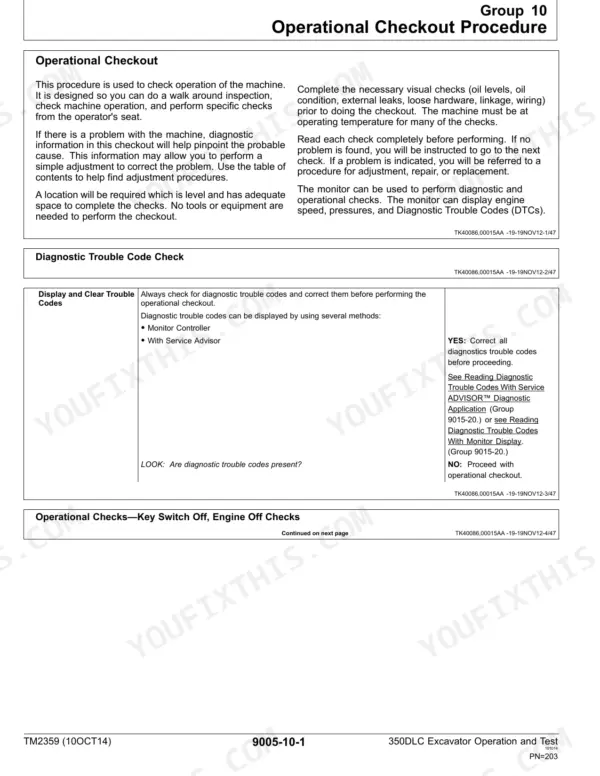
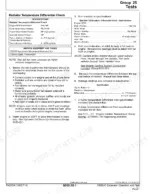
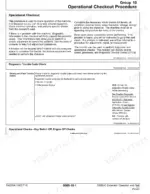
| Operational Checkout Procedure | 201-242 | Operational Checkout, Diagnostic Trouble Code Check, Operational Checks, Key Switch Off, Engine Off Checks, Key Switch on |
| Engine | 243-263 | Engine Oil Sampling Port Location, Engine Fuel System Component Location, Engine Cooling System Component Location, Engine Speed Control System Operation |
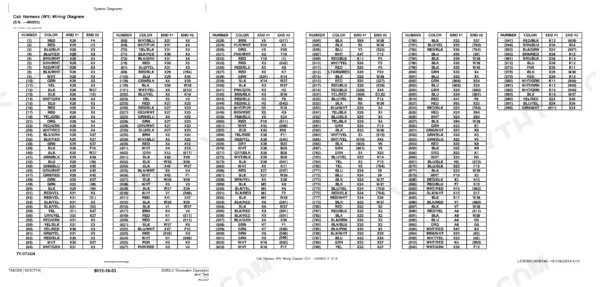
| Electrical System | 264-606 | Electrical Diagram Information, Explanation of Wire Markings, Fuse and Relay Specifications, System Functional Schematic, Component Location, And Wiring Diagram Master Legend |
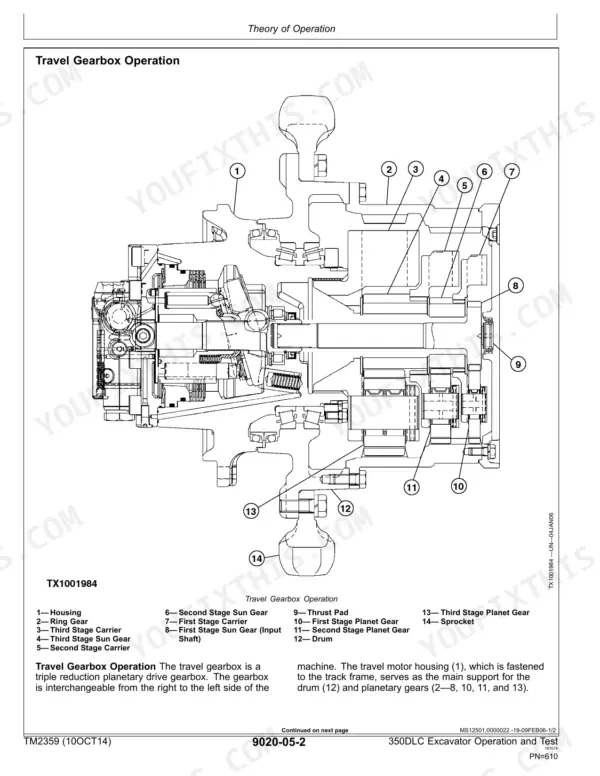
| Power Train & Undercarriage | 607-620 | Track Adjuster and Recoil Spring Operation, Travel Gearbox Operation, Diagnose Undercarriage Components Malfunctions, Excessive Oil Leakage From Front Idler, Track Rollers |
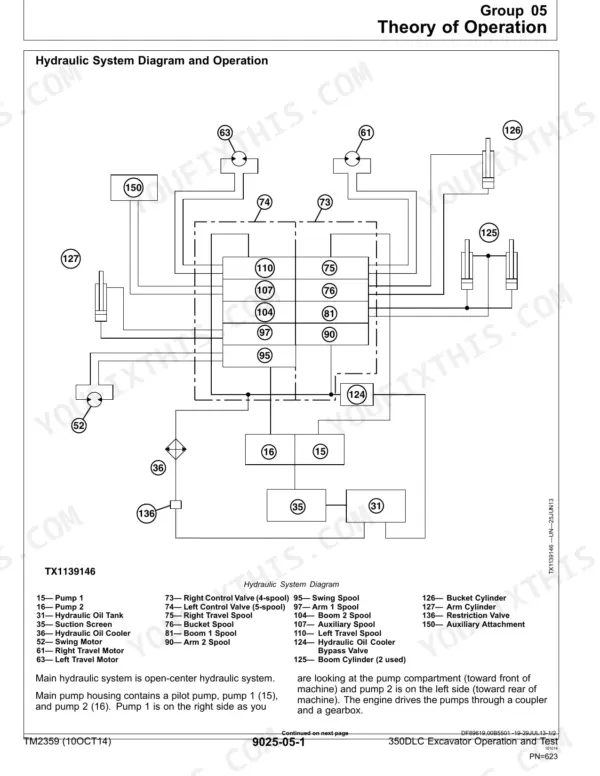
| Hydraulic System | 621-914 | Hydraulic System Diagram and Operation, Fan Drive System Operation, Pilot System Diagram and Operation, Pump and Drive Gearbox Operation, Control Valve Operation, Swing Motor |
| Heating and Air Conditioning | 915-938 | Air Conditioning System Cycle of Operation, Diagnose Air Conditioning System Malfunctions, Diagnose Heating System Malfunctions |
| Reference Material | 939-942 | Terminology Cross Reference Chart, Conversion Charts, Abbreviations |
| Specifications and Dealer-Fabricated Tools | 943-958 | Machine Specifications, Torque Charts, Dealer-Fabricated Tool Drawings |
Quick Reference Specifications
| Specification | Value | Page |
|---|---|---|
| Swing Bearing Play | 0.2–1.25 mm normal | p. 617 |
| Hydraulic Oil Temperature | 45-55°C | p. 906 |
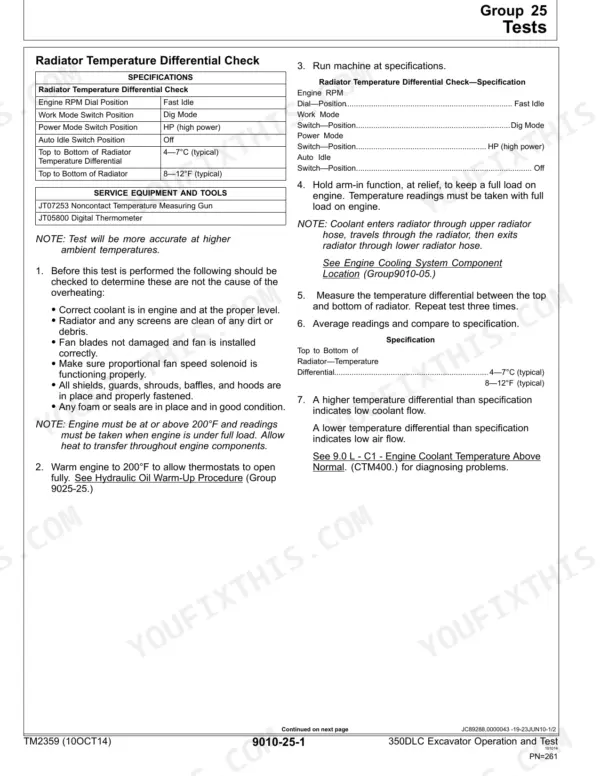
| Radiator Temperature Differential (typical) | 4-7°C | p. 261 |
| Engine Slow Idle Speed | 750-850 rpm | p. 256 |
| Fuel Level Sensor Resistance (FULL) | 6-10 Ohms | p. 196 |
| Boom Cylinder Drift (max. 5 min.) | 20 mm | p. 880 |
John Deere 350DLC Common Problems This Manual Covers
John Deere 350DLC hydraulic oil overheating during heavy digging, temperature climbing fast under load
Check the diagnostic information on page 777 for hydraulic oil overheating and inspect the radiator core for packed debris restricting airflow. Verify hydraulic oil temperature runs 45-55°C per page 906 and confirm cooling fan speed hits 1700-1830 rpm on page 911. Clean the cores, top off oil, and recheck the radiator differential against the 4-7°C spec on page 261.
Manual Section: Hydraulic System p. 777Hydraulic leak at the main control valve section, oil weeping steadily around the housing
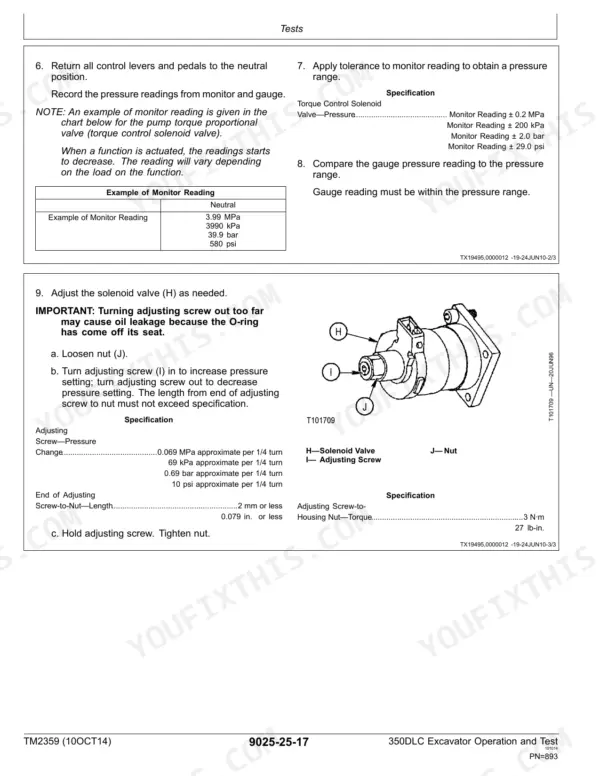
Shut down and relieve system pressure before pulling the valve section apart. Check torque specifications, since a loose section bolt lets the O-ring extrude and weep oil under pressure. Replace the failed O-ring, torque the housing nut to 3 N·m per page 892, then cycle the valve through full stroke to confirm the leak has stopped.
Manual Section: Hydraulic SystemExcessive noise from swing gear after extended hours, grinding sound during rotation
Check swing bearing play on page 617; normal clearance runs 0.2-1.25 mm and anything looser points to worn bearings or loose mounting bolts. Remove the access cover, measure play with a dial indicator, and torque the mounting bolts to spec if clearance stays within range. Replace the bearing assembly if play exceeds 1.25 mm and regrease before reassembly.
Manual Section: Power Train p. 617Engine won't start or cranks slowly despite a recently charged battery
Check diagnostic test values on the electrical system reference at page 559 before condemning the starter. Test battery voltage under load and inspect wiring harness connectors for corrosion, since a weak battery or bad ground mimics starter failure. Replace the battery or starter motor only after confirming cranking voltage drops below spec at the solenoid terminal.
Manual Section: Electrical System p. 559Undercarriage wear accelerating in muddy or icy ground conditions, track running loose
Inspect the undercarriage for track chain sag, bent shoes, and popping before replacing any components. Check track tension and measure sag against spec, then inspect idler and roller seals for oil leakage common in muddy or icy conditions. Adjust the track tension adapters and replace any worn shoes or rollers showing chipped or cracked links.
Manual Section: Power TrainFrequently Asked Questions
What are the error codes for John Deere 350DLC hydraulic system?
The manual lists various diagnostic trouble codes (DTCs) related to the hydraulic system under the Diagnostics section for different controllers. For example, under the Main Controller (MCF) Diagnostic Trouble Codes, there are codes for Pump 1 Delivery Pressure Sensor, Swing Pilot Pressure Sensor, Boom Up Pilot Pressure Sensor, Arm In Pilot Pressure Sensor, Travel Pilot Pressure Sensor, Front Attachment Pilot Pressure Sensor, and Hydraulic Oil Temperature Sensor. Additionally, the Engine Control Unit (ECU) lists "1638.09 — Hydraulic Oil Temperature Message Not Received or Timed Out" and the Monitor Controller (MON) lists "20105.2 — Hydraulic Oil Filter Restriction Alarm." p. 23
How to reset John Deere 350DLC error codes?
To clear inactive diagnostic trouble codes for the air conditioning system, press the air conditioner (A/C) switch for three seconds. The A/C switch indicator will flash five times to confirm that inactive trouble codes are deleted. For other controllers, the manual indicates that codes can be cleared, but does not provide a general button sequence for all DTCs. p. 926
How to reset John Deere 350DLC hydraulic alarm?
To cancel the travel alarm, press and release the travel alarm cancel switch (S13). The alarm must sound for 10 seconds before the switch will deactivate it. The travel alarm (H4) resets when the control levers are returned to the neutral position. p. 543
What is the specified hydraulic oil temperature for the John Deere 350DLC?
The specified hydraulic oil temperature for the John Deere 350DLC is 45—55°C (110—130°F). This specification is important for procedures such as hydraulic oil warm-up and various system tests. p. 879
What is the specified torque for the plug to the Pilot Pressure Regulating Valve Housing on the John Deere 350DLC?
The specified torque for the plug to the Pilot Pressure Regulating Valve Housing is 25 N·m (220 lb-in.). This torque value is critical for proper assembly during the Pilot Pressure Regulating Valve Test and Adjustment procedure. p. 881
What format is this John Deere 350DLC manual in?
Instant PDF download. You get the full 958-page searchable Technical Manual immediately after payment. Open it on your laptop, tablet, or phone right in the shop.
Am I able to print pages from this John Deere 350DLC manual?
Yes. Print the pages or sections you need for your own shop use. Any standard printer works.






Reviews
There are no reviews yet.