
Part of the John Deere Repair Manuals.
This is John Deere Technical Manual TM4403 for the 2350 and 2550 tractors. It covers the closed-center constant pressure hydraulic system with a full flow chart, step-by-step diagnosis, a pressure test kit procedure and a testing record sheet. It also covers the 4-cylinder 3920 cm3 diesel, the Roto Diesel injection pump, the Hi-Lo, reverser and creeper units, both transmissions, the PTO, MFWD, hydrostatic steering and brakes.
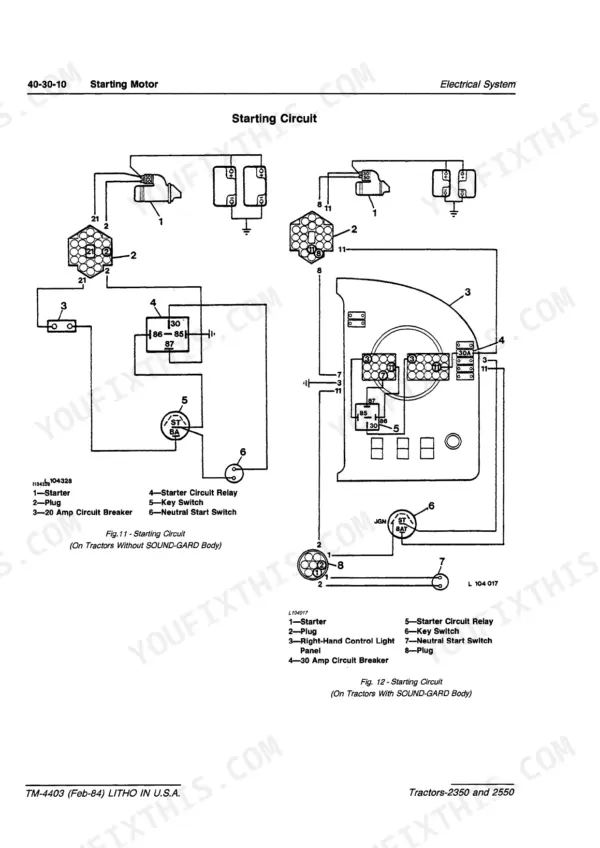
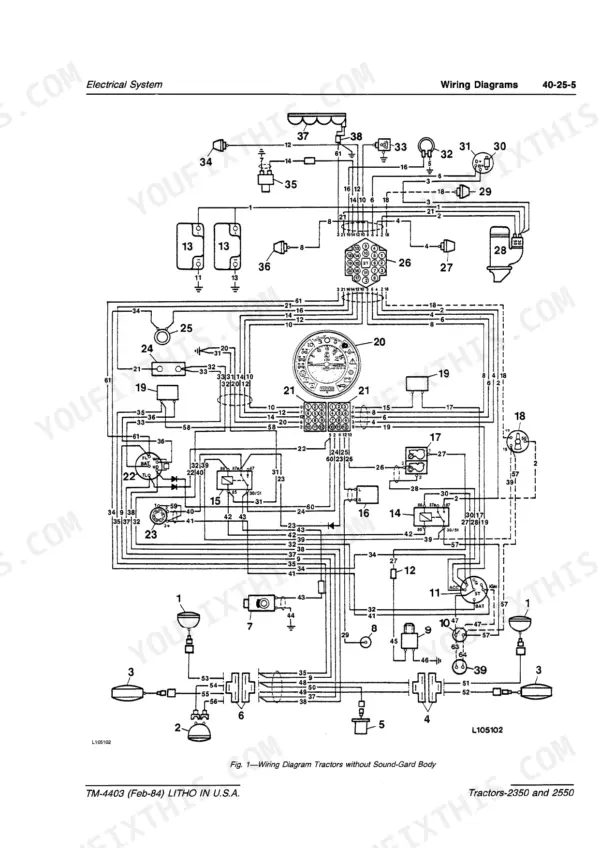
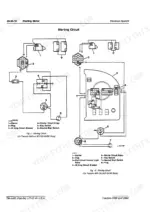
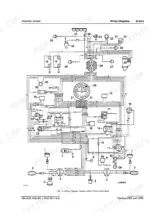
It gives the standby, working and relief pressures for the hydraulic system, and wiring diagrams for tractors with and without the SOUND-GARD body.
It is laid out by system, from specs and tractor separation through the wiring diagrams to the SOUND-GARD body.
What's Inside This John Deere 2350, 2550 Manual
| System | Pages | Key Topics |
|---|---|---|
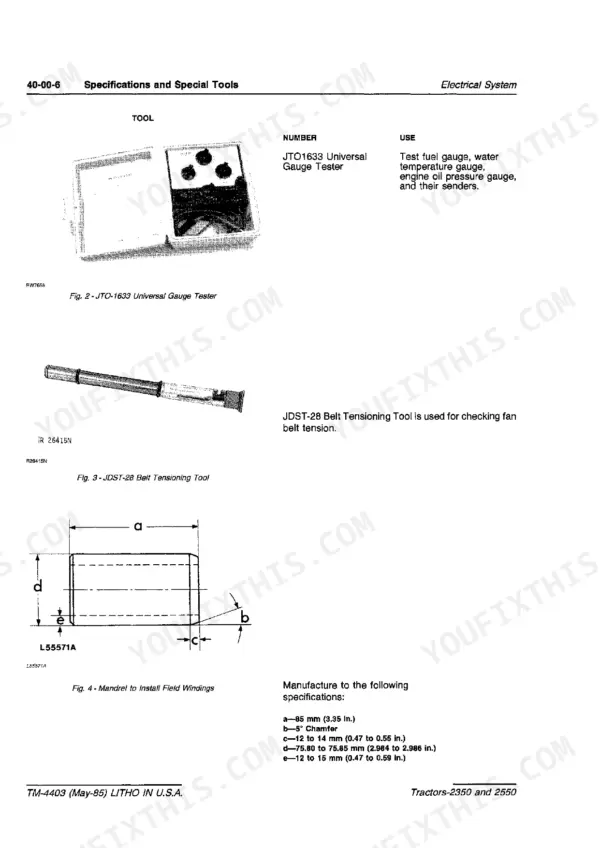
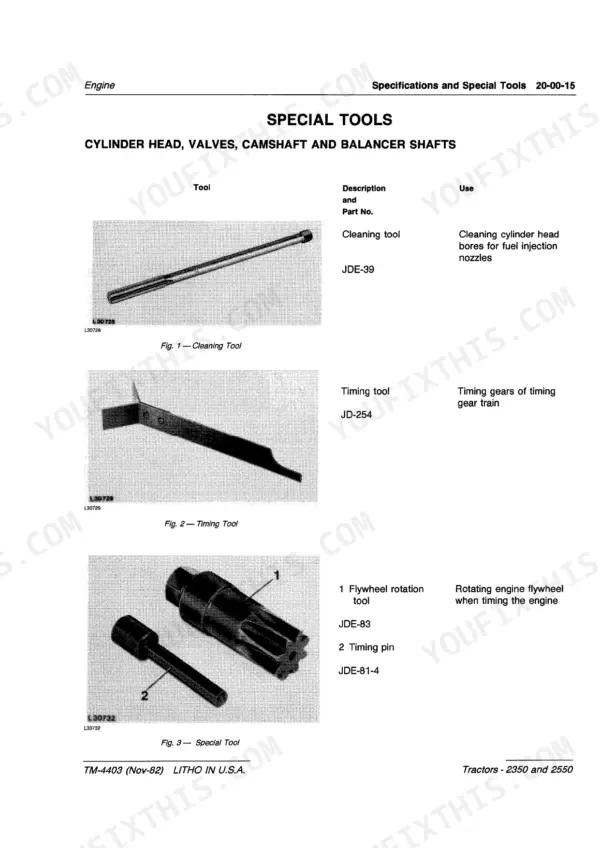
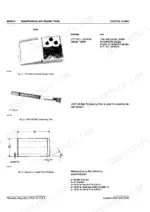
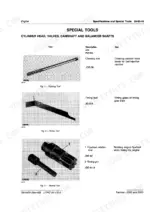
| General: Specifications and Special Tools | 1-24 | Contents, Serial and Model Numbers, Engine Specs, PTO Speeds, Capacities, Service Intervals, Front Wheel Toe-In, Hardware Torques, Tune-Up Specs, Special Tools |
| General: Predelivery and After-Sales Inspections | 25-42 | Tractor Storage, Predelivery, Delivery and After-Sales Inspections, Clutch Pedal, Hi-Lo Shift Unit, MFWD, Reverser and Creeper Transmissions, Roll-Gard |
| General: Lubrication, Service and Tune-Up | 43-64 | Oil Grades by Air Temperature, Engine Oil and Filter Change, Wheel Hub Oil Level, Three-Point Hitch Lubrication, Dynamometer Test, Compression Test, Standard Torques |
| General: Tractor Separation | 65-92 | Separating Engine From Front End, Engine Removal and Installation, Clutch Housing, Final Drives Removal, Rockshaft Removal, Sound-Gard Body Removal |
| Engine: Specifications and Diagnosing | 93-124 | Cylinder Head, Valve, Liner, Piston and Crankshaft Specs, Engine Break-In, Will Not Crank, Low Oil Pressure, Exhaust Smoke, Abnormal Noise |
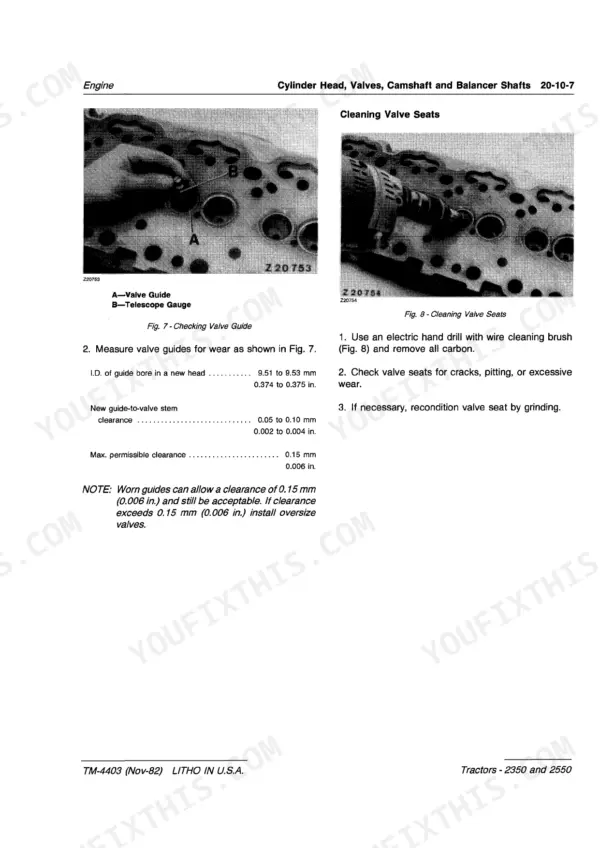
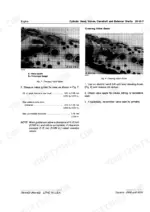
| Engine: Cylinder Head, Valves, Camshaft, Balancer Shafts | 125-146 | Preliminary Valve Checks, Cylinder Head Removal and Inspection, Rocker Arm Shaft, Valves, Valve Clearance Adjustment, Camshaft End Play, Balance Shafts, Valve Guides and Seats |
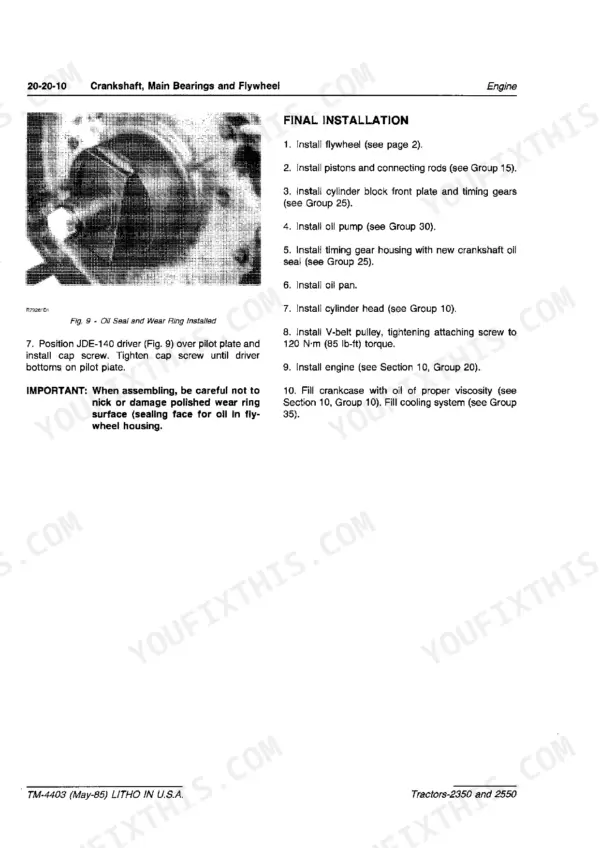
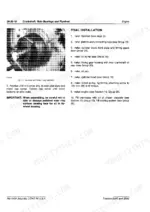
| Engine: Cylinder Block, Pistons, Crankshaft, Flywheel | 147-172 | Cylinder Liners, Pistons and Rings, Connecting Rods, Cylinder Block, Crankshaft End Play, Main Bearings, Flywheel and Housing, Rear Oil Seal |
| Engine: Timing Gears, Lubrication, Cooling | 173-200 | Timing Gear Backlash, Idler Gears, Timing Gear Cover, Oil Pump, Oil Pressure Regulating Valve, Radiator, Water Pump, Fan Belt, Thermostat |
| Fuel and Air Intake System | 201-256 | Fuel Tank, Water Trap, Transfer Pumps, Fuel Filter, Roto Diesel Injection Pump, Injection Nozzle Testing, Ether and Thermostart Aids, Speed Control Linkage, Air Cleaner |
| Electrical: Specifications, Diagnosing, Tests | 257-310 | Battery, Starter and Alternator Specs, Diagnosing Malfunctions, Neutral Start Switch, Hourmeter and Tachometer, MFWD Solenoid, Connector Repair |
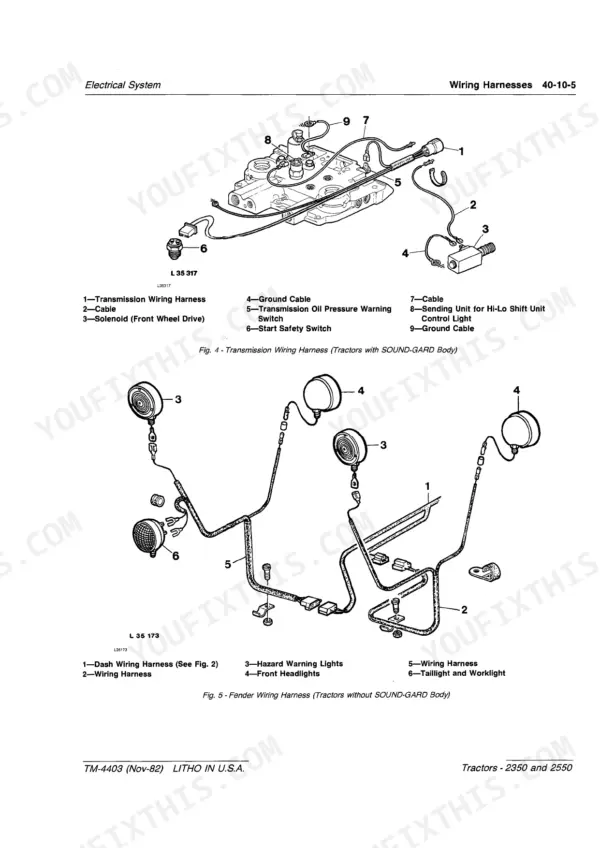
| Electrical: Harnesses, Instruments, Lighting | 311-360 | Wiring Harnesses, Dash Panel, Instrument Cluster, Control Light Panel, Circuit Breaker, Key Switch, Cab Heater and Blower Circuit, Headlights |
| Electrical: Wiring Diagrams | 361-402 | Wiring Diagram Without Sound-Gard Body, With Sound-Gard Body Up to and From Serial 491028L, Wire Colour and Gauge Tables, Reading a Wiring Diagram |
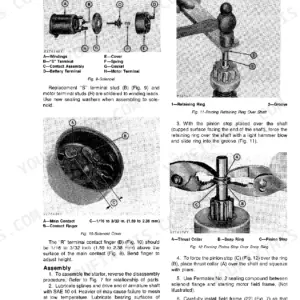
| Electrical: Starting Motor and Alternator | 403-428 | Starting Motor Operation, Removal and Repair, Starting Circuit, Alternator Testing and Repair, Output Test, Charging Circuit |
| Power Train: Clutch | 429-516 | Description and Operation, Lubricating System, Hydraulic and Mechanical Clutch Linkages, Bleeding, Single-Stage and Dual-Stage Clutches, Clutch Adjustment |
| Power Train: Hi-Lo, Reverser, Creeper | 517-566 | Hi-Lo Shift Unit Operation, Operating and Lube Pressure Checks, Hi-Lo Brake and Clutch, Control Valve, Reverser Testing and Adjustment, Creeper Transmission |
| Power Train: Transmissions, Differential, Final Drives | 567-632 | Shift Linkage, Synchronized and Collar Shift Transmissions, Transmission Oil Pump, Differential and Differential Lock, Final Drives |
| Power Train: PTO and MFWD | 633-724 | Independent PTO, PTO Clutch and Brake Pressure Test, PTO Control Valve, Continuous Running PTO, Mid PTO, MFWD Clutch, Drive Shaft, Front Axle Differential |
| Steering System and Brakes | 725-790 | Hydrostatic Steering Operation and Diagnosis, Steering Valve, Dual Safety Valve, Steering Cylinders, Hydraulic Brakes, Brake Valve, Brake Disks, Handbrake |
| Hydraulics: Specifications, Flow Chart, Diagnosis and Tests | 791-850 | Pump, Rockshaft and SCV Specs, Description and Operation, Hydraulic Flow Chart, Step-By-Step Diagnosis, Pressure Test Kit, Testing Record Sheet, Typical Malfunctions |
| Hydraulics: Reservoir, Filter, Valves, Pumps | 851-906 | Oil Reservoir and Intake Screen, Transmission Oil Filter and By-Pass Valve, Surge Relief Valve, Steering Pressure Control Valve, Oil Cooler, Hydraulic Pumps and Stroke Control Valve |
| Hydraulics: Rockshaft, Selective Control Valves, Remote Cylinder | 907-968 | Rockshaft, Load Control, Three-Point Hitch, Poppet and Spool Type SCVs, Breakaway Coupler, Quick Coupler, Remote Cylinder Bleeding and Adjustment |
| Front Axle, Wheels and Operator's Station | 969-1080 | Front Axle, Toe-In, Wheel Bearings, Rear Wheels, Air Conditioning, Cab Ventilation and Heating, Seats, Sound-Gard Body, Roll-Gard |
Quick Reference Specifications
| Specification | Value | Page |
|---|---|---|
| Engine displacement, 4 cylinders | 3920 cm³ (239 cu. in.) | p. 7 |
| Cylinder liner bore | 106.5 mm (4.19 in.) | p. 7 |
| Max torque, 2350 at 1400 rpm | 220 N·m (160 lb-ft) | p. 7 |
| Max torque, 2550 at 1400 rpm | 250 N·m (185 lb-ft) | p. 7 |
| Valve clearance, intake (hot or cold) | 0.35 mm (0.014 in.) | p. 7 |
| Valve clearance, exhaust (hot or cold) | 0.45 mm (0.018 in.) | p. 7 |
| Fast idle speed | 2610 to 2660 rpm | p. 15 |
| Rated engine speed | 2500 rpm | p. 15 |
| Compression pressure | 2100 kPa (21 bar; 300 psi) | p. 15 |
| Thermostat opens at | 82°C (180°F) | p. 15 |
| Cylinder head cap screws, oiled, three steps | 50 N·m (35 lb-ft), then 90 N·m (65 lb-ft), then 130 N·m (95 lb-ft) | p. 98 |
| Engine crankcase oil without filter change | 8.0 L (2.1 U.S. gal) | p. 13 |
| Engine crankcase oil with filter change | 8.5 L (2.3 U.S. gal) | p. 13 |
| Transmission-hydraulic system, dry, 2350 | 59 L (15.6 U.S. gal) | p. 13 |
| Transmission-hydraulic system, dry, 2550 | 64 L (16.9 U.S. gal) | p. 13 |
| Hydraulic standby pressure | 15800 to 16200 kPa (158 to 162 bar; 2300 to 2350 psi) | p. 11 |
| Hydraulic working pressure | 14000 kPa (140 bar; 2050 psi) | p. 11 |
| Hydrostatic steering pressure control valve | 11600 to 12300 kPa (116 to 123 bar; 1700 to 1800 psi) | p. 794 |
| Rockshaft pressure relief valve opening | 20800 to 22200 kPa (208 to 222 bar; 3020 to 3220 psi) | p. 800 |
| Independent PTO clutch and brake pressure | 1000 kPa (10 bar; 145 psi) | p. 638 |
| Injection nozzle opening pressure, new or reconditioned | 21700 to 22500 kPa (217 to 225 bar; 3150 to 3250 psi) | p. 203 |
John Deere 2350, 2550 Common Problems This Manual Covers
Engine will not crank
Start with the simple things. Check for flat batteries and loose or corroded battery connections. Then test the main switch and the start safety switch. If those pass, check the starter solenoid and finally the starter itself. The diagnosis charts and neutral start switch checks are in Electrical: Specifications, Diagnosing, Tests. Starter removal and repair are in Electrical: Starting Motor and Alternator.
Manual Section: Engine: Specifications and Diagnosing p. 120Low engine oil pressure
Check the crankcase oil level first, then make sure the oil grade is correct. If both are right, look for leaks in the internal oil passages or a worn oil pump. Excessive main or connecting rod bearing clearance can also cause it, as can an incorrectly adjusted pressure regulating valve. The fault list is in Engine: Specifications and Diagnosing. The oil pump and regulating valve are covered under Timing Gears, Lubrication, Cooling.
Manual Section: Engine: Specifications and Diagnosing p. 122Black or grey exhaust smoke
The book lists excess fuel as the first cause. Check for a restricted or dirty air cleaner, an overloaded engine or a damaged muffler causing back-pressure. Then check for dirty or faulty injection nozzles and incorrect engine timing. The Fuel and Air Intake System section covers nozzle testing. New or reconditioned nozzles should open at 21700 to 22500 kPa (217 to 225 bar; 3150 to 3250 psi).
Manual Section: Engine: Specifications and Diagnosing p. 122Rockshaft fails to rise under load
First make sure the load on the three-point hitch is not simply too heavy. Next, check and adjust the hydraulic pump output, because low delivery will stall the lift. Then check the negative stop screw on the load control arm. Finally, look for a damaged or worn rockshaft piston seal ring and replace it. The procedures are in Hydraulics: Rockshaft, Selective Control Valves, Remote Cylinder.
Manual Section: Hydraulics: Specifications, Flow Chart, Diagnosis and Tests p. 847Frequently Asked Questions
How much oil does the John Deere 2350 and 2550 engine crankcase take?
The crankcase takes 8.0 L (2.1 U.S. gal) if you leave the filter on. If you change the filter, put in 8.5 L (2.3 U.S. gal). Both figures are the same for the 2350 and the 2550. p. 13
What is the hydraulic standby pressure on the 2350 and 2550?
These tractors run a closed-center, constant pressure system. Standby pressure should read 15800 to 16200 kPa (158 to 162 bar; 2300 to 2350 psi). Working pressure is 14000 kPa (140 bar; 2050 psi). p. 11
What are the valve clearances on the 2350 and 2550 engine?
Set intake valves to 0.35 mm (0.014 in.) and exhaust valves to 0.45 mm (0.018 in.). The book gives the same settings for a hot or cold engine. p. 7
What is the cylinder head bolt torque on the 2350 and 2550?
Oil the cap screws and tighten them in three steps: 50 N·m (35 lb-ft), then 90 N·m (65 lb-ft), then 130 N·m (95 lb-ft). p. 98
How often should the transmission-hydraulic oil and filter be changed?
Change the transmission-hydraulic oil every 1000 hours and the filter every 500 hours. Check the oil level every 50 hours. p. 14






Reviews
There are no reviews yet.