


![John Deere 1654 1854 2054 2104 6165J 6185J 6205J 6210J Repair Manual [Tractors]](https://youfixthis.com/wp-content/uploads/2012/02/Manual_Download-300x300.jpg)

Part of the John Deere Repair Manuals.
This is the factory repair technical manual TM116419 for the John Deere 5075M, 5085M, 5100M, 5100MH, 5100ML, 5115M and 5115ML utility tractors built from 2013 to 2017. It covers the whole machine in standard Deere section format: 20 Engine, 30 Fuel/Air Intake/Exhaust, 40 Electrical, 50 Power Train, 60 Steering and Brake, 70 Hydraulic, 90 Operator's Station, plus Special Tools in Section 99. These are two different engines under one series name: the 5075M runs a 3 cylinder 2.9 L at 55.9 kW (75 hp), while the 5085M through 5115ML use the 4.5 L four cylinder from 63 kW (85 hp) up to 85.8 kW (115 hp). The manual keeps those specs separated by model, and so should you.
Complete the set for your 5075M-5115M
Other edition of this manual
What's Inside This John Deere 5075M-5115M Repair Manual
| System | Pages | Key Topics |
|---|---|---|
| General Information (Section 10) | 8-110 | Safety, Machine Specifications per Model, Fuels and Lubricants, Standard Torques |
| Engine (Section 20) | 111-189 | Engine Overhaul (2.9 L 3-Cylinder and 4.5 L 4-Cylinder), Cooling, Lubrication, Timing |
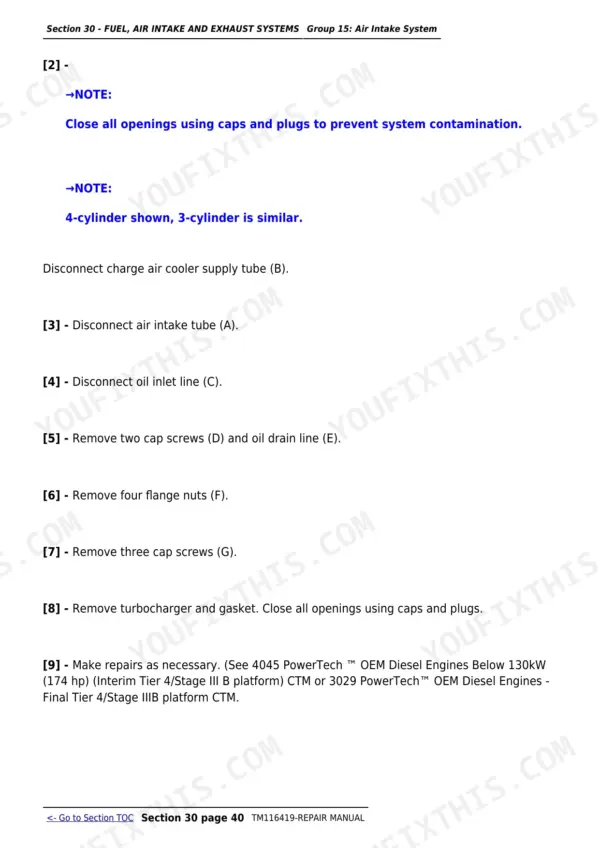
| Fuel, Air Intake and Exhaust Systems (Section 30) | 190-240 | Fuel System, Injection, Filters, Turbocharger, Air Intake, Exhaust and Aftertreatment |
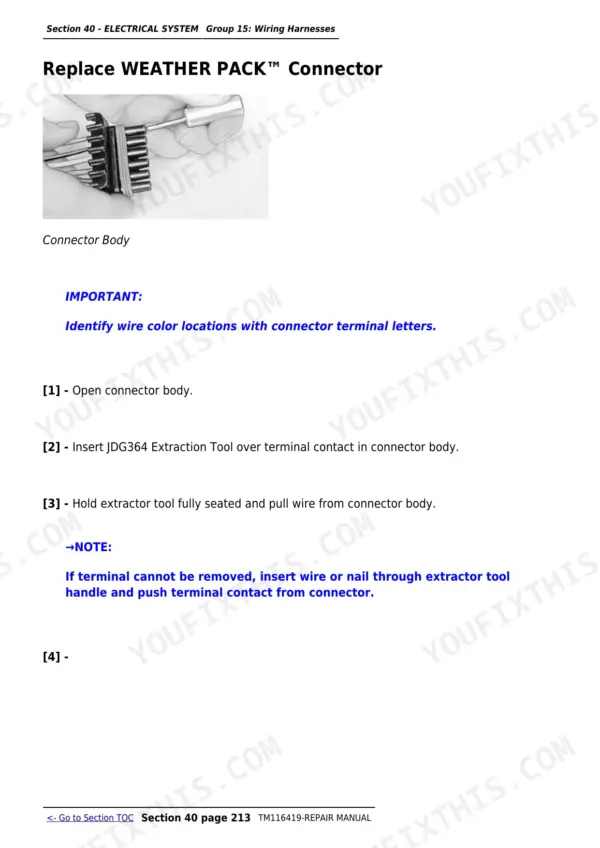
| Electrical System (Section 40) | 241-655 | Wiring, Component Location, Sensors, Charging and Starting, Diagnostics |
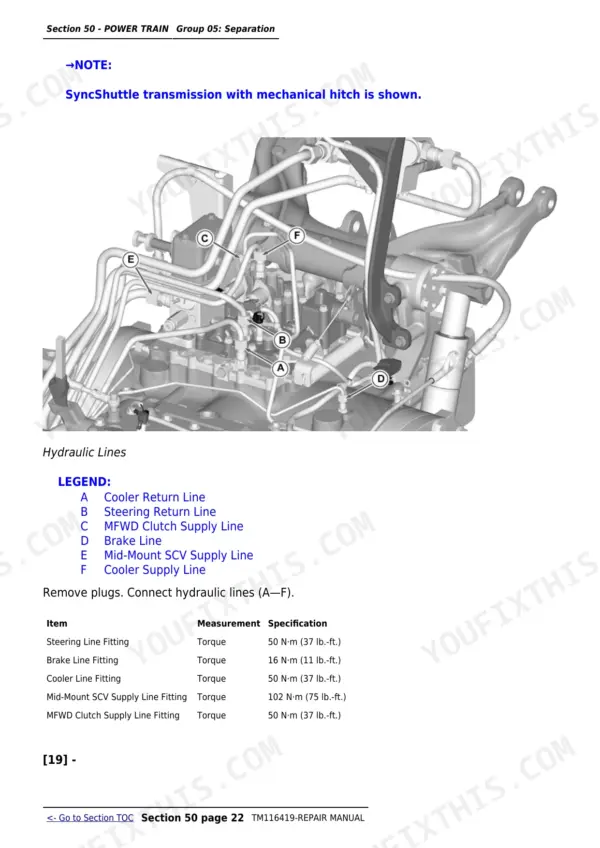
| Power Train (Section 50) | 656-1179 | Clutch, Transmission, PowrReverser, Differential, Final Drives, PTO, MFWD |
| Steering and Brake (Section 60) | 1180-1295 | Steering Pump and Cylinder, Service and Park Brakes, Bleeding |
| Hydraulic (Section 70) | 1296-1656 | Hydraulic Pump and Filters, SCVS, Rockshaft and Hitch, Pressure Tests |
| Miscellaneous (Section 80) | 1657-1738 | Frame, Ballast, Wheels and Tires, Miscellaneous Service |
| Operator'S Station (Section 90) | 1739-1996 | Cab, Seat, HVAC, Controls and Instrument Panel |
| Special Tools (Section 99) | 1997-2023 | John Deere Special Service Tools |
Quick Reference Specifications
| Specification | Value | Page |
|---|---|---|
| 5075M | ||
| Engine Horsepower at 2200 rpm, 5075M | 55.9 kW (75 hp) | p. 63 |
| PTO Horsepower (SAE), 5075M | 44.7 kW (60 hp) | p. 63 |
| Engine Cylinders, 5075M | 3 | p. 63 |
| Engine Displacement, 5075M | 2.9 L (179 cu. in.) | p. 63 |
| 5085M | ||
| Engine Horsepower at 2200 rpm, 5085M | 63 kW (85 hp) | p. 63 |
| PTO Horsepower (SAE), 5085M | 52 kW (70 hp) | p. 63 |
| 5100M, 5100MH | ||
| Engine Horsepower at 2200 rpm (5100M, 5100MH) | 74.6 kW (100 hp) | p. 63 |
| PTO Horsepower (SAE) (5100M, 5100MH) | 63.4 kW (85 hp) | p. 63 |
| 5115M, 5115ML | ||
| Engine Horsepower at 2200 rpm (5115M, 5115ML) | 85.8 kW (115 hp) | p. 63 |
| PTO Horsepower (SAE) (5115M, 5115ML) | 74.6 kW (100 hp) | p. 63 |
| 5085M, 5100M, 5100MH, 5115M, 5115ML | ||
| Engine Cylinders (5085M, 5100M, 5100MH, 5115M, 5115ML) | 4 | p. 63 |
| Engine Displacement (5085M, 5100M, 5100MH, 5115M, 5115ML) | 4.5 L (276 cu. in.) | p. 63 |
| All models | ||
| Low Idle Speed | 900 ± 25 rpm | p. 63 |
| High Idle Speed | 2200 ± 25 rpm | p. 63 |
| Engine Speed for 540 rpm PTO | 2100 rpm | p. 63 |
| Engine Speed for 540E rpm PTO | 1645 rpm | p. 63 |
John Deere 5075M-5115M Common Problems This Manual Covers
Engine hard to start or will not start at all
Almost always fuel delivery: a plugged filter, water in the fuel, or air drawn into the lines. Section 30 covers filter replacement, water separator service and the full bleeding procedure to purge air from the system.
Manual Section: Fuel, Air Intake And Exhaust Systems (Section 30) p. 190Engine knocks under load
Check oil level first, then injection pump timing. A knock can be as cheap as low oil or as serious as a pump out of time. Section 20 gives the diagnostic sequence and bottom end inspection procedures, Section 30 covers pump timing.
Manual Section: Engine (Section 20) p. 111Noisy valve train and falling engine performance
Worn lifters or bent pushrods let the valves fall out of adjustment and rob power. Section 20 covers rocker arm and pushrod inspection, lifter replacement and valve clearance adjustment for both the 3 cylinder and 4 cylinder engines, with the correct specs for each.
Manual Section: Engine (Section 20) p. 111Fuel leaks or starved injection system
Cracked or kinked fuel lines restrict flow and starve the injectors, showing up as surging, low power or a diesel smell around the frame. Section 30 covers line routing, inspection and replacement, plus the pressure tests that confirm the system flows what it should.
Manual Section: Fuel, Air Intake And Exhaust Systems (Section 30) p. 190Frequently Asked Questions
My 5100M cranks but will not start, or starts hard when cold. Where do I begin?
Start with fuel, not electronics. On these Tier 4 interim engines the usual culprits are a plugged fuel filter, water in the filter bowl, or air pulled into the system through a loose fitting. Section 30 walks you through filter service, bleeding the system, and checking supply pressure before you ever touch the injection side. Nine times out of ten you fix it there.
Does this manual cover diagnostic trouble codes on the 5115M?
These tractors have electronic engine control, and Section 40 covers the electrical system, wiring, connectors and diagnostic procedures for tracing faults. The repair manual gives you the circuit level tests to find why a code set, which is what actually fixes the tractor. Clearing a code without the circuit test just brings it back.
What engine speed do I run for 540 PTO work?
Rated 540 rpm PTO output comes at 2100 engine rpm on all models in this series. If you have the 540E economy option, the same PTO speed arrives at 1645 engine rpm, which saves fuel on light loads like raking or tedding. Low idle is 900 rpm and high idle is 2200 rpm, both plus or minus 25. p. 63
Is the 5075M really the same tractor as the 5085M and up?
No, and the manual treats them separately where it matters. The 5075M has a 3 cylinder 2.9 L engine making 55.9 kW (75 hp) with 44.7 kW (60 hp) at the PTO. The 5085M, 5100M, 5100MH, 5115M and 5115ML all run the 4.5 L four cylinder, from 63 kW (85 hp) to 85.8 kW (115 hp). Always match the spec table to your model number before ordering parts or setting clearances.
Are torque specs and special tools listed, or do I need a second book?
Torque values, clearances and test specifications are printed inside each repair procedure where you use them, with general hardware torque charts in Section 10. Section 99 lists every special tool by number, so you can decide before teardown whether to buy the tool or improvise. No second book needed for repair work.







Reviews
There are no reviews yet.